





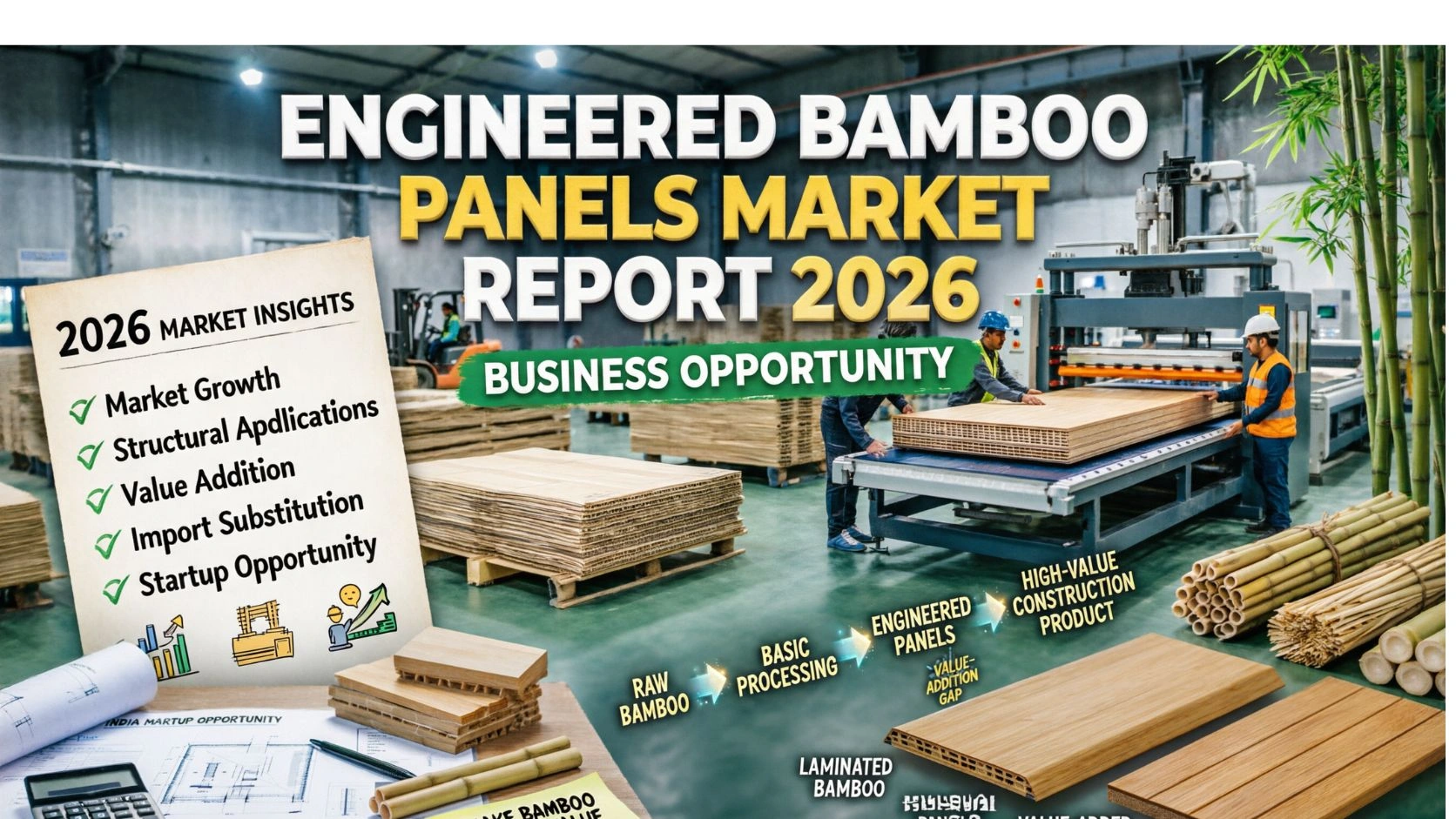
Despite India being one of the world’s biggest producers of bamboo, the majority of it continues to be left as raw culm in the bamboo groves, or used in low-value applications such as scaffolding and in basic matting in the country, as opposed to being processed into the high-value engineered structural panels that are now specified in green buildings globally. India, with its expected growth at 11.7% CAGR till 2036 and a National Bamboo Mission dedicated to the development of processing capacity, is indeed a market with tremendous value addition potential between raw bamboo availability and output of engineered bamboo panels.
What Are Engineered/Structural Bamboo Panels?
Engineered bamboo panels are a type of sheet or lumber material made from raw bamboo culm by splitting, strip-forming, lamination, or strand-weaving, and then processing the raw bamboo under heat and pressure to form a standardised, dimensionally-stable engineered bamboo material with structural or semi-structural properties. Structural bamboo panels provide consistent, code compliant performance due to a bamboo engineered to reduce the natural variability of bamboo (between bamboo culms, along the nodes and sensitivity to moisture).
There are several different engineered formats in the category:
- Laminated Bamboo Lumber (LBL) / Glue-Laminated Bamboo (Glulam) – bamboo strips layered and glued together under high pressure, used for load-bearing beams, columns and floor panels and has MOE and compressive strength that can equal or exceed high-quality structural timber
- Cross-Laminated Bamboo (CLB) Panels – cross oriented laminated layers (with possible softwood/eucalyptus core) with up to 2-fold stiffness compared to an equivalent thickness softwood panel, suitable for mid- and high-rise wood-frame structures
- Bamboo Strand Woven (BSW) panels/scrimber – crushed and woven before being bonded with resin, which makes it extremely hard and durable, used for flooring and decking applications
- Bamboo composite/fibre-reinforced boards – Processed bamboo fibre and resin binders used in the manufacture of fibre-reinforced interior wall/ceiling panels, cabinetry and modular construction parts
- Bamboo plywood and veneer panels – laminated veneer sheets used in architectural millwork, cabinetry, and interior fit-out
Manufacturing quality is now measured by international standards, such as ISO 22156, which establishes mechanical property evaluation procedures for bamboo-based composites, and thus bamboo can be formally classified as engineered structural panel materials.
Explore This Book: Bamboo Plantation and Utilization Handbook
Global and India Bamboo Panel Market Size and Growth
The global market estimates have a large range and are dependent on the scope. The global bamboo construction materials market is estimated to be valued at USD 96.1-105 billion (2024-26), expected to grow at approximately 4.5-5.6% for the next eight years, with the bamboo lumber and panels segment having the largest revenue share (37% in the construction materials segment). A more conservative estimate of the global engineered bamboo structural materials market value is USD 72.1 billion in 2025, rising to USD 214 billion by 2034 at a remarkable 13.5% CAGR, which is significantly higher than the growth of bamboo products in general, mainly due to the stricter green building codes and net-zero construction goals.
In this, India is indeed a real growth leader as the overall bamboo market in the country is expected to grow at a CAGR of 11.7% during 2026-2036, ranking it among the fastest growing national markets in the world, alongside China and Southeast Asia.
Note on figures: The market study of bamboo panels differs widely with respect to the classification of the bamboo panels being measured as raw bamboo, semi-processed bamboo or fully processed bamboo panels. NPCS can develop a tailored techno-economic feasibility study to your product format (LBL, CLB, BSW/scrimber, or composite board) and application (investor grade numbers) for your product.
India’s Raw-Material Abundance, Value-Addition Gap
India boasts one of the world’s largest areas dedicated to the cultivation of bamboos and in the last decade, the government has made a point of emphasizing the economic potential of this resource, with most notable being the National Bamboo Mission and the significant change in the Indian Forest Act to treat bamboo as a grass, instead of a tree, on non-forest land in 2017 which removed a major regulatory hurdle for commercial growing and harvesting of bamboos.
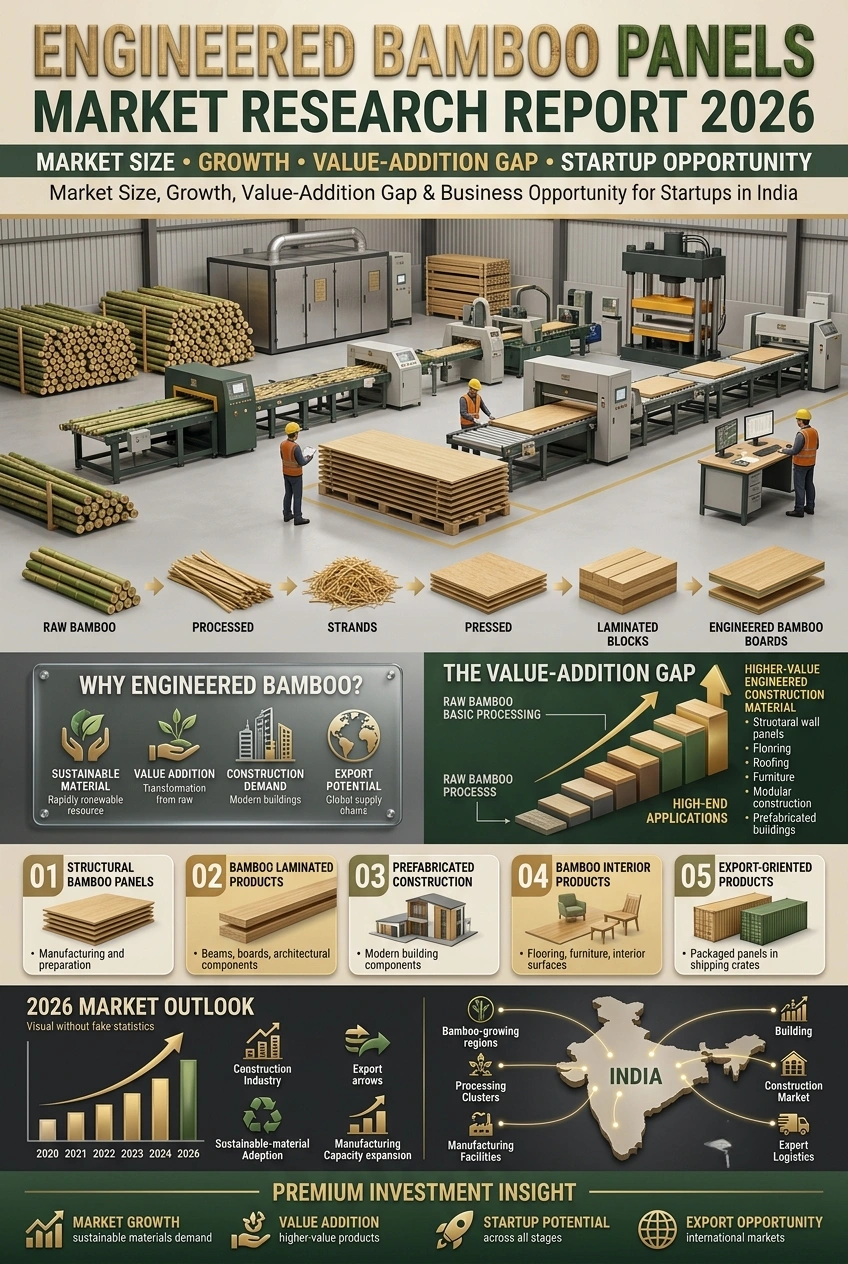
But, even at this size, the Indian bamboo economy is largely dominated by the lower value traditional construction scaffolding and matting market and the raw, unprocessed bamboo culm market as opposed to the higher value, engineered panel and laminated bamboo market that fetches premium prices in the international market and is gaining traction in green certified commercial and residential construction. This vertical value-add-chain disconnect is the critical structural opportunity in this category: processed products (e.g. engineered panels/boards) are one of the most compelling value-added product forms globally given the current level of processing capability and India’s growth-leading market position offers the intrinsic demand pull to justify new investments in processing.
Policy Tailwinds
- National Bamboo Mission (NBM): A dedicated scheme of Government of India that emphasizes on the entire bamboo value chain from plantation and cultivation to processing, product development and market linkage, with special emphasis on processing infrastructure development to transform raw bamboo into higher value products.
- Indian Forest Act reclassification (2017): Removing bamboo grown on non-forest land from the legal definition of “tree” eliminated significant regulatory and transit-permit barriers to commercial bamboo cultivation and processing, directly supporting the raw material supply chain that engineered panel manufacturers depend on.
- Strategic standards: They increase the credibility and market share for processed bamboo products through the policy support given to public works procurement, such as the use of bamboo materials in public works construction schedules in India.
- Green building certification demand (IGBC, GRIHA, LEED): As construction accounts for nearly 38% of global CO2 emissions per UNEP estimates, and bamboo sequesters carbon at a significantly faster rate than slow-growing timber (maturing in 3-5 years versus 25-60 years for softwood), certification frameworks increasingly reward engineered bamboo specification.
- Disaster-resilient structure programmes: Bamboo is important in disaster-resilient construction programs where there is specific government support in seismically active and flood-prone areas of Indian regions and has tensile strength and flexibility.
Get Detailed Project Report (DPR): Bamboo Furniture Manufacturing – Detailed Project Report & Business Plan
India Value-Addition Gap: Engineered Bamboo Panels
| Parameter | Current Position |
| India’s bamboo resource base | Among the world’s largest areas under bamboo cultivation, supported by the 2017 Forest Act reclassification removing key regulatory barriers |
| India market growth | Projected 11.7% CAGR (2026-2036) — among the fastest-growing national bamboo markets globally |
| Current value-chain positioning | Weighted toward lower-value applications — raw culm supply, traditional scaffolding, and basic matting — relative to the higher-value engineered panel and laminated lumber segment |
| Global engineered segment growth | The engineered bamboo structural materials segment specifically is growing at a much faster rate (13.5% CAGR globally) than the broader bamboo materials category (4.5-5.6% CAGR) |
| Nature of the gap | A value-addition and processing capacity gap — India has the raw material base and a dedicated government mission (NBM) to build processing capability, but engineered panel manufacturing capacity has not yet scaled to match either the resource base or the fast-growing green building demand it could serve |
| Opportunity for new entrants | Strong across the engineered panel value chain — from basic strand-woven/composite board production through advanced cross-laminated structural panels for green-certified construction |
Reading the gap: This is a category where India’s constraint isn’t raw material scarcity — quite the opposite — but processing sophistication and installed engineered-panel manufacturing capacity relative to a resource base and market growth rate that rank among the best globally. The National Bamboo Mission’s explicit focus on the processing stage of the value chain, combined with the much faster growth rate of the engineered segment versus raw bamboo products generally, points directly to where new capital should be directed: converting India’s raw material advantage into the finished, code-compliant, certifiable products that green construction increasingly demands.
Notable Indian Bamboo Processing and Panel Manufacturers
| Company | Base/Region | Notes |
| Kerala State Bamboo Corporation | Kerala | Established state-government-linked bamboo processing enterprise, recognised among India’s leading bamboo product companies |
| Epitome Bamboowood Products (Mutha Industries) | India | Recognised Indian manufacturer specialising in engineered bamboo wood products |
| Various National Bamboo Mission-supported processing clusters | Assam, Tripura, Maharashtra, Karnataka, and other bamboo-growing states | Government-supported processing units established under NBM funding, representing the segment where MSME-scale entry is most directly incentivised |
| Regional bamboo panel and board fabricators | Distributed across bamboo-growing states | A developing base of smaller manufacturers producing bamboo plywood, wall panels, and composite boards for domestic construction and furniture markets |
Major International Engineered Bamboo Players
| Company | Country | Notes |
| MOSO International B.V. | Netherlands | Global leader in engineered bamboo panels and flooring, leveraging its European distribution network to supply certified panels for commercial interiors and construction |
| Dasso Industrial Group Co. Ltd. | China | Major global bamboo processing and engineered products manufacturer |
| Cali Bamboo | United States | Recognised North American bamboo flooring, decking, and building products company |
| EcoPlanet Bamboo Group | United States/global operations | Recognised international bamboo cultivation and processing company with sustainability-focused positioning |
| Guadua Bamboo | International | Recognised specialist in Guadua species bamboo construction materials |
| Fujian Golden Bamboo | China | Recognised Chinese engineered bamboo panel manufacturer noted for quality and certification standards |
| Hebei JH Equine (bamboo products division) | China | Recognised Chinese engineered bamboo panel manufacturer |
Market Segmentation
By Product Form
- Laminated Bamboo Lumber (LBL)/Glulam — structural beams, columns, load-bearing panels
- Cross-Laminated Bamboo (CLB) panels — mid/high-rise construction frameworks
- Bamboo Strand Woven (BSW)/scrimber — flooring, decking, high-wear applications
- Bamboo composite/fibre-reinforced boards — interior wall/ceiling panels, cabinetry
- Bamboo plywood and veneer panels — architectural millwork, furniture
By Application
- Structural framework and load-bearing components — fastest-growing application, tied to green building certification demand
- Flooring and decking
- Interior wall and ceiling panels, cladding
- Furniture and cabinetry
- Modular construction components
By End-Use Sector
- Residential construction — largest application segment globally (~40% of engineered bamboo applications)
- Commercial construction and hospitality
- Industrial and modular construction
- Public infrastructure and institutional buildings
Related Article: The Bamboo Billionaire: How a Manipur Tribal Entrepreneur Created a Global Eco-Furniture Brand
Key Growth Drivers
- World-wide green building certification and commitments to net zero buildings. The carbon sequestration rate of bamboo is much more rapid than timber and with construction accounting for close to 38% of the global CO2 emissions, engineered bamboo is gaining popularity in LEED, BREEAM, IGBC and GRIHA certification systems.
- India’s largest bamboo resource base and fastest in class market growth. The huge raw material availability coupled with an 11.7% CAGR growth rate generates a good domestic demand pull for processing capacity investment.
- National Bamboo Mission funding and support. Dedicated government investment in the complete bamboo value chain, with particular emphasis on processing infrastructure, directly de-risks new manufacturing capacity investment.
- Growing competition with timber and steel due to advancements in processing technology. To overcome some of the previous drawbacks of termite resistance, moisture absorption, and consistency in quality, cross-lamination, resin infusion, and heat treatment technologies have been developed to create the potential of an alternative structural material from bamboo.
- Urbanisation in emerging economies and demand for affordable homes. In the context of India’s affordable housing programmes, engineered bamboo panels are a cost-effective, quickly renewable option for big housing projects.
- Disaster-resilient construction demand. Bamboo’s tensile strength, flexibility and impact resistance have led to its use in the seismic and disaster-resilient building programme, which is currently being promoted by the Indian government.
Challenges and Restraints
- Raw material variability. Bamboo culms are more difficult to process than more standardised timber because they vary in quality depending on natural factors such as age, wall thickness, node weakness and damage by pests.
- Manual and semi-automated processing delays. In many industries, the bamboo element grading, assembly and mat forming process is still largely done by hand, which needs optimisation and automatic investment for scaling up.
- Lack of uniformity in standards within the industry in different regions. However, inconsistent quality of raw materials and certification procedures continue to be a challenge for widespread implementation, especially for structural use, where code compliance is a key requirement.
- Cost and environmental concerns of resin and adhesive. Most engineered bamboo products are based on phenol-formaldehyde or isocyanate resins; regulations on formaldehyde emissions (as demonstrated by China’s tightening up of the GB standard) are becoming an increasingly critical compliance issue.
- There is competition from existing timber and steel supply chains. Although bamboo performs and sounds sustainable, to change the habits of architects, engineers and builders to replace established bamboo specification practice, it will take time and project performance to do so.
Competitive Landscape
The Indian bamboo-panel industry is in an early stage of development when compared with the raw material base, with an existing network of state-supported enterprises (Kerala State Bamboo Corporation) and a few specialised manufacturers (Epitome Bamboowood Products), with a growing number of NBM-supported regional processing units.
Leading the market internationally are the companies with long processing experience and global distribution, such as MOSO International, Dasso Industrial Group and a group of Chinese companies that have access to the established processing facilities and government support in the dual-carbon process. The problem is that India has a small processing industry for a huge raw material base and the potential for more market growth – a space that is real and backed by the government.
Your investment deserves the right opportunity
Engineered Bamboo Panel Manufacturing: Business Opportunity for Startups and MSMEs
- NBM-supported regional processing unit. Establishing a bamboo processing facility in one of India’s major bamboo-growing states (Assam, Tripura, and other Northeast states, Maharashtra, Karnataka), positioned to access National Bamboo Mission funding and support, offers a policy-de-risked entry point directly aligned with government value-chain development priorities.
- Structural/laminated lumber manufacturing for green building. The production of laminated bamboo lumber (LBL) and cross-laminated bamboo (CLB) has the potential to yield the highest value, fastest-growing market share segment, if the manufactured product is a suitable material for the application.
- Production of bamboo composite boards for interior and furniture industry. An alternative to the traditional wooden panels, with a lower technology barrier, thus meeting the substantial furniture and interior fit-out market of India with a sustainable solution.
- Production of certified engineered bamboo for export. Creating capacity for international certification to meet ISO 22156 and FSC standards enables an Indian manufacturer to enter new export markets like those in the rapidly growing regions of bamboo demand in the world, similar to the way in which established Chinese manufacturers have penetrated export markets.
- Integrated cultivation-to-processing model. Because of the rapid maturation of bamboo (3-5 years compared to decades for timber), an integrated business model – where bamboo is cultivated in-house or through contracted farmers – and bamboo is processed can guarantee a consistent supply of high-quality raw bamboo – a problem inherent in less-integrated processors dealing with raw bamboo variability.
Assumption flag: The investment and technology needed for manufacturing engineered bamboo panels are also significantly different depending on the bamboo product format — the technology of manufacturing composite board is less complex than that of manufacturing structural cross-laminated panel. NPCS builds detailed, bankable Project Reports including format-specific machinery lists, guidance from the National Bamboo Mission and raw material sourcing strategy specific to your desired capacity and product format.
How NPCS Supports Entrepreneurs Entering This Space
The first step to consider for any businessman who is thinking of starting an engineered bamboo panel business is to carry out a Detailed Project Report (DPR) which should include raw material sourcing/cultivation strategy, plant size, processing technology (lamination, strand-weaving, or composite board processing mechanism), manpower requirement, cost estimation for the project, financial feasibility, and product format and target market.
About NPCS (Niir Project Consultancy Services)
The New Delhi based industrial consultancy, NPCS was formed in 1994 and is an ISO 9001:2015 certified industry with more than 30 years’ experience in Techno-Economics and project consultancy. During these 30+ years NPCS has provided over 150,000 project reports & profiles in 85 countries, in almost every manufacturing and process industry, including engineered wood, sustainable building materials and agro-forestry-based manufacturing.
For an engineered bamboo panel venture, NPCS’s main outputs that are relevant are:
- Detailed Project Reports (DPRs) including Plant capacity, Machinery specification, Plant layout etc.
- Techno-economic feasibility studies with guidance of the National Bamboo Mission scheme
- Financial modelling – project cost, financial profitability analysis, ROI, and break-even analysis
- Feedback from the bamboo growing areas of India on the raw material issue and market potential.
- Support documents for MSME Loan Application, NBM subsidy Application, Bank funding requirements
Government and Institutional Reference Links
India is a member state of the International Bamboo and Rattan Organisation (INBAR), an intergovernmental development organisation entrepreneurs can consult for global technical standards, market intelligence, and international partnership opportunities in engineered bamboo. The FICCI Agri-Business Committee is also a useful contact point for bamboo value-chain policy and market linkage support.
- Ministry of Environment, Forest and Climate Change
- Ministry of Housing & Urban Affairs
- Bureau of Indian Standards (BIS)
- Ministry of Micro, Small and Medium Enterprises (MSME)
- Development Commissioner, MSME (DCMSME)
- Indian Council of Forestry Research and Education (ICFRE)
- Press Information Bureau (PIB), Government of India
- Startup India
- Invest India (National Investment Promotion and Facilitation Agency)
Entrepreneurs are advised to verify the latest National Bamboo Mission scheme guidelines, BIS quality standards for engineered bamboo, and MSME subsidy norms directly on these portals, as regulatory provisions are periodically revised.
Conclusion
Engineered and structural bamboo panels represent a genuinely underexploited manufacturing opportunity in India: a raw material resource base among the largest in the world, a national market growing faster than nearly any other globally, and a dedicated government mission specifically funded to build the processing capacity that converts raw bamboo abundance into high-value engineered products. With the engineered structural segment growing nearly three times faster than the broader bamboo materials category worldwide, and green building certification frameworks increasingly rewarding bamboo’s carbon-sequestration advantages, this is a category where India’s natural resource position and its manufacturing capability gap point toward the same conclusion: genuine room for new, well-supported processing capacity.
For entrepreneurs and MSMEs evaluating sustainable building materials investments, engineered bamboo panel manufacturing offers a rare combination of abundant local raw material, fast-growing domestic and export demand, and active government value-chain development support.


