






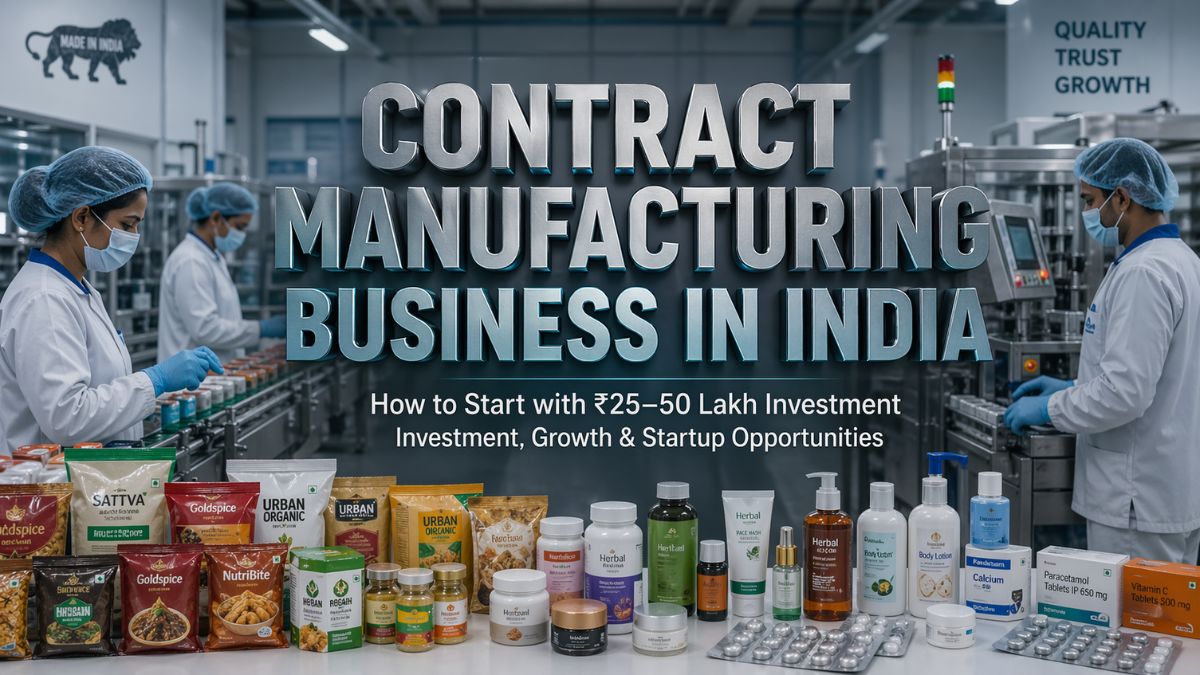
Contract Manufacturing Business
The manufacturing industry in India is expanding at a high rate and contract manufacturing is emerging as one of the most appealing business models among the new business persons. You do not have to create your own brand and invest a lot of money into marketing; you can produce goods with well-known firms and get a certain amount of money on production jobs.
Companies today Favor outsourcing production as it saves them the cost of running the business and they are able to concentrate on sales and branding. This has led to a high demand of the dependable contract manufacturers in the food processing, packaging, cosmetics, electronics, and plastic components industries.
To small business owners and first-time entrepreneurs, contract manufacturing can be an efficient means to penetrate the manufacturing industry with average start-up capital and a predictable income.
What Is Contract Manufacturing?
A contract manufacturing is a business model whereby a single company manufactures goods on behalf of another company which markets those goods under its brand name. The manufacturer is concerned with production, quality control, and delivery in time whereas the brand owner deals with marketing and distribution.
The model has been popular over the decades since it is beneficial to both sides. Big businesses have the ability to increase their production without constructing new facilities, and small manufacturers are able to have regular orders without investing in advertisement.
Simply put, contract manufacturing enables you to make money on production and not sales.
Why Contract Manufacturing Is Growing in India
There are a number of business and economic trends that are contributing to the development of contract manufacturing in India. A change in global supply chains is one of the largest causes. Most global businesses are currently obtaining products in various countries rather than a single destination. The attractive workforce and competitive cost of production have made India a country of choice.
The rapid increase of the number of the brands of the label of the companies operating privately is another influential consideration. Supermarkets, online stores and distributors are also starting their own branded products and they solely rely on contract manufacturers to manufacture them.
The government has also come up with policies which facilitate production and are favourable to small businesses.
Key reasons for growth include:
- Increased demand of the products of their own labels.
- Growth of e-commerce and retail outlets.
- Loan schemes and government subsidies.
- Increasing export opportunities
- Expansion of startups and new brands.
These are likely to ensure a high demand in the coming years.
Access Complete Business Plan: Project Reports & Profiles
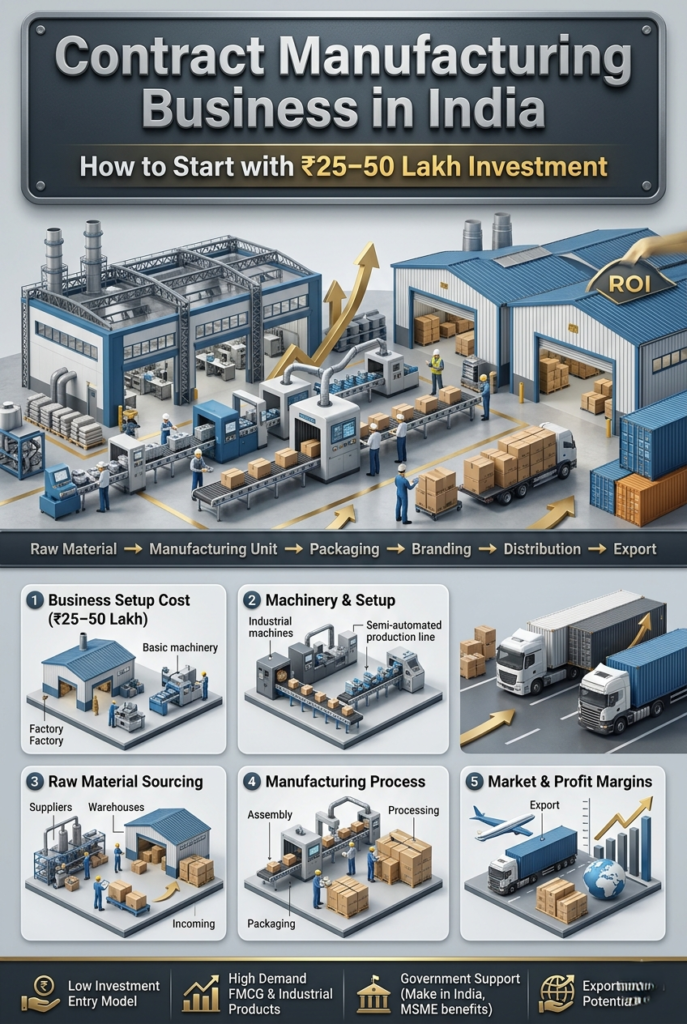
Best Contract Manufacturing Business Ideas in India
One of the most crucial decisions to make when launching a manufacturing business is the selection of the product category. Certain industries are more demanding and have easy entry as compared to others.
Food processing is one of the most popular industries. Packaged food products have been on the increase due to the shift in lifestyle of urban people and the need to have ready to eat meals. Distributors and retailers regularly make orders with small manufacturers that produce spices, flour, snacks, and ready-to-eat foods.
Packaging services are another expanding industry. A lot of businesses outsource packaging services due to the fact that it involves specialized equipment and skilled labor. Contract packaging units deal with the filling, sealing, labeling and quality checking of different consumer products.
High-demand contract manufacturing sectors include:
- FMCG and food package.
- Cosmetic and personal care products.
- Plastic components manufacturing
- LED light assembly
- Cleaning and household products
These industries provide good predictability in demand and good profitability to small manufacturing firms.
Investment Required to Start a Contract Manufacturing Business
The capital needed to initiate a contract manufacturing facility hinges on the type of product, size of production, and machinery needs. The capital to be used in a small packaging or assembly unit is usually lower than the large manufacturing sectors.
The starting level of a contract manufacturing company needs 22-65 lakh of investment. This is usually the cost of factory establishment, equipment, and utility, and the working capital during the first months of operation.
Key cost elements are:
- Set up and deposit of rent on factories.
- Machinery and equipment
- Connection of electricity and utilities.
- Raw materials and wages.
- Licenses and registrations
Financial planning should be done properly to facilitate smooth running in the initial stages of the business.
Step-by-Step Process to Start a Contract Manufacturing Unit
There are a number of significant steps that need to be undertaken when starting a contract manufacturing business. It might seem complicated but when done in the right order, then it becomes easily manageable.
The first one is the choice of a product whose demand is constant and competition can be controlled. Entrepreneurs ought to select products that are relative to the local resources and market opportunities.
Once the product has been chosen, the other thing is to find an appropriate place. Industrial locations tend to be favoured as they offer good infrastructure and accessibility to transport.
Simple procedures to initiate the business:
- Select a product category.
- Lease a warehouse.
- Acquire machinery and equipment.
- Hire skilled workers
- Obtain necessary licenses
- Begin manufacturing and get clients.
This order of sequence minimizes risk and enhances the probability of success.
Government Schemes Supporting Manufacturing Businesses
Indian government has provided a number of financial schemes to attract business starters to initiate manufacturing business. These programs minimise the cost of starting up and financing is easier.
These schemes are used by many small business owners to acquire machinery, grow the business, and work capital.
Important government schemes include:
- PMEGP – subsidy of manufacturing projects.
- MUDRA Loan- provides loans with no collateral to small businesses.
- CGTMSE – ensures bank loans without collateral.
- PLI Scheme – incentives are given according to production output.
These plans greatly lessen the pressure on finances at the start-up of the business.
How NPCS Helps Entrepreneurs Start Manufacturing Businesses
NPCS or NIIR Project Consultancy Services is a reputable institution that assists business people in establishing manufacturing facilities. They come in handy particularly when a person is starting a business and is a first-time entrepreneur.
NPCS offers professional project reports that entail in-depth data on machineries needs, manufacturing procedures, financial forecasts, and compliance with regulatory procedures. Such reports are frequently applicable when borrowing bank loans since they have transparent and sound business strategies.
Besides the project reports, NPCS also provides consultancy services to assist the entrepreneurs in the planning of factory layout, cost estimates and finding the appropriate suppliers of raw materials. Their advice minimizes uncertainty and assists business owners to make informed decisions.
Profit Potential in Contract Manufacturing
Contract manufacturing has the potential to produce a predictable revenue after the processes start and the relations with clients are built. Revenue is based on the capacity to produce and volume of orders as well as efficiency in operations.
Small manufacturing units are able to gain profitability after only two or three years. The higher the production capacity and the number of clients, the higher the profits.
A benefit of a contract manufacturing company is that there is low cost of marketing. Promotion and distribution of the products is done by the client and the manufacturer is only involved in producing the products with maximum efficiency.
Typical financial performance:
- Monthly revenue: 18 lakh -30 lakh.
- Profit per month: 3 lakhs to 6 lakhs.
- Investment payback period: 18-36 months.
These numbers differ according to the industry and the level of production.
Future of Contract Manufacturing in India
The prospects of contract manufacturing in India are very bright. The fast urbanization process, growing consumer demand, and growing export markets are also opening new opportunities in front of manufacturers in various sectors.
With the increasing outsourcing of production by more companies in order to cut down on costs, the contract manufacturers that are reliable will still be in demand. The early entrants to the market will have a long-term relationship with the clients and experience growth of their businesses as time goes by.
When done right, with quality control, and professional advice, contract manufacturing will be a stable, lucrative business over several years.
Conclusion
One of the most feasible business opportunities in India today is contract manufacturing. It has a predictable demand, easy investment needs and good government support. By concentrating on quality production and quality service, the entrepreneur can develop winning manufacturing enterprises within a few years.
This is facilitated by organizations such as NPCS which offer technical advice and professional project reports that facilitate easy funding and effective organization of operations. Contract manufacturing can be a strong way to achieve business success in the long-term with the proper strategy and commitment.
Frequently ask questions (FAQ)
- What is the amount of investment necessary to begin with contract manufacturing in India?
Small contract manufacturing businesses vary between ₹22 lakh and ₹65 lakh according to the product and machinery.
- Does contract manufacturing make sense?
Yes, it makes a profit when the operations are handled effectively. Most businesses realize a profit margin of between 15 to 25%.
- Time to start a manufacturing unit?
The majority of units start functioning in six to nine months after being set up and licensed.
- Am I allowed to commence production without having land?
Yes, lots of business owners begin with rented industrial sheds to save on the start-up costs.
- What is the best industry to be a beginner?
The industries that are beginner friendly are food processing, packaging, cosmetics and plastic components manufacturing.
- What is the benefit of NPCS to the entrepreneurs?
NPCS offers reports on projects, finances, machinery directions and records, which assist entrepreneurs in launching manufacturing companies effectively.


