





Introduction: MSME government schemes
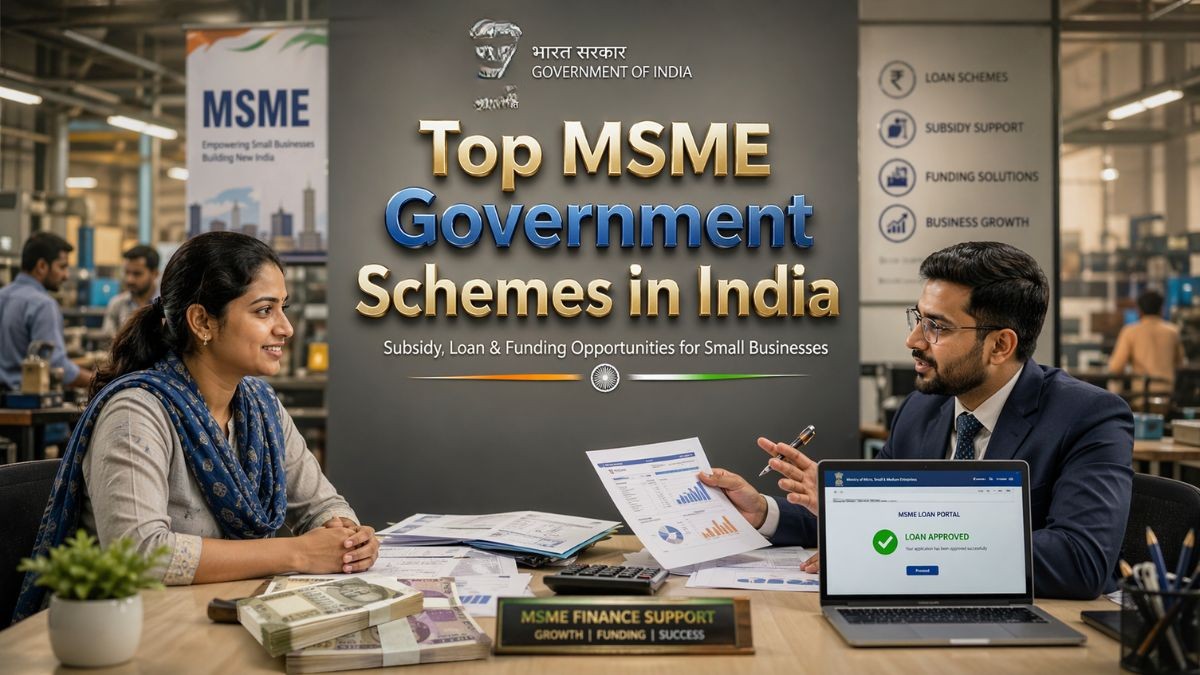
The Micro, Small, and Medium Enterprises (MSME) sector of the Indian economy is considered to be one of the most robust. It is a major contributor to employment, export and industry. Even after the government offers financial support, subsidies, and business support to many entrepreneurs, not all of them utilize such schemes. It is not because there is no money, but because of the absence of knowledge and appropriate education.
The government has made it easier in the recent years by computerizing applications, simplifying processes and providing more funding to small businesses. This implies that it can start or grow a business in 2026 more easily than it has ever been. The entrepreneurs with knowledge of how to tap into these schemes are able to have a lower investment load, enhanced profitability and faster growth.
Why MSME Schemes Are More Important Than Ever in 2026
The government is exerting a push to achieve entrepreneurship and manufacturing through the programs like Make in India and Startup India. Banks too are stimulated to lend to the small businesses, particularly those registered under the MSME category. Consequently, it has become easier to get financial assistance and the approval process is also more transparent.
There are a number of ways in which government schemes assist businesses:
- They lower startup costs by subsidizing.
- They facilitate the easy access to loans.
- They enhance the quality and competitiveness of products.
- They promote growth and modernization.
The Most Important Government Schemes for MSMEs
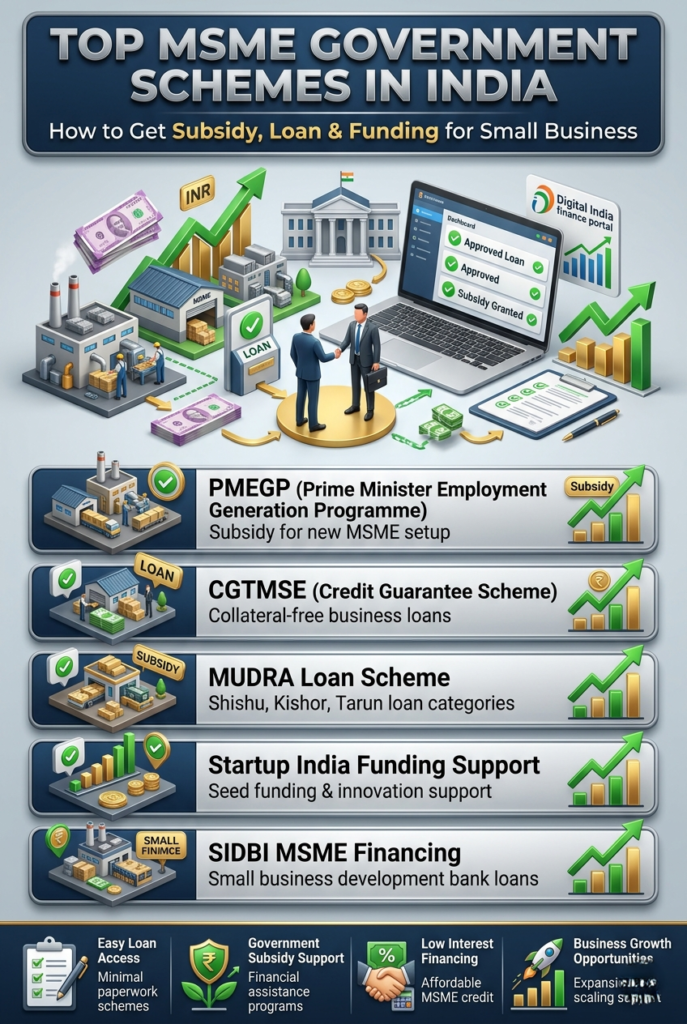
The Prime Ministers Employment Generation Programme also referred to as PMEGP is one of the most popular schemes used in India. This plan is aimed at assisting new businesspeople to open a business venture either in manufacturing or in services. This program is a subsidy on the overall project cost given by the government that makes the borrowing of money by banks lower.
CGTMSE is another scheme that is of significance. This plan is especially helpful to entrepreneurs who lack property or assets to provide as security. The government gives a guarantee to the banks under CGTMSE and a significant part of the loan is guaranteed.
The Credit Linked Capital Subsidy Scheme provides subsidies to businesses already in operation and wishing to upgrade their machinery or technology. This plan promotes modernisation by offering subsidy on the acquisition of new equipment’s.
Another area that the government can offer support to is quality improvement in the form of the Zero Defect Zero Effect scheme that emphasizes on manufacturing excellence and environmental responsibility.
Best Option: Get Detailed Project Report (DPR):Project Reports & Profiles
The First Step Every Entrepreneur Must Take
Udyam registration must be obtained before applying to any of the government schemes. This is a registration which technically makes a business micro, small or medium enterprise. Most schemes cannot be reached without it.
The procedure is easy and only needs some basic information like:
- Aadhaar number
- PAN card
- Business information
- Bank account details
A lot of the entrepreneurs are not keen on the right information in registration. Any wrong turnover or investment information may result in denial of scheme applications in future.
The Role of a Strong Project Report in Scheme Approval
A weak project report is one of the most frequent causes of rejection of loan or subsidy applications. This document is very important in the assessment of the viability of a business by banks and government agencies. An effective project report will show that the entrepreneur has knowledge of the market, costs and profitability of the venture.
A project report prepared by a professional is generally supposed to contain:
- Business background and product description.
- Market demand and competition analysis.
- Raw material and machinery needs.
- Cost estimation and profit estimates.
- Break-even and risk analysis.
How NPCS Supports Entrepreneurs and MSME Businesses
NPCS or Niir Project Consultancy Services is one of the most successful industrial consultancy organizations in India that has over thirty years of experience. The organization has assisted thousands of entrepreneurs to start and grow successful business in various industries.
Their services normally involve:
- Detailed Project Reports (DPR)
- Techno-Economic Feasibility Studies
- Market Research and Demand Analysis.
- Financial Projections, and Costing.
- Staffing in Bank Loan and Subsidy Applications.
Most banks and government agencies prefer documentation prepared by professionals since it minimises risk and enhances decision-making.
Growing Business Opportunities for MSMEs in the Coming Years
The changing consumer demand and government policies are likely to see several industries rise in a great way. MSME entrepreneurs have the potential to make it in some of the most promising areas:
- Food processing and packaged foods.
- Packaging materials and printing.
- Renewable energy and solar products.
- Healthcare and medical supplies.
- Construction and building materials.
The first movers in these industries are able to have a competitive edge and ensure profitability in the long run.
Practical Advice for Entrepreneurs Applying for Government Schemes
Darwin needs to think of the schemes by the government as a strategic move to be followed and not as a bonus. An effective course of action tends to be:
- Choosing the appropriate scheme depending on the level of business.
- Making proper financial records.
- On time submission of complete applications.
- Regularly following up with banks or authorities.
These little procedures can be what will count or not.
Conclusion: Turning Government Support into Business Success
Government programs designed for MSMEs serve as effective instruments which enable entrepreneurs to develop their business concepts into successful enterprises. The organizations gain three benefits which include decreased financial risk, enhanced operational efficiency, and newly available growth opportunities. Entrepreneurs who take initiative and use these schemes effectively achieve faster progress than those who rely solely on personal funding.
The successful path of entrepreneurs starts with a basic sequence which they must follow:
- Complete Udyam registration
- Choose the most relevant government scheme
- Prepare a professional project report
- Apply through the correct bank or portal
The combination of effective planning and adequate support enables government programs to establish a strong foundation which leads to business success that lasts.
Frequently Asked Question (FAQ)
Which is the most suitable government plan to start a new business in India?
The PMEGP is popularly regarded as among the most effective schemes to use in supporting the new entrepreneurs since it offers financial assistance in terms of subsidy and bank financing.
Is it possible to take a loan without collateral by a business?
Yes, through the CGTMSE scheme, banks will be able to provide loans without a collateral since the government would guarantee a substantial amount of the loan.
How much time does it normally take to approve an MSME scheme?
The process of the approval typically requires three-six months based on the quality of the documentation and the pace of the bank handling.
What is NPCS role in MSME projects?
NPCS helps the entrepreneurs by drafting professional project reports, feasibility studies and offering advice on how to apply the loans and subsidies, which greatly increases the chances of approval.


