





Export manufacturing business ideas India
India is ushering in a new industrial era. In the last ten years, Indian firms have outgrown their national markets and proceeded to establish strong market positions in the international trade. In automobiles, pharmaceuticals, chemicals, processed foods among other products, Indian manufacturers are exporting products to consumers worldwide. This change does not only concern big companies, but also startups and small enterprises.
Such companies as Tata and Mahindra have demonstrated that Indian brands can compete with other global companies when these companies are concentrated on quality, innovation, and long-term strategy. Thousands of entrepreneurs have been encouraged to venture into exports thanks to their success. To new business owners, it is important to know about this global expansion as it shows them how business manufacturing can be more profitable and expanded quicker.
Get Detailed Insights from This Book: Just For Starters: How To Start Your Own Export Business
Why Indian Companies Are Expanding into Global Markets
The Indian companies are now expanding beyond the nation. The domestic markets are not to be ignored, yet the global ones have more customers and greater potential revenue. The manufacturing technology, logistics, and government policies have become better than ever and this has made exporting easier.
This expansion across the world is being catalysed by a few factors. To begin with, India has built a powerful manufacturing ecosystem, which is backed by motivated labor force and trustworthy suppliers. Second, multinational firms are seeking new sources of supply as they seek to diversify supply chains. Third, government efforts have lowered the costs of exports and made the process of regulation easier.
The key competitive strengths that Indian products have in the world market are:
- Competitive manufacturing costs
- Availability of skilled technical manpower.
- Increasing confidence in the quality of India.
- Favourable government export policies.
- Rising demand of Indian goods across the world.
The above strengths have made India one of the fastest growing export economies in the world.
The Tata Model: Building Global Credibility Through Quality
The emergence of the Tata Group is among the strongest Indian global success stories. It has gone international, with a company culture that has been emphasizing the quality of the product, brand reputation, and technological capability. A significant milestone was the acquisition of Jaguar Land Rover by Tata Motors which enabled it to access high-end engineering and the high-end market segments.
The key to the strategy of Tata to entrepreneurs is that it has a long-term vision. The company did not compete solely on price but spent a lot of money on the research, testing, and certification. This method has contributed to the establishment of trust in international customers and has provided a competitive edge.
This strategy can teach businesses intending to venture into export markets some valuable lessons. They need to focus on good infrastructure and adherence to international standards early enough despite the increased initial capital expenditure.
Mahindra’s Global Strategy: Serving Underserved Markets
Mahindra has taken another route to internationalization. The company did not focus on the premium customers but rather practical solutions to everyday users. Its tractors became popular in the United States as it provided good performance at a low cost to low farms.
This practice shows the significance of establishing gaps in the market. Businessmen do not necessarily have to compete with big multinational brands. They can do so instead by providing products that can address certain issues to customers.
The main lessons of the strategy of Mahindra are:
- emphasize on customer requirements as opposed to brand image.
- Design products to be long lasting and efficient.
- Find untapped market segments.
- Develop effective after sales support.
These values can assist startups to develop viable export enterprises.
Industries Driving India’s Export Growth
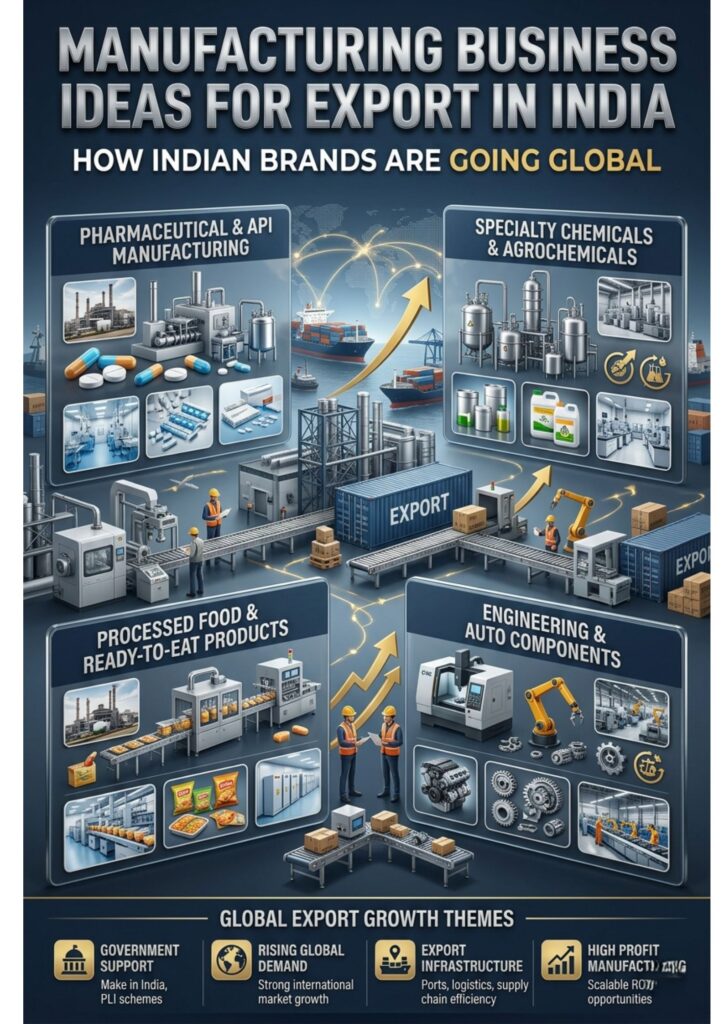
A number of high potential industries are driving the growth of India on export. These industries have a high demand, predictable income, and government assistance.
Pharmaceutical and API Manufacturing
One of the biggest export industries in India is the pharmaceutical industry. Indian companies supply affordable medicines to countries around the world. The demand in generic drugs and active drugs ingredients is still growing because of the rising healthcare demands.
Get Detailed Insights from This Book: India Active Pharmaceutical Ingredient (API) Market Analysis
Specialty Chemicals and Agrochemicals
Agriculture, textiles, and industrial manufacturing utilise specialty chemicals. Indian manufacturers have established a high level of chemical competencies which enable them to provide specialised products to the international markets.
Processed Food and Ready-to-Eat Products
Food processing is now a major export sector as foreign customers demand easy and culturally varied food. India has a natural advantage in this sector due to its strength in agriculture.
Some of the popular export products in this industry are:
- Spice mixes and seasonings.
- Frozen foods and ready-to-eat meals.
- Healthy and pre-prepared snacks.
- Fruits and vegetables that have been processed.
This is a particularly appealing sector to entrepreneurs as it has a moderate level of investment and a stable demand.
Access Complete Business Plan: Fruits and Vegetables Value Addition
Engineering and Auto Components
Another significant export prospect is the engineering of goods and automotive parts. The world manufacturers are in dire need of quality suppliers and Indian companies are fulfilling this need by providing quality precision parts.
The investment in state-of-the-art equipment and quality management systems has helped the Indian manufacturers to match international standards and compete with international suppliers.
How Entrepreneurs Can Prepare for Export Success
To initiate an export-based business, one has to plan and be aware of the market needs. The entrepreneurs need to concentrate on developing dependable production systems and ensuring the same standards of quality. Such a product can find it difficult to succeed in the foreign markets even when it is promising without proper preparation.
Export preparedness steps include:
- Choosing products that have good demand in the world market.
- Getting international quality certification.
- Creating effective logistics and documentation.
- Adequate working capital.
- Carrying out in-depth market research.
All these measures will establish a strong business base in the long run.
Find high-return business ideas based on your budget & ROI
The Importance of a Detailed Project Report (DPR)
One of the most important documents of any manufacturing business is a Detailed Project Report. It gives a full picture of the project, investment needs, production capacity and profits. This report has helped banks and investors to determine the viability of new businesses.
Writing a professional DPR assists entrepreneurs in knowing the risks and opportunities in the market, before undertaking significant financial obligations. It also enhances opportunities of getting loans and government assistance.
About NIIR Project Consultancy Services (NPCS)
The NIIR Project Consultancy Services is a top industrial consultancy firm in India which is widely referred to as NPCS. Having over four decades of experience, NPCS has assisted thousands of entrepreneurs to build successful manufacturing companies in different industries.
The company offers a wide range of consulting services aiming to help businesses through the planning phase to high scale production. Their areas of specialization include technical, financial and operational areas of industrial development.
NPCS offers a wide range of professional services, including:
- Drawing up of Detailed Project Reports.
- Market research and feasibility analysis.
- Selection of machinery and plant layout planning.
- Cost estimation and profitability analysis.
- Regulatory approvals and licensing advice.
- Guidance to business planning that is export-oriented.
These services enable entrepreneurs to mitigate risk and make effective investment decisions.
Related Article: India’s $5 Trillion Economy: Top Industries Driving Growth for Entrepreneurs and Investors
The Future of Indian Export Businesses
There is a bright future of Indian exports. There is a growing need in the world to have a manufacturing partner that is reliable and India can fit the bill. Advancements in technology, infrastructure as well as logistics are enabling businesses to compete globally.
Meanwhile, the government programs are promoting production and export. The policies should generate millions of new jobs, and will solidify the position of India in international trade.
The current export-oriented entrepreneurs can have long-term growth prospects due to the availability of opportunities to the business by those who initiate them. New companies can create strong brands by focusing on quality, innovation and customer satisfaction, and sustain success.
Conclusion
Indian brands are gaining popularity in the global markets, and this is changing the industrial face of the country. Global success can be achieved with the right approach and hard work as seen by companies such as Tata and Mahindra. Their success has made the startups and small businesses to take the same route.
This is the opportune time when would-be entrepreneurs should consider export-oriented manufacturing. The world market is expanding; the Indian products are in demand and support systems are in existence as never before. With adequate planning and professional advice of organizations such as NPCS, companies can transform their ambitious ideas into lucrative business ventures.
Frequently Asked Question (FAQs)
Q1. Is it possible to start exporting with a small business?
Well, there are numerous small businesses that export products. The most important thing is to keep the quality standards and make proper documentation prior to entering the international markets.
Q2. What manufacturing industries should be exported in India?
The most prospective industries are pharmaceuticals, specialty chemicals, food processing, engineering components, and electric vehicle parts.
Q3. What is the time required to start an export business?
The average manufacturing companies that are export-oriented require one to three years to develop production, get certifications, and find consistent international orders.
Q4. What is the importance of a Detailed Project Report to new businesses?
A Detailed Project Report assists an entrepreneur to know the costs, estimate the profits and raise finances with banks or investors.
Q5. What are some ways in which NPCS can assist entrepreneurs to begin manufacturing businesses?
NPCS offers professional consulting, feasibility studies, project planning services that assist business starters to start successful and profitable companies.


