






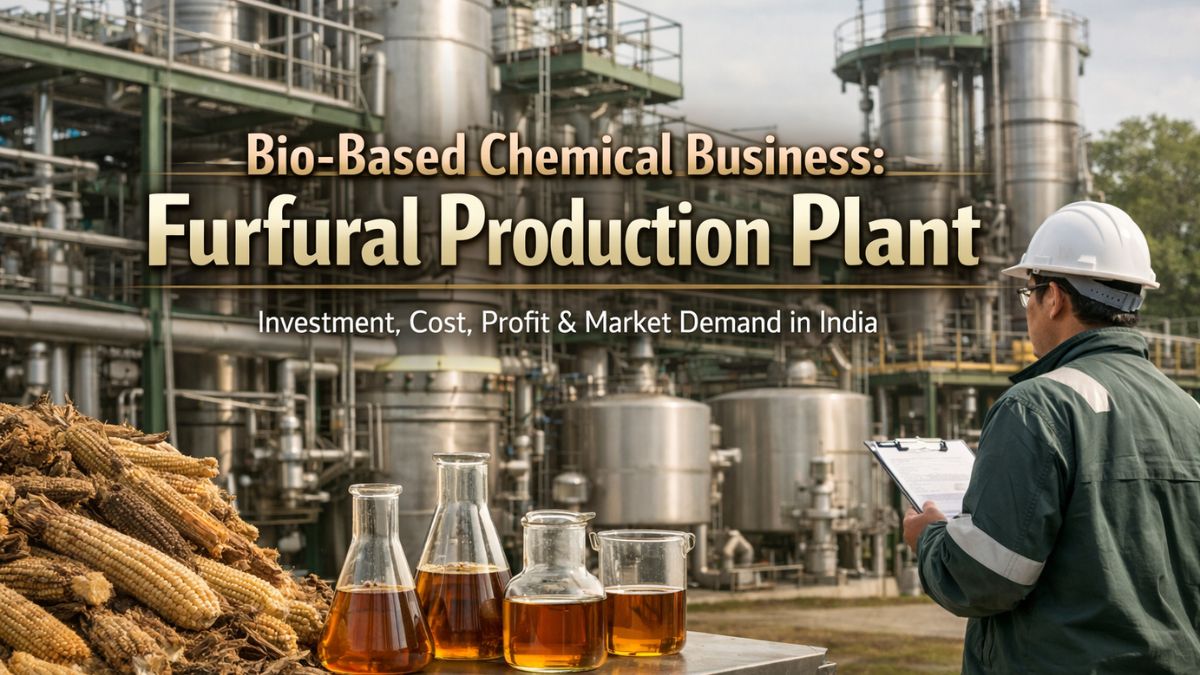
Furfural plant project cost in India
The chemical industry is slowly moving towards green and eco-friendly material all over the world. Growing environmental standards, fluctuating oil prices, and the increasing demand towards environmentally friendly products are forcing industries to abandon the conventional petrochemicals. In this changing landscape, bio-based chemicals have become one of the fastest-growing sectors worldwide. Of these new opportunities, furfural and furfural derivatives are attracting a lot of attention among entrepreneurs and investors in India.
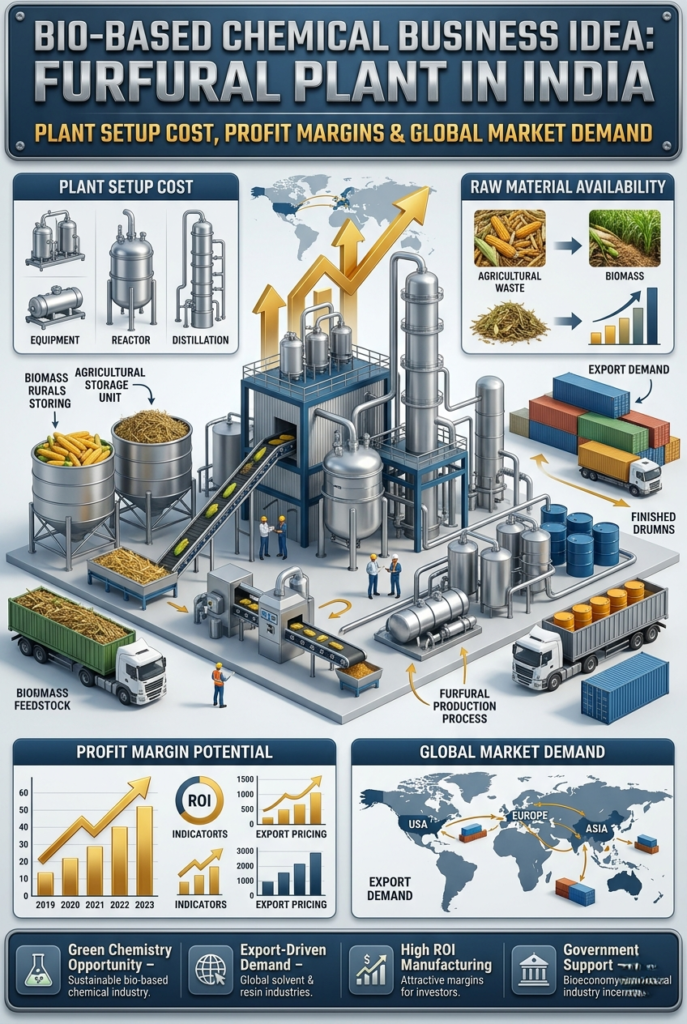
The agricultural residues, i.e. rice husk, corn cobs and sugarcane bagasse are used to produce furfural. Low-cost production is naturally suited to India, with these materials being readily accessible all over the country. Rather than disposing agricultural waste as a waste, industries can transform the waste into useful chemical products. This would not only generate new sources of revenue but also help in environmental sustainability and development of the rural areas.
The furfural industry is now leaving small-scale operations behind as it turns into a strategic part of the chemical market worldwide. Those who venture into this industry early enough will establish business with high demand, exportability and sustainable growth.
Table of Contents
ToggleGet Detailed Insights from This Book: Handbook On Chemical Industries (Alcohol Based)
Growing Market Demand for Furfural and Its Derivatives
Furfural is on the rise in demand as it is used as a raw material in most industrial products. It finds extensive application in pharmaceuticals, agrochemicals, lubricants and resin and specialty chemicals. The role of bio-based chemicals is also increasing as industries become increasingly clean in production.
The furfural market research indicates that the market is growing steadily all over the world. Industrial demand is favouring the growth and not speculation. Several manufacturers have been turning to bio-based inputs in order to meet the environmental requirements and minimize their carbon footprint.
The key demand generating industries are:
- Pharmaceutical manufacturing
- Agrochemical production
- Foundry and casting industries.
- Manufacturers of paint and coating.
- Plastic and solvent sectors: bi-plastic and green solvents.
These industries need stable supplies of quality chemicals and this opens up prospects of new manufacturers.
Why India Has a Strong Competitive Advantage
The ability of India to provide furfural is based on her agricultural foundation and the industrial infrastructural development. The country produces a huge amount of agricultural residue which can be used as raw material in the production of chemicals every year. Availability of these resources lessens reliance on imported inputs and makes production costs to be competitive.
A large domestic market is another favourable opportunity. India has had a booming manufacturing industry especially in the automotive, engineering and pharmaceutical industries. Chemicals are needed to manufacture these industries, which guarantees a constant demand of furfural and its derivatives.
The main benefits of establishing the business in India are:
- Abundant supply of agricultural waste
- Low cost of raw material.
- Increasing local and foreign demand.
- Government subsidies to manufacturing by MSMEs.
- Increasing focus on sustainable production
All these aspects render India as one of the most appealing places to manufacture bio-based chemicals.
Detailed Project Report (DPR): Furfural from Bagasse & Corncobs Project Report
Profitable Business Opportunities in the Furfural Value Chain
The furfural business has various business opportunities, which can be either small-scale units or large manufacturing units. Depending on investment capabilities and technical skills, entrepreneurs have the opportunity to select an entry point.
The industry is based on a complete furfural production facility. In this facility, agricultural waste is processed into crude furfural by means of chemicals. Although it has a higher initial investment, it offers more control on the supply chain and is able to expand to downstream products.
The other promising alternative is the manufacture of furfuryl alcohol. The chemical finds extensive application in foundry industry to make molds and castings. The automotive and engineering industries in India are expanding, which means that the demand on this product is likely to be high in a number of years.
Tetrahydrofurfuryl alcohol (also referred to as THFA) has a promising profit market to offer to those entrepreneurs who may wish to have a more specialized market. It is applied in the production of pharmaceuticals and crop protection products. The fact that domestic production is low means that the local manufacturers get a chance to substitute imports and win the market share.
An easier and more convenient entry point is the manufacture of furan resins. These are the resins that are invaluable in metal casting and industrial fabrication. It is relatively easy technology and thus can be used with small and medium-scale enterprises.
The normal investment amounts in various projects are:
- Furan resin manufacturing unit: ₹4 crore to ₹8 crore
- Furfural production plant: ₹8 crore- 18 crore.
- Furfuryl alcohol plant: ₹12 crore to ₹20 crore
- THFA manufacturing unit: ₹15 crore to ₹25 crore
The decision on the project is based on the capital available, technical capacity and market target.
Export Potential and Global Opportunities
One of the most effective growth drivers of the furfural market is export markets. A large number of nations rely on imported chemicals to aid their industries. Meanwhile, companies are seeking to diversify suppliers as a way of mitigating risk and enhancing supply chain stability.
India has an established export infrastructure, ports, network of logistics and trade agreements. This facilitates manufacturers to provide international customers. Those companies that uphold quality and have the relevant certifications can get permanent export contracts.
Key export markets are:
- Europe
- United States
- Japan
- South Korea
- Southeast Asia
Exporting goods and services can lead to an increase in profit margins than in home markets hence this is a desirable business expansion strategy.
Investment Requirements and Financial Outlook
Furfural business needs a proper financial planning. The investment entails machinery, plant construction, utilities and working capital. The initial cost might be expensive, but in the long-term, returns can be quite profitable.
Most companies in this industry would reach a steady level of profitability when the production is at full capacity. Effective operations and relationship with customers are significant in financial success. Value-added products instead of raw materials Entrepreneurs who concentrate on value-added products as opposed to raw materials tend to get better returns.
Usual financial expectations comprise:
- Payback period of about 3-5 years.
- Profit margins between 15 to 30 percent.
- Growing revenue by exporting and diversification of products.
The business can be a stable source of income in the long run with proper planning.
Challenges and Risk Management
The furfural industry, just like any other manufacturing enterprise, has a number of challenges that it has to handle. Production processes require technical knowledge and strict operational control to achieve consistent results. Environmental regulations mandate that facilities must establish effective waste management systems together with emission control systems.
Another factor that influences the operating costs is energy consumption. Modern equipment and efficient production processes can significantly decrease the expenses and enhance profitability.
Investing in smart personnel, efficient technology, and effective administration systems will increase the chances of these entrepreneurs succeeding in this competitive sector.
How NPCS Helps Entrepreneurs Start Manufacturing Businesses
The establishment of a chemical manufacturing company may be complicated, particularly among the first-time entrepreneurs. Professional advice minimizes risks and provides a smooth execution of the project. NPCS or Niir Project Consultancy Services is an established organization that offers industrial consulting consultancy services to new businesses.
NPCS assists entrepreneurs with all the development stages of projects. They offer their services in preparing comprehensive feasibility report, market demand analysis, appropriate machinery selection and cost of production estimation. Banks and other financial institutions usually demand these reports prior to loan approval.
The organization also helps in regulatory approvals, subsidy applications and plan plant layout. Entrepreneurs will be able to work with experienced consultants and eliminate expensive mistakes and start their businesses more effectively.
Conclusion
The furfural derivatives market is a good business opportunity to entrepreneurs who would like to venture in the manufacturing business with futuristic business model. The fertile agricultural land, increasing industrial need and favourable government policies make India a perfect place to invest.
With the use of sustainable materials being embraced by industries in the world, there is a steady increase in demand of bio-based chemicals. Companies concentrating on quality, efficiency and innovation will be in a good position to prosper in this growing market. The furfural industry is an attractive way to go among investors looking to achieve long-term growth and export opportunities.
Frequently Asked Questions (FAQ)
Q1. Is furfural business profitable in India?
Yes, the venture can be lucrative because of low costs of raw materials and high demands of the industrial sectors. Most firms have a stable return in a few years of operation.
Q2. How much investment would you need to start this business?
An investment of approximately 4 crores to 6 crores can be made to start a small manufacturing plant like a resin plant.
Q3. What is the raw material of furfural?
Agricultural residues like rice husk, corn cobs, and sugarcane bagasse are the most widely used raw materials.
Q4. Are there furfural products export requirements?
Yea, most foreign markets rely on imported chemicals, offering good export potential to Indian manufacturers.
Q5. Time to recover investment: How much time does it take to recover the investment?
In the majority of cases, the payback period of most projects can be three to five years, depending on the efficiency of production and the demand in the market.


