




Healthcare manufacturing business
India’s healthcare industry has undergone a revolution in the last decade. What was then concentrated in metros has spread to tier-II and tier-III cities, triggered by new medical colleges, diagnostic chains, and government-supported initiatives such as Ayushman Bharat. This expansion has led to a huge and regular need for medical consumables and surgical devices, which are products with solid margins.
For entrepreneurs and MSMEs, it is not speculative to enter healthcare manufacturing but is necessity-driven. Among the most lucrative parts are hospital-grade disposable garbage bags, diagnostic sample containers and surgical instruments. These products are used on a daily basis for hospitals, clinics, and labs, with constant demand and long-term business potential.
Table of Contents
ToggleRead the Complete Book Here: Business Ideas for Startup in Drugs & Pharmaceutical Industry with Project Profiles (3rd Edition)
1. Disposable Garbage Bags Hospital-Grade
Proper biomedical waste management is very important for public health. Medical facilities need to use color-coded garbage bags for their waste disposal procedures. The hospital-grade bags which comply with the Biomedical Waste Management Rules provide better protection against punctures and leaks than standard city garbage bags.
Applications include: Hospitals, Diagnostic Labs, Pathology Centres, Nursing Homes, Veterinary Clinics.
The manufacturing process includes blown film extrusion, printing of biohazard symbols, cutting, sealing and quality testing. Using polymers of a high quality (e.g. LLDPE or HDPE) guarantees durability and compliance. Capital investment is moderate and therefore accessible to small and medium enterprises.
The reason for profitability of this segment:
- Steady demand on account of rise in hospital beds and healthcare facilities
- Margins range from 12–18%
- Moderate investment with fairly rapid payback
- Volume driven business with recurring orders
India generates more than 600 tonnes of biomedical waste every day and the growth rate in the hospital consumables market is about 8-10% per annum.
Get Detailed Project Report (DPR): Disposable Syringes Project Report & Feasibility Study
2. Diagnostic Sample Containers and Blood Collection Tubes
The diagnostics industry is growing fast because of preventive health check-ups and corporate wellness programs. Products such as blood collection tubes, urine containers and stool containers are important for testing and laboratory diagnostics.
These products demand GMP cleanroom, precision manufacturing. Blood collection tubes are manufactured from medical-grade polypropylene or PET with vacuum sealing and urine and stool containers are injection moulding, sterilized, and tamper proof. Regulatory approvals are mandatory which puts up entry barriers, but also helps organized players from small scale competition.
Most important features of this segment:
- High demand from hospitals/labs/research centers/home sample collection services
- Margins above 15-22%, particularly for vacuum-based blood collection tubes
- Export potential to Africa, Southeast Asia and Middle East
- Growth that is aligned with India’s USD 15 billion diagnostics industry
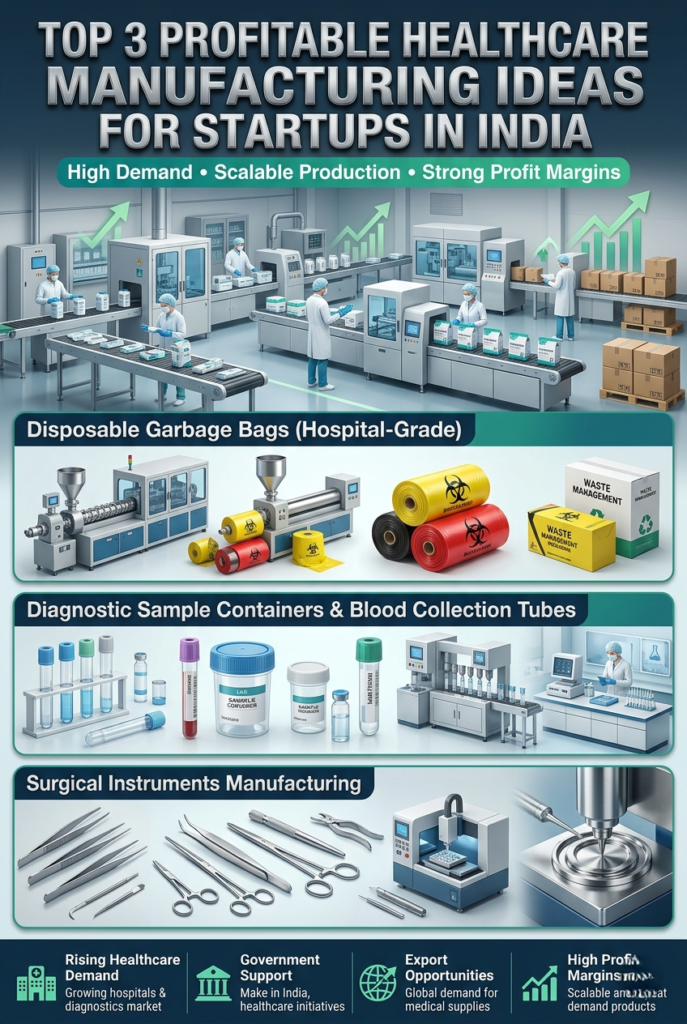
3. Surgical Instruments
Surgical instruments are key essential tools for operating theatres. General surgery and orthopaedics and cardiovascular surgery and dental surgery and veterinary medicine frequently utilize products which include scalpels and blades and forceps and retractors and clamps as standard equipment.
India has established manufacturing clusters like Jalandhar which focus on producing high-quality products for international markets through their skilled craftsmanship. Production includes stainless steel or carbon steel, forging, machining, polishing, ultrasonic cleaning and sterilization. Instruments would have to be sharp, corrosion resistant, and meet international standards.
Why surgical instruments are profitable:
- High margin products (Up to 25% for certified premium instruments)
- Good export potential to Europe, the US and Latin America
- Growing market at 12–15% annually
- Medium capital intensity with the ability to scale operations
Entrepreneur Strategic Insights
Healthcare manufacturing is largely volume-based with recurring orders coming from institutional clients. While there may be longer sales cycles than other sectors, these clients provide predictable revenue streams.
Factors to pay attention to to be successful:
- Regulatory compliance – CE, ISO, CDSCO approvals
- Quality control – especially important with diagnostic consumables and surgical instruments
- Automation – to ensure consistency, sterilisation, minimise the risk of contamination
- Supply chain efficiency – important in serving hospitals in tier-II and tier-III cities
- Export readiness – certified products open high value international markets
Government programs such as Make in India also offer incentives for domestic medical device production, which is further aiding MSMEs in entering the sector.
Conclusion
Healthcare manufacturing in India is a space that presents entrepreneurs with an unprecedented mix of stable demand, manageable entry barriers and scalability. Hospital Garbage Bags give predictable revenue with moderate investment, Diagnostic Consumables give high margins and Surgical Instruments give high export opportunities.
The success is dependent on regulatory compliance, quality, credibility, and supply chain efficiency. Entrepreneurs who pay attention to these factors at an early stage will be able to build profitable, resilient, and growth-oriented businesses in the growing healthcare ecosystem of India.
In healthcare manufacturing, credibility equals currency. Build it early, keep it consistent and growth will follow.
FAQs
Which segment should require the minimum investment?
In terms of the capital needed, hospital garbage bags are the least expensive options when compared to diagnostic tubes or surgical instruments.
Do export certifications need to be mandatory?
Yes, CE or ISO is very important for surgical instruments and diagnostic consumables for the international market.
What is the average break-even period?
A managed unit can break even in 3-5 years (depending on scale and financing).
Can MSMEs withstand established brands?
Yes, especially for regional supply chains and value focused export markets.
How important is automation?
Automated systems deliver uniform product quality while maintaining sterility and reducing contamination hazards which especially affects diagnostic consumables.


