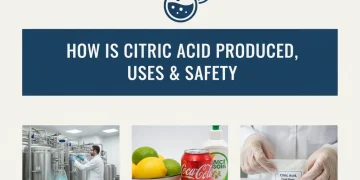







In addition to the natural acidic substance, citric acid is full of properties that facilitate preservation and is also good for adjusting the pH of the product. The versatility of citric acid such as food, drinks, medicine or cosmetic aids also makes it useful in everyday life in the home.
It is respected all over the world for its natural acidic taste, preservation of nature and as a means that humanists could use to modify pH. The demand is high every year. Although it is a mature product, the prospects of a citric acid market do not seem to be less optimistic.
In this article, NPCS will lead new entrepurs in this business “citric acid”.
What is citric acid
Citric acid is a weak organic acid contained in citrus fruit juices. Like lemons, lime and oranges. It contains three carboxyl groups and one hydroxyl group, which is useful for adjusting taste and pH, binding minerals and metals with their two opposite charges.
On the market, citric acid may be released in 1 of 2 main forms: anhydrous (no water) and monohydrate (one water molecule). It is sold in food class, pharmaceutical class and industrial class.
The key properties of citric acid
Appearance: white crystal powder or granules
Taste: sharp, acid, citrusic
Solubility: fast resolution in water
PH: Very acidic, ideal for lowering or stabilizing pH
Stability: Stable at a room temperature breaks at high heat
How is citric acid produced?
Almost all commercial citric acid is now produced from straight fruit, but fermentation.
- Raw materials: Sugar sources such as molasses and corn starch are a good place to start.
- Fermentation: In large fermentation tanks, mushrooms are added to the mix – mostly Aspergillus niger. They convert sugars into citric acid.
- Regeneration: After fermentation, the mixture is filtered to separate the fungal cells.
- Cleaning: Chemical treatments and other filtering are performed to remove dirt.
- Crystallization and drying: Purified solution is concentrated, crystallized, dried and then milled into its final form.

Using and applying citric acid
- Commodity and drink: acidic acid, can save food and keep it fresh, prevent desert fruit rot, stop induction of microorganisms.
- Medicinal to help: add candies, no Pilsen and chewing aspirin.
- Pharmaceuticals: It can be used in tablets and syrups, promotes the absorption of trace elements, plays a role in carbonation (fizzy tablets).
- Cosmetics and personal care: It is used to regulate the value of the product, prevent its loss of stability and providing a slight peeling effect.
- Cleaning products: Removes lime and soap base, can also soften water and increase green cleaning agents.
- Industry: It helps to control water quality, surface treatment of metal products, serves as a basis for biodegradable surface active substances and is widely used as a laboratory agent.
Quality, safety and control framework
Because citric acid is widely used in food and medicines, quality and security checks are particularly important.
This includes at all levels for the following grades: the food class must meet strict requirements such as cleanliness and low contamination; The pharmaceutical stage goes further in all respects and limits heavy metals, microbial levels and dirt.
When handling citric acid powder or strong solutions, protective clothing such as gloves and glasses is useful because it can irritate the skin or eyes. Save citric acid dry and closed; Do not allow to take moisture, otherwise the product will be damaged.
Regulatory agencies approve this as a food with Gras and each country sets limits for contaminants.
Read Our Project Report: Click Here
Perspectives of Environmental and Sustainability (Vision 2025)
Trends in the field: towards sustainability. Many manufacturers now use cost -effective materials such as molasses or agricultural by -products, to remove waste and expenditure. Each saves energy during evaporation and drying and companies use any waste heat that they can.
It is necessary to properly process waste products from fermentation; Untreated waste can be harmful to the environment. Forms of certification and labels, such as “environmentally friendly” and “clean label”, are more important in 2025 than ever before and meet the expectations of consumers and the requirements of the regulatory agency.
Read Our Book: Click Here
Market contexts (2025 and beyond)
Citric acid demand grows worldwide, measured in millions of tons. The main driving forces are food and drinks, health care, products for cleaning and pharmacies.
Technological advances include better microbial trunks, more efficient fermentation and new cleaning processes. The production base now moves east to Asia, especially China and India for reducing costs; And there are also stricter checks from regulatory bodies.
Nowadays it is not just about sustainability, the transparency of the supplier chain and ethical sources gain much more attention.
How can NPCs (or Counseling Services) help
Starting business with citric acid production requires significant preparation and planning; As a result, advice as NPCS (NIIR Project Consultancy Services) can be invaluable.
The NPCS cooperates with individuals and companies to provide comprehensive support services in the preparation of in -depth reports on projects describing the costs, equipment, space, staff and income to develop a comprehensive business plan adapted to your budget and market characteristics.
With the provision of extensive market survey, they will help you understand the level of demand, suppliers and competition. Their feasibility studies can also help you verify the location, size and financing of business.
Finally, they can help your business in navigation in government policies, obtaining the required amounts of subsidies or ensuring financial approval.
Their range of consultations is widely usable to start your business, allowing you to eliminate the risk, reduce errors and easier and profitably enter your business.
Find the Best Idea for Yourself With our Startup Selector Tool
Conclusion
Citric acid is everywhere, food and medicine, cleaning agents and cosmetics. In 2025, industrial procedures are changed to safe production, strict compliance and good environmental sustainability standards.
To be successful, they need the best inputs and microbes, they correctly control their process and store their product correctly; Of course, also tuned to new trends on the market or environmental impact. With this priority, citric acid production will continue to be effective, responsible and competitive.
FAQ (5 common questions)
Q1: Can citrus fruit be made on a large scale of citrus fruit?
It is not really, it is impractical to make fruits, because the costs are so high and the yield is low, rather now citric acid comes mainly from microbial fermentation.
Q2: How does food class differ from pharmaceutical degree?
The food class is designed for foods with requirements, while the pharmaceutical fair is strict clean and the standards of cleanliness, often monitors national pharmacopoeia.
Q3: Do the health risks of citric acid risk?
It is safe for most people at normal food level. However, concentrated forms can injure skin or eyes; Too much can damage tooth enamel; And sometimes some people have an unfavorable response to fermentation by -products.
Q4: What is the best way to store citric acid and how long will it maintain?
Keep it dry, sealed and cold – the document may take several years, but the solution deteriorates faster and moisture causes clustering.
Q5: What are the common problems that arise in industry and how can they be solved?
Problems include low yield, dirt or waste pollution; The solution is better tribes of microbe, improved processes and proper waste processing.


