



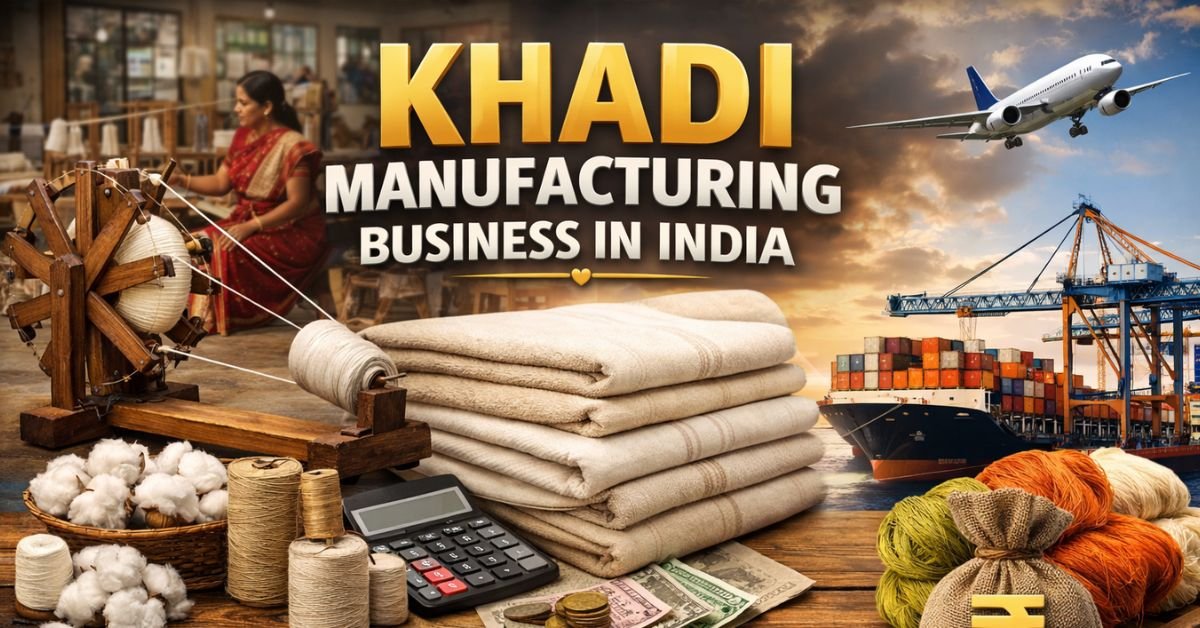
Introduction: Khadi Manufacturing Business India
Sustainability in Indian manufacturing is no longer an option. It affects export eligibility, investor confidence, institutional procurement and brand positioning. In this structural transformation, Khadi-based industries have evolved from small rural industries to an organised, scalable and policy-supported manufacturing ecosystem.
According to Khadi and Village Industries Commission (KVIC), the sector has exceeded the production value of over Rs 1.16 lakh crore and annual sales of over Rs 1.45 lakh crore. Over 49 lac artisans are engaged of which women constitute close to 80 percent of the workforce. These numbers prove that Khadi is at commercial scale-not at the margins.
For entrepreneurs looking for a sector which is oriented towards sustainability but can make financial sense, Khadi offers a rare combination of market demand, institutional support, and export potential.
Table of Contents
ToggleRead More: TEXTILE BLEACHING, DYEING, SPINNING, WEAVING, PRINTING, FINISHING AND TEXTILE AUXILIARIES PROJECTS
Why Sustainability Became a Business Advantage
Global buyers and domestic consumers, as well as policymakers, now judge businesses on environmental and ethical grounds. Sustainable manufacturing is a way to increase resilience and access to markets in the long term.
Khadi has an inherent edge in that:
- Production using minimal electricity
- Natural Fibers – these fibres reduce environmental impact
- Decentralized processes to support traceability
- Low carbon footprint to be in line with export standards
Unlike so many “green startups” these days, Khadi does not require high spending on carbon offsets for demonstration of sustainability. It is that credibility that the product itself carries.(Khadi Manufacturing Business India)
Scale of the Industry and Market Strength
Khadi’s ecosystem today comprises thousands of retail outlets, growing sales channels on digital platforms, as well as exports to more than 100 countries. The industry is structured in terms of distribution and policy support, which creates a stability that new manufacturing industries often lack.
Key indicators for the industry are:
- Steady year on year growth in sales
- Expanding institutional procurement
- Rapid penetration of the digital marketplace
- Increasing participation of organized private brands
This is a structured ecosystem that makes it less of a gamble for new entrepreneurs.(Khadi Manufacturing Business India)
Why The Entrepreneurs are Engaging in Khadi Manufacturing
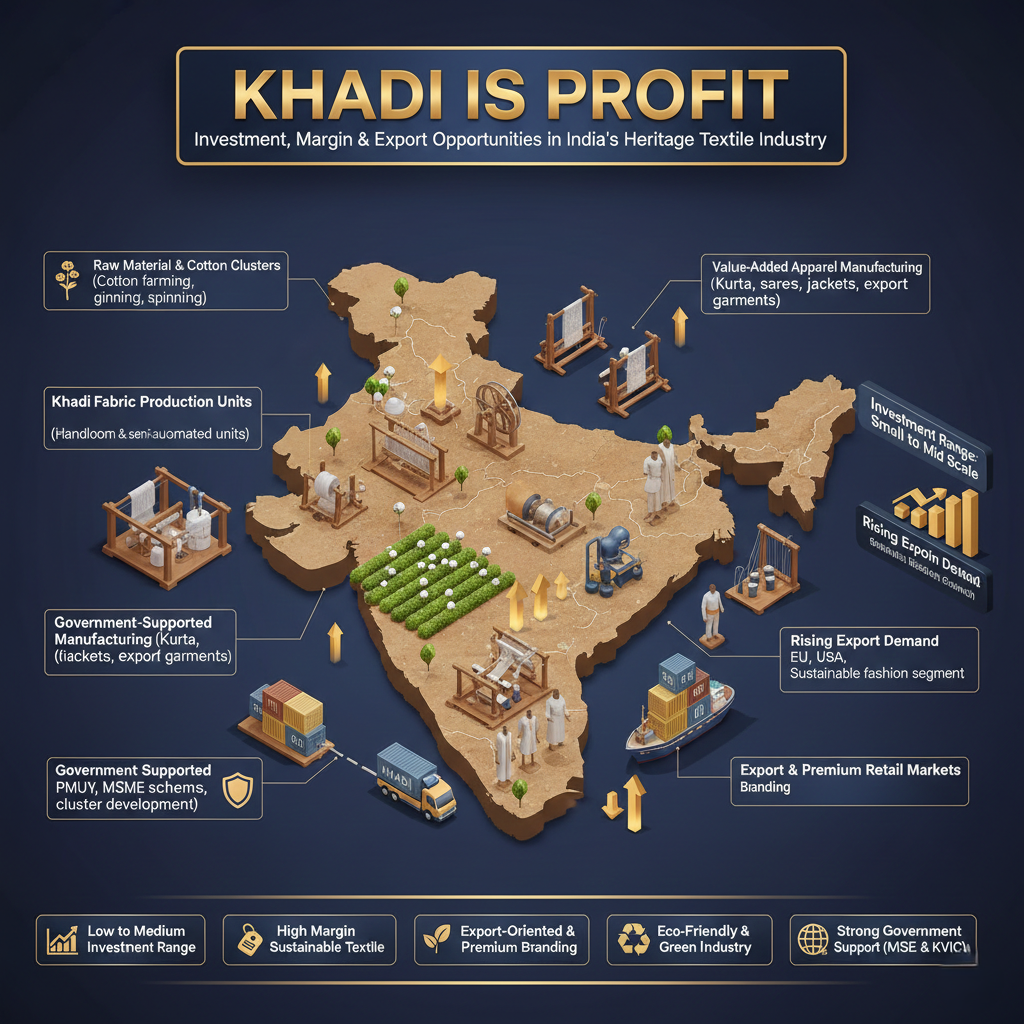
Khadi-based businesses provide an equation of risk and reward. Capital requirements are not too high when we compare it with heavy textile manufacturing and the units can scale gradually.
The sector offers:
- Modular setup options such as spinning, weaving, stitching and finishing
- Domestic sourcing of raw materials, with less risk of imports
- Various revenue channels such as retail, exports and e-commerce
- Policy and institutional ecosystem support
This flexibility enables first generation entrepreneurs to get access to the manufacturing industry without being exposed financially to the extreme.(Khadi Manufacturing Business India)
Export Potential: Where Margins are Improved
International textile markets are moving towards ethical sources and low carbon production. Khadi fits in these requirements perfectly. Export buyers are increasingly more interested in products that provide authenticity and traceability, rather than simply low prices.
Major export opportunities are available in:
- Sustainable apparel
- Eco-friendly home textiles
- Ethical fashion brands
- Lifestyle and décor products
Because of the value on which Khadi competes and not just on price, the margin is often more stable as compared to the commodity textiles.
High Potential Segments of Khadi Manufacturing
1. Sustainable Manufacturing of Apparel
Modern Khadi fashion has gone a long way from the traditional garments. With better design, finish and branding, it now has an appeal in urban and international markets.
Opportunities include:
- Institutional uniforms
- Designer and ethical fashion collection
- Export oriented garment units
- Private Label Manufacturing
Integrating design and branding is very beneficial to profitability.(Khadi Manufacturing Business India)
2. Khadi Home Furnishing Manufacturers
Hospitality and high-end residential segments are embracing the sustainable interior solutions. Khadi fabrics have texture, durability and an eco-friendly look.
High-demand product categories are:
- Curtains and drapes
- Cushion covers
- Upholstery fabric
- Table linen
These products often have better per-unit margins than usual apparel.
3. Natural Dyeing and Eco-Processing Units
As sustainable textiles increase, eco-compliant dyeing is of importance. Entrepreneurs can set up special processing facilities to cater to several Khadi manufacturers, developing a B2B service model with a saleable revenue.(Khadi Manufacturing Business India)
4. Khadi-Based Personal Care Product and Wellness Products
Khadi branded soaps, cosmetics and wellness products have a tremendous level of consumer confidence, and repeat purchase cycles.
Advantages of this segment:
- Increased working capital rotation
- Higher branding margins
- Increasing demand for herbal products
Risk Factors That Entrepreneurs Have To Plan For
No manufacturing industry is free of risk. In case of Khadi-based industries some of the major challenges are keeping the quality uniform among decentralized production networks and changing designs to suit the changing needs of consumers.
Other important considerations are:
- Working capital management
- Inventory planning
- Export documentation compliance
- Standardization of processes
Structured feasibility planning and financial modelling go a long way to minimizing these risks.(Khadi Manufacturing Business India)
Long-Term Demand Outlook
Khadi’s expansion is based on structural economic trends and not ephemeral fashion trends. Climate conscious consumption, policies on promoting MSMEs, export sustainability standards and women-led rural employment programs build the base of the sector.
With these long-term drivers, Khadi-based industries are a strategic manufacturing opportunity, and not a short-lived trend.(Khadi Manufacturing Business India)
Conclusion
Khadi-based industries are a strong convergence of sustainability, profitability and policy support. With moderate capital requirements, export potential and multi-channel demand, the sector provides entrepreneurs with a structured path into green manufacturing.
For those who are approaching it with professional planning and strategic execution, Khadi is not only a traditional fabric – it is the future-ready manufacturing opportunity for India.(Khadi Manufacturing Business India)
Frequently Asked Questions (FAQ)
Is Khadi manufacturing profitable 2026?
Yes. With growth in the domestic market and export market with the support of Khadi and Village Industries Commission, the units, if properly managed, can operate at a stable and sustainable margin.
How much investment is needed to get going?
Investment is dependent upon scale and level of integration. Modular setups enable one to slowly scale up which is good for first-time entrepreneurs.
Is Khadi export-oriented?
Yes. Sustainable textiles and eco-friendly products for a sustainable lifestyle have a great demand from the international markets, particularly from the premium markets.
What Are the Major Operational Risks?
Quality consistency, working capital management and design competitiveness are the main operational challenges.
Is long-term demand secure?
Yes. Sustainability, domestic manufacturing are structural changes in the economy and will therefore remain relevant.


