



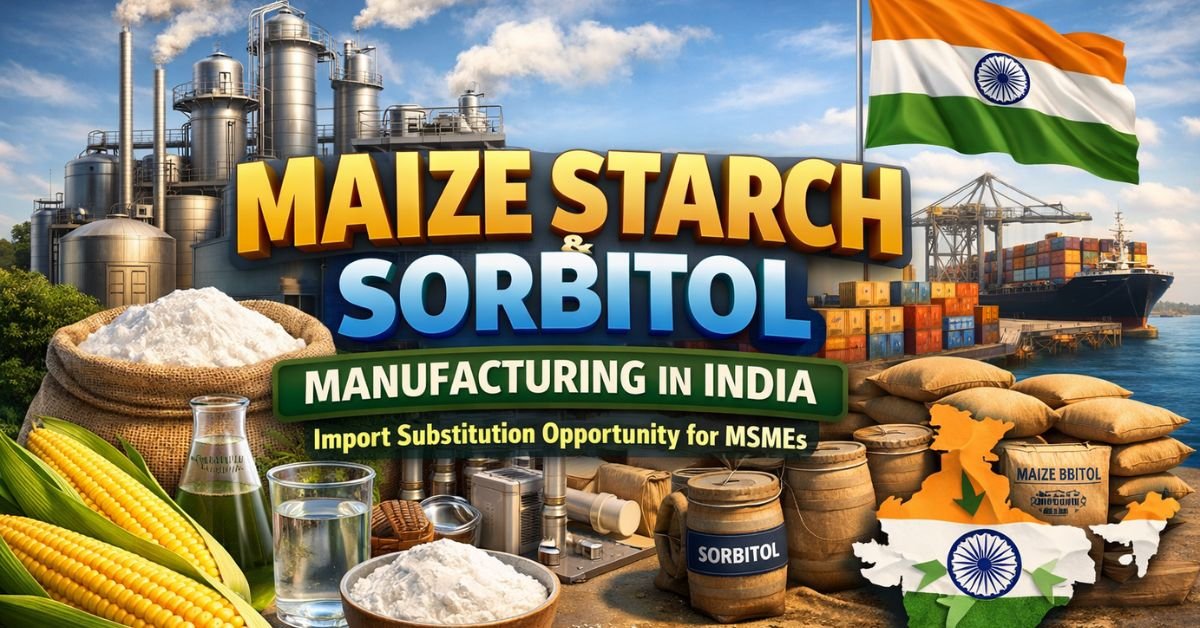
Maize Starch Manufacturing in India is viewed as a low margin commodity business. In reality it functions as a conversion-related industrial value chain where one input (agriculture, in this case maize) is turned into a number of industrial and consumer-facing products. Investors are not simply establishing a starch plant, they are constructing a platform capable of serving paper mills, packaging producers, textile processors, food companies, oral care brands and pharmaceutical formulators at the same time.
Because of this multi-product nature, the success of a starch-sorbitol project is less dependent on headline demand and more dependent on the intelligent structuring of the project. Product mix, procurement strategy, utilities, compliance readiness, and customer integration collectively determine whether or not the plant can withhold maize price volatility and demand cycles.
The macro environment in India is currently positive for such projects. The chemical and agro-processing industries are growing, and government policy is increasingly favourable to domestic processing, import substitution and value addition to agricultural production. For MSMEs, this alignment creates a better comfort in financing and a sustained existence in the long term.(Maize Starch Manufacturing in India)
Raw Material Strength and Location Economics
India’s base of maize production has increased considerably during the previous decade, making maize a reliable feedstock for industries, rather than a marginal crop. Production now exceeds 40 million tonnes per year and improvements in productivity support consistent availability.(Maize Starch Manufacturing in India)
Maize cultivation is geographically clustered, and this creates high location advantages for starch manufacturers. States like Madhya Pradesh, Karnataka and Bihar account for a large portion of the national output. Locating of a plant in or close to these belts aids in:
- Reducing raw material freight costs
- Enabling cluster procurement and storage
- Smoothening out seasonal price volatility
- Improving the quality consistency by closer engagement with farmers
For starch-based projects, location often is more important than scale.(Maize Starch Manufacturing in India)
Understanding the Actual Demand-Supply Gap
A misconception is that the Indian starch market is saturated in India – the country exports maize starch. Export data really tells a more complicated story.
India is self-reliant to a significant extent with native maize starch, which explains why it has minimal import of basic starch. However, things change when we are looking at modified starches and dextrin’s. Despite the availability of maize in abundance, India is still importing large volumes of such higher performance starch products every year.(Maize Starch Manufacturing in India)
These imports are continuing because modified starches are specification driven. End users in the paper, packaging, textiles, food, and pharmaceuticals industries need strict control over functional parameters. For MSMEs, this provides a very obvious opportunity, provided the plant is designed to customer-approved standards instead of generic output.
Some key application areas that fuel this demand are:
- Paper surface sizing and coating
- Corrugation and packaging adhesives
- Textile Sizing and Finishing
- Food texture and stabilisation systems
- Pharmaceutical excipients
This is where import substitution is commercially viable, not just attractive on paper.(Maize Starch Manufacturing in India)
Sorbitol: More Than Just Starch Value
Sorbitol is a strategic role when it comes to improving project economics. Produced by hydrogenation of glucose syrup, sorbitol has various end-use sectors and provides superior realisation as compared to base starch products.(Maize Starch Manufacturing in India)
India already exports sorbitol to several global markets proving manufacturing capability domestically. At the same time, selective imports persist, usually for higher purity or specialised grades or to make up for regional supply gaps. This combination represents an opportunity at grade level, and not market saturation.
Sorbitol demand in India is pegged to:
- Oral care products, such as toothpaste and mouthwash
- Pharmaceutical formulations and excipients
- Regulated applications of food and beverages
Further regulatory acceptance in the framework of food additives in India strengthens its market stability.(Maize Starch Manufacturing in India)
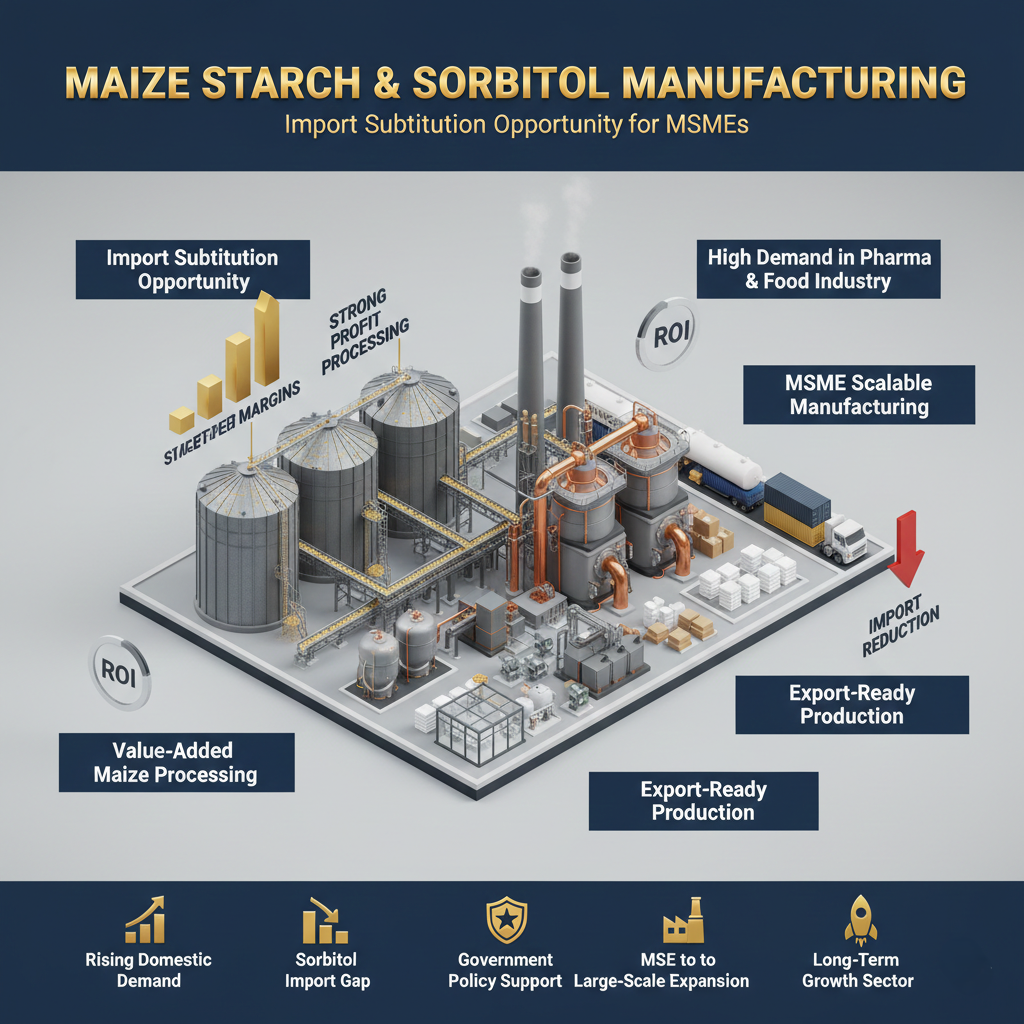
Techno-Economic Feasibility: How MSMEs Should Look at the Project
Maize starch-sorbitol plant should be considered a portfolio manufacturing unit, rather than a one-product factory. Wet milling produces a natural number of co-products in addition to starch that are economic stabilisers as long as any one of the markets weakens.(Maize Starch Manufacturing in India)
Project feasibility gets a significant boost if the plant is designed with product laddering from the very first day. Successful MSME projects are typically able to move across:
- Native maize starch for base load volumes
- Modified starches for import substitution and increased margins
- Sorbitol for diversification into: food, pharma and oral care
Utilities and effluent treatment are central. Starch and starch sugar processes are water intensive and high organic load effluent generating. Often the single biggest cause of disruption to an operation is under-designed effluent systems. Investing sufficient money in utilities and ETP is thus a risk mitigation strategy and not an avoidable cost.
Sorbitol production is another layer of complexity. The hydrogenation process entails high-pressure processes, hydrogen handling and catalyst management. While it is technically proven, it requires chemical-plant level safety discipline. MSME promoters need explicitly to account for this transition when considering risk and capital cost.(Maize Starch Manufacturing in India)
What Really Determines the Profitability of Projects
In actual usage, margins are determined by a small number of variables that are under the control of the user. Among the most critical are:
- Maize procurement stability throughout the seasons
- Conversion efficiency and energy management
- Ability to achieve and maintain customer grade approvals
- Stable offtake for co-products, e.g. germ and fibre
- Freight economics related to proximity to end users
Ignoring even one of these factors can compromise otherwise well-designed project.(Maize Starch Manufacturing in India)
Competitive Landscape and Positioning of MSMEs
India has considerable successful existing large integrated starch and sorbitol manufacturers. Their presence confirms the depth of the market but also sets the bar high in terms of entry. MSMEs should not try to compete with sheer volume or price.
Instead, the successful smaller players focus on:
- Import-substitution grades having specified specifications
- Customers on the regional market requiring faster deliveries
- Smaller batch sizes and customised formulations
- Closer technical interaction with end users
This positioning enables MSMEs to co-exist profitably with the large producers.(Maize Starch Manufacturing in India)
Conclusion: Why This Opportunity Still Makes Sense
The maize-based starch and sorbitol sector remains a strong MSME opportunity when approached with the right mindset. It’s not about recreating commodity capacity, but enabling specification-first, customer-anchored manufacturing platform.(Maize Starch Manufacturing in India)
The plant can process imported modified starch volumes after businesses secure their first major clients and design the facility according to those clients specific requirements. The business gains additional strength through sorbitol integration because it creates new market demand and enables export potential. The development of maize processing into a permanent industrial enterprise requires proper project structuring and utilities design and market connection development.(Maize Starch Manufacturing in India)
Frequently Asked Questions (FAQ)
Is maize starch manufacturing profitable for MSMEs in India?
Yes, particularly when the focus is on modified starches and application-specific grades rather than only native starch.
Can a small plant compete with large manufacturers?
Yes, by leveraging regional proximity, faster service, and customer-specific formulations.
Does adding sorbitol significantly improve project economics?
Sorbitol improves diversification and stability when designed with proper safety and quality systems.
How critical is plant location?
Location is one of the most decisive factors due to freight sensitivity and raw material logistics.
What is the most common mistake in starch projects?
Underestimating utilities, effluent treatment, and quality compliance.


