




Multi Layer Plastic Waste Business
The most difficult plastic waste stream to deal with is multi-layer plastic (MLP), which refers to flexible packaging that comes in multiple layers of differing polymers bonded together to provide the packaging barrier. Examples of MLP products include sachets, pouches, laminated films, chip packets, shampoo sachets and coffee pouches. About 3 million tonnes of MLP packaging waste is produced in India every year, mostly by FMCG product packaging for shampoo, detergent, food and beverage products. The multi-layer construction – polyester, aluminium foil, polyethylene and others – makes it impossible to recycle the material in a conventional mechanical way, because with the current technology, the layers cannot be separated economically.
The EPR rules have brought MLP into the limelight. MLP is required by law to fund the collection and recycling of those products on which it is used by brand owners, under EPR targets. Unfortunately, MLP cannot be mechanically recycled and should be sent to co-processing, energy recovery or chemical recycling. This provides a secure supply of MLP waste (from brand EPR obligations) for entrepreneurs who can provide technically sound end-of-life processing. The business model is not like the old plastic recycling because the income won’t be generated from the sale of their higher value recycled products, but rather from tipping fees and EPR certificates.
Get Detailed Project Report (DPR): Plastic Waste Recycling Business Project Report
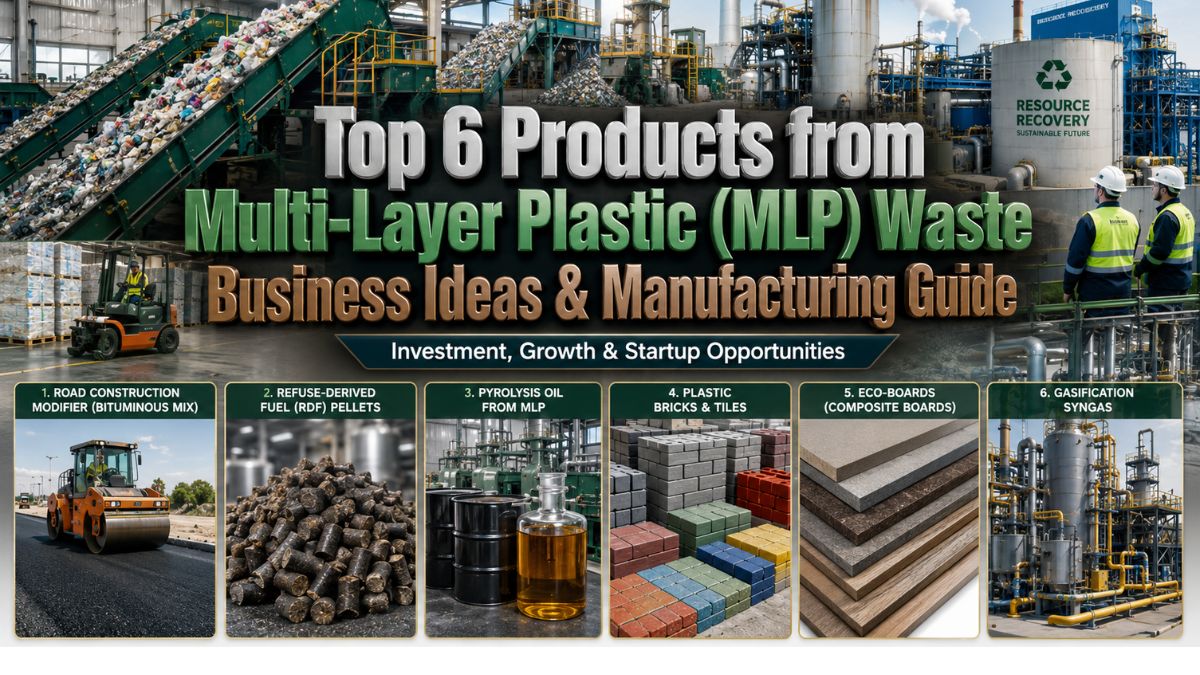
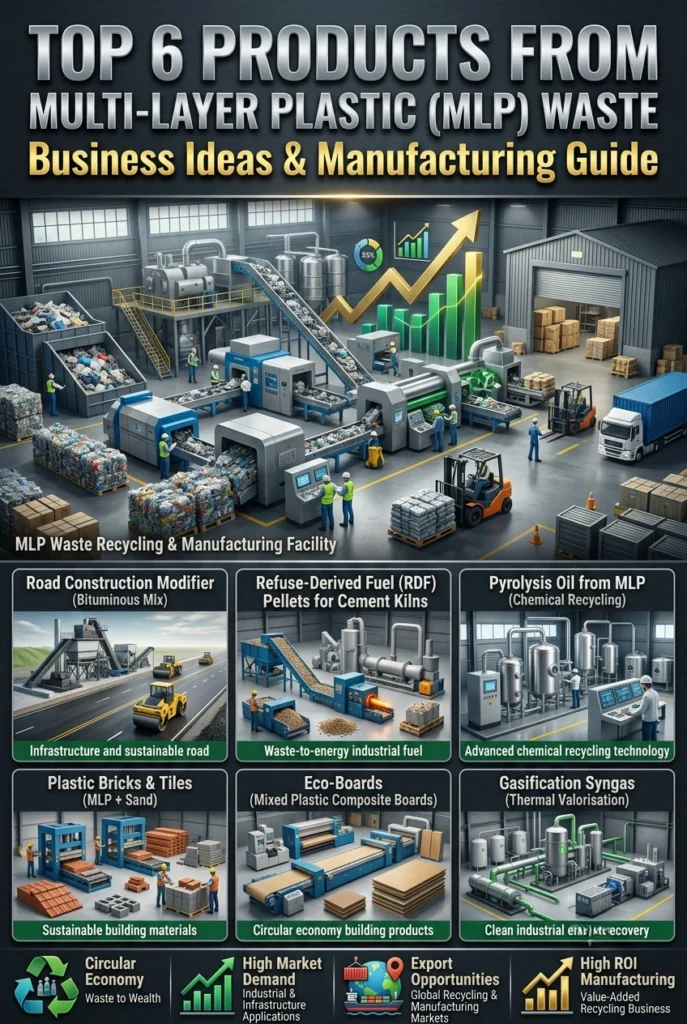
Top 6 Products and Applications from Multi-Layer Plastic Waste
1. Road Construction Modifier (Bituminous Mix)
MLP waste is dry blended into hot bituminous aggregate mix, adding 6–10% by weight of bitumen, to create MLP modified bituminous concrete. Use of plastic waste is allowed in the construction of roads as per the specification IRC: SP: 98:2013, issued by the MoRTH. Primary applications include municipal roads, rural PMGSY roads and construction site internal roads. This represents the most significant MLP disposal channel that has structured demand in the form of buyer requirements from Municipalities and PWD.
2. Refuse-Derived Fuel (RDF) Pellets for Cement Kilns
The shredded MLP waste is fed to the cement kiln pre calciner burners as a substitute of coal after processing it to RDF pellets with specific size (25–50 mm) and moisture (below 15%). Though the calorific value of MLP is higher as compared to coal, ranging from 8,000–12,000kcal per kg, the ash content is comparatively lower than that of coal, which is less than 5%. There are established and enlargement of buyers for MLP-RDF under SPCB authorization for co-processing of waste by cement companies. 2,000–5,000 per tonne.
3. Pyrolysis Oil from MLP (Chemical Recycling)
The products of MLP waste pyrolysis at operating temperatures of 350-500°C under oxygen free conditions are hydrocarbon rich pyrolysis oil (30-45%), carbon residue (20-30%) and combustible gas (20-25%). The calorific value of the MLP pyrolysis oil is 8,000-10,000 kcal/kg, and it is used as fuel for industrial furnace. Technically simple and increasingly recognised as a valid EPR compliance pathway by CPCB, the chemical recycling of MLP through pyrolysis.
4. Conversion to Plastic Bricks and Tiles (with Sand)
The MLP waste is melted and mixed with sand (60-70% sand, and 30-40% melted plastic) to produce the plastic-sand bricks or tiles under pressure. They have applications in non-load bearing paving, garden path lining and low traffic pedestrian applications. This model has been shown in small communities in several social enterprise countries such as Kenya, Colombia & India. However, investment is very low (Rs. The waste can be processed in a decentralised manner and is in the range of 5-20 lakh.
5. Eco-Boards (Mixed Plastic Composite Boards)
The composite boards made by the process of melting MLP and mixing the plastic waste along with glass fibre or jute fibre reinforcement are lighter than regular plastic boards and have greater flexural strength. Eco-boards are used to construct temporary site hoardings, packaging boards and furniture backing panels. Investment: Rs. 40–100 lakh.
Get Detailed Insights from This Book: Handbook on Biodegradable Plastics (Eco Friendly Plastics)
6. Gasification Syngas (Thermal Valorisation)
Another way to dispose of MLP waste is through the high temperature gasification (HTG) method. With temperatures above 800C the MLP is transformed into a gas (synthesis gas) which consists of CO + H and can then be used for burning (producing electricity or for chemical input). However, this process is technically challenging, but at the end the products (including only very little tar, as well as little traces of dioxins) will be very clean. The cost of small-scale gasification units (1-5 TPD) using MLP and mixed plastic waste is Rs. Be used to produce energy for industry, 1-3 crore.
Investment and Market Summary
| Revenue Stream | Investment (Rs.) | Revenue / Tonne MLP | Buyer / Model |
| Road Modifier | Rs. 20–50 lakh | Rs. 1,000–3,000/MT | Municipal Roads, PWD |
| RDF Pellets for Cement | Rs. 30–80 lakh | Rs. 2,000–5,000/MT | Cement Co-Processing |
| Pyrolysis Oil | Rs. 80 lakh–2 crore | Rs. 8,000–15,000/MT | Industrial Boiler Fuel |
| Plastic-Sand Bricks | Rs. 5–20 lakh | Rs. 5–15/brick | Paving, Community Projects |
| EPR Certificates | Registration cost only | Rs. 5,000–12,000/MT | FMCG Brand Owners |
EPR as the Primary Business Model for MLP Processing
The most crucial revenue source of an MLP processing business is not the product sold, but the EPR certificate produced. Brand owners that have opted for MLP packaging (Hindustan Unilever, P&G, ITC, Nestle and Britannia) are legally obliged to meet MLP collection and recycling goals. Co-processing and chemical recycling operators are the only ones that can help them meet their targets, as MLP cannot be mechanically recycled. The EPR certificates for MLP are worth Rs. The price of 8,000-20,000 per tonne are much higher than PET or HDPE certificates, due to limited supply.
The MLP co-processing operator, who is the building of volume collection with brand partnership, and registered on the CPCB unified portal as a valid EPR pathway, earns mostly through certificates and not through product value. This is a new business model, unlike traditional plastic recycling, and demands investment in regulatory relationships, rather than just investment in processing equipment.
Build a profitable business with the right idea
The MLP EPR Market: Understanding Brand Owner Needs
Brands targeting by MLP EPR in India have some of the biggest names in the FMCG sector like Hindustan Unilever (shampoo and detergent sachets), P&G (Ariel, Whisper pouches), Nestle (Maggi, KitKat foil), Britannia (biscuit wrappers), ITC (food packaging) and many other midsize consumer brands. MLP should be collected from each brand owner, otherwise, there will be penalty proceedings with the CPCB. They have appointed sustainability managers in these brand owners who are specifically looking for partnerships with certified MLP processing operators.
An MLP processor that can show CPCB registration, verified processing quantity documentation, and an audit trail from the collection to the final co-processing/pyrolysis process (clearly) gives the brand owner both EPR credit certification and a guard against the scrutiny of NGT.
Instead of investing in large processing capacity, anchor brand EPR partnerships can be established in building 3–5 to achieve revenue certainty for bank financing. The brand partnership agreement, which defines minimum quantities of MLPs to be processed annually and the price of EPR certificate, is essentially a pre-sales agreement that reduces the risk of processing investment.
Municipal MLP Collection Infrastructure and Business Partnerships
Several Indian municipal corporations — Pune, Bengaluru, Surat, and Coimbatore — have implemented ward-level dry waste collection centres where MLP and other plastics are segregated from household waste. Entrepreneurs who partner with municipal corporations as MLP processors receive guaranteed waste volumes through the municipal collection system, avoiding the cost of building independent collection infrastructure. The municipal partnership model offers processing fee income (Rs. 2,000–5,000 per tonne paid by ULBs for MLP disposal) in addition to EPR certificate revenue and product sale income.
Building the municipal partnership requires demonstrating CPCB processing authorisation, processing capacity documentation, and an operational plan that fits within the municipal collection logistics framework. Several cities have issued specific tenders for MLP co-processing partnerships — monitoring Central Pollution Control Board and respective state SPCBs for these tender opportunities is a key business development activity.
Related Article: How to Start a Plastic Waste Recycling Business: A Comprehensive Guide
How NPCS Helps Entrepreneurs Enter This Sector
At Niir Project Consultancy Services (NPCS), we provide professional consulting for Market Survey cum Detailed Techno-Economic Feasibility Reports (DPRs) for setting up multi-layer plastic and flexible packaging waste processing manufacturing businesses. Our reports cover the complete manufacturing process, market demand analysis, process flow diagrams, plant layout, machinery and raw material sourcing, and full financial projections with profitability analysis.
For entrepreneurs looking to enter waste-based manufacturing, NPCS project reports give you the technical and financial foundation to approach banks, investors, and government agencies with confidence. Visit www.niir.org to explore our full library of waste-based project reports.
Conclusion: The Business Case for Multi-Layer Plastic Waste Processing
Multi-layer plastic is simultaneously India’s most challenging plastic waste management problem and one of the most commercially interesting EPR business opportunities. The combination of tipping fee income, RDF and pyrolysis product revenue, and high-value EPR certificates creates a multi-stream revenue model that makes MLP processing more financially robust than many conventional manufacturing businesses. Entrepreneurs who build compliant, documented MLP processing operations with strong brand EPR partnerships are creating businesses at the intersection of environmental necessity and regulatory mandate.
Entrepreneurs who move early into waste-based manufacturing secure raw material relationships, buyer networks, and regulatory approvals that latecomers find difficult to replicate. The best time to act on these business ideas is before the sector becomes crowded — and for most waste streams profiled here, that window is still open.
Frequently Asked Questions (FAQ)
Q1. What makes MLP different from other plastics for recycling purposes?
MLP consists of 3–7 different polymer layers (PET/PE/AL/PP etc.) bonded together with adhesive layers. The layers cannot be separated economically, so MLP cannot be recycled into any single polymer type. It must be treated as a mixed material for energy recovery, co-processing, or chemical recycling.
Q2. Is pyrolysis of MLP environmentally acceptable?
MLP containing aluminium layers produces aluminium oxide in pyrolysis char, which must be managed. MLP without aluminium produces cleaner pyrolysis oil. The CPCB has approved pyrolysis as a valid EPR pathway for MLP. Plants must control emissions to CPCB-specified limits and cannot process PVC-containing MLP without specific dioxin/furan emission controls.
Q3. How do brand owners transfer MLP waste for EPR compliance?
Brand owners register on the CPCB EPR portal and issue EPR credits to registered plastic waste processors who demonstrate verified collection and processing. Processors submit quarterly reports with documentation of waste received, processed quantity, and disposal pathway. EPR credit transfer is electronic on the CPCB portal.
Q4. What is the minimum scale for an economically viable MLP processing business?
A cement co-processing supply business (RDF palletisation) can start at 1–2 TPD (Rs. 30–50 lakh) with 1–2 cement plant buyers. Pyrolysis requires minimum 3–5 TPD for viable economics. The EPR certificate revenue makes even small-scale operations economically viable if brand owner relationships are established.
Q5. Are there any chemical recycling technologies for MLP in India?
Pyrolysis is the most commercially deployed chemical recycling technology in India for MLP and mixed plastics. Solvolysis (acid or base hydrolysis) is effective for PET-containing MLP. Enzymatic depolymerisation is early-stage for PET. Catalytic hydrocracking is deployed at scale internationally but not yet in India for MLP.
Q6. What certifications help MLP processors attract brand EPR partnerships?
ISO 14001 EMS certification, CPCB registration as Plastic Waste Processor, BIS IS 16690 compliances for Plastic RDF and 3rd Party mass balance audits (as proof of processing reported quantities) form the set of credentials required by FMCG Brand Sustainability teams for signing their ERP Supply Agreements.


