


Plastic Business for Export India
Plastic fabrication and moulded products are usually the initial choice for manufacturing for new entrepreneurs. Machines are readily available in India, labour training is manageable and the universe of products is very large. Despite this, a limited number of plastic units manage to earn transition into export-oriented manufacturing businesses.
The reason is not technology. Export success in plastics depends on the selection of products, discipline of operations and strength of ecosystems. Units that opt for the wrong product category or ignore process consistency tend to be stuck in the price competition, while others develop long-term export relationships for relatively simple products.
India’s plastics opportunity is backed by the size of the chemical industry. As per the Ministry of Chemicals & Fertilizers, output of India’s chemical sector has crossed the mark of Rs 15 lakh crore with a growth rate of more than 11% per year. This growth fuels unceasing demand from packaging, agriculture, infrastructure, automotive, electrical, textile, and healthcare industries – industries that consume plastic components multiple times and increasingly require export grade compliance.
For the founders of startups, it is not if there is demand but for which plastic products can behave like repeat industrial consumables rather than low-margin commodities.(Plastic Business for Export India)
Table of Contents
ToggleRead More: Profitable Plastic Industries
Why Plastic Moulding and Fabrication is Suitable for Exports
Export buyers do not pay more for origin alone. They pay for reliability, consistency and performance. Plastic fabrication is ideal for exports because once the tooling and process parameters are resolved, the same requirements can be replicated over extended periods of time.
Three structural factors make plastics export-friendly if selected correctly:
- Standardization: Injection moulding and fabrication can provide strict control over dimensions and material properties
- Logistics efficiency: Most plastic products are light and easily packable in containers
- Performance differentiation: UV resistance, load capacity, food grade compliance, heat resistance: creates value beyond price
India has a good polymer availability which ensures that raw material supply is rarely a bottleneck. The true opportunity lies downstream in conversion and application specific products in which MSMEs can compete on a global scale.(Plastic Business for Export India)
Export-Opportunities in Plastic Manufacturing
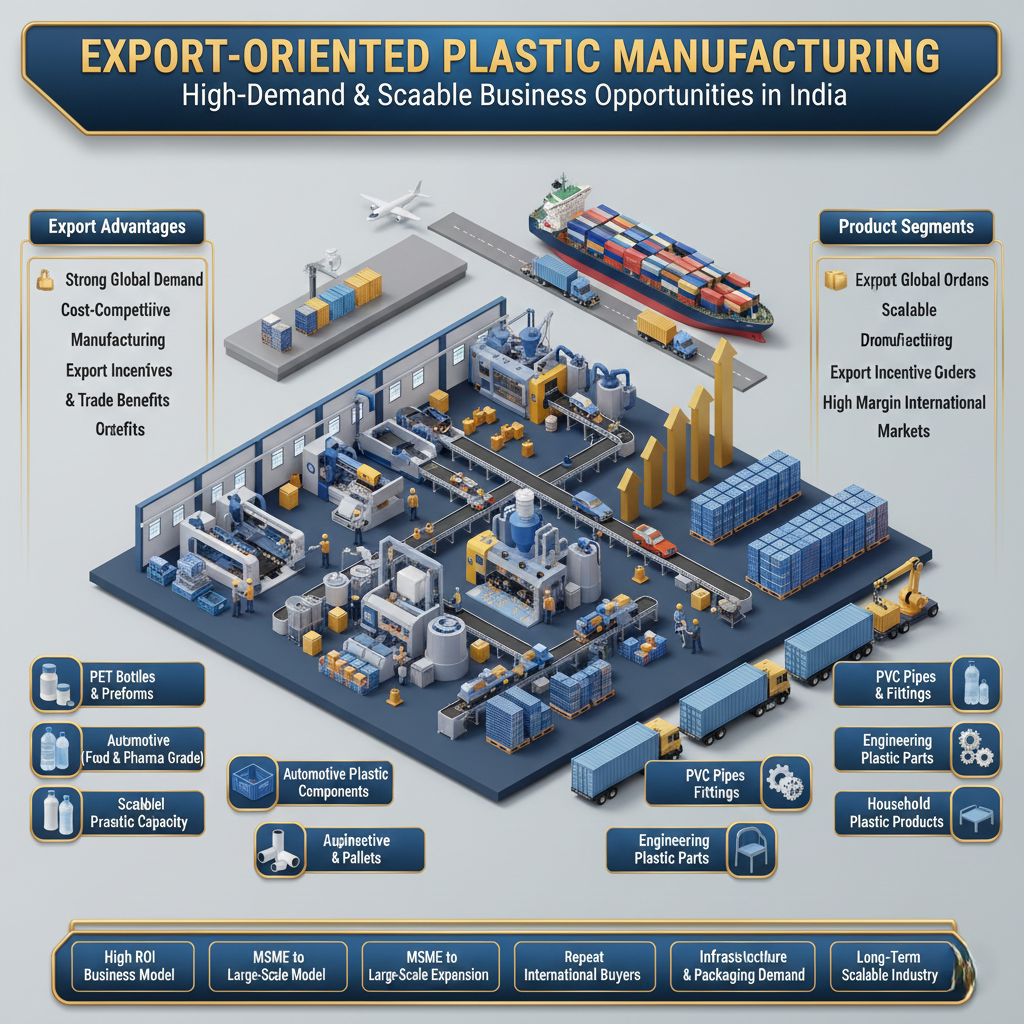
Industrial Plastic Pallets, Crates and Returnable Packaging
Industrial handling products are one of the most stable export categories. Warehouses, cold chains, FMCG plants, e-commerce fulfillment centres and others increasingly use standardized plastic pallets and crates.
What makes this segment export-friendly is compatibility. Once a design of the pallet fits a buyer’s racking system and material-handling equipment, supplier switching is not convenient.
Key success factors include:
- Load bearing performance and testing
- Weight consistency across batches
- Durable packaging for exports
Margins are made by the engineering discipline rather than the competition of resin price.(Plastic Business for Export India)
Injection-Moulded Technical Parts for Automobile and Appliances
Small plastic parts that include clips, housings, ducts, and brackets are extensively used in automotive and appliance assemblies that are exported all over the world. This segment is approval driven, as opposed to price driven.(Plastic Business for Export India)
Founders need to understand that:
- Orders are repeat based once a component is approved
- Documentation and traceability are non-negotiable
- Dimensional stability has more importance than low pricing
Export opportunities are often indirect in supplying domestic vendors whose export products are final products.(Plastic Business for Export India)
Irrigation Fittings and Agricultural Plastics.
Agriculture-linked plastic products are a combination of strong domestic market, and increasing export market relevance, particularly in areas where water is scarce. Drip irrigation fittings, connectors and micro-irrigation accessories are standardized to a greater extent.(Plastic Business for Export India)
In this part, reputation is made in the field. Product failure causes permanent loss of trust.
Manufacturers that are export-ready are focused on:
- UV stabilization for outdoor use
- Including: – Pressure and leakage testing
- Consistent wall thickness and quality of material
These factors cause the repeat orders on a long-term basis.(Plastic Business for Export India)
Food-Grade Plastic Packaging Components
Rigid plastic packaging components such as caps, closures, jars, tubs and dispensers have steady demand for export from food and FMCG manufacturers.
Buyers in this segment have the following priorities:
- Hygiene and compliance with food-contact
- Consistent torque and fit
- Low rejection rates and clean production
Profitability is more process-related and cycle-time-efficient and less dependent on raw material pricing.(Plastic Business for Export India)
Electrical Plastic Fittings and Parts of Insulation
Data showing the current state of electrical infrastructure development in the world generates consistent demand for plastic fitting around the world. Junction boxes, conduit accessories, cable management parts and protective housings are standardized to a large extent.
Export feasibility is better when:
- Materials offer heat and flame resistance
- UV stability is ensured for outdoor applications
- Product markings and specifications are standardized
These products have a great distance to travel and are repeat demand in construction driven markets.(Plastic Business for Export Indi)
Functioning Plastic Hardware Used in Furniture and Building Systems
Plastic hardware used in furniture and modular building systems is also normally functional, rather than decorative. Items such as clips, spacers, hinges and connectors are used in large amounts by OEM assemblers.
This category works best when you have startups:
- Specialize in a narrow range of products
- Reusing tooling across variants
- Consistently supply to assembly lines
Exports frequently take place in contract manufacturing relationships.(Plastic Business for Export India)
Recycled Plastic Granules and Products with Recycled Contents
Sustainability-driven procurement is creating export opportunities for recycled plastics. Buyers do not look for cheap recycled material, they look for predictable performance.
Successful startups in this segment focus on:
- Controlled sorting and removal of contamination
- Stable melt flow index (MFI)
- Consistent mechanical properties
Recycled-content pallets and crates are of particular interest to buyers around the world who are meeting sustainability targets.(Plastic Business for Export India)
Why Industrial Clusters and Plastic Parks are Important
Export manufacturing relies on dispatch reliability. Power stability, access to logistics, packaging vendors, and compliance support are strong influencing factors on the confidence of buyers. Industrial clusters and plastic parks minimize these types of invisible costs through shared infrastructure and ecosystem support.(Plastic Business for Export India)
For the MSMEs, conducting business in such clusters enhances efficiency of operations and increases the credibility of exports.
Lessons for Plastic Startup Founders
Indian industrial leaders offer good lessons for new manufacturers.
Mukesh Ambani shows the value in going downstream and not competing only on raw materials.
Kumar Mangalam Birla emphasizes disciplined material strategies with a sectoral scale.
Karsanbhai Patel proves that operating consistency is more important than scale.
Gautam Adani demonstrates the role of infrastructure and logistics in competitiveness.
The common lesson is clear: export readiness starts on the factory floor and not in marketing brochures.
How NPCS is Supporting Export Oriented Plastic Projects
Niir Project Consultancy Services (NPCS) prepares Market Survey cum Detailed Techno-Economic Feasibility Reports (DPRs) for plastic fabrication/molding projects. These reports include market demand, manufacturing process, machinery selection, raw materials, capacity planning, financial projections and long-term scalability. The goal is to take ideas generated for export and turn them into businesses ready to be executed.(Plastic Business for Export India)
Final Perspective
Plastic fabrication and moulded goods form the backbone of India’s downstream petrochemical ecosystem. Startups that select export-friendly product categories and implement strict process control and operate within industrial ecosystems which support their growth can achieve sustainable scaling without entering commodity price wars.(Plastic Business for Export India)
Frequently Asked Questions
Which plastic products are easiest to export for MSMEs?
Standardized industrial products such as pallets, crates, fittings, technical components, packaging closures, and electrical accessories.
What is the biggest mistake plastic startups make?
Competing only on price instead of controlling quality, consistency, and documentation.
How can a small plastic unit build export credibility?
By maintaining strict quality control, batch traceability, stable raw material sourcing, and professional packaging.
Do plastic parks really help exports?
Yes. They reduce operational friction, improve logistics reliability, and enhance buyer confidence.
How should a founder choose the right product mix?
Select products with tooling reuse, repeat demand, and differentiation through performance rather than appearance.


