


Introduction: Why Indian Railways Is a Goldmine for New Manufacturing Startups
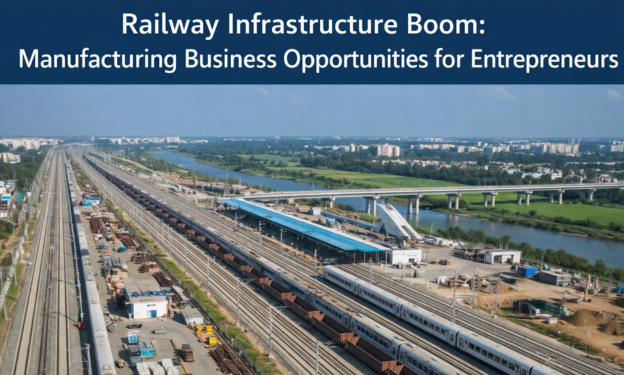
Railway infrastructure Boom: Indian Railways has ceased being a mere means of transport and has grown to be one of the biggest infrastructure-based industrial ecosystems in India. The rail industry is causing institutions to demand hundreds of industrial products and services which have a long term, institutional requirement as the tracks, stations, electrification, freight corridors, rolling stock, logistics terminals and safety systems are being invested in in large numbers.
This is an uncommon opportunity for startups and first-generation entrepreneurs: construct auxiliary manufacturing facilities and expand them alongside a government-sponsored mega customer.
Indian Railways Annual Report 202324, Government of India, the railways received more than 1,588 million tonnes of revenue-earning freight, capital investment of more than 7.4 lakh crore and applied massive works which included electrification, engineering, rolling stock, and freight infrastructure. These are not mere figures but an indication of long term industrial demand.
In this article, a feasibility-based framework for establishing, analysing, and deploying ancillary manufacturing sites in line with the railway infrastructure growth is provided in reference to the official governmental data and actual industrial reasoning.
Read This: Railway Logistics Business Opportunities in India
Why Ancillary Manufacturing Around Railways Makes Business Sense
It makes a number of structural benefits to open a manufacturing facility associated with railway infrastructure-
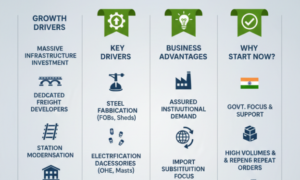
- Assured demand from a single large buyer ecosystem
- Low marketing risk compared to consumer industries
- Long project cycles ensuring stable orders
- Import substitution opportunities across engineering products
- Export potential through EXIM container movement
- Bankability, as railway-linked projects are preferred by lenders
Railway projects need standardized and quality-controlled components that should be supplied constantly, which is why they are the best place to have MSMEs involved.
Snapshot of Railway Infrastructure Expansion (2023–24)
Among the major Infrastructure Indicators (annual report of Indian Railways 2023-24) one can distinguish the following.
| Segment | 2023–24 Performance |
| Capital Investment | ₹7.47 lakh crore |
| New Railway Lines Constructed | 2,806 km |
| Track Renewals | 5,950 km |
| Route Electrification | 4,644 km |
| Freight Loaded | 1,588 million tonnes |
| Freight Earnings | ₹1,65,880 crore |
| Passenger Earnings | ₹70,693 crore
|
Wholesome Rolling Stock (leased and owned)
Over 12,700 locos & 2.1 lakh wagons
High-Potential Other Manufacturing opportunities (Feasibility-Focused).
The following are manufacturing opportunities with railways connected, which can be explained point to point and in detail, and which are compatible with startups and MSMEs.
Read this book: Investment Opportunities In Infrastructure Projects
Railway infrastructure Steel Fabrication Division.
What to Manufacture
- Foot over bridges (FOBs)
- Station sheds & platform roofing
- Cable tray, handrails, crash barriers.
- Maintenance gantries and structural frames.
Why This Industry Is Growing
The Amrit Bharat Station Scheme saw Indian Railways carry out 5,950km of track renewals and massive redevelopment of stations. The fabricated steel that goes into each project is in thousands of tonnes.
Feasibility Advantage
- Technology is well-developed and open to the MSME.
- Domestically available Raw material (steel) is available.
- Localisation is high which decreases imports.
Business Logic
The fabrication units close to the railroad areas have reduced the costs of logistics and quicker approvals. The standardised designs and batch production are better in terms of margins.
Railway Electrification Components Manufacturing
Products in Demand
- Brackets and overhead equipment (OHE) masts.
- Insulators, clamps, cantilevers.
- Earthing rod and traction equipment.
Sector Data
It was estimated that in 2023-24, Indian Railways electrified 4,644 km of routes, one of the largest years of global electrification.
Read Our Project Report: Click Here
Why Start This Business
- Electrification is irreversible and nationwide
- High repeat demand
- Scope for import substitution in fittings and assemblies
Export Angle
Similar traction hardware is exported to South Asia, Africa, and Middle East railway projects using India as a manufacturing base.
Railway Signalling, Safety & Track Accessories
Products
- Cable ducts, junction boxes
- Track fasteners and elastic clips
- Fibreglass relay cabinets
- LED railway signal housings
Growth Driver
Safety improvements reduced accidents to 0.03 per million train km, achieved through technology upgrades.
Feasibility Strength
- Compact manufacturing footprint
- Strong standardization
- High value-to-weight ratio (logistics friendly)
Freight Wagon & Container Ancillary Components
Market Context
Indian Railways moved 84.76 million tonnes of container traffic, including 63.78 million tonnes of EXIM containers.
Products to Manufacture
- Wagon brake components
- Rubber and polymer parts
- Container locking devices
- Wear plates and liners
Import-Export Opportunity
India still imports several precision wagon components. MSMEs can localise these and also export to private freight operators.
Railway Station Infrastructure & Passenger Amenity Products
Demand Areas
- Stainless steel benches
- Platform railings
- Drinking water units
- Modular toilets
- LED lighting fixtures
Government Push
Over 1,334 stations identified for redevelopment under the Amrit Bharat Station Scheme.
Why Ideal for Startups
- Low technical complexity
- High order volumes
- Repeat procurement cycles
Role of Import–Export Trends in Business Planning
Railway freight data shows strong movement in:
- Iron ore (including export traffic)
- Cement
- Fertilizers
- Containerized goods
This indicates rising industrial throughput, supporting:
- Packaging units
- Pallet manufacturing
- Industrial bags
- Rail-linked warehousing equipment
Startups can align manufacturing with logistics and EXIM demand, not just rail consumption.
Learning from Indian MSME Business Leaders (Business Models)
Rather than large conglomerates, new entrepreneurs should observe MSME-scaled success models:
- Balkrishna Industries (early phase) – Component specialisation
- KEI Industries – Infrastructure-led wire & cable growth
- Skipper Ltd. – Fabrication & EPC synergy
- Havells (initial decades) – Government & institutional supply focus
The common theme: standardised products + infrastructure demand + scale discipline.
Read Our Book: Click Here
Why Entrepreneurs Should Start Now
- Railway capex is multi-year and sustained
- The government prefers domestic sourcing
- MSME participation is actively encouraged
- Rail projects improve creditworthiness
- Import substitution creates pricing power
Timing matters. Entry during expansion phases allows startups to grow with the system, not chase it later.
How NPCS Supports Railway-Linked Manufacturing Projects
In the middle of this opportunity landscape, professional feasibility planning becomes critical.
We at Niir Project Consultancy Services (NPCS) provide professional consulting for the preparation of Market Survey cum Detailed Techno-Economic Feasibility Reports (DPRs) for setting up new industries or businesses.
Our reports include:
- Detailed manufacturing process
- Market research and demand analysis
- Process flow diagrams
- Product mix and capacity planning
- Machinery and raw material details
- Full project financials and profitability analysis
We will help entrepreneurs to assess the feasibility, profitability and scalability of industrial projects, particularly those associated with infrastructure and government demand.
FAQ
Q1. Are railway ancillary units only for large companies?
No. Most components are sourced from MSMEs, especially fabrication, electrical, polymer, and mechanical items.
Q2. Is the railway business profitable for startups?
Yes, due to volume stability, repeat orders, and institutional pricing, profitability improves with scale and compliance.
Q3. What is the minimum investment range?
Depending on the product, ₹1.5 crore to ₹10 crore is sufficient for many ancillary units.
Q4. Can these products be exported?
Yes. EXIM container movement shows strong export potential for standardised railway components.
Q5. Do banks support such projects?
Railway-linked manufacturing is considered low-risk, making it attractive for term loans


