





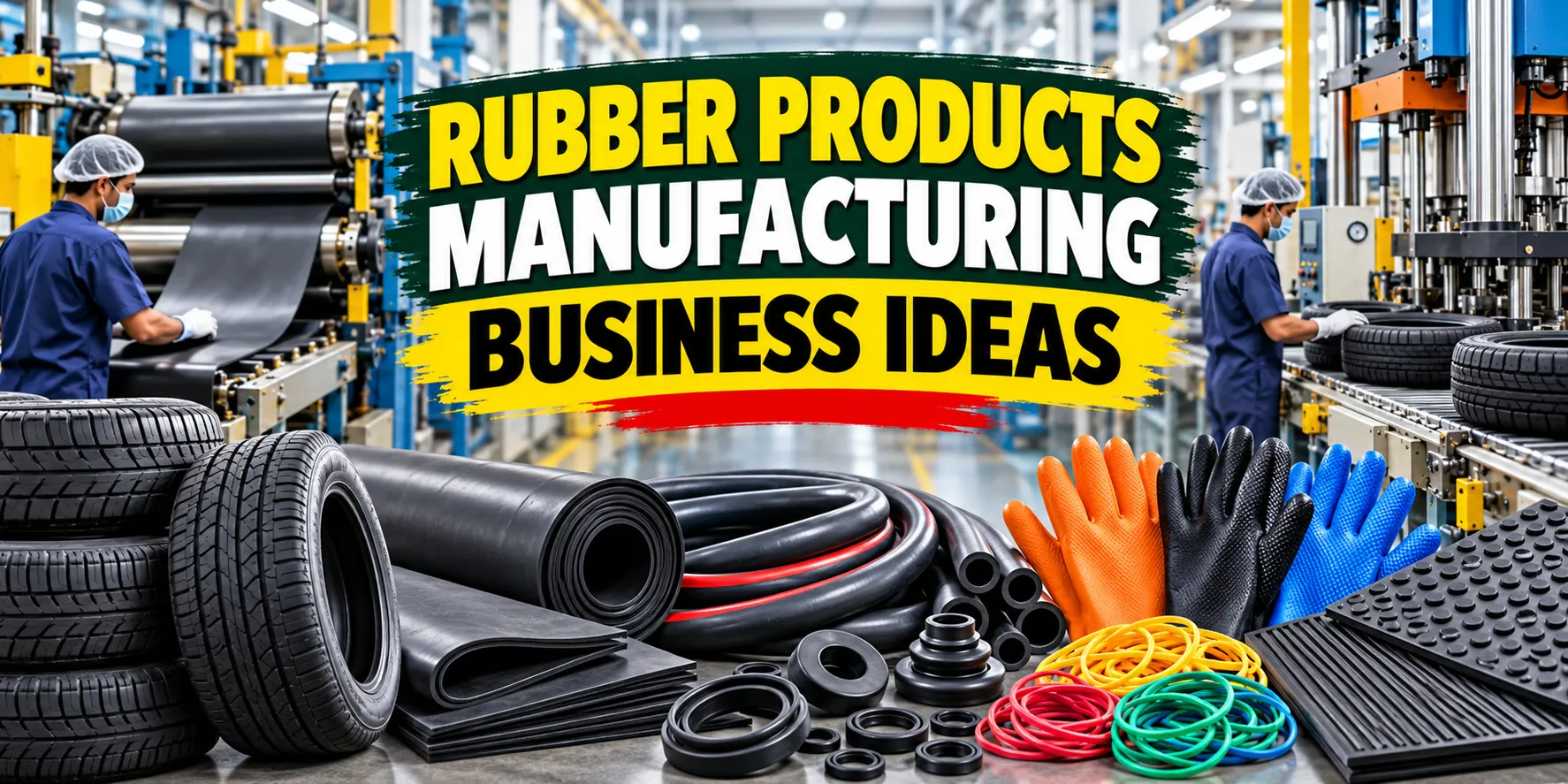
Rubber Products Manufacturing business Ideas are gaining strong potential in India as the fitness industry expands, industrial safety standards improve, and demand for reliable defense infrastructure continues to grow. A single manufacturing unit based on vulcanizing rubber compounds can produce a wide range of products, including ballistic rubber tiles for military and security applications, durable gym flooring tiles for fitness centers, and rubber mats for homes, commercial spaces, and automobiles. This production flexibility allows entrepreneurs to serve multiple customer segments using the same core manufacturing process, reducing dependence on any one market and creating opportunities for a more diversified and scalable rubber products business.
Why Rubber Products Manufacturing Is a Smart Business Idea Right Now
Fitness centers, gyms, and home workout areas have grown a lot lately. They all need rubber flooring that can absorb impact to protect their equipment and floors. At the same time, defense, paramilitary, and important infrastructure sites need rubber flooring and blocks that can resist bullets and blasts for safety. This is a smaller market but makes more profit. If you add in the demand for rubber mats from the general industrial and automotive sectors, a manufacturer can really diversify their customer base. They can sell to consumers, institutions, and even defense-related buyers, all while using pretty much the same technology for mixing rubber compounds and molding products.
Government Policies & Incentives
Manufacturers of rubber products can get technical help and support for quality improvement from the Rubber Board of India. The Board also helps processors find sources for raw rubber. Small and medium-sized rubber manufacturing businesses can get loans without collateral and help with cluster development from the Ministry of MSME. For products used in defense, like ballistic flooring, there are procurement opportunities thanks to the Make in India initiative, which promotes domestic suppliers over foreign ones. Training centers linked to the Rubber Board provide short courses on compounding and quality testing. This is a practical and affordable way for new manufacturers to build their technical skills instead of relying solely on hiring from the job market.
6 Rubber Products Manufacturing business Ideas for Startups
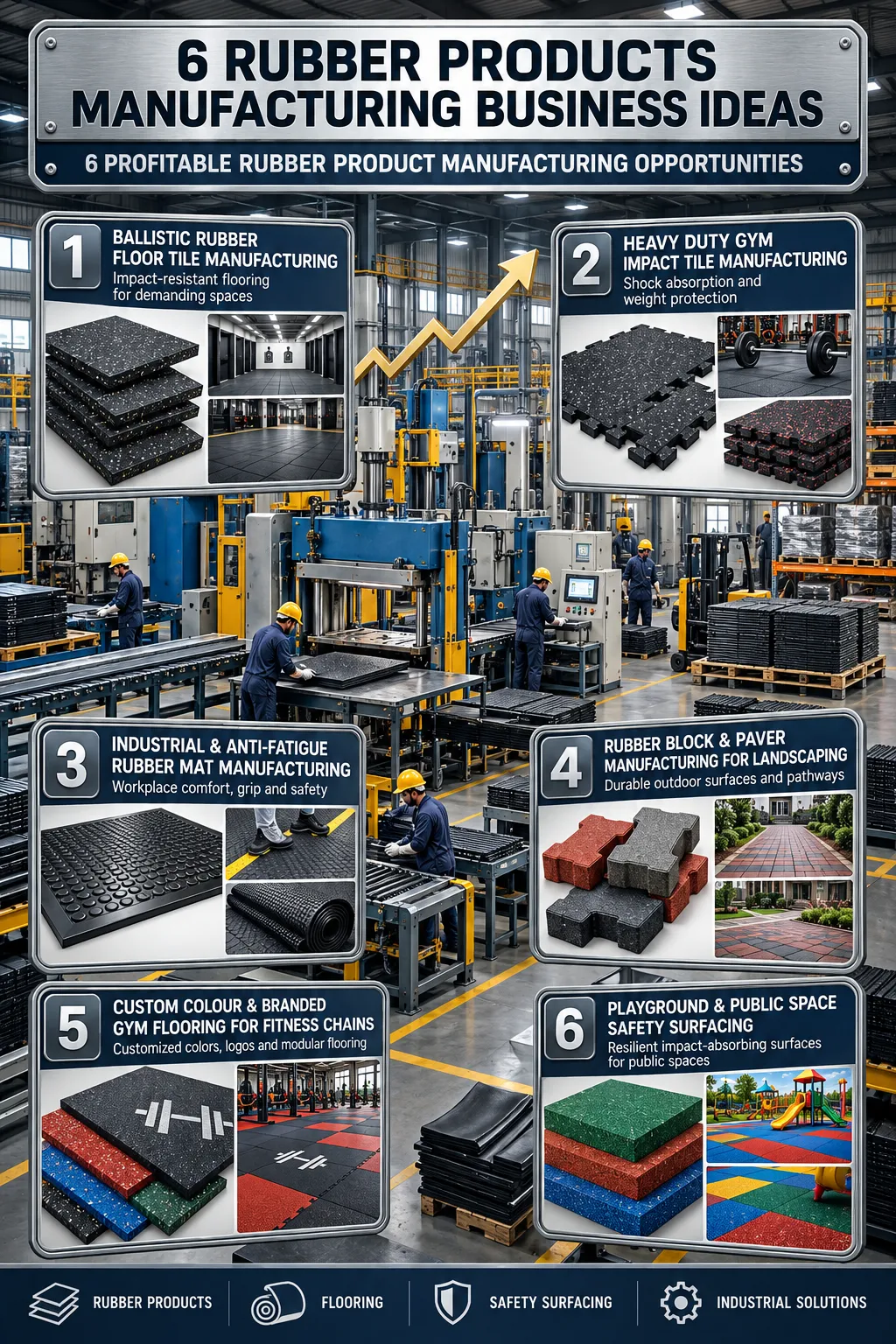
Ballistic Rubber Floor Tile Manufacturing
Specialized rubber flooring built to withstand blasts and last a long time is used at military bases, security checkpoints, and important infrastructure sites. This product brings in the most profit in its category. However, it needs strict testing of its materials and often requires approval from vendors that work with the defense industry. This means it’s a good next step for a company that has already proven itself with regular rubber products.
Heavy Duty Gym Impact Tile Manufacturing
Gyms are popping up everywhere, in big cities and smaller towns too. This means there’s a steady need for flooring that can handle a lot of impact. This kind of flooring saves gym equipment from getting damaged and also protects the concrete underneath. If a flooring company can make sure its products are always the same thickness and offer custom colours, they can work directly with gym equipment sellers and big gym chains. This would lead to regular, large orders.
Industrial & Anti-Fatigue Rubber Mat Manufacturing
Factories, workshops and commercial kitchens require anti-fatigue anti-slip rubber matting for their workers’ safety and comfort – an ongoing institutionally driven demand stream that is isolated from consumer trends. They also provide part of the OSHA-like safety compliance that most larger manufacturing companies now require on their shop floors.
Rubber Block & Paver Manufacturing for Landscaping
Recycled and virgin rubber blocks and pavers are a growing element in landscaping, playground safety surfacing and pedestrian pathway applications, which provides a niche for manufacturers to include reclaimed rubber content and with an advantage of enhancing raw material cost economics and positioning for sustainability.
Custom Colour & Branded Gym Flooring for Fitness Chains
More gym chains are demanding proprietary colours and gym flooring with their own logo printed in the floor than ever before, instead of mass produced, black rubber tiles. A manufacturer able to provide custom colour matching and logo inlay can charge a profitable premium for gym flooring and develop long-term relationships with gym chains opening multiple gyms per year.
Playground & Public Space Safety Surfacing
Rubber safety surfacing for playgrounds, parks and public pedestrian spaces is a rapidly growing category for municipalities and private developers that has the same core compounding platform as gym flooring and allows a manufacturer to venture into public infrastructure projects without much additional commitment.
Import–Export Opportunity Analysis
While rubber is grown domestically in Kerala and the Northeast, rubber is also imported in the event of a shortfall in domestic supplies, which is closely monitored by the Rubber Board of India, and would be processed in local factories. Rubber flooring, with a special focus on industrial and gym mats, is an increasingly sought-after export product, with Middle East and African markets already showing interest in India’s capability to produce quality, low-cost rubber flooring. This was facilitated by the Indian industry chamber, the Confederation of Indian Industry.
Market Outlook & Scaling Roadmap
The demands of India’s fitness industry, push for greater industrial safety compliance, and defence infrastructure modernisation will each support considerable growth in the coming years for rubber flooring and matting products. So businesses that spread the risk by selling across all three demand segments will develop more stable order pipelines than competitors reliant on just one segment.
Skills, Manpower & Quality Control
Rubber compounding and moulding require technicians who understand how temperature, pressure, and cure time interact, since even minor deviations affect product durability significantly. A small unit typically employs 20 to 25 workers, with a compounding supervisor experienced in rubber formulation being the most critical technical role, particularly when the product range spans multiple applications from gym tiles to ballistic flooring with different performance requirements.
Indian MSME Success Stories
Balkrishna Industries — Arvind Poddar
Arvind Poddar built Balkrishna Industries into a globally competitive rubber and tyre manufacturer by focusing on niche, off-highway tyre segments rather than competing head-on in the crowded passenger tyre market, a lesson directly relevant to rubber flooring manufacturers considering ballistic or specialised niches over commodity mats.
MRF Limited — K.M. Mammen Mappillai
K.M. Mammen Mappillai’s founding of MRF from a modest balloon-manufacturing operation into India’s largest rubber and tyre company illustrates how disciplined process improvement in rubber compounding, sustained over decades, can transform a small manufacturing venture into a major industrial enterprise.
How NPCS Can Help Entrepreneurs Evaluate the Opportunity
We at Niir Project Consultancy Services (NPCS) provide professional consulting for the preparation of Market Survey cum Detailed Techno-Economic Feasibility Reports (DPRs) for setting up new industries or businesses. Our reports include detailed manufacturing processes, market research and demand analysis, process flow diagrams, product mix and capacity planning, machinery and raw material details, and complete project financials with profitability analysis. Entrepreneurs use these reports to evaluate feasibility, profitability, and long-term scalability before investing, which reduces guesswork at the most capital-intensive stage of a new venture.
For anyone evaluating Rubber Products Manufacturing, that groundwork matters most before any capital is committed: NPCS studies work through machinery selection, raw material sourcing, plant layout, manpower planning, and a full financial model covering capital cost, working capital, revenue projections, and return on investment. Entrepreneurs approaching banks, NBFCs, or state MSME schemes for financing typically need exactly this kind of documented feasibility study, since lenders rarely fund a project on an idea alone. Working with an established consultancy also shortens the learning curve considerably, letting a first-time promoter benefit from patterns NPCS has already observed across hundreds of similar manufacturing projects.
NPCS has published a comprehensive printed reference book on Rubber Products Manufacturing, covering technology, market analysis, investment parameters, and manufacturing processes in depth — the printed book: Handbook on Rubber
For a detailed techno-economic Project Report on setting up a manufacturing business in this sector — including plant economics, machinery lists, financial projections, and applicable government incentives — the NPCS Project Report: Rubber Floor Mats – Manufacturing Plant, Detailed Project Report.
Data Table
Indicative Cost & Capacity for a Rubber Products Manufacturing Unit
| Parameter | Small Unit | Mid-Size Unit |
|---|---|---|
| Approximate project cost | ₹2–2.5 crore | ₹8–10 crore |
| Production capacity | 500–800 sq metres/day | 2,500–3,000 sq metres/day |
| Core manpower | 20–25 | 70–90 |
| Key certification | IS standards for rubber flooring, gym mat testing | IS standards, ballistic/blast-resistance testing where applicable |
| Typical payback period | 3–4 years | 4–5 years |
Note: Figures above are indicative planning estimates for feasibility discussion and vary by location, scale, and machinery configuration.
Common Pitfalls to Avoid
A common mistake is spreading product development too thin across gym, industrial, and defence-linked applications before mastering consistent compounding quality in any single line. Another frequent pitfall is underestimating certification timelines for specialised products like ballistic flooring, which can take considerably longer than standard commercial mats.
Conclusion
Rubber products manufacturing rewards founders who diversify across consumer, industrial, and specialised institutional applications rather than depending on a single product line. Coordinating with rubber-processing states such as Kerala Department of Industries can help secure reliable raw rubber sourcing and technical support from the outset.
Your Investment Deserves the Right Opportunity
Every serious investment begins with choosing the right sector and the right business model. With hundreds of industrial opportunities available across India’s manufacturing and clean-energy landscape, making the most informed choice is critical. NIIR’s Startup Selector tool helps entrepreneurs, MSMEs, and investors identify the most suitable business opportunities based on their investment capacity, location, and interests — so your capital is directed toward a venture with the strongest fit and potential.


