





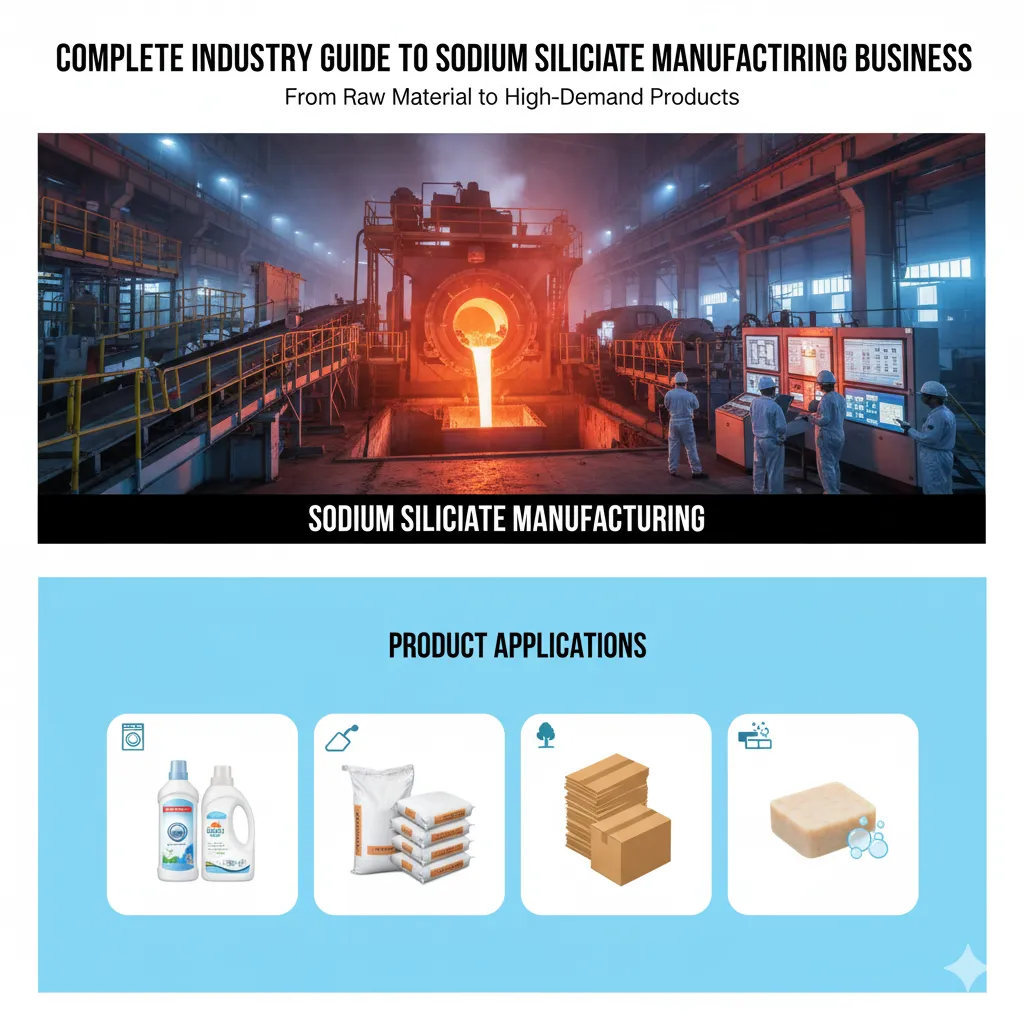
Sodium silicate, also known as water glass or liquid glass, is a kind of chemical substance. It is used in such a wide variety of applications and industries as detergents, water treatment, construction materials for bridges and other forms of infrastructure work.
In 2025, Sodium Silicate presents an excellent business opportunity for those with industrial ambitions. The export potential is growing and as China becomes more competitive, domestic demand will remain steady.
This article discusses how to make money in this industry, where raw materials are to be found, what the market trends are, and even government help for beginners.
Reasons to Start the Sodium Silicate Industry
Investment in the sodium silicate industry is finding strong support:
Large industrial demand: its clients come from washing powder, wood glue, cement making, paper pulping and drinking water treatment.
Wide range of applications: Its ‘versatility’ has led to criticism that some applications are peripheral yet it is critical in many fields really shows how adapt the chemical can be changed according to requirements.
Export Opportunities: Those developing countries where construction and industrial activity continue to increase bring high quality sodium silicate with open arms.
Conservative Industrial Development: The expansion of industrial capacity in developing countries will increase demand for bulk chemicals.
Low Pollution: Compared with other chemicals, the production of Sodium Silicate has less potential for harm and is easier to manage on an environmental basis
These are factors behind a steady and profitable industrial sector that is likely to grow long-term.
Read More: How to Start Manufacturing Business of Sodium Silicate?
Availability of Raw Material and Other Factors
For making silicate of soda expensive and readily available raw materials are required.
- Sodium Carbonate (Soda Ash): Chief source of sodium.
- Silica Sand (Silicon Dioxide): Highpurity sand is most abundant in many places.
- Water: Essential in getting raw materials to dissolve and controlling the process.
Other inputs include fuel for heating (coal, natural gas, or oil), small amounts of chemicals. These materials are in good supply and are therefore constantly at-the-ready worldwide to be put into production.
Why Select This Industry for a Startup
Sodium silicate industry for start-ups has the following advantages:
- A constant, stable market: it is used in laundry supplies, paper, and fabrics. Demand for all three industries is predictable to some extent.
- Scalable: A factory can start out with modest capacity and expand by increments.
- It can be exported: In places like the Middle East, Africa and Southeast Asia, high quality Sodium Silicate.
- Simple technology: The process is simple, old production methods still in use.
- Products with a long shelf life: This lowers the pressure of inventory turnover and makes storage and transport more convenient.

Market demand coupled with future forecast
With the global industrial expansion, the Sodium Silicate market has grown steadily for five consecutive years.
Market Size: It was estimated at USD 3.2 billion in 2024 and is expected to reach USD 5.1 billion by 2030, with annual average growth rates (AGRs) ranging from 6 to 7% (marketwatch.com)
Key Drivers: Construction activity rising, detergent industry growth papers expansion and industrial automation increasing.
Regional Trends: Asia-Pacific is the largest consumer, followed by North America and Europe. However, emerging in commodity markets in Africa and Latin America may be doing very well indeed in growing import demand there.
Future Outlook: In developing countries, demand is expected to nearly double by 2030 on account of infrastructure projects and industrial expansion.
This forecast shows that new entrants will benefit from the prospects of a robust upswing in business with sustained profitability.
Read Our Project Report: Click Here
Manufacturing Process
Sodium Silicate may be prepared by fusing method or by precipitation method. Here is a detailed account of the process.
Fusion Process (Most Common)
Raw Material Mixing: Materials including silica sand and sodium carbonate are mixed in prescribed proportions.
Fusion: The mixture is placed into a furnace that operates at 1100 – 1300°C and becomes molten.
Quenching: Molten sodium silicate is rapidly cooled by water to achieve a watery solution.
Filtration: Insoluble impurities are removed using various kinds of filters or settling tanks.
Concentration Adjusting: Water is removed so that the desired SiO2:Na2O ratio results (the industry standard is 2-3:1)..,
Quality Analysis: Mixture is checked for viscosity, density, alkalinity and amount of silicic acid
Precipitation Process (Powder Type of Production)
Reaction: There is a reaction between sodium hydroxide solution and sillica slurry.
Filtration & Washing: Insoluable residues are removed.
Packing: The product is packed in bags or drums ready for sale.
Quality Testing: In order to give a good yield of sodium silicate, the SiO2:Na2O must be appropriately balanced, the mixture also must be clear and alkaline, free from impurities.
Government Support (In Brief)
In many different for s, the governments re:sponsd to the encouragment of production of chemicals and other industries by:
Subsidies and Tax Rebatements: For the construction of chemical processing industries and sponsered for the enhancing of machinery and technology.
Export Promotion Schemes: For assistance of chemicals sold to overseas customers.
Infrastructural Support: The construction of industries and assistance to the region of logistics.
Sanitary Aid: The losing of the standards for the treatment of effluents and the protective chemicals.
This form of support enables start up businesses to come into the market with diminished chances and higher chances of growth.
Read Our Book: Click Here
How NPCS (or Consultancy Services) Can Help
Launching a Sodium Silicate business requires significant preparation and planning; as a result, consultancies like NPCS (Niir Project Consultancy Services) can be invaluable.
NPCS works with individuals and companies to provide comprehensive support services from preparing in-depth project reports that describe costs, equipment, space, personnel, and revenue to developing a comprehensive business plan tailored to your budget and market characteristics.
With extensive market research provided, we help you understand the level of demand, suppliers, and competition. Further, our feasibility studies can assist you in validating the location, size, and funding of the business.
Find the Best Idea for Yourself With our Startup Selector Tool
Conclusion
By 2025, the Sodium Silicate sector will be one of high demand, and great versatility and profit, thus becoming an excellent opportunity for entrepreneurs.
Since the raw materials available are abundant, the industry is scalable with steady demand for domestic and export. This, plus government support, means abundant opportunity.
New businesses, by focusing on quality and efficient processes, as well as on sustainable market expansion, can easily build a successful venture while serving diverse industrial needs globally.
FAQs
What are the key uses of Sodium Silicate?
Detergents, adhesives, water paper, textiles, construction, and water treatment.
Are liquid and powder forms of Sodium Silicate available?
Yes. Generally, fusion creates a liquid solution, whereas fusion creates powder or granular forms.
What are the raw materials used for its production?
For Sodium Silicate production, Silica Sand, sodium carbonate, water, and heating energy are required.
Can this industry be accessed by small, new businesses?
Yes, particularly for specialized or regional areas, the available technology and funds needed are not as high as other industries.
What are the methods of keeping the product’s quality?
Quality is maintained by controlling SiO₂:Na₂O ratios, impurities, viscosity, alkalinity, and industrial testing.


