






Introduction: Textile Manufacturing Business
The textile industry is among the most powerful economic pillars in India, with an approximate value of 2.3 percent of the GDP, and over 45 million individuals are employed. It is no longer a traditional industry, but has evolved into a contemporary, export-oriented, and MSME-oriented manufacturing environment.
The diversity of this industry is what is particularly appealing to new entrepreneurs. It is possible to begin business with low capital in FMCG textile products or develop a large-scale exporting unit in the garments, technical textile, or recycled fibre.
The entry has now been easy with the government facilitating through schemes such as PM MITRA Parks, PLI incentives, CGTMSE loans, and MSME registration. The most constant and expansive business in India in 2026 is textile manufacturing.
Read the Complete Book Here: Modern Technology of Textile Dyes & Pigments (3rd Edition)
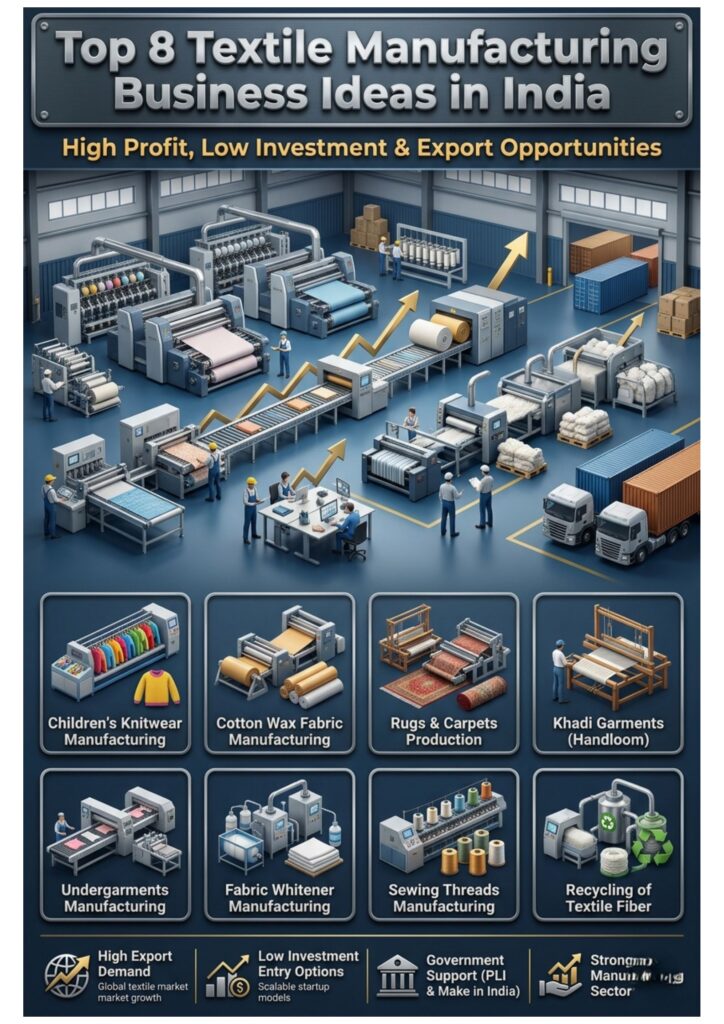
1. Children’s Knitwear Manufacturing
One of the steadiest demand-driven sectors in the textile industry is the clothing of children. This is a very stable business since kids readily outgrow their clothes, and repeat purchases are common and predictable.
Some of the common products are T-shirts, shorts, school uniforms, and innerwear.
Key advantages:
- Consistent year-round demand
- Good export capabilities in India.
- Easy manufacturing process of MSMEs.
- Small unit to brand scalability.
A small unit can begin with a moderate investment and eventually grow into branded retail or export-manufacturing. The profit margins are also healthy owing to the constant demand and bulk order provision.
2. Cotton Wax Fabric Manufacturing
Cotton wax fabric is a small, yet rapidly expanding product in fashion, outdoor gear and industrial applications. It is made through applying a coating of wax-based products on cotton fabric to render it waterproof and durable.
This market is yet to be established in India and provides new business persons with a good market entry point.
Key applications:
- Outdoor jackets and bags.
- Waterproof covers and tent.
- Fashion accessories and industrial textile.
Why this business is attractive:
- Weak competition in India.
- High export demand
- Strong profit margins
- Expanding outdoor lifestyle market.
Find high-return business ideas based on your budget & ROI
Get Detailed Insights from This Book: Just For Starters: How To Start Your Own Export Business
3. Rugs and Carpets Production.
Carpet manufacturing is a world known industry in India, particularly in areas such as Bhadohi, Jaipur, and Panipat. The industry caters to both handmade and machine-made markets, but machine tufted carpets are easier to invest in by new investors of MSMEs.
The demand is as a result of real estate development, interior decoration trend and international export.
Key growth drivers:
- Increasing demand in resorts and real estate.
- Good export markets (USA, Europe)
- E-commerce development in home decor.
This is an industry in which a business person can grow fast as long as the production quality and design uniformity is ensured.
4. Khadi Garments Handloom.
Khadi has developed as a high-quality fashion product in India. Nowadays it is utilized in contemporary lines, corporate gifting and export markets because of its eco-friendly and crafted image.
Rather than the conventional production, business people now emphasize on value added Khadi clothes such as shirts, kurtas, jackets, and fusion clothes.
Why Khadi business works:
- Strong government support
- Eco-friendly product demand
- Premium pricing opportunity
- Growing export market
Khadi would particularly fit well with businessmen who are aiming at sustainable and lifestyle fashion segments.
5. Undergarments Manufacturing
One of the most resistant to recession and textile business is innerwear manufacturing. As it is a necessity, the demand will be constant and will not be affected by income levels.
Main product categories:
- Shorts and vests of men.
- Women’s bras and panties
- Children’s innerwear
Key advantages:
- Continuous daily-use demand
- Both urban and rural market growth.
- Stop using unbranded to branded products.
- Great scalability by distribution networks.
This segment is good at building the brand, particularly in the Tier 2 and Tier 3 cities.
Related Article: Textile Manufacturing Business Ideas in India – High Profit MSME Opportunities with Low Investment
6. Fabric Whitener Manufacturing
Fabric whitener is a FMCG product that is fast-moving used to make fabrics of white color look brighter. It is commonly utilized in homes, hotels, and laundry.
It is among the least investment related textile businesses that have consistent demand.
Key benefits:
- Low startup cost
- High repeat consumption
- Good rural and semi-urban demand.
- Easy distribution model
Since it is a consumable product, a robust distributor network can enable entrepreneurs to generate recurring monthly revenue.
7. Sewing Threads Manufacturing
Sewing thread is a necessary material in all garments and textile products. No textile manufacturing ecosystem would be able to operate without thread, and this is an incredibly stable industrial business.
Key advantages:
- Good B2B demand by garment factories.
- Long-term customer relationships
- Low buyer switching after quality has been approved.
- Export opportunities in developing countries
This is a business that is more concerned with consistency and reliability of supply chain rather than branding or marketing.
8. Recycling of Textile Fibre.
One of the booming future industries in India is recycled textile fibre. It is the transformation of textile waste and PET bottles into useful fibre to be used in garments and industry.
This is a high-demand sector as global brands are moving towards sustainable materials.
Key drivers:
- Increasing sustainability demands in the world.
- High supply of textile wastes in India.
- Circular economy push by the government.
- The European and Asian export opportunities.
Why it is a business of the future:
- Strong 14–18% CAGR growth
- Providing more regulatory backing (EPR policies)
- Existing high export value of certified recycled goods.
Access Complete Business Plan: Textile Processing and Auxiliaries Projects
Role of NPCS (NIIR Project Consultancy Services)
To start an enterprise involved in textile manufacturing, one needs to plan, understand the technical aspects, and structure his/her finances. In absence of this, even the good ideas may fail at execution.
It is under this that NPCS (NIIR Project Consultancy Services) comes in. NPCS is a company based in Delhi that offers project reports and feasibility studies on different manufacturing ventures.
NPCS services include:
- Detailed Project Reports (DPRs).
- Market research and feasibility analysis.
- Machinery selection guidance
- Plant layout planning
- Profitability analysis and estimation of cost.
Entrepreneurs, MSMEs, and banks commonly use these reports to measure the feasibility of business prior to investments.
NPCS serves to guide the creation of a manufacturing business with lower risks and higher accuracy of planning.
Conclusion: Is Textile Manufacturing a Good Business in India?
One of the best MSME business opportunities in India is textile manufacturing. It has numerous entry points – low-investment FMCG products such as fabric whitener through high-growth segments such as recycled fibre and export garments.
The strength of this industry is that it is a combination of:
- Constant domestic demand
- Strong export opportunities
- Government support
- Scalable MSME structure
Textile production can be a sustainable long-term, stable and very profitable enterprise in the expanding industrial economy of India, when properly planned.
FAQs
Q1. What is the best business to start in textile?
Knitwear, fabric whitener and sewing thread manufacturing of children are best to start with because they require less investment and demand is steady.
Q2. What will be the amount of investment needed?
Depending on the scale and product, investment is between 15 lakh and 1.5 crore.
Q3. Is it lucrative to manufacture textiles in India?
Yes, it is very profitable since domestic consumption and export demand is high.
Q4. Is it possible to have a bank loan to textile business?
Yes, CGTMSE and other government schemes MSME loans assist in textile production.
Q5. What is NPCS?
NPCS (NIIR Project Consultancy Services) is a company that offers project reports, feasibility studies, and consultancy services to manufacturing companies in India.


