





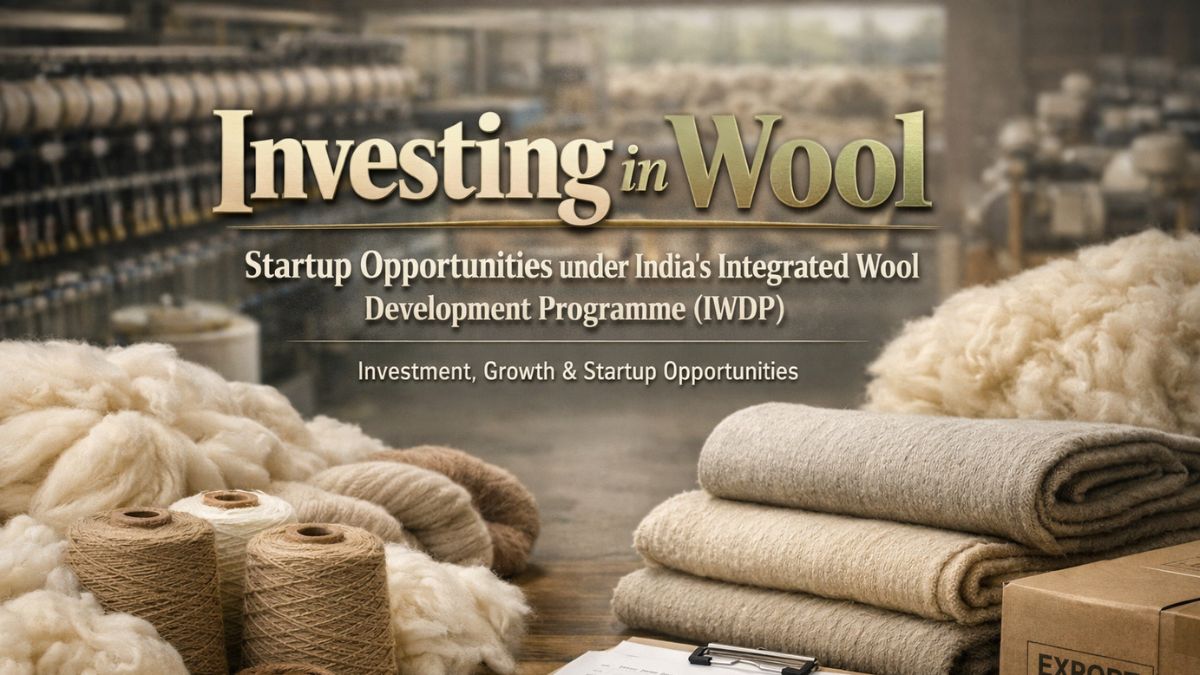
Introduction: Wool business startup India IWDP
India is experiencing a tremendous change in the wool industry. It is traditionally regarded as a rural livelihood activity, but it is currently being transformed into a highly organized investment-based industry with good start-up and export opportunities. In the high-altitude areas of Ladakh with premium pashmina wool production, to the carpet clusters in Rajasthan that are world renowned, wool has remained a critical factor in sustaining rural economies and making a contribution to the volumes of textiles exported by India.
The sector has been struggling with structural issues including lack of supply chain cohesion, low machineries, reliance on middlemen, and massive imports of wool of fineness quality despite its potential. These problems have hampered the capacity of India to exploit its raw material base and the demand of wool products in the world.
To deal with these issues the Government of India has initiated the Integrated Wool Development Programme (IWDP) through the Ministry of Textiles. This project is set to modernize the whole wool value chain, boost the earnings of farmers and create new opportunities as an entrepreneur and start-up.
Table of Contents
ToggleGet Detailed Insights from This Book: The Complete Technology Book on Textile Processing with Effluent Treatment
What is the Integrated Wool Development Programme (IWDP)?
The Integrated Wool Development Programme is a government project that aims at empowering and modernizing the wool ecosystem in India, including the production and marketing. The program aims at enhancing productivity, quality and better distribution of income across the value chain.
IWDP works in a multi-dimensional framework that encompasses infrastructure development, skill improvement, systematized procurement and branding support. It assures the producers of wool no longer have to rely on middlemen and it also allows them to enjoy fair market prices provided by transparent systems.
Key Components of IWDP
- Structured buying of wool straight to farmers and shepherds.
- Creation of Common Facility Centres (CFCs) to process and grade.
- Worker and artisan training and skill development programs.
- Branding programs: Wool mark and Pashmina certification.
- Financial aid in form of subsidies, revolving funds and government support schemes.
These measures are slowly converting wool into a well-organized investment friendly industry in India.
India’s Wool Industry: Current Scenario and Market Gap
India is a major producer of coarse wool which is mainly utilized in carpets, blankets as well as low cost textiles. Nevertheless, the nation continues to receive a huge amount of fine wool, to be used in high-end clothing and luxury fashion items.
This gives a significant disconnection between the domestic production and market demand. Although India has good availability of raw materials in some of its areas, value addition is still at its early stages. This leads to a significant amount of revenue being lost to imports and incomplete exports.
Meanwhile, the growth in global markets of Indian handmade carpet industry has been stable, which means that Indian craftsmanship is in high demand at the international level. In the same manner, the products such as pashminas shawls are highly positioned across the globe.
The greatest potential is value addition, i.e., converting raw wool into yarn, fabrics, garments, and luxury items and exporting them rather than sending it in their raw form.
Access Complete Business Plan: Wool Yarn Manufacturing Plant Report
Why Wool is a Promising Startup Sector in India
Various economic and policy-related factors are making wool industry more and more appealing to businessmen.
1. Strong Government Support
IWDP offers financial subsidies, infrastructure, and training programs, which alleviate the start-up risks of investing.
2. Import Substitution Opportunity
The quantity of wool products that India imports is big. This generates a high local demand which can be met by local startups.
3. Increasing Global Sustainable Product Demand.
Wool is a natural, biodegradable and renewable fiber. As the world becomes more concerned with the issue of sustainability, the wool products are becoming popular in the global market.
4. Export Potential
The Indian wool products like carpets, shawls and textiles have a high export demand particularly in Europe, Middle East and North America.
5. Scalability
Wool industry enables companies to begin small and expand to large manufacturing or export companies.
Profitable Wool-Based Startup Opportunities
It has a broad spectrum of business opportunities in the wool industry based on investment capability and knowledge.
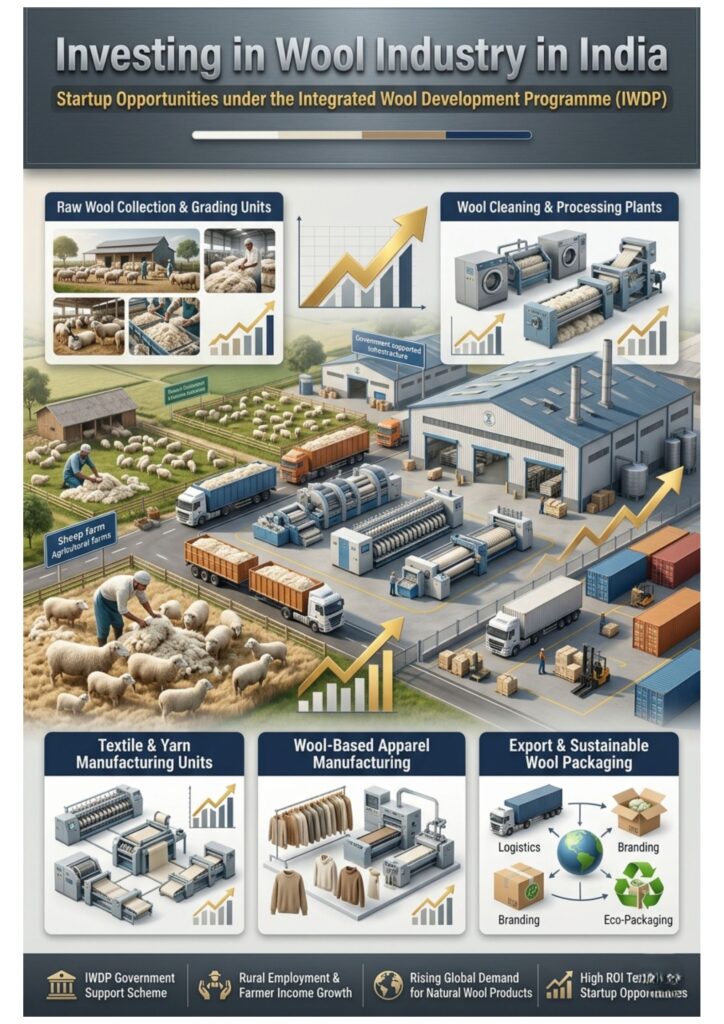
1. Wool Collection and Aggregation Centers
Businessmen will be able to establish wool purchasing stations where raw wool is picked by farmers. These facilities guarantee appropriate grading, cleaning and provision to processing facilities. This model not only enhances income of farmers but also quality supply of raw materials.
2. Wool Processing Units
Raw wool is processed into useful forms like yarn and fiber in the processing units. The entrepreneur is able to cut down on the costs of machinery and share infrastructure with the government-assisted Common Facility Centres.
3. Wool Yarn and Fabric Production.
It is a medium/large-scale opportunity that entails processing of the processed wool into fine yarns and fabrics that are utilized in garments and home textiles. There is high domestic and export demand in this segment.
4. Handmade Carpet Manufacturing
Already, India is a world leader in handmade carpets. Through design innovation and branding, startups are able to open premium international markets that have a high profit margin.
5. Pashmina and Luxury Wool Products.
Pashmina shawls and luxury wool clothes provide very high margins when coupled with certification, branding authenticity and high-end positioning.
Role of Government Schemes in Business Growth
The role of government support on the viability of wool-based start ups is important. IWDP lowers the entry barriers through the subsidies in the form of machinery, support in working capital, and development of infrastructural facilities.
The program also focuses on development of skills, where workers are trained to be equipped in the latest techniques like fiber processing, quality control and design innovation. This assists in enhancing the productivity and quality of products in the industry.
This kind of organized assistance enables the businesspeople to concentrate more on production, branding and market expansion than the problems of operation.
Challenges in the Wool Industry
Although the industry has a good potential, there are some challenges:
- Variating prices of raw materials.
- Heavy dependence on wool imports
- Close international competition with other nations such as China, Turkey and Iran.
- Low knowledge of contemporary means of processing.
But these problems can be dealt with successfully by:
- Diversification of product portfolio
- Branding and certification investment.
- Long-term supplier agreements
- Pay attention to value-added products rather than trading in raw wool.
Lessons from India’s Textile Industry Leaders
The successful experience of major Indian textile firms shows that the key to success in the long run is innovation, implementing technology, and brand development.
Other companies such as Raymond, Vardhman Textiles, and Oswal Woollen Mills have expanded by investing in state-of-the-art machinery, effective supply chains, and international branding. They did not only depend on raw materials production, but placed much emphasis on value addition, and product differentiation.
Such lessons are very applicable to new wool startups seeking to develop sustainable and scalable business.
Conclusion
The wool industry in India is at a crossroad. As government effort such as the Integrated Wool Development Programme, the world seeks sustainable fibers, and more opportunity of substituting imports, the industry is looking more appealing to startups and investors.
A high-profit business can be developed by the entrepreneurs, who concentrate on processing, innovation, branding, and export-oriented products. Simultaneously, they also lead to the rural development, the increase in the income of farmers, and the conservation of traditional crafts.
Wool is no longer an ancient rural product- it is a potential with a high market in the changing textile economy in India.
FAQs
- What is the IWDP scheme?
Integrated Wool Development Programme (IWDP) is a programme under the Indian government that is geared towards modernizing the wool industry in India and to enhance the entire value chain.
- Wool business is profitable in India?
Yes, wool business is profitable because it has high export demand, the government subsidies, and more people are interested in sustainable products worldwide.
- Which are the top wool startup ideas?
Top opportunities include wool collection centers, processing units, carpet manufacturing, yarn production, and luxury products made of pashminas.
- What is the amount of investment needed?
The investment can be classified as small lakhs setups and large manufacturing units that are in the millions of crores.
- What is the role of IWDP in helping entrepreneurs?
It offers subsidies, training, infrastructure support and financial assistance to minimize risks of start-ups.


