





Manufacture of Pan Masala, Tobacco and Tobacco Products
India’s Tobacco Sector Is Bigger Than Most People Realise
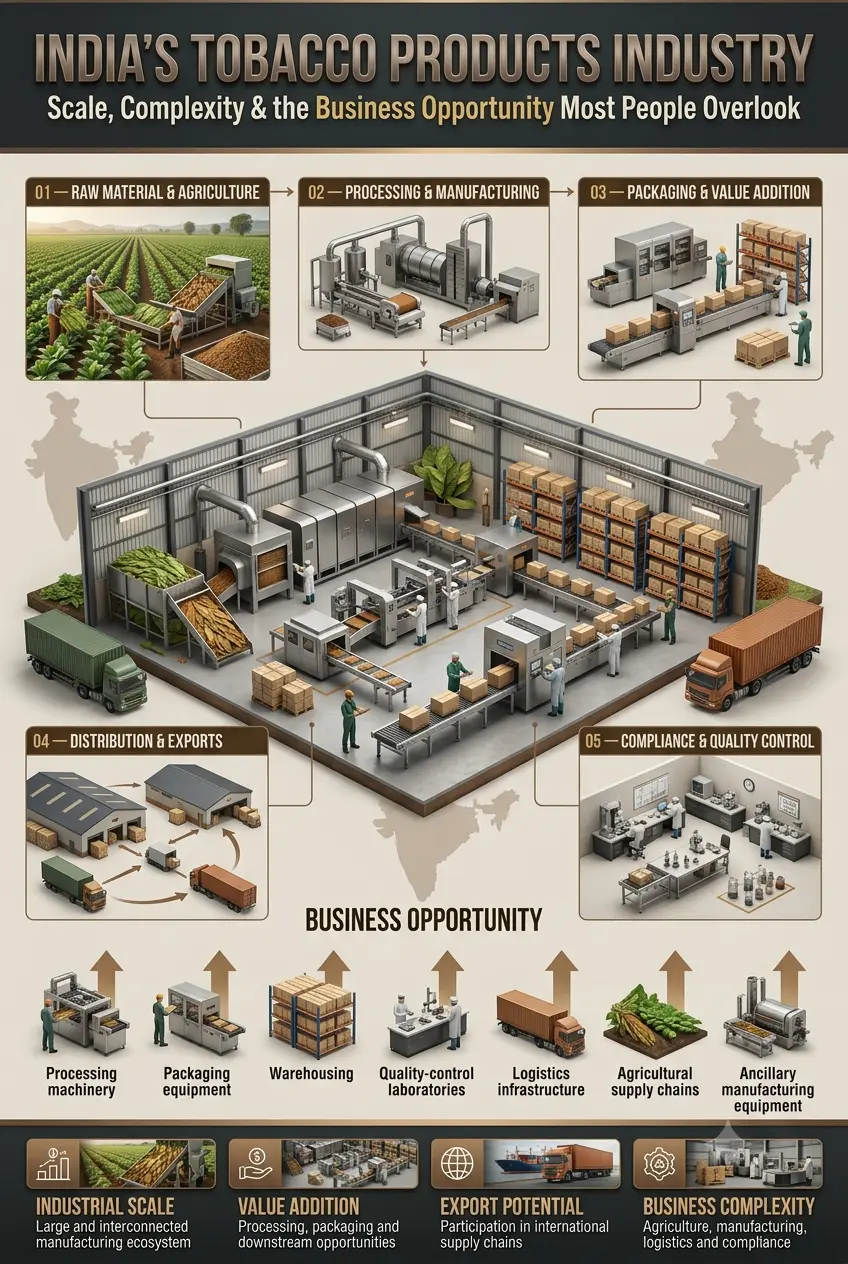
India’s tobacco and pan masala industry is unique in its scale, depth of agriculture and complexity of manufacturing. India is a major producer and consumer of tobacco products and is home to a market for tobacco products that is broader than just cigarettes. The product smoked by hundreds of millions of people is hand-rolled and wrapped in tendu leaves, and produced by a massive unorganised and semi-organised workforce in rural India. Pan masala, chewing tobacco, khaini, zarda, kimam, gutka, sweet supari and mouth fresheners are a unique and much more culturally embedded group of products, having their own raw material supply chains, processing needs and distribution logic.
Tobacco is one of the major cash crops of India, and it is cultivated in a variety of states, including Andhra Pradesh, Telangana, Gujarat, Karnataka and more. It is an important source of agricultural income, excise and GST revenue and employment from the cultivation to processing to retailing. The tobacco products segment (smokeless tobacco and pan masala) has a turnover of thousands of crores this year and is deeply engaged in rural markets as well as high income segments with rich tobacco consumption habits.
It is a sector that offers manufacturers, investors and entrepreneurs specific technical entry requirements, clear regulations and established commercial channels. The understanding of it requires knowledge of the agricultural process (cultivation, curing, grading) and processing knowledge (blending, flavouring, packaging) and the familiarity of the regulatory process (COTPA, FSSAI, GST special procedures, and state-level regulations).
The Market Landscape: Smokeless Tobacco, Pan Masala, and the Products Between
The tobacco products market in India can be segmented into smoked and smokeless tobacco products. Smoked segment includes cigarettes, bidi, cigars, cheroots and hookah tobacco. The smokeless portion, which forms a larger portion of consumers, consists of pan masala, chewing tobacco, khaini, zarda, gutka, snuff and other mouth freshener varieties.
Pan masala is an umbrella term for a range of products which consist of areca nut (supari) with a mixture of slaked lime, catechu (katha), cardamom and permitted flavours. The use of tobacco or nicotine in a pan masala base results in the creation of a product called gutka, which is regulated in several states, but still sold in different product formulations as part of the chewing tobacco category.
As a result of these regulatory forces, the sweet supari and non-tobacco mouth freshener category has emerged. Manufacturers are reformulating their products to meet the demand of consumers who wish to experience the taste and ritual of supari but do not want to do so with tobacco. This segment is now a substantial market in its own right and niche products and premium positioning can be achieved.
From the manufacturing perspective, there are various raw materials, processes, machines and regulations needed for each of these product types. The reality of a bidi manufacturer is very different from that of a cigarette manufacturer or a pan masala blending unit, namely hand-rolling, sourcing of tendu leaf, labour management etc. To understand these differences at a process level is critical for anyone who wishes to enter, or expand, in this sector.
Business Opportunities in the Tobacco and Pan Masala Sector
While the sector is vast, and there are opportunities for entrepreneurs and investors of varying scales, it is critical to be mindful of the regulations from the beginning.
Small-Scale and MSME Manufacturing
Bidi makers have traditionally been the small and cottage scale producers, and the bidi industry is supported by millions of the home based and workers in the workshops in the states such as Madhya Pradesh, Maharashtra, Odisha and West Bengal. Capital requirements are relatively low, but key factors in making the product successful are the quality of raw materials, labour management and product consistency.
Production of pan masala and mouth freshener on a small scale is possible to MSME entrepreneurs who know how to blend and flavour and can easily source areca nut and adjuvants with reliability, and have the ability to comply with the regulatory requirements for packaging and labelling as prescribed by FSSAI and COTPA. For pan masala and tobacco manufacturers, GST’s special procedures such as monthly production statements and machine registration (FORM SRM-I) should be taken into account from the beginning of the operations.
Medium-Scale Tobacco Processing and Cigarette Manufacturing
The cigarette manufacturing, on the other hand, is a capital-intensive business dominated by bigger players. But there are opportunities for medium scale manufacturers in contract manufacturing, private label manufacturing and export-oriented product formats of tobacco leaf preferred by the markets in the country.
Nicotine Derivatives: A Distinct Industrial Opportunity
The extraction and refinement of nicotine derivatives (nicotine sulphate, USP nicotine, nicotine tartarate and nicotine polacrilex resin) is one of the less talked about, but commercially important sections of the tobacco processing industry. They are used in the pharmaceutical industry (nicotine replacement therapy products such as patches, gums and lozenges), agrochemical industry (nicotine sulphate used as a precursor of pesticides) and specialty chemical applications.
The global market for nicotine replacement therapy is growing with tobacco cessation programmes being expanded in both developed and developing countries, as a result, the demand for pharmaceutical grade nicotine derivatives is increasing. Indian manufacturers who have access to tobacco leaf, and have the proper extraction technology, are ideally suited to cater this demand and it is also a value-added manufacturing opportunity with better margin than most of the primary tobacco manufacturing processes.
The Regulatory Context: What Manufacturers Need to Know
In India, the business of tobacco and pan masala is regulated in a cascading manner. Labeling, health warning, advertising restrictions and sale under the Cigarettes and Other Tobacco Products Act (COTPA) are regulated. FSSAI regulates food safety claims of pan masalas and mouth freshener products. For pan masala manufacturers, the introduction of specific compliance requirements under GST in 2023 has included registration of packing machines and reporting monthly production.For pan masala manufacturers, specific compliance requirements under the GST have been introduced in 2023, including the registration of packing machines and the reporting of monthly production. There are also state-level regulations, and some states have banned and/or limited the use of gutka and tobacco containing pan masala products.
The challenges of navigating this environment are not just legal, but operational, and compliance needs must be built into the manufacturing process. Production records, batch documentation, labelling standards, machine registration and monthly returns are not “add-ons” but are woven into the operational flow of a compliant tobacco manufacturing facility.
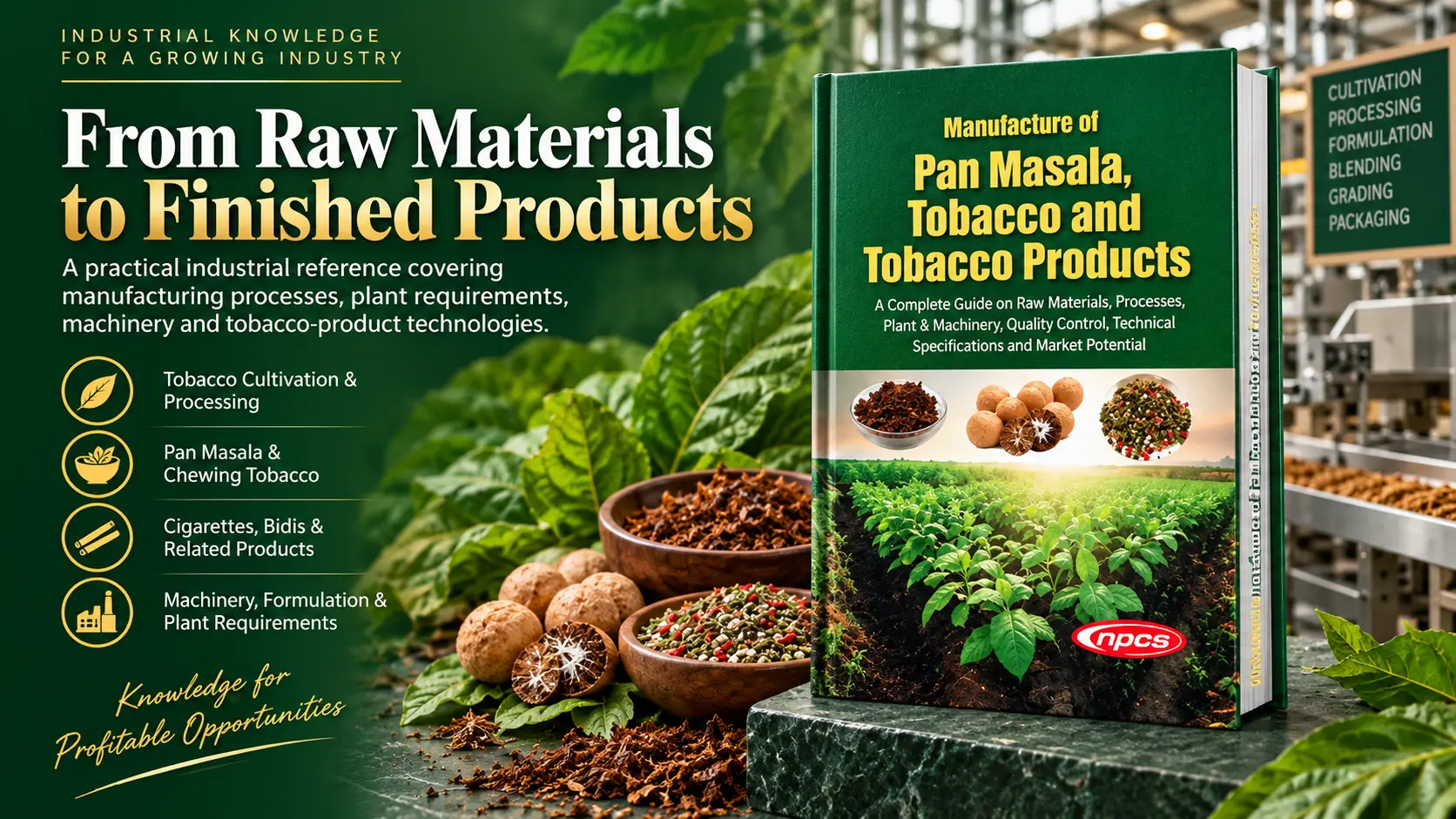
Manufacture of Pan Masala, Tobacco and Tobacco Products (2nd Revised Edition): What This Handbook Covers
Written by P. K. Chattopadhyay and published by NIIR Project Consultancy Services, this 448-page handbook is the most comprehensive single-volume technical reference available on the manufacturing processes for the full range of tobacco and pan masala products produced commercially in India.
The second revised edition updates the content to reflect current manufacturing practices, regulatory developments, and market realities. At 448 pages, it covers the complete product spectrum — from tobacco cultivation to nicotine derivative extraction — in the consistent, process-oriented format that NPCS publications are known for.
What the Book Covers — Complete Product Chapters
The handbook is organised by product, with each chapter covering raw materials, manufacturing process, machinery and equipment, quality control, and commercial context. The product coverage includes:
- Tobacco Cultivation — Nicotiana tabacum and Nicotiana rustica varieties, growing conditions, soil and climate requirements, agronomic practices
- Tobacco Diseases and Pests — identification and management of major diseases and pest threats in commercial tobacco cultivation
- Organic Tobacco Production — processes and standards for organically grown tobacco
- Chewing Tobacco — raw material preparation, blending, flavouring, and packaging
- Cigarettes — tobacco blending, cut rag production, paper specification, filter manufacture, cigarette assembly and packaging
- Bidi — tendu leaf selection and preparation, tobacco blend, hand-rolling and machine-rolling processes, quality standards
- Cigars — leaf selection, long-filler and short-filler processes, binder and wrapper preparation
- Readymade Khaini — processing, blending, and packaging
- Zarda — flavoured chewing tobacco processing
- Gutka — areca nut base processing combined with tobacco, regulatory context
- Katha (Catechu) — extraction from acacia wood, processing and application in pan masala formulations
- Mouth Freshener / Pan Chatni — non-tobacco formulations, ingredients, blending and packaging
- Kimam — flavoured tobacco paste, traditional formulation and manufacture
- Sweet Supari — areca nut processing, flavouring, and packaging
- Nicotine Sulphate — extraction and processing from tobacco waste
- USP Nicotine — pharmaceutical-grade purification process
- Nicotine Tartarate — production and quality standards
- Nicotine Polacrilex Resin — manufacture for pharmaceutical nicotine replacement applications
- Tobacco Waste Utilisation — recovery and processing of tobacco dust and waste generated during manufacturing
Who This Handbook Is Written For
The target readership spans a wide range:
- Entrepreneurs setting up pan masala, mouth freshener, or tobacco product manufacturing units
- Existing bidi and tobacco manufacturers looking to diversify into higher-value products or nicotine derivatives
- Agricultural entrepreneurs involved in tobacco cultivation who want to understand downstream processing options
- Project consultants and bank officers assessing tobacco product manufacturing projects
- Research scholars and students in food technology, agricultural processing, and industrial manufacturing programmes
- Regulatory and compliance professionals working in the tobacco sector
Why This Edition Matters
The 2nd revised edition reflects updated regulatory requirements, revised product formulation standards, and the expansion of the nicotine derivative market since the first edition. For any practitioner or entrepreneur in this space, working from an outdated technical reference is a real risk — manufacturing processes, regulatory obligations, and raw material standards evolve, and this revision ensures the content is aligned with current commercial and legal realities in India’s tobacco products sector.
Book Details at a Glance
| Book Title | Manufacture of Pan Masala, Tobacco and Tobacco Products (2nd Revised Edition) |
| Author | P. K. Chattopadhyay |
| Publisher | NIIR Project Consultancy Services (NPCS) |
| ISBN | 9788194737971 |
| Pages | 448 |
| Edition | 2nd Revised |
| Format | Paperback |
Get Your Copy Today
Manufacture of Pan Masala, Tobacco and Tobacco Products (2nd Revised Edition)
If you are setting up a pan masala, bidi, chewing tobacco, or nicotine processing unit — or advising someone who is — this handbook is the reference you need before you spend a rupee on machinery or raw materials. The process descriptions, equipment guidance, raw material specifications, and regulatory context packed into 448 pages will save you time, reduce costly errors, and give you a credible foundation for your project feasibility work.
K. Chattopadhyay’s expertise and the NPCS editorial team’s track record in industrial technical publishing make this one of the most reliable single-volume references on tobacco products manufacturing available to the Indian market today. The second revised edition ensures the content is current.
Available on Niir.org | Amazon India | Flipkart
Published by NIIR Project Consultancy Services (NPCS)
106-E Kamla Nagar, New Delhi — niir.org | entrepreneurindia.co | npcsblog.com
30+ Years in Consulting | 150,000+ Projects | 85 Countries | ISO 9001:2015 Certified
Your Investment Deserves the Right Opportunity
Every serious investment begins with choosing the right sector and the right business model. With hundreds of industrial opportunities available across India’s manufacturing and clean-energy landscape, making the most informed choice is crucial. Niir’s Startup Selector tool helps entrepreneurs, MSMEs and investors identify the most suitable business opportunities based on their investment capacity, location and interests, ensuring their capital is directed toward the venture with the best fit.


