





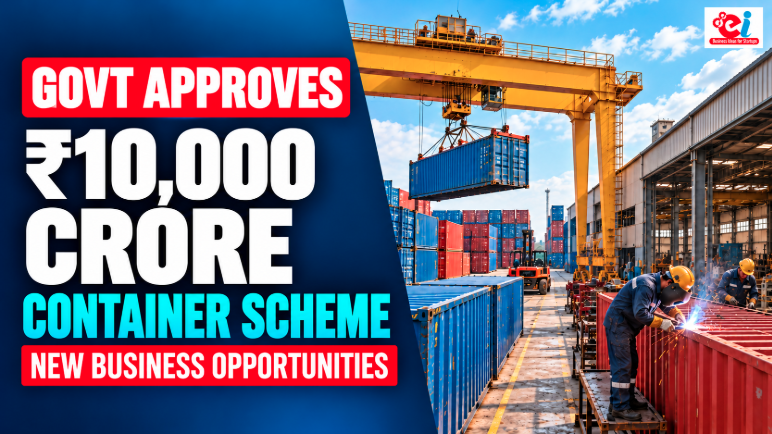
A new national push to manufacture shipping containers in India is creating an opportunity beyond the large factories that make the finished steel boxes. The Union Cabinet approved the ₹10,000 crore Container Manufacturing Scheme 2026. It aims to expand domestic capacity, reduce dependence on imported containers, and build a stronger supply chain for exporters and shipping lines.
The plan targets an annual capacity of about 7.5 lakh twenty-foot equivalent units (TEUs), roughly ten times the current level. It could increase demand for precision castings, weather-resistant steel, flooring, door hardware and protective coatings. For entrepreneurs, however, an important distinction remains: a small component workshop may benefit from orders without qualifying for the scheme’s direct incentives. The commercial opening is real, but finding a customer and meeting marine-grade quality requirements will matter more than the headline subsidy.
What This Development Means for Indian Businesses
The scheme covers new plants and expansions. Its policy roots appear in the Union Budget container manufacturing proposal. The approved programme runs through FY 2039–40, with construction followed by production support. It may encourage larger manufacturers to buy domestic parts and materials. Fabricators, foundries and coating suppliers should investigate vendor requirements before investing.
Why This Industry Could See Stronger Growth
Shipping containers move across sea, rail and road without repacking cargo. India’s trade and multimodal logistics plans make reliable container access important. The Maritime Amrit Kaal Vision 2047 sets out broader port ambitions. But traffic growth does not automatically mean new-container demand: reusable boxes circulate globally. Investors must verify purchase orders, replacement needs, and export competitiveness.
Government Policies and Incentives
Container Manufacturing Scheme 2026: The ₹10,000 crore scheme allocates ₹859 crore for 3% annual interest support on eligible capital loans, ₹8,891 crore for operational assistance on globally compliant containers made and sold by qualifying manufacturers, and ₹150 crore for shared testing and certification. Greenfield projects must plan at least 1,00,000 TEUs annually; eligible brownfield expansions must add at least 25,000 TEUs. These are major industrial scales, not entry-level MSME capacities.
Published support includes ₹49,500 per 20-foot container and ₹86,625 per 40-foot container; specialised models have separate rates. Required domestic content is 70% through FY 2031–32 and 90% thereafter. These are not guaranteed profits. Applicants must confirm final eligibility and claims procedures before projecting incentives.
The Odisha Industries Department’s port-linked industrial development page describes coastal industrial zones. Gujarat’s GIDC policy page for logistics and warehousing activity explains estate rules; neither proves a container-specific subsidy. Smaller suppliers can review the MSME credit guarantee programme if eligible. Product-design startups may examine the Startup India Seed Fund Scheme for early-stage work, not a full container factory.
Manufacturing Business Opportunities Emerging From This Development
Standard Steel Shipping Containers
Factories make 20-foot and 40-foot dry cargo boxes from weathering steel, corrugated panels and welded frames for shipping lines and lessors. A plant needs fabrication, painting, heavy handling and prototype testing. It demands substantial capital and signed orders.
Specialised Containers
Open-top and flat-rack units serve oversized cargo. Fabrication overlaps with dry containers, but designs and tests vary. Specialised production needs confirmed buyer drawings and certification routes.
Container Corner Castings and Fittings
Foundries can supply corner castings, locking components and fittings. Containers need reliable load-transfer points; rejected castings create safety risks. Experienced suppliers must document metallurgy, dimensions, and traceable tests.
Container Doors and Locking Assemblies
Metalworking firms can make door frames, hinges, rods, cams, keepers and seals. Container OEMs require accurate fit, corrosion protection and repeatable quality. Storage-cabin hardware cannot replace approved marine fittings.
Container Flooring Panels
Engineered timber or bamboo-based flooring may gain orders. Buyers require strength, moisture resistance and consistent quality. Adhesives, treatment, raw materials and testing costs must be evaluated.
Marine Protective Paints and Coatings
Container makers need corrosion-resistant primers, topcoats and underbody coatings. Suppliers face demanding qualification: salt-spray performance, consistent application, solvent handling, and environmental compliance matter as much as price.
Import Export and International Market Opportunity
India’s first commercial goal is to replace imports with dependable domestic containers and parts. Exports may follow where factories can match global pricing, delivery schedules, safety requirements, and repeat orders. Select markets through shipping-line purchasing networks rather than broad country-level demand claims. Exporters should review the Directorate General of Foreign Trade guidance on IEC registration and calculate landed costs, warranties, inspection fees and freight repositioning before quoting overseas.
Indian Manufacturers and Emerging Suppliers
APPL Containers Limited in Bhavnagar manufactures standard and specialised ISO-style containers. Its example shows the importance of a dedicated factory and several product designs. Castora Foam Tech, also in Bhavnagar, focuses on precision castings and container fittings: a clearer model for component-led entry. J K Technologies in Haryana makes portable structures and container products, illustrating a smaller fabrication route. Their existence does not establish their MSME status or eligibility for CMPS. Buyers should distinguish certified marine freight containers from portable site cabins.
What Entrepreneurs Should Evaluate Before Investing
Begin with named buyers, sample drawings, expected monthly offtake, and target prices. Then compare steel or casting input costs, scrap rates, machinery, skilled welders, utilities, coating waste treatment, testing, working capital, and logistics. A new ocean-freight container requires a suitable design and safety certification pathway; the Directorate General of Shipping’s list of international conventions identifies the Safe Containers Convention, while the Indian Register of Shipping’s container prototype testing process shows how design checks and testing work. Stress-test profits without subsidy and at lower capacity utilisation.
How NPCS Can Help Entrepreneurs Evaluate the Opportunity
Niir Project Consultancy Services (NPCS) prepares market surveys, detailed project reports, techno-economic feasibility studies, manufacturing-process assessments, plant and machinery evaluations and investment plans. A project-specific study should separate the economics of a full container factory from a supplier unit and test buyer qualification before financing.
NPCS has published a printed reference book covering related steel processing, casting, and fabrication techniques. It is a supporting steel-industry resource, not a container-specific manual. You can access the various related projects:- Steel Shipping Containers, Cargo Containers, Freight Containers, ISO Containers, Intermodal Containers, Steel Storage Containers, Transport Containers, Industrial Containers, Sea Containers, Marine Containers, Export Containers, Heavy-Duty Steel Containers
For a detailed techno-economic project report on setting up a steel shipping-container manufacturing business, including plant economics, machinery and financial projections, see the Manufacturing Plant of Steel Shipping Container Project Report.
Business Opportunity Snapshot
| Parameter | Commercial assessment |
| Industry | Steel freight containers and components |
| Market driver | Container availability and domestic sourcing |
| Key development | ₹10,000 crore national manufacturing scheme |
| MSME opportunity | Castings, door fittings, flooring, coatings |
| Manufacturing potential | High if approved buyers commit to offtake |
| Export potential | Conditional on price and certification |
| Import substitution | Finished boxes and selected components |
| Government support | CMPS for eligible plants; other schemes separately |
| Investment consideration | High for full plants; variable for suppliers |
| Risk level | High without quality approval and anchor orders |
| Growth outlook | Positive policy direction; demand must be validated |
Conclusion
India’s new container manufacturing programme is a serious attempt to build industrial capacity around a basic piece of global trade equipment. The largest direct incentives are designed for eligible manufacturers operating at substantial scale, and the proposed jump to 7.5 lakh TEUs annually remains a target, not a guaranteed order book. That distinction is critical for anyone preparing an investment proposal.
A more realistic entry point for many entrepreneurs is supplying castings, fittings, floor panels, coatings, or fabrication work to larger manufacturers. These businesses can grow with domestic container production, but only when they meet demanding specifications and secure dependable customers. Export sales are possible; they are not automatic. Before committing capital, investors should conduct buyer research, machinery and raw-material studies, financial sensitivity analysis, and prepare a credible, detailed project report. The opportunity is worth investigating now, but the final decision must rest on contracts, compliance and economics.
Your Investment Deserves the Right Opportunity
Every serious investment starts with choosing the right sector and business model. With hundreds of industrial opportunities available across India’s manufacturing and clean-energy landscape, making the most informed choice is critical. NIIR’s Startup Selector tool helps entrepreneurs, MSMEs, and investors identify the most suitable business opportunities based on their investment capacity, location, and interests. So your capital goes to a venture with the strongest fit and potential.


