




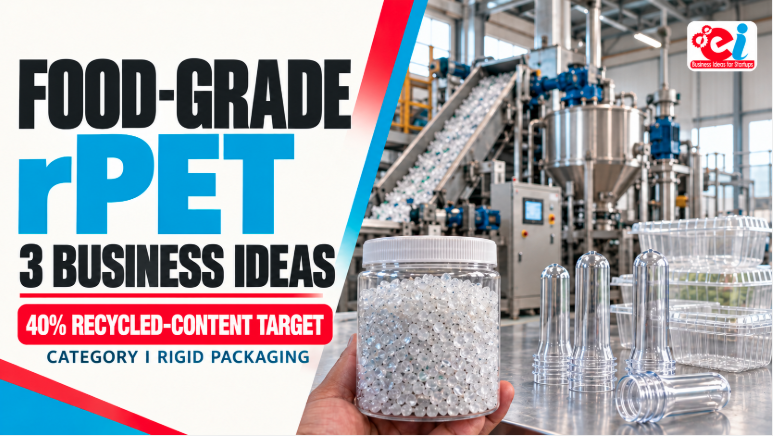
Food-grade rPET business ideas in India: India’s shift towards recycled plastic packaging creates an opening for manufacturers who can supply the right quality at a competitive cost. Food-grade recycled PET, commonly called food-grade rPET, is one such opportunity. It can be used to manufacture suitable food contact packaging, including beverage bottles, when the resin and its intended use meet the applicable requirements. For entrepreneurs, the real question is not whether recycling is growing. It is which part of this business they can operate profitably.
A startup does not necessarily need to build a complete bottle-to-bottle recycling plant. It can enter through authorised resin production, bottle preforms, or food packaging sheet conversion. These models demand different amounts of capital, technical expertise, and customer access. Choosing the right one can save years of expensive mistakes.
Why manufacturers are studying food-grade rPET
Beverage, food, and consumer product companies use plastic packaging daily. Large buyers need consistent supply, measurable recycled content, and documents that support product safety. This creates an opportunity for dependable B2B manufacturers, especially those that can deliver predictable quality across repeated orders.
Under the Plastic Waste Management (Amendment) Rules, 2026, the recycled-content schedule for Category I rigid plastic packaging is 30% in FY 2025–26, 40% in FY 2026–27, 50% in FY 2027–28 and 60% from FY 2028–29 onward. The rules include statutory exceptions and carry-forward provisions for certain earlier shortfalls in food-contact applications. These are category-level obligations; they do not require every individual PET bottle to contain exactly 40% recycled resin. Nor do they guarantee orders for a new recycling plant.
The commercial opportunity follows from a buyer’s need to source compliant recycled material. A new entrant must still win its business through pricing, process approval, testing, reliable delivery, and reasonable payment terms.
Three manufacturing opportunities worth comparing
1. Food-grade rPET resin manufacturing
This is the most technically demanding route. A recycler procures suitable post-consumer PET, sorts and washes it, then uses a validated recycling and decontamination process to produce resin intended for food contact. Depending on the selected technology, the line may include advanced filtration and steps to restore polymer properties.
The attraction is direct participation in the recycled-resin supply chain. A successful plant may serve packaging converters and bottle manufacturers through repeat supply contracts. However, it needs dependable bottle sourcing, laboratory capability, technical staff, a stable power and water system, and sufficient working capital to purchase feedstock before customer payments arrive.
The major barrier is food-contact safety. FSSAI requires authorisation of the relevant recycling process and facility, process-validation evidence, traceability and ongoing quality controls. Its framework includes annual audits. Buying a line described as “food grade” does not by itself authorise the output for food-contact use.
Best suited to: experienced recyclers, industrial groups with strong capital backing, or investors with feedstock and serious prospective customers.
2. PET bottle preform manufacturing using suitable rPET
A preform unit buys resin from a suitably authorised supplier and converts it into preforms that customers later blow into bottles. Compared with producing food-grade resin, this model avoids owning the full recycling and decontamination chain. The investment shifts towards injection moulding machines, moulds, resin drying, cooling, quality checking and customer-specific product development.
For a startup with packaging experience, the advantage is a clearer product and a direct relationship with bottlers. But mould cost, machine utilisation and product rejection can be significant. A bottler may require prolonged trials before placing regular orders. The preform manufacturer must confirm that the selected resin, blend and finished package satisfy the intended food-contact requirements.
Best suited to: existing plastics processors, entrepreneurs near beverage clusters, and manufacturers who can secure purchase interest for a limited number of preform sizes before expanding.
3. Food packaging sheet and thermoformed products
Another path is to convert suitable rPET into sheets and, where applicable, thermoformed trays or containers. Customers may include food packers and packaging distributors. Revenue comes from selling a specified finished format rather than commodity pellets, and customisation can help a small manufacturer build repeat accounts.
This model requires skill in sheet thickness control, clarity, forming, trimming, scrap handling and food-contact documentation. A resin suitable for one approved use should not be assumed suitable for every food type, storage period or temperature. Product development and buyer trials must come before bulk production.
Best suited to: packaging businesses with existing sales networks, sheet extrusion operators and startups serving local food processors.
Which model is realistic for your investment capacity
| Business model | Capital intensity | Main commercial test |
| Food grade rPET resin | High | Authorised process, steady feedstock and qualified resin buyers |
| Bottle preforms | Medium to high | Bottler trials, mould utilisation and repeat orders |
| Sheets and trays | Medium to high | Application suitability, tooling and nearby packaging customers |
These are relative comparisons, not project cost estimates. Capacity, automation, technology, land, utility infrastructure and product specifications can change the investment substantially. Machinery quotations and realistic customer requirements are essential before fixing a budget
How a new manufacturing unit actually makes money
The sale price alone says little about profitability. For a resin plant, the cost of usable PET feedstock often decides profitability. A tonne of purchased bottles does not turn into a tonne of sellable resin: sorting, contamination, moisture and process losses reduce recovery. Electricity, water treatment, filtration consumables, testing, labour, maintenance, packaging, freight and finance costs must also be included.
Preform and sheet manufacturers face different pressures. Resin purchase price, machine output per hour, mould or tooling cost, scrap generation and customer-specific rejections drive their margins. In all three businesses, cash can remain tied up in raw material and finished stock while customers conduct trials or take extended credit.
A sensible financial model should estimate contribution per saleable kilogram, monthly fixed costs, break-even utilisation, working capital and debt service. Run a downside case with higher bottle or resin prices, lower production yield, delayed buyer approval and weaker realisations. If the project only works at full capacity and premium selling prices, it is not ready for investment.
A practical route from business idea to commercial plant
First, choose one product and a specific buyer group. Contact actual preform makers, bottlers, or food packers to understand volume, quality, packing, documentation, payment, and trial requirements. Expressions of interest are useful, but they are not purchase contracts.
Second, establish raw material supply. A resin recycler needs information on bottle collection channels, seasonal availability, contamination, and delivered cost. A converter needs dependable access to appropriate authorised resin. Test alternative suppliers instead of assuming that a low spot-market quotation will remain available.
Third, match the machinery to the agreed specification. Ask suppliers for guaranteed throughput under stated inputs, expected saleable yield, utility consumption, critical-process monitoring, spares, commissioning and performance-test conditions. For resin production, validate that the proposed technology and facility can meet FSSAI requirements.
Fourth, plan permissions before construction. Plastic waste processors should assess CPCB EPR registration, state pollution-control consents and local approvals as relevant. Food-grade resin manufacturers must address FSSAI authorisation separately. CPCB’s guidance confirms that registered plastic waste processors are the entities eligible to issue processing certificates for EPR fulfilment. Treat any certificate-related receipts as conditional, never as guaranteed profit.
Finally, prepare a realistic launch schedule: engineering, approvals, commissioning, sample production, customer trials, repeat orders, and scale-up. Do not assume that revenue begins at rated production capacity in the first month.
What established Indian manufacturers teach new entrants.
Srichakra Polyplast and Ganesha Ecopet appear on FSSAI’s published list of authorised food-grade rPET manufacturers. Their presence shows that the regulated supply route exists in India, but listing status alone does not reveal project profitability, margins, or an easy route for a new startup. The transferable lesson is to build around an authorised process and a customer specification, not simply the promise of recycling demand.
The right investment is the model you can execute
Food-grade rPET can become a serious manufacturing business for entrepreneurs who understand quality, procurement and B2B selling. The strongest opportunity is not necessarily the largest plant. It is the one with a clear customer, a workable technical route, and enough financial strength to survive the months before repeat orders begin.
At Niir Project Consultancy Services (NPCS), we help manufacturers and investors examine market demand, technology options, plant capacity, machinery, raw material sourcing, and project economics before committing capital. That assessment should answer a simple question: can this particular project earn money under realistic operating conditions?
Primary sources
Plastic Waste Management (Amendment) Rules, 2026, G.S.R. 237(E), Gazette copy filed with NSE
FSSAI Guidelines for Acceptance of Recycled PET as Food Contact Material
CPCB Notice on Registration of Plastic Waste Processors


