





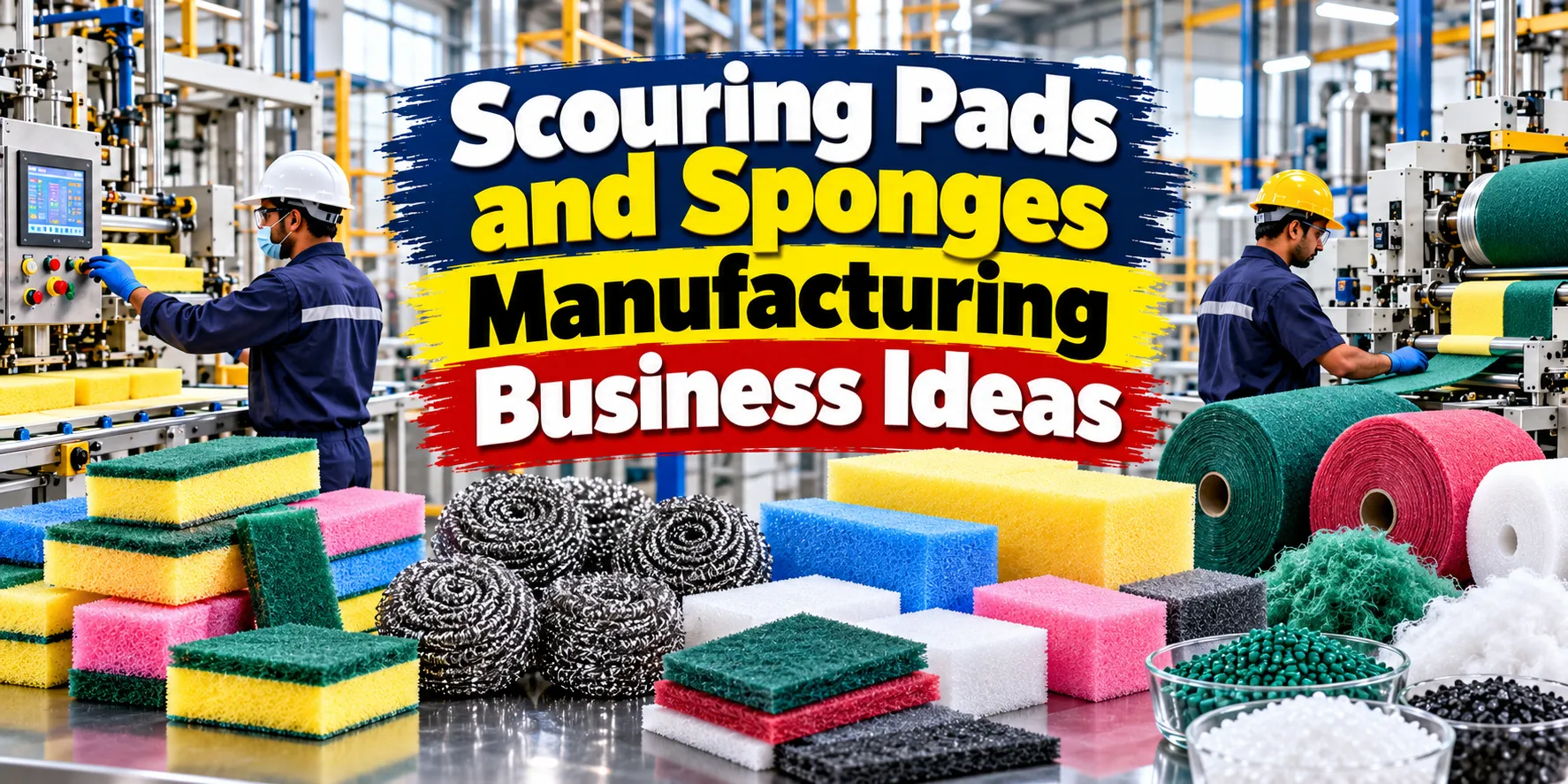
Sponge Manufacturing Business can be a practical and profitable option for novice entrepreneurs because sponges and scouring pads are everyday products with consistent replacement demand. Homes, restaurants, hotels, catering businesses, and commercial kitchens regularly purchase these cleaning essentials, creating opportunities for repeat sales and predictable consumption patterns.
Although the industry may not appear as exciting as technology or other fast-growing sectors, its strength lies in steady demand and relatively simple market dynamics. Entrepreneurs entering the sponge manufacturing business can focus on product quality, competitive pricing, efficient production, and reliable distribution to build a sustainable customer base.
Since sponges and scouring pads wear out quickly and need frequent replacement, manufacturers can benefit from recurring orders from both household consumers and commercial buyers. This makes the sector particularly suitable for entrepreneurs looking for a comparatively straightforward manufacturing business with long-term market potential.
Why Scouring Pads and Sponges Manufacturing Is a Smart Business Idea Right Now
The use of cleaning and sanitation goods is on the rise in households as well as hospitality and institutional kitchens and the use of scouring pads and sponges features as a vital tool of necessary spending. Since these goods are low-cost and have a turnover cycle, their demand remains constant even during economic downturns, unlike other discretionary consumer products. This category of goods has also received support due to the growth of private labels and modern retail chains as supermarket chains and rapid delivery suppliers want to have reliable suppliers of domestic products for their house-brand products.
Government Policies & Incentives
Scouring pad and sponge manufacturing perfectly fits into conventional MSME manufacturing support initiatives, which comprise collateral-free lending assistance through various schemes managed by the Ministry of MSME. Promoters setting up under a formal registered structure can also access early-stage assistance in the form of guidance and compliance support under Startup India, while quality testing for household cleaning products is typically governed by voluntary standards from the Bureau of Indian Standards. Basic MSME registration under Udyam helps in getting access to priority sector lending norms at public sector banks, which is particularly useful for a low-cap business like this one where quick access to small working capital is required over large project finance loans.
5 Sponges Manufacturing business ideas
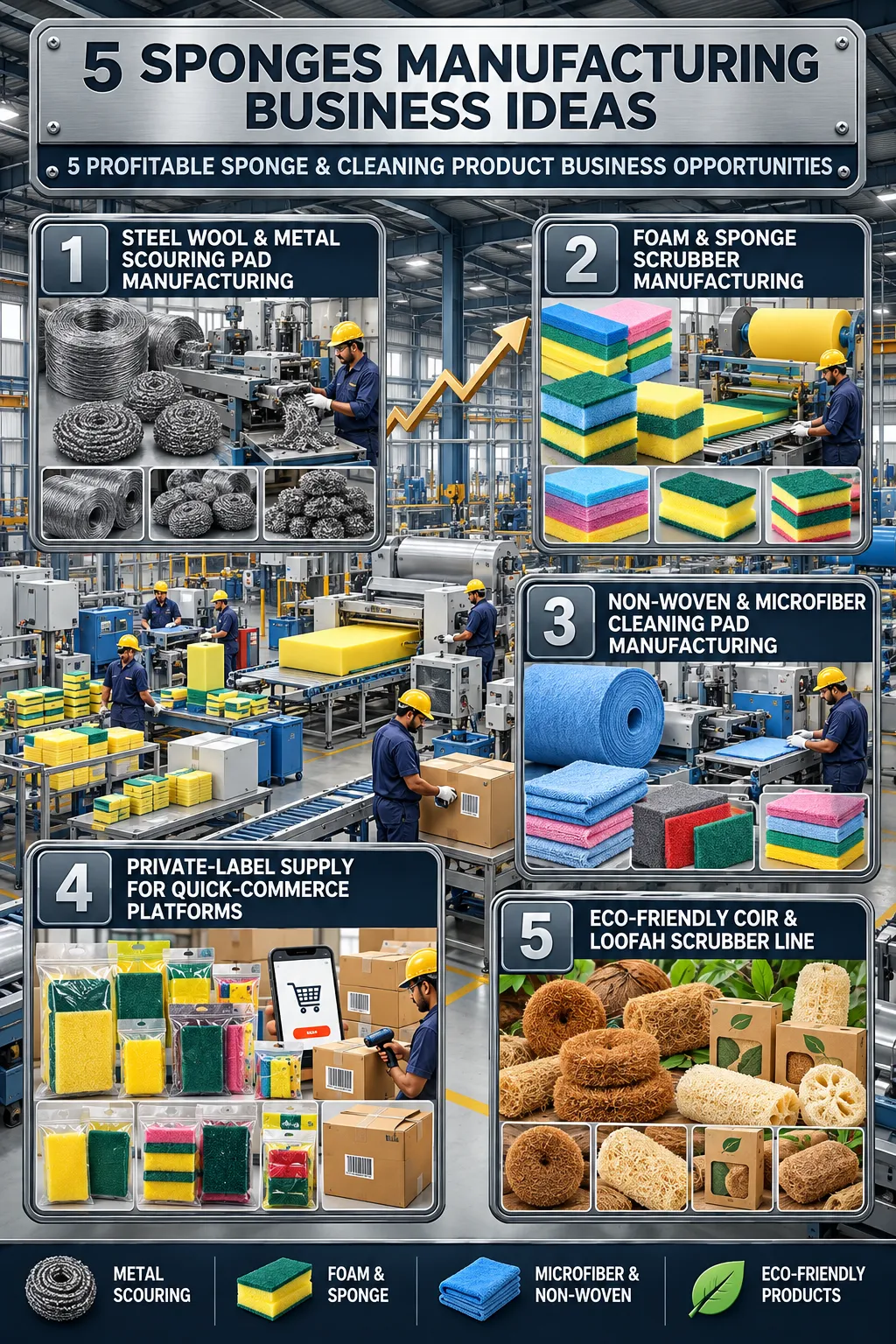
Steel Wool & Metal Scouring Pad Manufacturing
The metal scrub pads for use in the kitchen and cleaning utensils will still be the most sold product, while producers who can ensure a stable supply of steel wire and the quality of winding can fulfill orders from both retail chains and institutional buyers uninterruptedly.
Foam & Sponge Scrubber Manufacturing
Combination foam-and-scrub sponges, which are widely used for dishwashing and cleaning overall, mean that the product line is a little more hybrid, as various colours and shapes and types of packing may help with retail partnership.
Non-Woven & Microfiber Cleaning Pad Manufacturing
The growing need for non-scratch products for modular kitchens and modern dishes means that a premium niche gets created for pads based on microfiber and non-woven technology, which allows producers to get more profit than selling simple steel wool pads.
Private-Label Supply for Quick-Commerce Platforms
Quick-commerce platforms are increasingly interested in creating their own branded cleaning products, particularly as sponges and scourers are straightforward to produce. If a manufacturer can handle fast reordering and flexible packaging, it can keep receiving orders from these types of retailers in addition to traditional retail distribution.
Eco-Friendly Coir & Loofah Scrubber Line
Environmentally friendly consumers are interested in the use of natural scrubbers such as coir and loofah as a plastic-free alternative. For an existing manufacturer of foam and steel wool products, it won’t require much investment to add this line and open new opportunities in a growing market segment.
Import–Export Opportunity Analysis
Raw materials for this business, primarily steel wire, foam, and non-woven fabric, are largely available domestically, keeping import dependence limited. Export opportunity exists mainly through supplying cost-competitive household cleaning products to neighbouring South Asian markets and, for higher-quality private-label products, to buyers in the Middle East, an area where smaller Indian manufacturers have found steady niche demand through trade connections facilitated by the Federation of Indian Chambers of Commerce and Industry.
Market Outlook & Scaling Roadmap
Household cleaning product consumption in India continues to grow steadily with urbanisation and rising hygiene awareness, and quick-commerce platforms are actively looking for reliable domestic private-label manufacturing partners in this category. Manufacturers who can meet fast replenishment cycles and flexible packaging formats are best positioned to capture this growing institutional demand alongside traditional retail channels.
Skills, Manpower & Quality Control
This business is one of the more approachable manufacturing categories from a staffing perspective, since winding, cutting, and packing operations can be trained within days rather than weeks. A small unit typically employs 10 to 15 workers, and the most valuable early hire is a production supervisor who can maintain consistent quality across high-volume, repetitive operations where small defects compound quickly across large batch sizes.
Indian MSME Success Stories
Scotch-Brite (3M India manufacturing partners) — Contract manufacturing ecosystem in India
The growth of Scotch-Brite’s manufacturing footprint in India through domestic contract manufacturing partnerships shows how smaller Indian producers have built sustainable businesses by supplying established global cleaning brands rather than competing directly on branding from day one.
Regional private-label sponge manufacturers — Various small and mid-size Indian entrepreneurs
Numerous small Indian manufacturers have built profitable, low-key businesses supplying private-label cleaning products to regional supermarket chains, illustrating how steady, unglamorous B2B supply relationships can be just as viable as consumer branding for smaller entrepreneurs entering this category.
How NPCS Can Help Entrepreneurs Evaluate the Opportunity
We at Niir Project Consultancy Services (NPCS) provide professional consulting for the preparation of Market Survey cum Detailed Techno-Economic Feasibility Reports (DPRs) for setting up new industries or businesses. Our reports include detailed manufacturing processes, market research and demand analysis, process flow diagrams, product mix and capacity planning, machinery and raw material details, and complete project financials with profitability analysis. Entrepreneurs use these reports to evaluate feasibility, profitability, and long-term scalability before investing, which reduces guesswork at the most capital-intensive stage of a new venture.
For anyone evaluating Scouring Pads and Sponges Manufacturing, that groundwork matters most before any capital is committed: NPCS studies work through machinery selection, raw material sourcing, plant layout, manpower planning, and a full financial model covering capital cost, working capital, revenue projections, and return on investment. Entrepreneurs approaching banks, NBFCs, or state MSME schemes for financing typically need exactly this kind of documented feasibility study, since lenders rarely fund a project on an idea alone. Working with an established consultancy also shortens the learning curve considerably, letting a first-time promoter benefit from patterns NPCS has already observed across hundreds of similar manufacturing projects.
NPCS has published a comprehensive printed reference book on Scouring Pads and Sponges Manufacturing, covering technology, market analysis, investment parameters, and manufacturing processes in depth — the printed book: Market Research Report on FEMININE HYGIENE PRODUCTS.
For a detailed techno-economic Project Report on setting up a manufacturing business in this sector — including plant economics, machinery lists, financial projections, and applicable government incentives — the NPCS Project Report: Non Woven Fabric – Manufacturing Plant, Detailed Project Report
Data Table
Indicative Cost & Capacity for a Scouring Pad/Sponge Unit
| Parameter | Small Unit | Mid-Size Unit |
|---|---|---|
| Approximate project cost | ₹50–70 lakh | ₹2–3 crore |
| Production capacity | 8,000–10,000 units/day | 40,000–50,000 units/day |
| Core manpower | 10–15 | 35–45 |
| Key input | Steel wire, foam, non-woven fabric | Steel wire, foam, non-woven fabric, packaging materials |
| Typical payback period | 2–3 years | 3–4 years |
Note: Figures above are indicative planning estimates for feasibility discussion and vary by location, scale, and machinery configuration.
Common Pitfalls to Avoid
A common mistake in this low-barrier category is underestimating price competition, entering without a clear cost advantage or differentiation strategy against established regional players. Another frequent pitfall is neglecting packaging quality, which matters more than founders expect in a category judged heavily on shelf appeal.
Conclusion
Scouring pad and sponge manufacturing may not sound exciting, but it remains one of the steadiest, lowest-risk business ideas for first-time manufacturers with modest capital. Entrepreneurs coordinating with state MSME facilitation cells such as those under Invest Punjab portal can access simplified registration and early working-capital support to get started quickly.
Your Investment Deserves the Right Opportunity
Every serious investment begins with choosing the right sector and the right business model. With hundreds of industrial opportunities available across India’s manufacturing and clean-energy landscape, making the most informed choice is critical. NIIR’s Startup Selector tool helps entrepreneurs, MSMEs, and investors identify the most suitable business opportunities based on their investment capacity, location, and interests — so your capital is directed toward a venture with the strongest fit and potential.


