





Sodium Acetate Manufacturing Business Ideas are gaining attention among chemical entrepreneurs looking for a practical entry into specialty chemical production. Although sodium acetate rarely receives much attention outside the chemical industry, it plays an important role in textile dyeing, food preservation, leather processing, de-icing, pharmaceuticals, and other industrial applications.
One of the key advantages of starting a sodium acetate manufacturing business is its diversified demand base. Since the chemical is used across several unrelated industries, manufacturers are less dependent on the performance of any single market. This can provide greater business stability compared with chemical products tied to only one end-use sector.
For entrepreneurs with basic process chemistry knowledge, sodium acetate production can also offer a relatively manageable manufacturing opportunity. The process is generally less capital-intensive than large petrochemical or bulk chemical projects, while still providing access to industrial and commercial customers. With appropriate raw-material sourcing, quality control, regulatory compliance, and a reliable distribution network, sodium acetate manufacturing can become a promising specialty chemical business opportunity.
Why Sodium Acetate Manufacturing Is a Smart Business Idea Right Now
Textile processing, food preservation, and leather tanning together generate consistent, broad-based demand for sodium acetate, and India’s textile and leather export industries in particular continue to expand output. Because sodium acetate production uses relatively accessible raw materials, acetic acid and sodium hydroxide or sodium carbonate, the technical and capital barriers to entry are considerably lower than many other specialty chemicals, making it approachable for first-time chemical manufacturers. Growing food-grade buffer and preservative demand adds a further, higher-margin application layer beyond industrial use.
Government Policies & Incentives
Chemical manufacturing policy support, including bulk drug and speciality chemical park development, is coordinated through the Department of Chemicals and Petrochemicals. MSME-scale chemical units can access collateral-free credit and cluster development support through the Ministry of MSME, while food-grade sodium acetate production must additionally comply with FSSAI norms, and export-oriented units can leverage support from the Federation of Indian Chambers of Commerce and Industry for market access into new geographies. MSME chemical cluster development schemes in several states also provide shared effluent treatment infrastructure, reducing the individual compliance cost burden for smaller sodium acetate manufacturers operating within designated chemical industrial estates.
5 Sodium Acetate Manufacturing Business Ideas for Startups
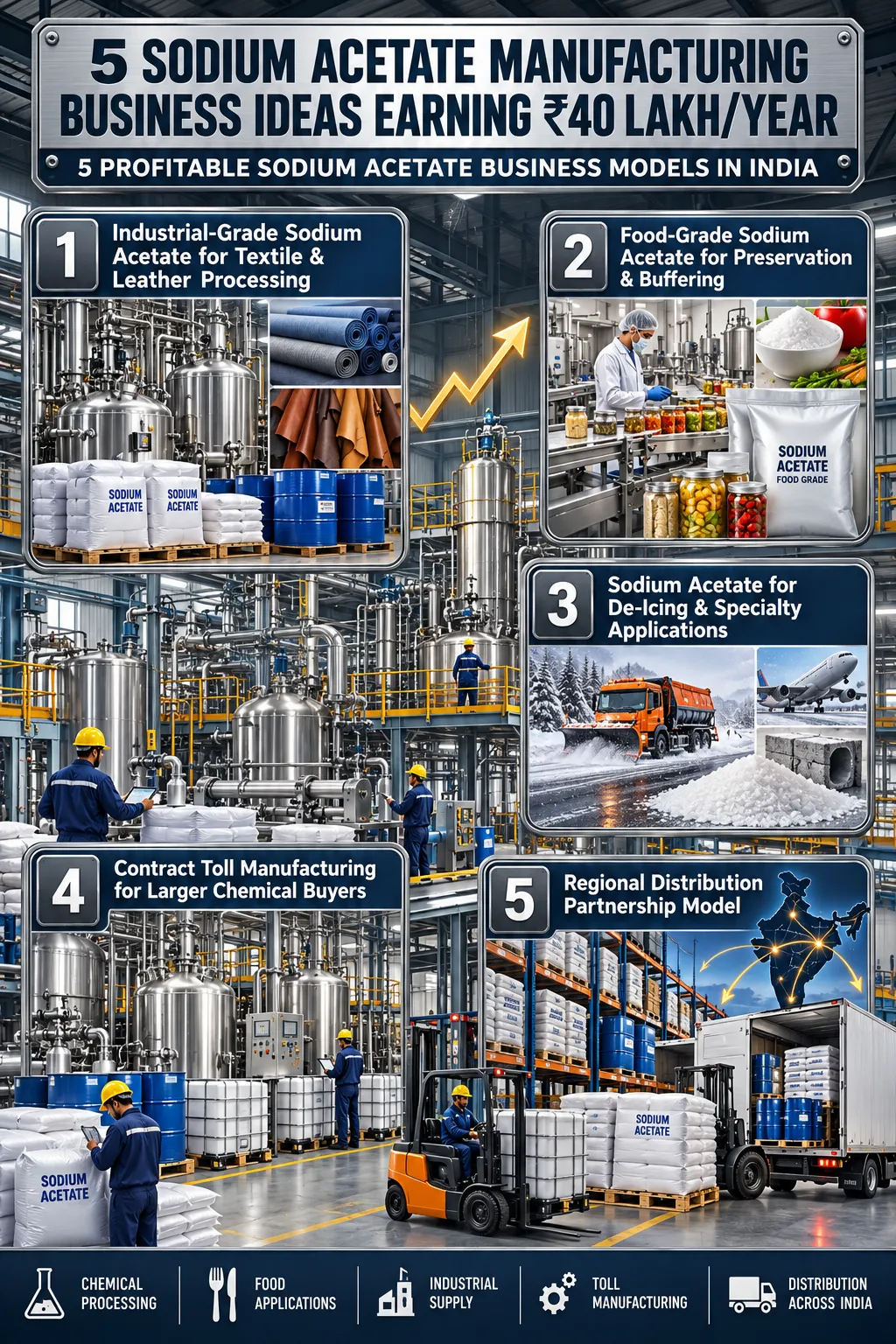
Industrial-Grade Sodium Acetate for Textile & Leather Processing
Textile dye-fixing and leather tanning applications represent the largest-volume demand segment, and a manufacturer supplying industrial-grade sodium acetate to dyeing units and tanneries can build steady bulk-order relationships, particularly in textile and leather manufacturing clusters where multiple potential buyers operate within a small geographic radius.
Food-Grade Sodium Acetate for Preservation & Buffering
Food-grade sodium acetate, used as a preservative and acidity regulator in packaged foods and snacks, commands notably higher pricing than industrial grade due to stricter purity and safety requirements. This segment suits manufacturers willing to invest in additional purification and FSSAI-compliant quality systems from the outset.
Sodium Acetate for De-Icing & Specialty Applications
Sodium acetate trihydrate is used in heating pads and eco-friendly de-icing formulations, a smaller but growing niche as demand for less corrosive alternatives to traditional road salt increases in colder regions and specialty consumer products. This provides a useful diversification line for a manufacturer already producing the base chemical.
Contract Toll Manufacturing for Larger Chemical Buyers
Several textile and leather processing companies prefer sourcing sodium acetate through toll manufacturing arrangements, supplying their own acetic acid in exchange for processed output at an agreed conversion fee. This model reduces working-capital pressure on a new manufacturer, since raw material financing sits with the customer, while the plant earns steady processing income regardless of acetic acid price swings.
Regional Distribution Partnership Model
Rather than selling directly to every buyer, a manufacturer can build a network of regional chemical distributors covering textile and leather clusters, reducing direct sales overhead while still reaching a geographically dispersed customer base efficiently.
Import–Export Opportunity Analysis
Acetic acid, the primary raw material for sodium acetate, is partly import-dependent in India, so backward integration or reliable domestic sourcing arrangements meaningfully affect production cost stability. On the demand side, Indian textile and leather exporters consume significant volumes of processing chemicals domestically, while finished sodium acetate itself finds export demand among smaller manufacturing economies that lack domestic chemical production capacity, an area supported through trade facilitation from the Confederation of Indian Industry.
Market Outlook & Scaling Roadmap
Sodium acetate demand tracks broadly with growth in India’s textile, leather, and food processing industries, all of which are expected to expand steadily over the coming years alongside export growth in these downstream sectors. Manufacturers who diversify between industrial and food-grade product lines tend to buffer demand fluctuations better than single-grade producers, since these end markets do not always move in the same direction simultaneously.
Skills, Manpower & Quality Control
Sodium acetate production needs process operators comfortable with reaction vessel monitoring and basic chemical safety protocols, though the chemistry itself is relatively straightforward compared with more complex specialty chemicals. A small unit typically employs 12 to 18 workers, with a chemical process supervisor overseeing reaction control and drying stages being the key technical role. Food-grade production additionally requires quality staff trained in FSSAI-aligned purity testing.
Indian MSME Success Stories
Aarti Industries — Chandrakant Gogri and family
Aarti Industries grew from a modest specialty chemical operation into a major diversified chemical manufacturer by consistently reinvesting in process technology and expanding into adjacent chemical product lines, a scaling pattern smaller sodium acetate manufacturers can emulate on a proportionate scale.
Deepak Nitrite — C.K. Mehta and family
Deepak Nitrite’s growth from basic chemical intermediates into higher-value specialty products illustrates how disciplined quality control and steady customer relationships in industrial chemicals eventually open doors to more profitable, higher-purity product categories.
How NPCS Can Help Entrepreneurs Evaluate the Opportunity
We at Niir Project Consultancy Services (NPCS) provide professional consulting for the preparation of Market Survey cum Detailed Techno-Economic Feasibility Reports (DPRs) for setting up new industries or businesses. Our reports include detailed manufacturing processes, market research and demand analysis, process flow diagrams, product mix and capacity planning, machinery and raw material details, and complete project financials with profitability analysis. Entrepreneurs use these reports to evaluate feasibility, profitability, and long-term scalability before investing, which reduces guesswork at the most capital-intensive stage of a new venture.
For anyone evaluating Sodium Acetate Manufacturing, that groundwork matters most before any capital is committed: NPCS studies work through machinery selection, raw material sourcing, plant layout, manpower planning, and a full financial model covering capital cost, working capital, revenue projections, and return on investment. Entrepreneurs approaching banks, NBFCs, or state MSME schemes for financing typically need exactly this kind of documented feasibility study, since lenders rarely fund a project on an idea alone. Working with an established consultancy also shortens the learning curve considerably, letting a first-time promoter benefit from patterns NPCS has already observed across hundreds of similar manufacturing projects.
NPCS has published a comprehensive printed reference book on Sodium Acetate Manufacturing, covering technology, market analysis, investment parameters, and manufacturing processes in depth — the printed book: Handbook on Manufacture of Acetophenone.
For a detailed techno-economic Project Report on setting up a manufacturing business in this sector — including plant economics, machinery lists, financial projections, and applicable government incentives — the NPCS Project Report: Glacial Acetic Acid – Manufacturing Plant, Detailed Project Report (precursor chemistry reference).
Data Table
Indicative Cost & Capacity for a Sodium Acetate Manufacturing Unit
| Parameter | Small Unit | Mid-Size Unit |
|---|---|---|
| Approximate project cost | ₹1–1.5 crore | ₹4–6 crore |
| Production capacity | 3–5 tonnes/day | 15–20 tonnes/day |
| Core manpower | 12–18 | 35–45 |
| Key input | Acetic acid, sodium hydroxide/carbonate | Acetic acid, sodium hydroxide, purification media |
| Typical payback period | 3–4 years | 3–5 years |
Note: Figures above are indicative planning estimates for feasibility discussion and vary by location, scale, and machinery configuration.
Common Pitfalls to Avoid
New entrants sometimes underestimate acetic acid supply reliability, assuming spot-market purchase will always be available at stable pricing. Another common mistake is entering food-grade production without adequate purification investment, leading to batches that fail buyer specification testing.
Conclusion
Sodium acetate manufacturing offers a practical, lower-barrier entry into specialty chemicals for founders seeking diversified, steady demand across textile, leather, and food sectors. Coordinating with chemical-cluster states such as Gujarat Industrial Development Corporation (GIDC) can simplify approvals and access to reliable raw material supply chains.
Your Investment Deserves the Right Opportunity
Every serious investment begins with choosing the right sector and the right business model. With hundreds of industrial opportunities available across India’s manufacturing and clean-energy landscape, making the most informed choice is critical. NIIR’s Startup Selector tool helps entrepreneurs, MSMEs, and investors identify the most suitable business opportunities based on their investment capacity, location, and interests — so your capital is directed toward a venture with the strongest fit and potential.


