





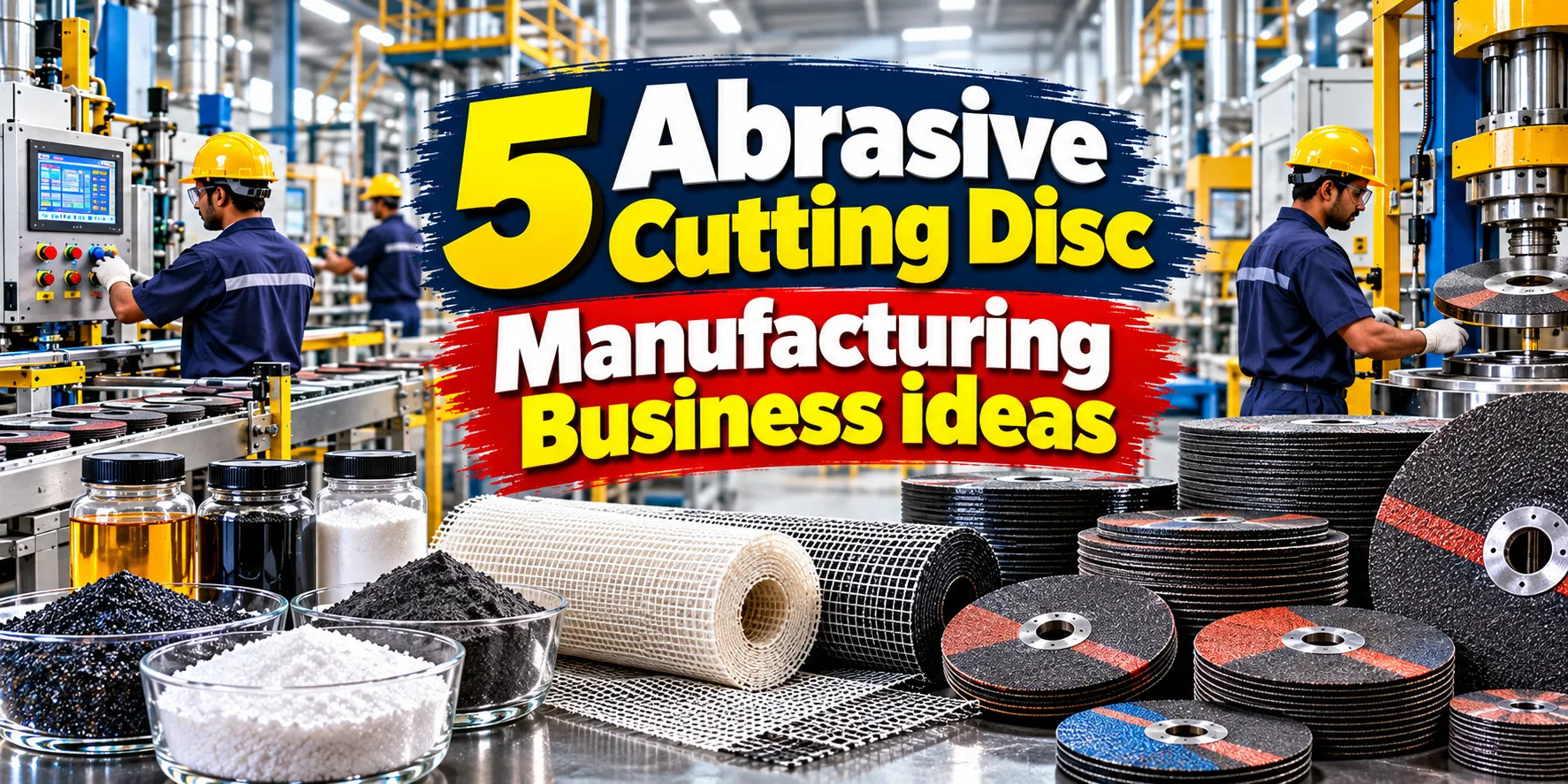
Cutting Disc Manufacturing Business ideas are gaining attention among entrepreneurs looking for a practical industrial manufacturing opportunity with consistent and recurring demand. Every fabrication shop, construction site, engineering workshop, automobile repair unit, and metalworking facility in India regularly uses abrasive cutting and grinding discs for cutting, shaping, finishing, and surface preparation.
Unlike capital equipment that may be purchased only once every few years, cutting discs are consumable products that wear out during regular use and need frequent replacement. This creates a continuous demand cycle for manufacturers and distributors, resulting in repeat orders rather than dependence on one-time sales.
The business can serve a wide customer base, including steel fabricators, welders, construction contractors, machinery manufacturers, automotive workshops, shipyards, infrastructure companies, and industrial maintenance units. Demand is also relatively non-seasonal because metal cutting, fabrication, repair, and construction activities continue throughout the year.
For new entrepreneurs entering industrial manufacturing, cutting disc production can offer a comparatively manageable entry point. Manufacturers can begin with selected disc sizes and applications, develop a dealer and distributor network, and gradually expand into grinding wheels, flap discs, polishing products, and other abrasive consumables.
With the right formulation, manufacturing equipment, quality-control processes, safety standards, branding, and distribution strategy, a cutting disc manufacturing business can develop into a scalable industrial consumables venture supported by recurring market demand.
Why Abrasive Cutting Disc Manufacturing Is a Smart Business Idea Right Now
Metal fabrication, construction, automotive repair, and general engineering workshops all consume cutting and grinding discs continuously as part of routine operations, not as occasional capital purchases. As India’s manufacturing and infrastructure activity has expanded, so has the base of workshops and fabrication units consuming these consumables daily. Because quality and safety certification directly affect user safety, given that discs operate at high rotational speeds, certified domestic manufacturers increasingly compete favourably against unregulated imports, particularly as buyers grow more safety-conscious.
Government Policies & Incentives
Abrasive product manufacturing falls under general engineering goods policy support, with quality benchmarking guided by the Bureau of Indian Standards, whose safety standards for bonded abrasive products are central to institutional buyer trust. MSME-scale manufacturers can access collateral-free credit and technology upgradation support through the Ministry of MSME, while Make in India initiatives continue to favour domestic sourcing of industrial consumables in government and public-sector procurement. MSME technology upgradation schemes also support subsidised acquisition of testing equipment such as speed-testing rigs, helping smaller manufacturers meet BIS safety certification requirements without the full capital cost falling entirely on the promoter.
5 Cutting Disc Manufacturing Business Ideas for Startups
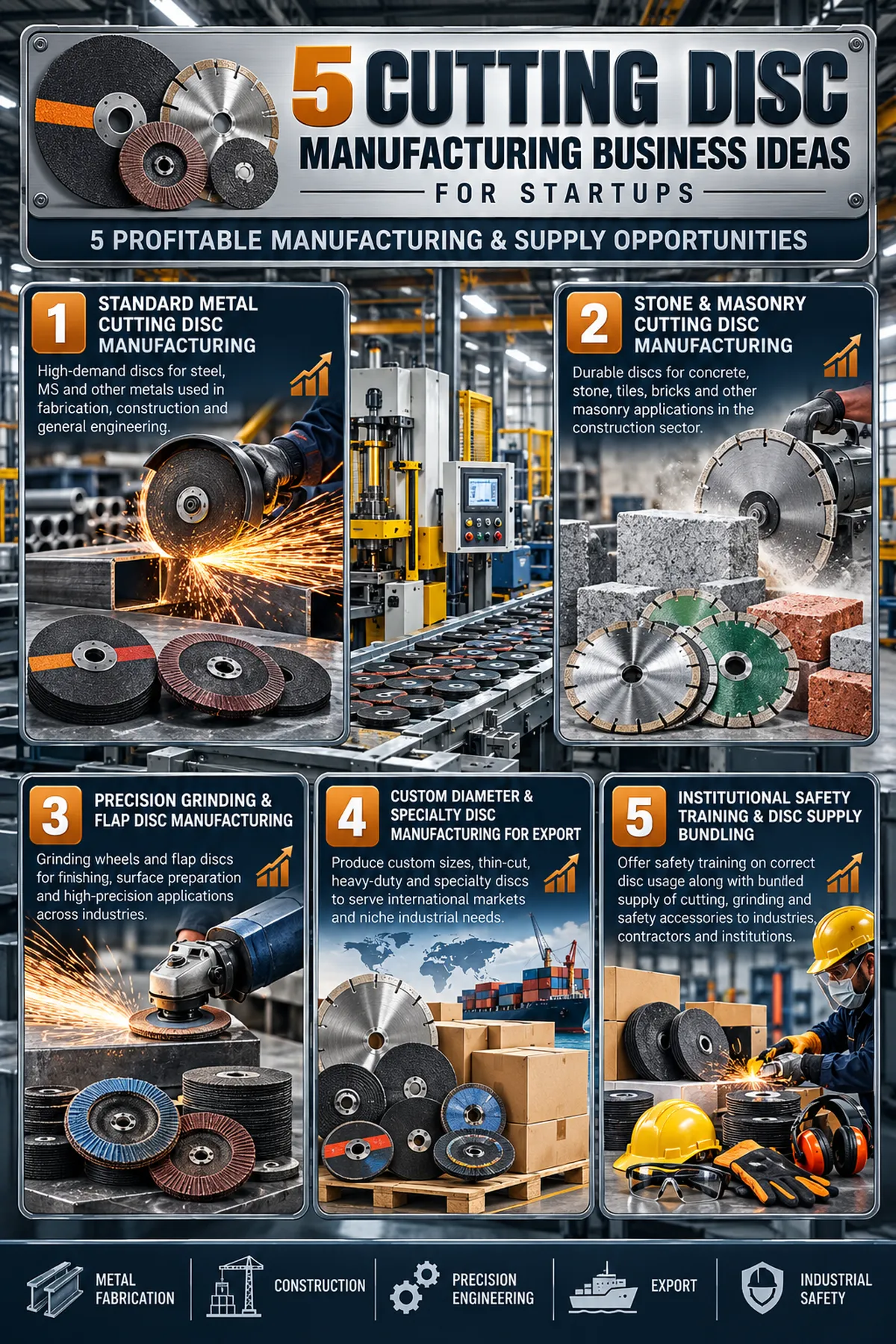
Standard Metal Cutting Disc Manufacturing
Basic reinforced cutting discs for angle grinders, used across fabrication shops, construction sites, and automotive workshops, represent the highest-volume product category. A manufacturer that focuses on consistent quality and safety-tested bonding can build strong distributor relationships across hardware retail networks, generating steady repeat orders.
Stone & Masonry Cutting Disc Manufacturing
Construction and stone-processing industries require specialised discs formulated for cutting concrete, tile, and masonry rather than metal. This product line diversifies a manufacturer’s customer base into construction and stone-processing clusters, which often operate independently of metal fabrication demand cycles.
Precision Grinding & Flap Disc Manufacturing
Beyond basic cutting, grinding and flap discs used for surface finishing in fabrication and automotive body work carry somewhat better margins due to more specialised bonding formulations. This segment rewards manufacturers who invest in formulation testing to match specific finishing requirements across different metal types.
Custom Diameter & Specialty Disc Manufacturing for Export
Many overseas buyers, particularly in Africa and the Middle East, want cutting and grinding discs in diameters or specifications not commonly stocked by large multinational brands. A manufacturer willing to accommodate smaller, customised export orders can build a loyal international buyer base that larger, more standardised competitors tend to overlook.
Institutional Safety Training & Disc Supply Bundling
Bundling basic grinder safety training materials with bulk disc supply contracts for industrial clients differentiates a manufacturer beyond price alone, building stickier institutional relationships with buyers who value demonstrated safety commitment.
Import–Export Opportunity Analysis
A meaningful share of India’s abrasive disc consumption still comes from imports, particularly from manufacturers offering lower-cost but sometimes uncertified products, creating a genuine opening for certified domestic manufacturers to win safety-conscious institutional buyers. On the export side, Indian abrasive manufacturers increasingly supply price-competitive, BIS-certified discs to neighbouring and African markets, an opportunity regularly highlighted through the Federation of Indian Chambers of Commerce and Industry.
Market Outlook & Scaling Roadmap
As India’s fabrication, construction, and automotive repair base continues expanding, particularly in tier-two and tier-three cities, demand for reliable, certified abrasive discs is expected to keep growing steadily. Manufacturers who invest early in safety testing infrastructure are best placed to win institutional and export business as buyers grow increasingly cautious about uncertified imports following well-publicised safety incidents.
Skills, Manpower & Quality Control
Cutting disc manufacturing needs press operators trained in precise resin-bonding and curing procedures, since inconsistent pressing directly causes the safety failures this industry works hard to avoid. A small unit typically employs 15 to 20 workers, with a quality control supervisor overseeing speed testing and dimensional accuracy being the single most important role given the safety stakes involved in this product category.
Indian MSME Success Stories
Grindwell Norton — Saint-Gobain Group (India operations)
Grindwell Norton’s decades-long focus on abrasive product quality and testing infrastructure in India shows how consistent investment in safety certification builds long-term trust with industrial buyers who cannot afford disc failures on the shop floor.
Carborundum Universal (CUMI) — Murugappa Group leadership
CUMI’s growth within the Murugappa Group demonstrates how disciplined process engineering in abrasives manufacturing, combined with steady export market development, can turn a specialised industrial consumable into a genuinely large-scale, export-oriented business.
How NPCS Can Help Entrepreneurs Evaluate the Opportunity
We at Niir Project Consultancy Services (NPCS) provide professional consulting for the preparation of Market Survey cum Detailed Techno-Economic Feasibility Reports (DPRs) for setting up new industries or businesses. Our reports include detailed manufacturing processes, market research and demand analysis, process flow diagrams, product mix and capacity planning, machinery and raw material details, and complete project financials with profitability analysis. Entrepreneurs use these reports to evaluate feasibility, profitability, and long-term scalability before investing, which reduces guesswork at the most capital-intensive stage of a new venture.
For anyone evaluating Abrasive Cutting Disc Manufacturing, that groundwork matters most before any capital is committed: NPCS studies work through machinery selection, raw material sourcing, plant layout, manpower planning, and a full financial model covering capital cost, working capital, revenue projections, and return on investment. Entrepreneurs approaching banks, NBFCs, or state MSME schemes for financing typically need exactly this kind of documented feasibility study, since lenders rarely fund a project on an idea alone. Working with an established consultancy also shortens the learning curve considerably, letting a first-time promoter benefit from patterns NPCS has already observed across hundreds of similar manufacturing projects.
NPCS has published a comprehensive printed reference book on Abrasive Cutting Disc Manufacturing, covering technology, market analysis, investment parameters, and manufacturing processes in depth — the printed book: Steel Rolling Technology Handbook.
For a detailed techno-economic Project Report on setting up a manufacturing business in this sector — including plant economics, machinery lists, financial projections, and applicable government incentives — the NPCS Project Report: Business Opportunities in Cutting Metal with Cutting Wheels.
Data Table
Indicative Cost & Capacity for a Cutting Disc Manufacturing Unit
| Parameter | Small Unit | Mid-Size Unit |
|---|---|---|
| Approximate project cost | ₹1.5–2 crore | ₹5–8 crore |
| Production capacity | 8,000–10,000 discs/day | 30,000–40,000 discs/day |
| Core manpower | 15–20 | 50–70 |
| Key certification | BIS bonded abrasive safety standard | BIS, export-market safety compliance |
| Typical payback period | 3–4 years | 3–5 years |
Note: Figures above are indicative planning estimates for feasibility discussion and vary by location, scale, and machinery configuration.
Common Pitfalls to Avoid
A serious and common mistake is cutting corners on speed and burst testing to reduce production cost, which creates genuine safety liability given how these products are used. Another frequent pitfall is underestimating the importance of consistent fibreglass reinforcement quality, which directly affects disc durability and safety.
Conclusion
Abrasive cutting disc manufacturing suits entrepreneurs who value steady, recurring industrial demand over dramatic growth spikes. Coordinating with manufacturing-heavy states such as Invest UP portal can help new entrants position themselves close to fabrication and construction clusters that consume these products daily.
Your Investment Deserves the Right Opportunity
Every serious investment begins with choosing the right sector and the right business model. With hundreds of industrial opportunities available across India’s manufacturing and clean-energy landscape, making the most informed choice is critical. NIIR’s Startup Selector tool helps entrepreneurs, MSMEs, and investors identify the most suitable business opportunities based on their investment capacity, location, and interests — so your capital is directed toward a venture with the strongest fit and potential.


