






Introduction: Indian Spice Industry Growth
India has always been known as the “Land of Spices.” For centuries, spices have been a key element in the country’s agriculture, trade and culinary traditions. Today, Indian spices industry has become a big agro-processing and export-oriented industry that plays an important role in the country’s economy.
India is the world’s largest producer, consumer, and exporter of spices at the moment, and provides a wide variety of spices to the world markets. With the advent of fast growth of food processing industries, increasing global demand for natural ingredients, and consumer preference for hygienically packaged products, the spice industry is experiencing a new phase of growth.
Government initiatives, support of organizations such as Spices Board India and increasing participation of private companies are further strengthening the industry.
Between 2026 and 2030, the spices industry in India is expected to grow at a good pace, driven by expansion in exports, organized retailing growth and increasing opportunities for entrepreneurs and MSME investors.(Indian Spice Industry Growth)
Read More: Handbook on Spices, Seasonings and Condiments Processing, Extraction with Kitchen Spices Manufacturing
India Spices Market Size And Growth Forecast
The Indian spices market has been witnessing a consistent growth in the last decade. In 2025, the industry was valued at around Rs. 2,21,832 Crores, while the industry is estimated to reach a value of almost Rs. 5,28,985 Crores by 2034 with the compound annual growth rate (CAGR) estimated at 10.14%.
Based on this growth trajectory, the market is expected to be steadily growing during the 2026 – 2030 period.(Indian Spice Industry Growth)
Estimated Market Growth
| Year | Market Size |
| 2026 | ₹2,44,326 Crores |
| 2027 | ₹2,69,100 Crores |
| 2028 | ₹2,96,387 Crores |
| 2029 | ₹3,26,441 Crores |
| 2030 | ₹3,59,542 Crores |
This implies that the industry has the potential to bring in more than the additional value of over Rs.1.38 Lacs in five years time, making it one of the best areas in India’s food processing industry.
Another area of the market that has experienced a notable change is the movement from loose spices to branded packaged products. Packaged spices now constitute about two-thirds of retail sales reflecting the increasing consumer awareness about food safety, hygiene and quality.(Indian Spice Industry Growth)
Production Base and Supply Base of Spices of India
India’s large agricultural diversity permits the growth of a large variety of spices in different climatic regions. The country produces over 70 types of spices ranging from traditional kitchen spices to high value specialty products.(Indian Spice Industry Growth)
In FY 2024-25, India’s total spice production is estimated to be approximately 12 million tonnes, making it the biggest spice producer in the world.
Major spice producing states are:
- Andhra Pradesh
- Telangana
- Gujarat
- Rajasthan
- Kerala
- Karnataka
- Tamil Nadu
These states constitute the backbone of the supply chain of spices in India for both domestic consumption and export.(Indian Spice Industry Growth)
Read More: A Business Plan For Spices (Red Chili, Turmeric, Coriander, Cumin & Garam Masala)
Export Performance of Indian Spice Industry
Spices are one of the most important export commodities of India’s agriculture. The country exports spices to more than 180 countries around the world, including major markets in the United States, Europe, the Middle East, and Southeast Asia.
During the fiscal year 2024-25, the exported quantity of spices and spice products from India was about 1.799 million tonnes, which earned export revenues of about US$4.72 billion.
Key export products include:
- Chilli
- Cumin
- Turmeric
- Cardamom
- Spice oils and oleoresins
Chilli and cumin have become the main export products which generate the highest revenue for most countries including China and the United States and Middle Eastern nations.
The market for spice oils and oleoresins has expanded as value-added products because they are essential components in food processing and pharmaceutical and cosmetic manufacturing. These processed products provide higher profit margins as compared to raw spices exports.(Indian Spice Industry Growth)
Read More: Spices and condiments, Indian Kitchen Spices, Masala Powder
Spice Imports and Import Dependent Products
Despite being the largest producer of spices, India still imports some spices to fulfil local demand as well as food processing industries.
In FY 2024-25, the import of spices was on the order of 400,811 tonnes with the overall import value of the same order of US$1.64 billion.
Some of the more import-dependent spices are:
- Cloves – Since domestic production reaches only small levels the country needs to bring in vast amounts of foreign products throughout the entire year.
- Black Pepper – India grows Black Pepper but the country depends on imports to meet its domestic demand for the product.
- Cassia and Cinnamon – People commonly use this ingredient as a spice which they add to both food products and processed items.
- Asafoetida (Hing) – Traditionally imported as commercial cultivation in India has been in existence only recently.
These imports create opportunity for processing, blending and packaging business within India.(Indian Spice Industry Growth)
Spice Trading Hubs in India
The Indian spice trade is concentrated around several big agricultural markets and trading clusters. These hubs are important canters for price discovery, bulk procurement and export logistic.(Indian Spice Industry Growth)
Key trading canters include:
Unjha, Gujarat
One of the largest spice markets in Asia and known to be mainly for cumin and other seed spices.
Guntur, Andhra Pradesh
A major chilli trading and export processing centre.
Rajkot and Mehsana, Gujarat
Important Markets for Fennel Seed and Other Spice
Setting up processing units closer to these trading hubs can ensure reduced transportation costs, difficulty in sourcing raw material and delays in procurement.(Indian Spice Industry Growth)
Read More: Spice Processing & Packaging Industry in India: Export Potential and Startup Profit Margins
Competitor Landscape in the Industry
The Indian spices industry is extremely fragmented with both large national brands as well as thousands of regional manufacturers.
Major organized players are:
- MDH
- Everest
- Aashirvaad Spices
- Catch Foods
- Patanjali
- Aachi Masala
While these brands have a monopoly in retails and supermarkets throughout the country, there are still regional spice manufacturers surviving in the local markets.(Indian Spice Industry Growth)
This fragmented structure of the market enables the new entrants to compete by targeting:
- Competitive pricing
- Regional taste preferences
- Unique spice blends
- High-quality packaging
Emerging Trends in the Spice Business
There are various new trends in the Indian spices market.
Increasing Demand for Organic and Clean-Label Spices
Consumers are becoming increasingly concerned with pesticide residues and chemical contamination of food products. As a result, demand for organic, pesticide free and traceable spices is increasing rapidly.(Indian Spice Industry Growth)
Growth of E-commerce and Quick commerce
Online grocery platforms and quick commerce services have grown significantly over the past several years. Digital channels enable smaller brands to access customers directly, without depending on the conventional distribution networks using wholesale retailers.
Growing Popularity of convenience foods
Urban consumers are increasingly switching to ready-to-cook spice mixes, marinades and cooking pastes that make their meals easy to prepare.
These value-added products provide higher profit margins for the manufacturers.(Indian Spice Industry Growth)
Read More: Inside India’s Spice Trade: History, Tech & Quality Standards in One Volume
MSME and Startup Opportunity in the Spices Sector
The spices business provides many lucrative opportunities for business owners and MSME investors.
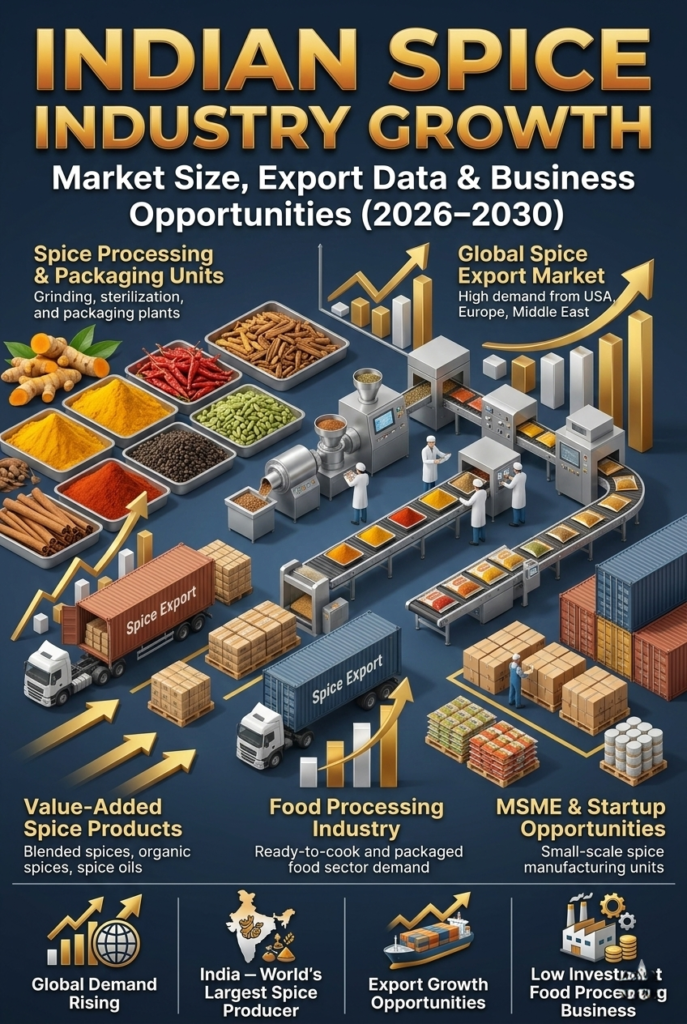
- Spice Processing and Grinding Units
Entrepreneurs can set up processing facilities that do:
- Cleaning
- Grading
- Grinding
- Blending
- Packaging
Such units can provide products to exporters and wholesalers; retail brands.
- Private Label Manufacturers
Many supermarkets and e-commerce sites sell their own brand names of spices but contract out its manufacturing to the third parties. The business model enables small companies to expand production capability without the need for substantial expenditure on promotional activities.
- Export Oriented Spice Processing
Spice processing units which meet export standards can achieve access to premium export markets through their focus on quality certification and standardized packaging and international food safety regulations.
- Value-Added Products
Entrepreneurs have the ability to develop products which include:
- Spice blends
- Cooking pastes
- Marinades
- Ready to cook seasoning mixes
The products are designed to meet the needs of contemporary consumers who prioritize both fast service and top-notch dining experiences.(Indian Spice Industry Growth)
Conclusion
The Indian spice market has entered its next growth stage which will increase exports and domestic sales while providing opportunities for advanced processing methods.(Indian Spice Industry Growth)
Between 2026 to 2030, the sector is likely to benefit from a strong global demand, technological development in food processing, and an increasing trend in consumer preference for high quality packaged spices.
With the backing of institutions such as Spices Board India and the growing digital retail platforms, the industry is getting more organized and becoming globally competitive.
For entrepreneurs and MSME investors, spice sector provides sustainable business opportunities, good export potentials and long-term markets growth.
The industry will experience success through businesses which focus on maintaining product quality and managing supply chains and developing new products.(Indian Spice Industry Growth)
Get Detailed Insights from This Book: Just For Starters: How To Start Your Own Export Business
Frequently Asked Questions (FAQ)
What is growth of Indian spices market expected ?
The Indian spices market is expected to rise at about 10 percent CAGR which may reach more than 5 Lacs Crores by 2034.
What are the most exported spices from India?
The leading exported spices from India are chilli, cumin, turmeric and spice oils or oleoresins.
Why do we import some spices in India?
India imports spices like cloves, cassia, cinnamon and asafoetida because insufficient domestic production is unable to meet the demand.
Is starting a spice processing business profitable?
The combination of constant product demand and extended product shelf life and large international export capacity enables spice processing companies to achieve profitable operations.


This article gives a detailed and practical overview of how the Indian spice industry is evolving beyond traditional agriculture into a strong value-added and export-driven sector. It is encouraging to see how factors like food processing, organized retail, e-commerce, and global demand for clean-label products are creating new opportunities for MSMEs and entrepreneurs. The focus on supply chains, quality standards, and value-added spice products also highlights how the industry is becoming more competitive and globally aligned. India’s strength in both production and exports continues to make the spice sector an important contributor to long-term agricultural and economic growth.