






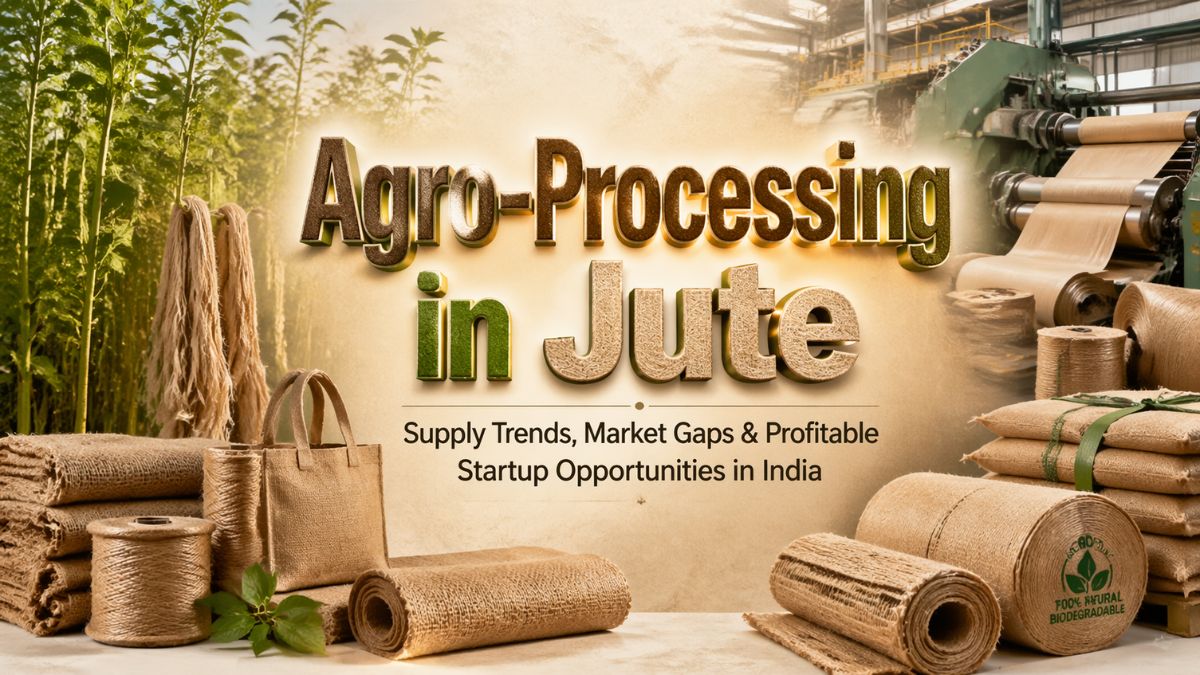
Introduction: Jute agro processing business
Although jute has been a highly significant agro-based industrial fibre in India over the decades, its role has grown further in the current sustainability conscious economy. With the global shift toward use of environmentally friendly materials by the governments and industries, jute is increasingly being considered as a safe alternative to the use of plastic and synthetic materials in packaging.
The jute industry is unlike many other commodities in that it enjoys a high institutional demand, government support mechanism and a well-established agricultural base. These aspects have presented an entrepreneur with a stable base to consider establishing manufacturing or agro-processing enterprises. Jute provides the first-generation entrepreneurs and MSMEs with a mix of predictable demand, controllable levels of investments, and long-term growth opportunities.
The trend towards biodegradable packaging and environmentally friendly goods is not a fad, and it is a structural shift in the markets worldwide. This change is creating new business opportunities by allowing businesses to manufacture high-quality jute products at an efficient and consistent rate.
Table of Contents
ToggleGet Detailed Insights from This Book: Complete Book on Jute & Coir Products
India’s Raw Jute Supply Situation and Market Stability
Millions of farmers and powerful agricultural infrastructure still make India the largest raw jute producer in the world. One of the most significant aspects of every processing business is the availability of raw material and in the case of jute, the stability of the supply has been continually ensured by government policies and market processes.
There are comparatively few changes in production between years and with buffer stocks there is continuity of supply even when production is affected by seasonal changes. Government procurement departments are also very critical as they buy raw jute at minimum support price (MSP) when the market price goes below a specific point.
To the entrepreneurs, it offers a predictable operating environment and lessens the possibility of price volatility.
Key Supply Advantages for Entrepreneurs
- Raw material that is available all year round.
- Price stabilization by the government by MSP.
- Strong domestic production which is backed by imports.
- Trustworthy buffer stock quantity to guarantee supply continuity.
All these acts to render the jute industry much more stable than most other industries in agricultural processing.
Why the Jute Industry is Attractive for New Businesses
The government procurement programs assure a stable demand, which is one of the greatest strengths of the jute industry. Jute packaging plays a major role in food grain storage and transportation systems, and the food will be consumed constantly without regard to the market condition.
Besides the domestic demand, the international market is also shifting towards using eco-friendly materials. The retailers, exporters as well as manufacturing companies are moving towards the use of biodegradable packaging solutions in order to adhere to environmental regulations.
There are a few structural advantages to entrepreneurs venturing into the jute industry:
- Government procurement agencies demand, which is policy-driven.
- Increasing demand on sustainable products all over the world.
- Medium barriers to entry as opposed to heavy industry.
- Access to skilled workforce in traditional jute areas.
- Expanding export opportunities
Due to such benefits, jute industry is said to be a low-risk entry point to the manufacturing industry.
Get Detailed Project Report (DPR): Jute, Oil & Coir Projects Guide
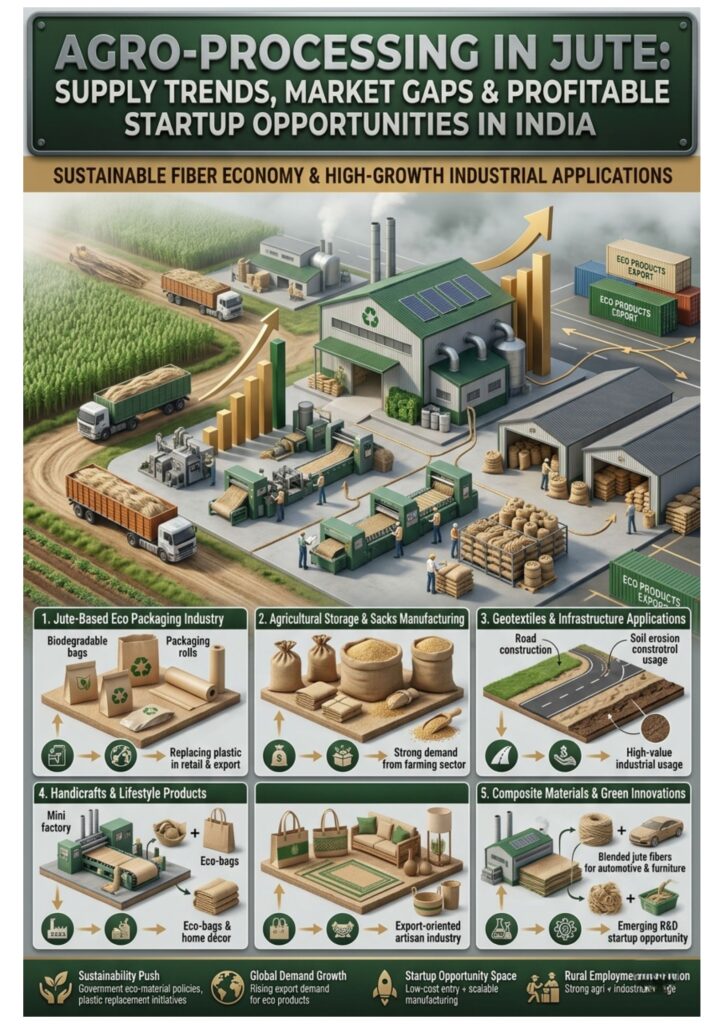
Emerging Market Gaps in the Jute Processing Industry
The jute industry has a number of structural gaps despite its strong base that opens up opportunities to the new businesses. The challenge of limited adoption of modern technology of processing is one of the biggest challenges. There are still numerous units that are using obsolete equipment and therefore, their productivity is reduced and their operating expenses are high.
The other significant gap is in the development of value added products. The jute sacks are traditional and are predominant in production yet there is increasing demand towards innovative and specialized products. Companies investing in quality and diversification of their products are able to attract new markets and attain greater profit margins.
Another aspect requiring improvement is supply chain management. Ungraded jute and poor quality of jute are sold in most areas and this has caused inefficiencies and variations in prices.
Major Market Opportunities
- Modernization of the current processing units.
- High value jute products development.
- Introduced centralized procurement and grading facilities.
- Diversification to export products.
These prospects show that there is still much room to be exploited and innovate in the industry.
Profitable Business Opportunities in Jute Agro-Processing
There are various business models of the jute industry that can be adopted by business people who have varied investment levels and technicalities. The production of jute bags to package food grains is probably one of the best and secure alternatives as it has stable demand and long-term contracts.
The other strong segment that can be exploited is the diversified jute product which is meant to be produced to serve the retail and export markets. These products are usually pricier due to their eco-friendliness and beauty.
Jute Business Ideas that have high potential
- Jute bag production to store food grain.
- Manufacturing diversified jute products.
- Grading and aggregation centers of jute fibres.
- Jute yarn spinning units
- Jute composite board production.
- Pulp and paper manufacturing (jute).
- Jute goods export business.
All these segments provide varying degrees of investment and returns, as well as the entrepreneur may select the business model that suits the resources and long-term objectives.
Financial Potential and Profitability outlook.
Operational efficiency, product selection and positioning in the market plays a key role in the profitability of a jute processing business. Nonetheless, the tendencies in the industry indicate that properly managed units are able to attain stable financial results and stable revenue increase.
The expenses involved in running the jute industry are normally low in comparison to other manufacturing industries and local raw materials are available which lowers transportation costs. Companies that invest in the current equipment and have stringent quality control measures are more likely to have a high profit margin.
Key Profit Drivers
- Good and stable market demand.
- High risk of low supply of raw materials.
- Growing export opportunities
- Growing need to have green products.
- Sustainable industries supported by the government.
Proper financial planning and working capital management will be crucial in avoiding disrupted operations particularly during peak seasons in procurement.
The Role of Professional Feasibility Planning in Business Success
The entrepreneurship of starting a manufacturing business without proper planning may put the entrepreneur at financial risks and operation difficulties. A systematic feasibility study is used to determine the market demand, investment needs as well as determine the possible profitability.
A project report is usually detailed with technical specifications, planning of production capacity, machinery needs, sourcing of raw materials, and financial forecasts. This document is often required by banks and financial institutions when evaluating loan applications.
Professional planning is not only able to minimize uncertainty but also enhances decision-making and the likelihood of succeeding in the long-term in the business.
Related Article: Eco-Friendly Packaging Business
About NPCS (Niir Project Consultancy Services)
Niir Project Consultancy Services (also referred to as NPCS) is an established industrial consulting firm specializing in giving technical and financial advice to new manufacturing ventures. The organization has many years of experience in industrial planning and market research and has assisted thousands of entrepreneurs to start successful businesses in various fields.
NPCS is the company which specializes in preparing the detailed project reports (as to all the aspects of the industrial development, starting with the analysis of the raw materials, and finishing with financial projections). The banks, investors and government agencies know these reports well and are thus a good source of information to the entrepreneur who wants to raise funds or have regulatory approvals.
Services that NPCS offers
- Detailed Project Reports (DPR)
- Market research and feasibility studies.
- Guidance on machinery and technology choice.
- Cost estimates and financial forecasts.
- Start-up and growth consultancy in business.
NPCS main aim is to assist the entrepreneurs develop sustainable and profitable industries by means of professional planning and technical skills.
Future Outlook of the Jute Processing Industry
The future of jute industry is directly connected with the global trends in sustainability and with the environmental laws. Demand of biodegradable materials will go up tremendously as more governments adopt policies that will minimize plastic waste.
The industry will also be boosted by infrastructure development, expansion of export markets, modernization of technology which will further enhance the growth curve of the industry. The long-term opportunities are likely to be enjoyed by entrepreneurs who come to the market with a clear plan and effective operations.
Jute is not only an old agricultural produce, but now it is a contemporary industrial produce that has high economic potential.
Frequently Asked Questions (FAQ)
Is it a profitable business to process jute in India?
Yes, it is possible to make jute processing profitable due to the stable demand in terms of government procurement programs and the development of foreign markets in the eco-friendly products.
What is the amount of capital needed to open a jute business?
The amount of investment required will differ according to the business model, the capacity of production and the degree of automation.
What is the best jute business to start with?
Manufacturing of diversified jute products and fibber aggregation is deemed to be appropriate as an entry point of new entrepreneurs.
Are raw materials reliable in jute industry?
Yes, the supply tends to remain constant because there is high agricultural production and government subsidies.
Are loans to jute processing businesses offered by banks?
Yes, banks and other financial institutions usually give loans to finance jute processing projects particularly with a well-prepared project report.


