






India’s manufacturing sector is growing at a tremendous rate with the continuous growth in infrastructure development, industrialization and renewable energy projects in the nation. Entrepreneurs are moving more and more away from trading businesses towards manufacturing due to the longer term assets, stable cash flow and scalability of production-based industries. With the government’s support for domestic manufacturing and export growth, there are a number of industrial sectors that are proving to be very lucrative business opportunities.
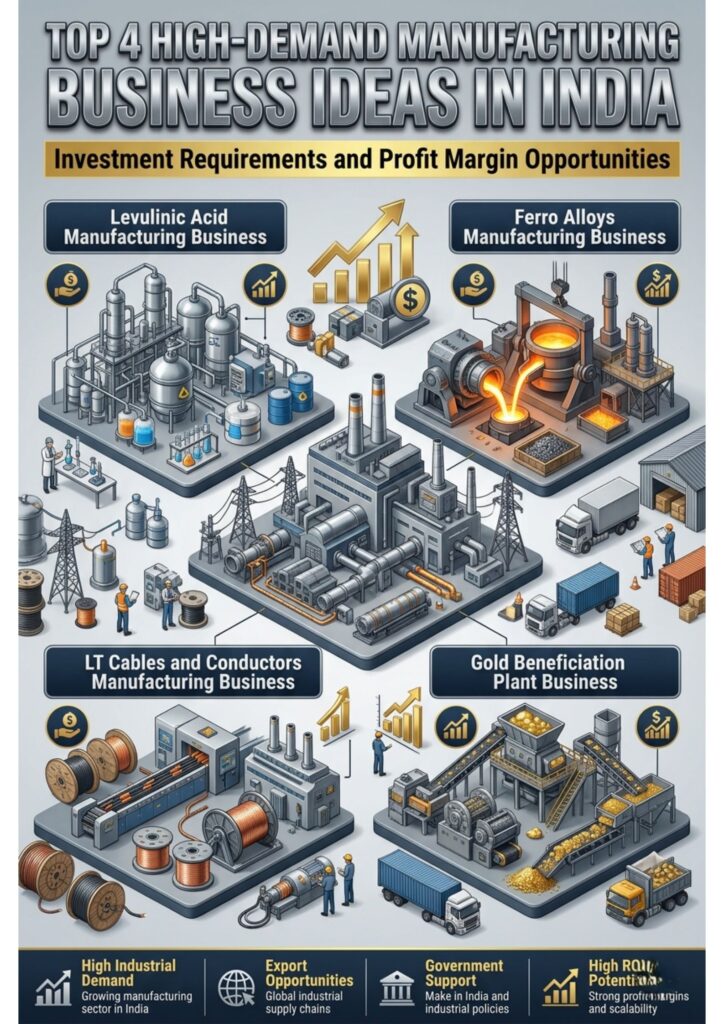
Among the most promising industries in today’s world are Levulinic Acid manufacturing, Ferro Alloys manufacturing, LT Cables and Conductors manufacturing and Gold Beneficiation plants. These sectors are directly related to construction, energy, chemicals, and mining industries that assure constant demand and good long-term growth potential.
This article explains these four high demand manufacturing business ideas in a practical business perspective such as market demand, production requirements, investment considerations, and profitability outlook.
Table of Contents
Toggle1. Levulinic Acid Manufacture Business
A Rapidly Expanding Opportunity in the Specialty Chemical Industry
Agricultural waste materials which include bagasse and rice husk and cellulose biomass serve as essential input materials for levulinic acid production. The chemical functions as a platform chemical because it can generate multiple industrial products through its use. The worldwide transition of industries to sustainable chemical solutions results in increasing demand for bio-based products.
The chemical serves multiple purposes across three main industrial sectors which include pharmaceutical production and agrochemical production and fuel additives. The chemical compounds which exist in this substance provide its essential value for green chemistry applications which create new business opportunities in specialty chemical manufacturing.
The manufacturing process is about converting biomass into levulinic acid by means of controlled chemical reactions. Agricultural waste is first prepared and treated by acid hydrolysis under certain temperature and pressure conditions. The product is then purified and concentrated by the use of industrial distillation equipment. Proper waste treatment systems are required to ensure compliance with the environment.
Read the Complete Book Here: Handbook On Chemical Industries (Alcohol Based)
Important Uses of Levulinic Acid
Some of the major industrial applications are:
- Pharmaceutical intermediates
- Agrochemicals and Fertilizers
- Plasticizers and resins
- Fuel additives
- Biodegradable solvents
Taking the manufacturing of levulinic acid from a business point of view, it needs a moderate level of investment compared to heavy industries. However, success in this sector is bound to depend on efficient production and reliable supply of raw materials. And plants near agricultural areas tend to be more profitable because of lower transportation costs.
Well-run manufacturing units in this industry can score operating margins of between 18 percent and 25 percent, especially if production efficiency is optimized and the use of by-products is put to good use.
2. Ferro Alloys Manufacturing Business
A Core Industry for the Growth of Steel and Infrastructure
Steel production requires ferro alloys because they provide essential materials that increase the metal’s strength and durability while protecting it from corrosion. The steel industry experiences increased demand because India expands its highway and bridge and railway and industrial facility construction projects. The manufacturing sector relies on ferro alloy demand because it drives growth in this industry which provides essential materials for production.
Ferro alloys form through the combination of iron with elements that include manganese and silicon and chromium. The materials improve steel performance, which enables usage in heavy construction projects and machinery manufacturing work and automotive production tasks.
The manufacturing process requires high-temperature smelting with electric furnaces. Continuous power supply is crucial due to the fact that electricity is one of the biggest operational costs in the industry.
Major Types of Ferro Alloys
Some of the common ferro alloys manufactured in India are:
- Ferro Silicon
- Silico Manganese
- Ferro Manganese
- Ferro Chrome
- High Carbon Ferro Manganese
Ferro alloys manufacture is thought to be a capital-intensive business with a high scalability and consistent demand. Companies that are able to establish stable sources of power and of raw materials can sustain steady production and profitability.
The efficient producers in this industry generate profit margins between 12 percent and 20 percent, which varies according to their operational efficiency and prevailing market conditions.
Get Detailed Project Report (DPR): Ferro Alloys Manufacturing Project Report
3. LT Cables and Conductors Manufacturing Business
A High-Demand Sector Driven by Power and Infrastructure Expansion
Low Tension cables and electrical conductors form the vital part of electricity distribution system. They are being used in residential buildings, commercial complexes, factories, and renewable energy installations. As urbanization is growing and the demand for electricity is rising day by day, the requirement for robust and reliable electrical wiring and distribution equipment is rapidly increasing all across India.
The demand for electrical cables increases due to government electrification programs and smart infrastructure projects. The growth of solar power systems and electric vehicle charging stations is also providing new market opportunities for cable manufacturers.
The production process is to make electrical wires by drawing and stranding the metal rods. These wires are then covered with insulation materials to ensure safety and durability. After insulation and sheathing, finished cables are quality tested to conform to industry standards.
Main Raw Materials Used In Manufacturing The Cable
The main materials needed are:
- Copper or aluminum
- PVC insulation compound
- XLPE insulation material
- Chemicals additives and stabilizers
Compared to heavy industries, the entry barriers for the manufacturing of LT cables are relatively moderate and the rate of entry into the market is faster. Entrepreneurs can begin with a medium-scale unit and expand the production capacity as the demand grows.
Well managed cable manufacturing businesses generally have net profit margins ranging from 8 percent to 15 percent. Companies that are concerned with product quality, distribution networks and customer relationships are often successful in this industry, at least in the long run.
4. Gold Beneficiation Plant Business
Value Addition in Mining and Mineral Processing Sector
Gold beneficiation is the process of enriching the gold on the ore before refining. This process helps to improve the efficiency of the extraction process and reduces the amount of waste generated, making it an essential step in the mining process. Although India is an importer of gold, the domestic mining activity is slowly growing, opening up new opportunities to mineral processing businesses.
The beneficiation process starts by crushing and grinding the gold-bearing ore into smaller particles. The material is then treated with separation methods to separate the gold from other minerals. Environmental compliance and waste management are very important in this industry because of the chemicals used in the extraction process.
Processes that are key to gold beneficiation
Typical stages in the beneficiation process are:
- Crushing and grinding
- Gravity separation
- Flotation process
- Chemical extraction
- Tailings management
This sector needs technical expertise, adequate safety systems, and environmental compliance. Investors venturing into this industry should thoroughly consider the regulations, equipment costs and long-term supply agreements before setting up a plant.
The profitability of this business is determined to a large extent by the quality of the ores and the efficiency of the operation. Stronger financial returns are usually seen with higher grade ore.
How to Choose Right Manufacturing Business in India
The selection of a manufacturing enterprise represents the most important choice which an entrepreneur must make. The establishment of a profitable manufacturing business requires entrepreneurs to execute their planning patterns together with market examination and financial assessment abilities. Companies need to understand their market demands and use operational needs to decrease their risk while creating pathways to generate enduring profits.
Before establishing a manufacturing facility, entrepreneurs need to evaluate multiple essential elements.
Important Factors to Consider
- Market demand and growth potential
- Investment in capital requirements
- Raw material availability
- Power & infrastructure support
- Government Approvals and Compliance
- Skilled workforce availability
A professional feasibility study needs to be conducted before any organization makes its manufacturing project investment decision. The business plan delivers financial estimates about expenses and revenue while assessing all potential business risks.
Conclusion
India’s manufacturing industry is passing through a stage of good and sustained growth. Sectors like specialty chemicals, metallurgical materials, electrical infrastructure, and mineral processing are evolving to be the major contributors to economic development. Entrepreneurs who carefully pick the right industry and operate their businesses efficiently can create manufacturing businesses that are profitable and sustainable.
With appropriate planning, stable raw material supply, and excellent operational control these high-demand manufacturing sectors provide long-term growth, stability, and success in the changing industrial landscape.
Frequently Asked Questions (FAQ)
What is the most profitable manufacturing business in India?
Levulinic acid manufacturing and ferro alloys production are the two industries which are thought to be highly profitable because of the strong industrial demand and export potential. However, profitability is determined by operational efficiency and cost management.
Which manufacturing business is suitable for beginners?
LT cable manufacturing is more suitable for new entrepreneurs for the most part since there is moderate investment and the market demand is stable.
How much investment is needed to launch a manufacturing plant?
Investment is varied in accordance with industry and capacity of production. Small units of manufacture require medium level of capital whereas large industrial plants require huge level of infrastructure and equipment investment.
Do manufacturing business require government approval?
Yes, most manufacturing businesses need licenses, environmental clearances and regulatory approvals before beginning operations.
Is manufacturing a good business opportunity in India 2026?
Yes, manufacturing is one of the high growth sectors in India, because of infrastructure development, industrial growth and support of the government for domestic manufacturing.


