





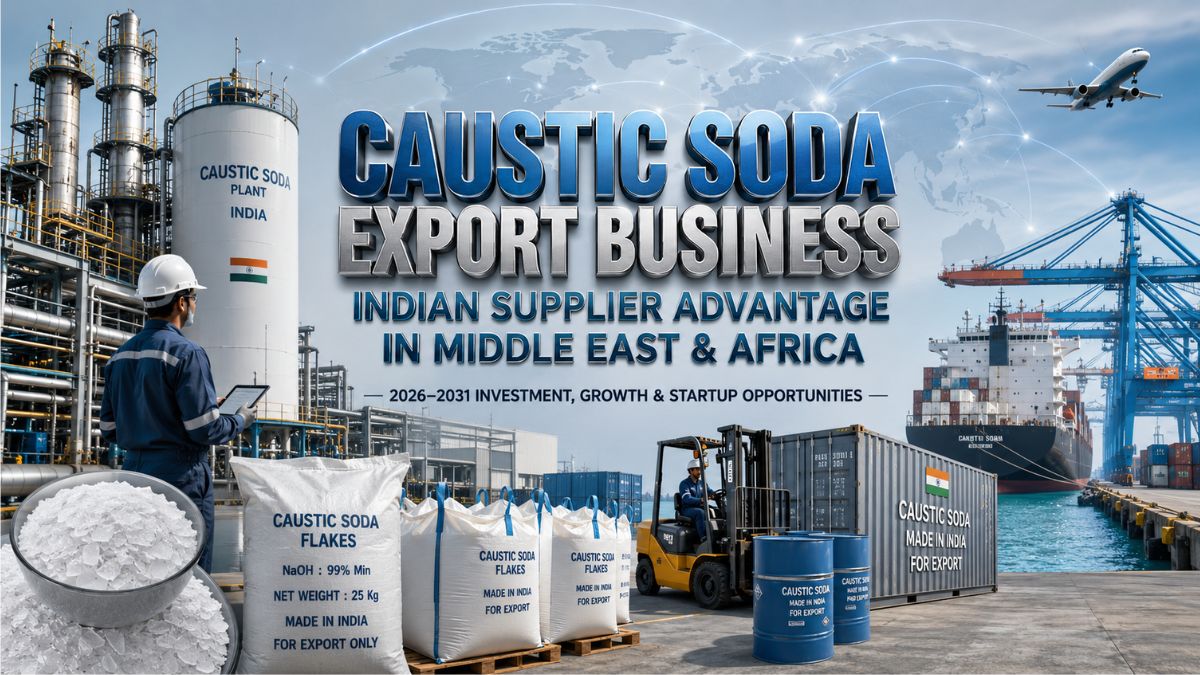
Caustic Soda Export Business
caustic soda is one of the most lucrative export opportunities for MSMEs and industrial entrepreneurs. Indian caustic soda is in high demand in the Middle East and Africa as the region is highly dependent on imported industrial chemicals for water treatment, textile processing, soap industry, alumina industry and petrochemical industries.
The latest report from the Ministry of Chemicals and Fertilizers indicates that India’s production of caustic soda rose to 3,926 thousand MT in FY 24-25, with the installed capacity of caustic soda production at 4,673 thousand MT. This overproduction capacity is good for export-based companies.
The Ministry of Chemicals and Fertilizers, Government of India, is the official source.
Today India is among the biggest and dependable sources of caustic soda in Asia apart from China. In the recent few years, Indian manufacturers have been upgrading the production of membrane cell technology, thereby producing high purity sodium hydroxide which is fit for export to international buyers. This technological advancement has helped India to become more competitive in chlor-alkali industry in the world.
Table of Contents
ToggleGet Detailed Insights from This Book: Industrial Chemicals Technology Hand Book
Why Gulf & African Markets Need Indian Caustic Soda
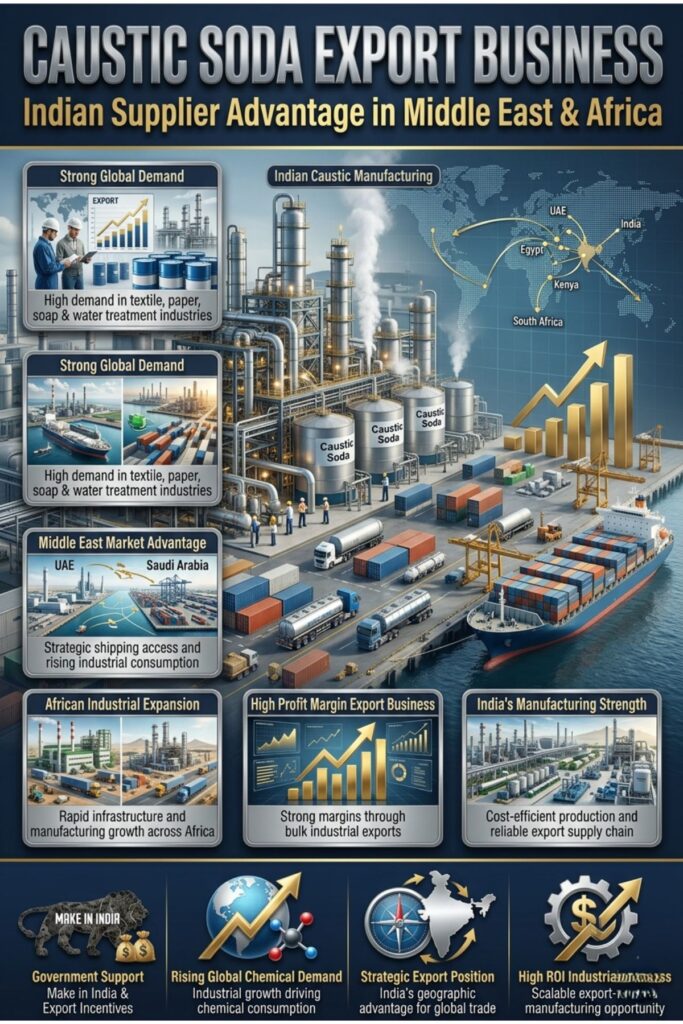
Caustic soda is still heavily imported into the Middle East and Africa, as it is produced in limited quantities in many of the countries. Annually, these industrial sectors are consuming huge amounts of sodium hydroxide.
Major industries using caustic soda:
- Alumina refining
- Textile processing
- Manufacture of soap and detergents
- Water treatment plants
- Petrochemical industries
- Paper and pulp production
Some of the other most rapidly expanding markets for Indian suppliers include countries like UAE, Saudi Arabia, Bahrain, Kenya, Ethiopia, Nigeria and South Africa.
The biggest asset to India is freight economics. Geographically, ports on the west coast of India like Mundra, Kandla and Nhava Sheva are nearer to the Gulf destinations, as opposed to Chinese and European exporters. It generally takes 5-12 days for shipping to Gulf countries and Indian exporters can provide faster shipping along with lower freight rates.
Furthermore, the markets in Africa are promising for long-term growth as many customers prefer to purchase caustic soda flakes in packages rather than liquid cargo. This opens up opportunities for traders as well as repackaging companies.
Why Indian Exporters Are Gaining Global Trust
Implementation of BIS Quality Control Orders as per IS 252:2013 is one of the leading reasons for the growth of exports in India. These regulations have increased the manufacturing discipline, purity standards and product consistency in the Indian chlor-alkali industry.
Benefits of BIS-compliant caustic soda:
- Better purity levels
- Rising demand from abroad for the produced goods
- Lowered rejection of poor-quality products
- Improved export credibility
- Easier acceptance in Gulf markets
Due to this quality positioning Indian exporters are in a steady process of swapping out Chinese suppliers in certain markets in the Gulf and African countries.
Best Business Models for Entrepreneurs
There are several entry points available in the export of caustic soda sector, depending on the investment capacity and risk appetite.
1. Export Trading Business
This is the easiest entry model for MSMEs and first-generation entrepreneurs. In this business exporters buy caustic soda from the Indian manufacturers and sell to the foreign buyers.
Investment Requirement:
- 25 lakhs to Rs. 75 lakh working capital
Expected Profit Margin:
- 6% to 10% net margins
Key Advantages:
- No manufacturing setup required
- Lower operational risk
- Faster break-even
- Easy scalability
Once they have established good relationships with buyers, many traders make steady profits in six months to a year.
2. Repackaging & Value-Added Export Unit
It is a model of purchasing bulk caustic soda flakes and re-bagging/re-drumming them for export to African and Middle Eastern buyers.
Common Packaging Formats:
- 25 kg HDPE bags
- 50 kg industrial bags
- Drums
- IBC containers
Investment Range:
- 80 lakhs to Rs. 1.5 crore
Advantages of Repackaging:
- Higher profit margins
- Brand-building opportunity
- Better customer retention
- Customized export packaging
Businesses that repackaged are usually able to achieve more robust and resilient returns than pure commodity-related businesses.
3. Sodium Hypochlorite Manufacturing
Some of the exporters are shifting into downstream chemical manufacturing where they are producing caustic soda-chlorine derived sodium hypochlorite. A popular sanitary and water treatment agent.
Major Applications:
- Municipal water treatment
- Textile bleaching
- Industrial cleaning
- Public sanitation systems
Sanitation chemicals are a high value-added opportunity in markets across Africa.
Access Complete Business Plan: Sodium Hypochlorite Manufacturing Plant Report
Government Support for MSMEs
The policy will strongly encourage export units in the chemical industry in India. There are several schemes to provide finance to MSMEs and to help lower their operational costs.
Important government support schemes:
- CGTMSE Collateral-free MSME loans
- PMEGP subsidy support
- RoDTEP export incentives
- PCPIR industrial infrastructure support
Major infrastructure advantages of chemical manufacturing clusters are:
- Port connectivity
- Shared effluent treatment
- Warehousing facilities
- Captive power access
These ecosystems help to lower operating expenses and increase export efficiency.
How NPCS Helps Entrepreneurs
Entrepreneurs should do proper market and feasibility study before investing in any project of chemical export. Niir Project Consultancy Services (NPCS) offers industrial entrepreneurs a detailed project report and techno-economic feasibility report for chemical manufacturing and export related industries.
NPCS services include:
- Detailed project reports
- Financial projections
- Machinery guidance
- Market feasibility studies
- Analysis of the raw materials source.
- Profitability assessment
- Export opportunity evaluation
This assists investors in identifying risks, profitability and break-even periods before investing.
Risks in the Caustic Soda Export Business
The market is ripe, but exporters need to be aware of key business risks.
Key risks include:
- Global price fluctuations
- Shipping disruptions
- Currency volatility
- Delays in payments from abroad buyers
- Quality rejection risks
These risks can be controlled by appropriately choosing suppliers, by taking export insurance, by laboratory testing and by using safe payment methods like Letter of Credit.
Why India Has a Long-Term Export Advantage
Multiple structural benefits abet the growth of caustic soda exports back to India:
- The country has a big domestic production base.
- Competitive manufacturing costs
- Strong port connectivity
- Improving quality standards
- Geographic advantage for Gulf exports
While international buyers keep reducing their reliance on China, Indian exporters are getting a good chance to build their market footprint.
In the year 2026, caustic soda is one of the most feasible and scalable export-driven industrial businesses for MSMEs.
FAQ
What will be the minimum investment amount needed to establish a caustic soda export business?
Typically, a trading export business needs Rs. 25 lakh and Rs. 75 lakhs.
In which countries Indian Caustic Soda exported more?
There are several large import markets, such as the UAE, Saudi Arabia, Bahrain, Kenya, Ethiopia, Nigeria and South Africa.
Is BIS certification important for exports?
Yes. When it comes to QA, BIS compliant products help in clearing the doubts of the international buyers and minimize the disputes.
Can there be a profit margin in export of caustic soda?
Typically, a trading business can make a margin of between 6% and 10% and a repackaging business can generate a higher margin.
What can NPCS do to get this business off the ground?
NPCS offers project report, feasibility study, financial analysis, machinery advice and export market analysis services to chemical companies.


