





An analytical, insight-driven editorial for chemical manufacturers, importers, and MSME investors
India’s chemical industry is undergoing a major transformation. The era of free play in the manufacturing industry is giving way to a regime of strict compliance based on quality under the Bureau of Indian Standards (BIS). As the government is expanding Quality Control Orders (QCO) on various chemical and petrochemical products, BIS certification is now mandatory for many products produced, sold or imported in India.
This transition poses a challenge as well as great business opportunity for chemical manufacturers, importers, MSME and industrial investors. Businesses that are ready to meet BIS compliance standards are increasingly gaining ground in the market and are getting better access from the industrial buyers and protection from inferior import competition.
In the current market where India is aiming to become a manufacturing hub, BIS certification is soon transforming from a legal mandate to a competitive edge for the manufacturers.
Table of Contents
ToggleUnderstanding BIS Certification and QCOs
The Bureau of Indian Standards (BIS) is the national standards body of India as provided in the BIS Act, 2016. The government enforces Indian Standards on certain products using various Quality Control Orders, which can be issued by different ministries, and they stipulate requirements for these products before they can be made, sold or imported into India.
These QCO regulations require that manufacturers be certified by BIS and apply the Standard Mark to products which are certified. If not, penalties, market access restrictions, customs rejection and goods seizure are possible.
Over the past few years, the government has extended the number of chemicals, polymers, petrochemicals and industrial raw materials covered by QCO. The mandatory BIS requirement now extends to products like Hydrogen Peroxide, PVC Resins, Polypropylene, ABS Resins, Acetone, Caustic Soda, Ethylene Glycol, Polyester Filament Yarn and various specialty chemicals.
The purpose of these policies is simple:
- Developing product quality and industrial safety
- Minimize flow of poor-quality products
- Control low-grade imports
- Strengthen domestic manufacturing
- Promote the “Make in India” initiative
- Increase global competitiveness of Indian industries
Why BIS Compliance Is Becoming Critical for Chemical Businesses
The Indian chemical industry has a worth of over Rs. It keeps rising at a fast pace, reaching 15 lakh crores, and is growing rapidly with the rising demand in various sectors like pharmaceuticals, textiles, agriculture, automobiles, construction, plastics, electronics, water treatment etc.
With increased industrial demand, consistency of quality is necessary. Many downstream industries are now opting to use products from BIS Certified suppliers as certified products are standard, safe and reliable.
It’s no longer an option for manufacturers to obtain BIS certification. It directly affects:
- Market credibility
- Supply chain participation
- Government procurement eligibility
- Industrial buyer trust
- Long-term scalability
The commercial uncertainty and regulatory risk for enterprises that are not registered with BIS in QCO categories grows.
How QCO Rules Are Supporting Indian Manufacturers
One of the most crucial results of compulsory BIS certification is safeguarding domestic manufacturers against low quality products from imports.
Indian markets were more dependent on lesser costly imported chemicals, especially from China and south Asian countries. But, according to the prevailing rules, foreign manufacturers exporting the chemicals that are covered under QCO will have to get BIS certification under the Foreign Manufacturers Certification Scheme (FMCS).
The FMCS process consists of:
- Product testing at BIS recognised laboratories
- The inspection will be carried out at the factory by the BIS officials.
- Technical documentation review
- Continued monitoring and monitoring for compliance.
These requirements add to the operating expense and approval process for many overseas manufacturers. This has led to some low-cost suppliers having difficulty in staying in India.
This has given rise to a great deal of opportunity for compliant Indian manufacturers.
Key benefits of BIS-certified manufacturing include:
- Competition from lower quality imports was decreased
- Better pricing power
- Stronger buyer confidence
- Easier entry into organized supply chains
- Improved export credibility
- Long-term regulatory stability
As enforcement is tightened in the coming years, manufacturers that obtain certification are expected to reap the benefits.
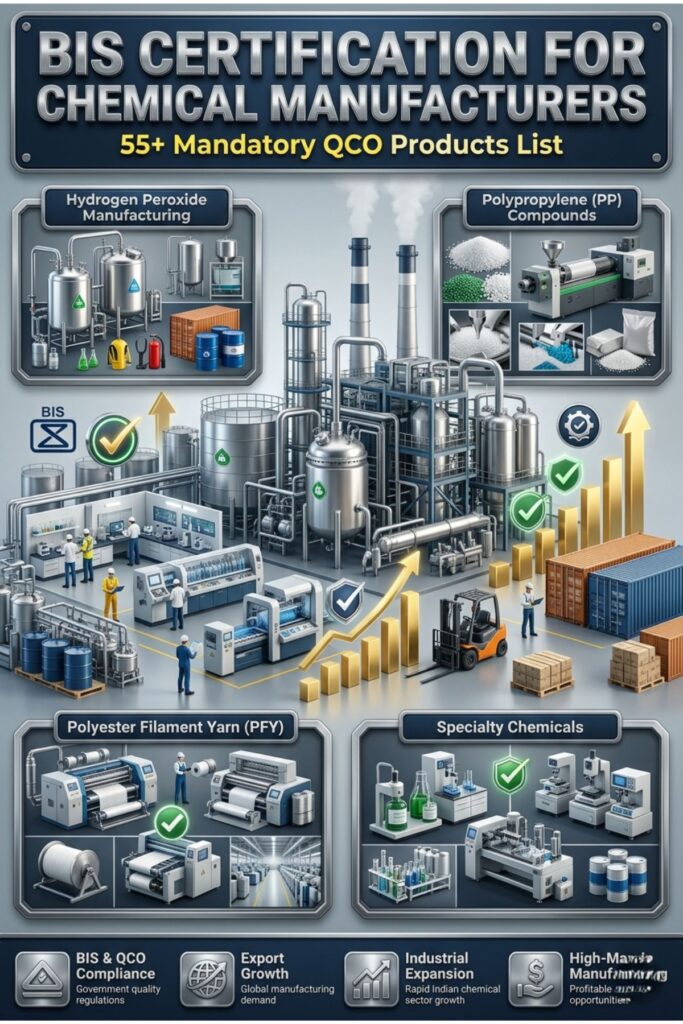
High-Growth Chemical Segments Under BIS QCO
The market of several chemical industries is witnessing good growth potential with a mandatory enforcement of BIS and increasing demand from the domestic market.
1. Hydrogen Peroxide Manufacturing
Hydrogen Peroxide has many applications, such as in the paper industry, textile bleaching, pharmaceuticals, health care, water treatment and chemical synthesis.
Demand for the compliant domestic suppliers has been steadily increasing since the enforcement of BIS became more stringent. Manufacturers having approved facilities are finding better positioning in the market and better profit margins.
View Full Project Details: Hydrogen Peroxide Manufacturing Business Plan
2. Polypropylene (PP) Compounds
In the automotive industry, polypropylene compounds are becoming more common in parts for cars, in consumer products, in packaging and in household products.
The opportunities for MSMEs are lucrative in this segment as specialty compound manufacturing can be started on moderate investments and can be utilized across various industries.
3. Polyester Filament Yarn (PFY)
Textile industry in India is still booming particularly in industrial clusters like Surat, Silvassa and Vapi.
The compulsory BIS certification has created an increased demand for organized domestic manufacturers of PFY especially for export-oriented textile units in terms of quality compliance of raw materials.
4. Specialty Chemicals
The specialty chemicals market, consisting of Morpholine, Sodium Sulphide, industrial solvents, performance chemicals, etc. is becoming a lucrative market with relatively lesser competition in the market with a stable demand for the industrial sector.
This will benefit compliant manufacturers in the long run if more specialty chemicals are added to the QCO coverage.
Get Detailed Insights from This Book: Handbook On Chemical Industries (Alcohol Based)
The Biggest Challenge: BIS Certification Preparation
Many entrepreneurs overlook the complexity of the BIS certification process, even though they have opportunities to obtain the certification.
The process of getting BIS Approval does not end with the mere registration. Manufacturers need to be ready for:
- Product testing
- Technical documentation
- Factory audits
- Process validation
- Quality management systems
- Ongoing surveillance inspections
Certification times can take between 6 and 18 months depending on the type of product and preparations of the factories.
Common challenges faced by chemical manufacturers include:
- Delays in laboratory testing
- Incomplete technical documentation
- Lack of understanding of BIS process
- The investment required for initial compliance.
- Factory infrastructure gaps
- Audit preparation difficulties
Companies often start the planning process for putting machinery into place without considering the timeframe for certification, and then end up with budget constraints and a delayed commercial production.
Why Detailed Project Planning Is Essential
When starting a chemical business, it is important for entrepreneurs to consider technical, financial, operational and compliance considerations.
This is where good project planning is essential.
A feasibility analysis assists businesses to comprehend:
- Market demand
- Raw material availability
- Manufacturing process requirements
- Selection of plant and machinery to be used for the process.
- Utility requirements
- BIS compliance obligations
- Capital investment
- Working capital needs
- Profitability projections
Apart from deciding which products to be brought under the scope of QCO, the planning phase helps to estimat:
- BIS certification timelines
- Product testing expenses
- Documentation requirements
- Audit readiness costs
- Compliance infrastructure investment
Being prepared in advance will allow business to move fast and grow efficiently.
Why Proper Project Planning Matters
Entrepreneurs need to know the technical, financial and compliance aspects of the business before entering the chemical manufacturing industry. This is where careful project planning is of vital importance.
NPCS Official Website is a solution that provides help for preparing Detailed Project Report (DPRs), Feasibility study, and market research reports for chemical manufacturing projects for entrepreneurs and industrial investors.
NPCS enables businesses to be supported in the following ways:
- Market demand analysis
- Manufacturing process guidance
- The selection, procurement and costing of plant and machinery.
- Raw material planning
- Profitability projections
- Financial feasibility studies
- Capacity planning
- Compliance-oriented project preparation
With BIS QCO-covered chemicals, business planning can help you to estimate the time that it will take to be certified, the testing costs, and the working capital that needs to be invested.
India’s Chemical Industry Has Strong Long-Term Potential
India is becoming a preferred manufacturing hub for the chemicals and petrochemical industry in the world. Long-term expansion of the sector is being facilitated by Government sponsored industrial corridors, PCPIR regions, Plastic Parks and infrastructure development programmes.
Meanwhile, BIS enforcement is changing the market dynamics by incentivizing quality production and minimising low-quality imports.
Over the next several years, industry experts believe that the government will continue to expand QCO to other specialty chemicals, advanced materials, industrial intermediates and performance chemicals.
This makes it easier for companies that are prepared to invest in a compliant manufacturing system early.
In the case of existing manufacturers, getting pre-enforcement approval from BIS may be a matter of life and death for their business survival. It’s an incredible time to transition from startup to growth mode, and regulation is emerging as a competitive edge.
Conclusion
BIS certification is no longer just a regulatory requirement for chemical manufacturers in India. It’s increasingly a requirement that directly affects market access, buyer trust and business growth.
The compliance process requires technical preparation, investment and prolonged time periods, but it also provides a tremendous opportunity to organized and quality manufacturers.
With the strengthening of the industrial standards system in India with the enforcement of QCO, BIS-certified businesses will likely see increased demand, competition from imports reduced and improved market positioning in the long term.
Compliance planning, detailed feasibility study, and quality-oriented manufacturing may be crucial factors influencing success in the fast-changing industrial landscape of India for the entrepreneurs seeking to carve a niche in the chemical sector.
Frequently Asked Questions (FAQ)
What is the meaning of BIS certification of chemicals?
BIS certification is an approval granted by the Bureau of Indian Standards and is required for products whose production is regulated by Quality Control Orders (QCOs) and for chemicals.
Do chemicals from outside India have to be certified by BIS?
Yes. In India, foreign manufacturers selling QCO chemicals to India will be required to get BIS approval for the Chemicals under FMCS scheme.
What is the timeframe to get BIS certification?
The entire certification process is typically 6-18 months, depending on product type, testing criteria and factory preparedness.
Which are the chemical industries with a high growth rate in India?
Specialty chemicals, petrochemicals, polymers, industrial intermediates, polyester yarns and performance chemicals are high growth areas.
Why is BIS certification important for MSMEs?
Regulatory compliance for QCO will eliminate low-quality imports, and improve market credibility for compliant MSMEs.
If a manufacturer does not meet the requirements of BIS what will happen?
Failure to comply with the requirements can result in penalties, seizure of product, refusal of customs clearance, loss of market access and legal action in accordance with BIS regulations.


