




Green Manufacturing Business Ideas
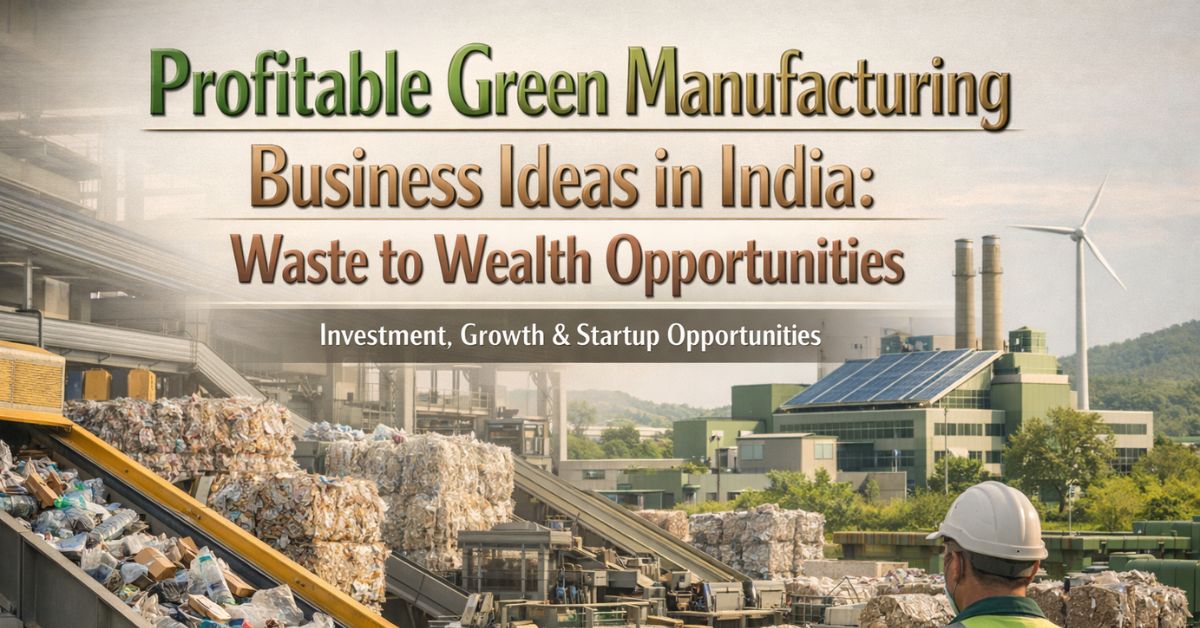
India’s industrial and manufacturing sector gradually adopts sustainable practices.Entrepreneurs can now pursue new business possibilities which arise from three factors: increased environmental awareness and tighter waste management rules and the market demand for environmentally friendly agricultural products. Green manufacturing is no longer a fad but rather a practical business model with great market demand and long-term growth potential.
Government initiatives to support renewable energy, organic farming and recycling have helped the sustainable industries to grow rapidly. At the same time, industries are experiencing increased fuel prices as well as increasingly stringent pollution regulations, which are driving them to switch to cleaner alternatives. These changes are creating new opportunities for new manufacturers who wish to start a profitable business while helping to protect the environment.
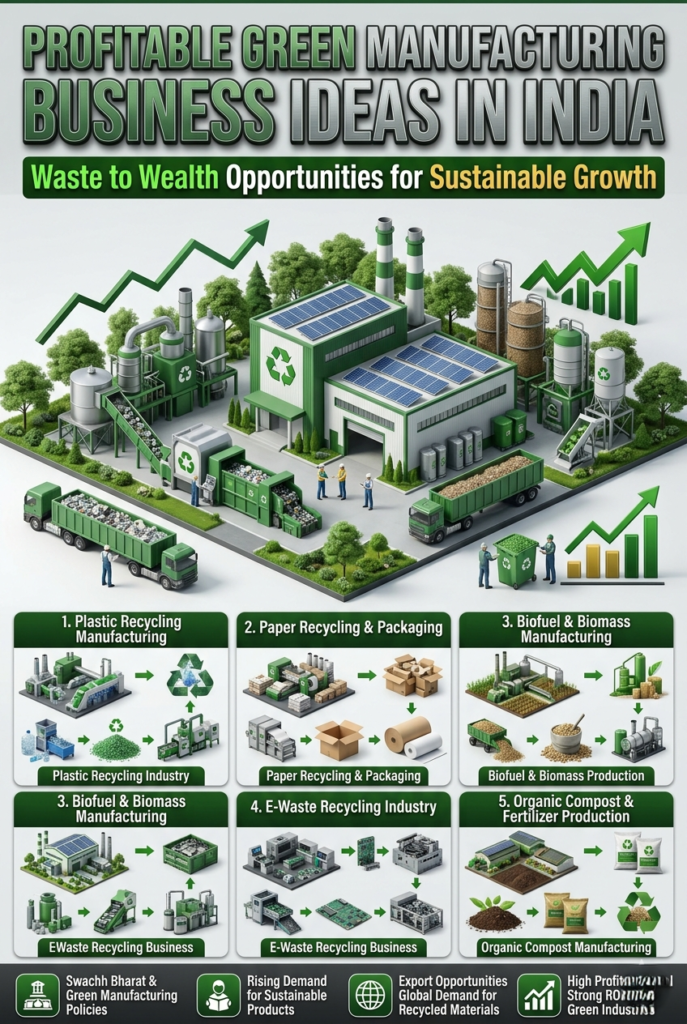
Among the many green manufacturing opportunities that exist today, three of the sectors stand out due to their steady demand and scalable production models. These businesses link the areas of agriculture, energy, and waste management, and are therefore stable even in times of economic slowdown.
The best green manufacturing businesses in India are as follows:
- Fertilizer and biomass briquettes of domestic waste
- Biogas plants using Napier grass and food waste with PROM fertilizer production
- Organic fertilizer manufacture from animal bones
Each of these sectors has strong demand, manageable levels of investment and long-term profitability for new entrepreneurs.
Table of Contents
ToggleExplore This Book: Profitable Agro Based Projects with Project Profiles (Cereal Food Technology) (2nd Revised Edition)
Fertilizer and Biomass Briquettes from Domestic Waste
One of the most practical green manufacturing businesses in India is converting domestic wastes into fertilizer and biomass briquettes. Every city produces huge amount of organic waste everyday, such as food waste, vegetable peelings, paper waste and agricultural residues. There are numerous reasons why produce this waste instead of sending it to a landfill can be processed for valuable products that benefit not only agriculture but also industry.
Organic fertilizer made from domestic waste helps to improve soil fertility and enhances the activity of the microbes. Farmers adopting the sustainable farming practice prefers such fertilizers as it improves the productivity of the crops without harming the soil health. At the same time, biomass briquettes are an alternative fuel for small industries, food vendors on the roadside, and households in rural areas.
The manufacturing process consists of a number of stages, beginning with waste collection and separation. Non-biodegradable materials (plastic, metal, etc) are removed before the organic part is handled. The material is then shredded, dried and made into fertilizer or compressed into briquettes using specialized machines.
Key equipment which are required for this business include:
- Waste shredder
- Rotary dryer
- Carbonization unit
- Briquette press
- Composting reactor
Maintaining proper moisture levels during production is critical as too much moisture decreases the strength of the briquette, and the fuel efficiency. With proper quality control and a reliable supply of waste, this is a business that can generate stable income and grow fast.
Access Complete Business Plan: Fertilizers and NPK Production Projects Guide
Biogas Plant from Napier Grass and Food Waste using PROM Fertilizer
Biogas production is another green manufacturing opportunity in India is of great promise. A biogas plant processes organic waste and converts it to methane-rich gas using a natural biological process. This gas can be used for cooking, electricity generation or as fuel for vehicles. The process also creates a valuable by-product called digestate that can be turned into organic fertiliser.
Napier grass is used widely as feedstock for biogas plants as it grows rapidly and produces large biomass. Farmers are able to cut Napier grass several times a year, thus maintaining a steady supply of raw material. When food waste is combined with Napier grass, the process is more efficient and also more gas is produced.
One of the greatest benefits of a biogas plant is that it has multiple sources of income. Instead of having a single product the business can achieve revenue from different activities.
Some of the major revenue streams in a biogas plant are:
- Sale of biogas or Bio-CNG fuel
- Electricity generation and supply.
- Production of PROM organic fertilizer
- Waste disposal service fees
- Carbon credit income
This multi-income model makes the bio gas plants financially strong and less risky than many of the typical manufacturing businesses.
In addition, demand for renewable energy is growing rapidly in India as a result of the rising fuel prices and environmental concerns. Industries, municipalities and rural communities are all investing in biogas solutions, and this creates long-term market opportunities for entrepreneurs.
Organic Fertilizer Production from Animal Bones
Organic fertilizer made from animal bones, better known as bone meal, is another profitable manufacturing business with increasing demands in agriculture. Bone meal contains essential nutrients such as phosphorus and calcium which are required for strong root development and healthy plant growth.
Farmers, nurseries and horticulture businesses like bone fertilizer as it is slow releasing and improves soil structure. The product functions differently from chemical fertilizers because it maintains the life of essential soil microorganisms. This makes it especially popular in organic farming systems.
Slaughterhouses and meat processing facilities serve as the starting point for bone collection which leads to the production process. The bones undergo a cleaning process which gets followed by thermal or steam sterilization until all bacterial contaminants are eliminated and the material becomes secure for use. The materials undergo destruction through crushing which leads to their transformation into fine powder before they enter the packaging and distribution process.
Typical nutrient composition of bone fertilizer are:
- Phosphorus: 12 to 15 percent
- Calcium: 20 to 25 percent
- Nitrogen: 2 to 4 percent
Farmers now understand the advantages of sustainable agriculture methods which leads to higher demand for organic fertilizers. Export demand also is on the rise, particularly from countries that need certified organic agricultural inputs.
Why Green Manufacturing Businesses are Growing in India
Green manufacturing is growing very fast in India due to various economic and environmental factors. Rising fuel prices, rising waste generation and declining soil fertility have generated urgent need for sustainable solutions. The market shows strong support for businesses which provide environmentally friendly product options to their customers.
Green industrial development receives strong support through government regulations which need to be established. The government provides three types of support to entrepreneurs who start renewable energy and waste management companies through its financial incentives and subsidies and technical assistance programs. These initiatives lower the financial risk and promote innovation in manufacturing.
Another important factor is the development of organic farming and rural industries. As consumers demand healthier food and cleaner energy industries have to adapt to meet these expectations. Green manufacturing businesses are primed to take advantage of this change in market demand.
Investment and Profitability Summary
The cost of investment for green manufacturing businesses is dependent on the type of product, size of plant and level of automation. Small-scale units usually need moderate investment whereas large commercial plants need more capital and have higher production capacity.
Typical investments range for these businesses are:
- Briquette manufacturing unit: 40 lakhs to 60 lakhs rupees
- Biogas plant 60 lakh to 2 crore rupees
- Bone fertilizer manufacturing: 30 Lacs to 80 Lacs Rupees
Profit margins in green manufacturing are generally high as the cost of raw materials are low and the market demand is stable. Most businesses pay back their initial investment in one to three years if operation is done efficiently.
Future Prospect of Green Manufacturing in India
The future of green manufacturing in India demonstrates a positive development path. The demand for environmentally friendly products will grow as industries transition to sustainable production methods and use renewable energy sources. Technological advancements are making both waste processing and energy generation more efficient which results in lower production costs and higher profitability.
The upcoming years will bring rapid expansion to certain industries which will create fresh business possibilities for entrepreneurs.
High growth areas for green manufacturing sectors include:
- Biomass fuel and briquette production
- Organic fertilizer production – in short, “Organic Fertilizer”
- Biogas and Bio-CNG plants
- Recycling and composting waste
- Renewable energy equipment production
Entrepreneurs who invest in these industries today will receive two advantages which include long-term market growth and government support.
Frequently Asked Questions (FAQ)
Which is the best green manufacturing business for beginners?
Briquette manufacturing is usually regarded as the most suitable choice for the beginners as it demands moderate investment and high demand in the market.
How much land is needed to establish a biogas plant?
A small commercial biogas plant will usually need about half an acre to one acre of land depending on the production capacity.
Is organic fertilizer manufacturing a lucrative business in India?
Yes, organic fertilizer manufacturing is a very lucrative business because of the demand of farmers and recent adoption of sustainable agriculture practices.
Are green manufacturing businesses subsidized by the government?
Yes, many renewable energy and waste management projects are eligible for financial support, tax benefits and subsidies in government programs.
How long do you take for a green manufacturing unit?
Most manufacturing units can be set up within three to six months of taking licenses and machinery.


