





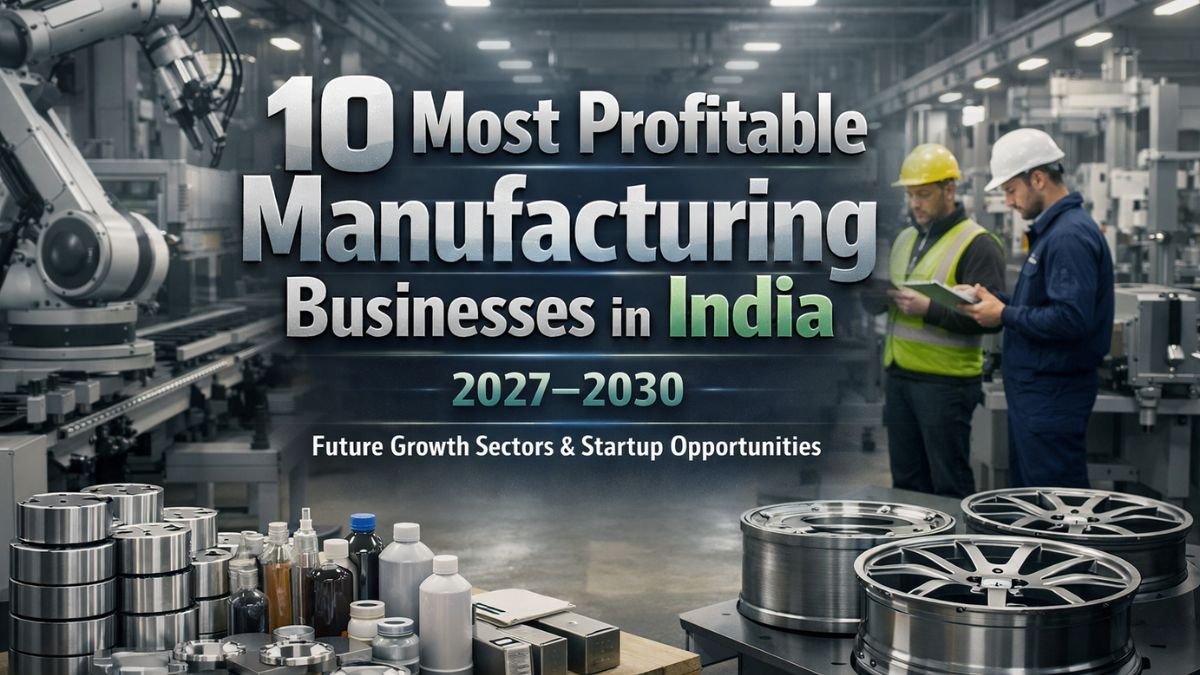
Introduction: Manufacturing businesses India 2030
India is in a significant stage of economic transformation whereby manufacturing is emerging as one of the main sources of growth. Historically, the economy of India was full of services and trade, which is in the process of being transformed. India is projected to become one of the top manufacturing centres in the world between 2027 and 2030 with robust policy encouragement, global supply chain changes, and increasing domestic demand.
This change is being accelerated by government programs like Production Linked Incentive (PLI) scheme, infrastructure development, and reforms in ease of doing business. Meanwhile, multinational organizations are implementing the so-called China-plus-one strategy, shifting production to other countries such as India.
This is not a fad to the entrepreneurs, MSMEs, and investors since it is a long-term opportunity of wealth creation. The decade to come will reward the ability to create capacity in manufacturing, integration of technology and export production.
Table of Contents
ToggleChoose the right startup backed by real market demand
1. Shift from Assembly to Complete Manufacturing Ecosystems
India is not just assembling but is progressing to the full scale production of parts, systems and finished products. In the past, a large number of industries had been dependent on imported parts to assemble the final products. The emphasis is currently moving towards in-country production of high-value components.
The transition is creating great opportunities in:
- Precision engineering
- Machining and tooling of industries.
- Component manufacturing
- Quality control systems
The investment in new machinery, labor skills, and quality certifications will provide a high level of competitive advantage to MSMEs in the international supply chains.
2. Green Manufacturing and Renewable Energy.
The effort of attaining 500 GW of renewable energy capacity in India is establishing one of the biggest cycles of industrial growth in the history of the country. The renewable energy ecosystem is also growing in terms of solar, wind, battery storage, and hydrogen infrastructure.
The major manufacturing opportunities are:
- Mounting systems and hardware of solar panels.
- Battery elements and thermal management systems.
- Control units and electrical inverters.
- Parts of hydrogen production and storage equipment.
This industry is long term and stable and has government support, which is best suited to sustainable industrial investment.
3. Growth of Specialty Chemicals and Agrochemical Industry
India is quickly establishing itself as a global substitute to China in manufacturing of chemicals. Specialty chemicals industry is expanding with the rising demand and diversification of supply chains around the world.
High-potential segments include:
- Industrial dyes and pigments.
- Agrochemical intermediates
- Performance chemicals
- Export-grade formulations
Even small and middle-size manufacturers can access international export markets with adequate compliance and environmental safety standards.
4. Growth of Food Processing and Nutraceutical Industry.
Urbanization, change of lifestyle and the need to reduce agricultural wastage are some of the factors that have made food processing one of the fastest-growing sectors in India. Concurrently, the nutraceutical market is enjoying great demand both locally and internationally.
The major growth opportunities are:
- Packaged and ready-eat foods.
- Frozen food processing
- Herbal extracts (ashwagandha, turmeric, amla)
- Fortified nutritional supplements
MSMEs find this sector quite appealing as it requires moderate investment and is very scalable.
Get Detailed Insights from This Book: Handbook on Fruits, Vegetables & Food Processing with Canning & Preservation (3rd Edition)
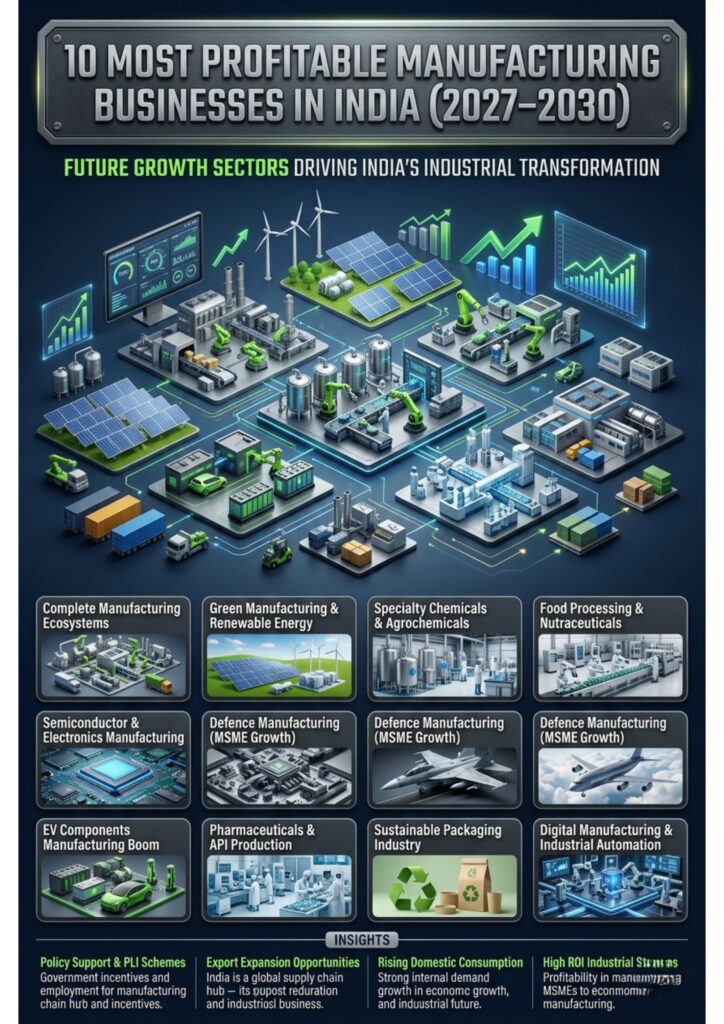
5. Semiconductor and Electronics Development.
India is slowly developing the semiconductor and electronics manufacturing ecosystem. Although it takes time to build semiconductor fabrication plants, the related industries are growing at a very rapid rate.
Opportunities include:
- PCB manufacturing
- Electronic component production
- Calibration and testing equipment.
- Cleanroom and precision assembly systems.
The first movers in this ecosystem will enjoy a supply chain integration in the long term.
6. Defence manufacturing sector open to MSMEs.
The defence manufacturing industry in India is becoming open to the participation of the private. The government procurement policies are favouring domestic suppliers, which are developing good MSME opportunities.
Key areas include:
- Precision machined components
- Aerospace-grade materials
- Defence electronics systems
- Coatings and materials, protective.
Nonetheless, this business industry needs stringent quality assurance, certification, and reliability over the long term.
7. EV (Electric Vehicle) Components Production Boom.
The EV development in India is not just a growth in terms of vehicle manufacturing; the actual potential is the component ecosystem.
High-demand components include:
- Battery cells and battery packs.
- Electric controllers and motors.
- Charging infrastructure systems
- Thermal management systems
Lower risk and increased scalability will be available to MSMEs involved in the production of components instead of whole vehicles.
Access Complete Business Plan: Profitable Business Industry of EV Charging Stations.
8. Pharmaceutical and API Growth.
India is a leading pharmaceutical producer already but has a substantial level of imports in active pharmaceutical ingredients (APIs). This loophole is a significant manufacturing prospect.
Key segments include:
- Production of bulk drugs and APIs.
- Contract manufacturing services
- Ayurvedic and herbal preparations.
- Pharmaceutical packaging solutions
African, Latin American and Southeast Asian export demand is also increasing consistently, which enhances long-term prospects.
9. Growth of Sustainable Packaging Industry.
There is a high demand in environmentally friendly packaging solutions due to environmental regulations and consumer awareness. It is turning into a compliance issue but not a decision.
Growth areas include:
- Biodegradable packaging materials
- Paper-based packaging solutions
- Compostable plastics alternatives
- e-commerce packaging systems and FMCG.
This sector is set to experience a tremendous growth in the wake of stricter global sustainability standards.
10. Digital Manufacturing and industrial automation.
Manufacturing requires digital transformation through the deployment of automated systems combined with sensor technology and data-driven solutions. Industry 4.0 technologies are now becoming a necessity in the contemporary factories.
Key developments include:
- Industrial IoT systems
- Sensors and monitoring devices that are smart.
- Robotics and automation solutions.
- Predictive maintenance systems
This is the future of industrial competitiveness with this hybrid sector that combines manufacturing and software.
About NPCS (Niir Project Consultancy Services)
Niir Project Consultancy Services (NPCS) is one of the top consultancies with the aim of assisting entrepreneurs, MSMEs and investors to establish successful manufacturing enterprises in India.
NPCS also offers full business support such as:
- Taking Detailed Project Reports (DPR)
- Market research and feasibility studies.
- Plant and machinery establishment advice.
- Financial planning and profitability analysis.
- Technical process flow support.
Such reports are popular among first-generation entrepreneurs, MSME borrowers, and industrial investors to assess the feasibility of business prior to investing capital.
NPCS assists in mitigating business risk by making sure that the decisions are made based on the appropriate data, market analysis, and financial projections, but not assumptions.
Conclusion: India’s Manufacturing Future is Extremely Promising
India is on the cusp of the best industrial growth in its history. Between 2027 and 2030, manufacturing, renewable energy, electronics, chemicals, EVs, pharmaceuticals and automation will all contribute to economic growth.
Nonetheless, the success will rely on timely entry, planning, and developing of capabilities. This change will be the most profitable to the entrepreneurs who invest in technology, quality systems, and export preparedness.
The coming decade is not merely a period of expanding the business but an expansion that incorporates long-term industrial capacity that will compete at the global level.
Frequently Asked Questions (FAQ)
Q1. Will manufacturing be a good business in India in the future?
Yes. With government support, increasing demand, and global supply chain changes, manufacturing is one of the fastest-growing industries in India. It has high growth prospects in the long-term.
Q2. What is the most lucrative sector of manufacturing in India?
The electronics, EV components, specialty chemicals, pharmaceuticals, food processing, and renewable energy equipment manufacturing are high potential areas currently.
Q3. Are MSMEs able to operate in manufacturing industries?
Yes. In India, MSMEs are significant contributors to the manufacturing ecosystem in terms of component supply, packaging, processing and industrial services.
Q4. What is the largest opportunity in the Indian manufacturing in 2030?
The largest opportunities are EV components, semiconductor supply chains, renewable energy equipment and specialty chemicals.
Q5. Would I require high investment in order to establish a manufacturing business?
Not always. Large-scale investment in many sectors such as food processing, packaging and small-scale component manufacturing can begin with moderate investment based on scale and machinery.


