





Introduction: India R&D investment manufacturing
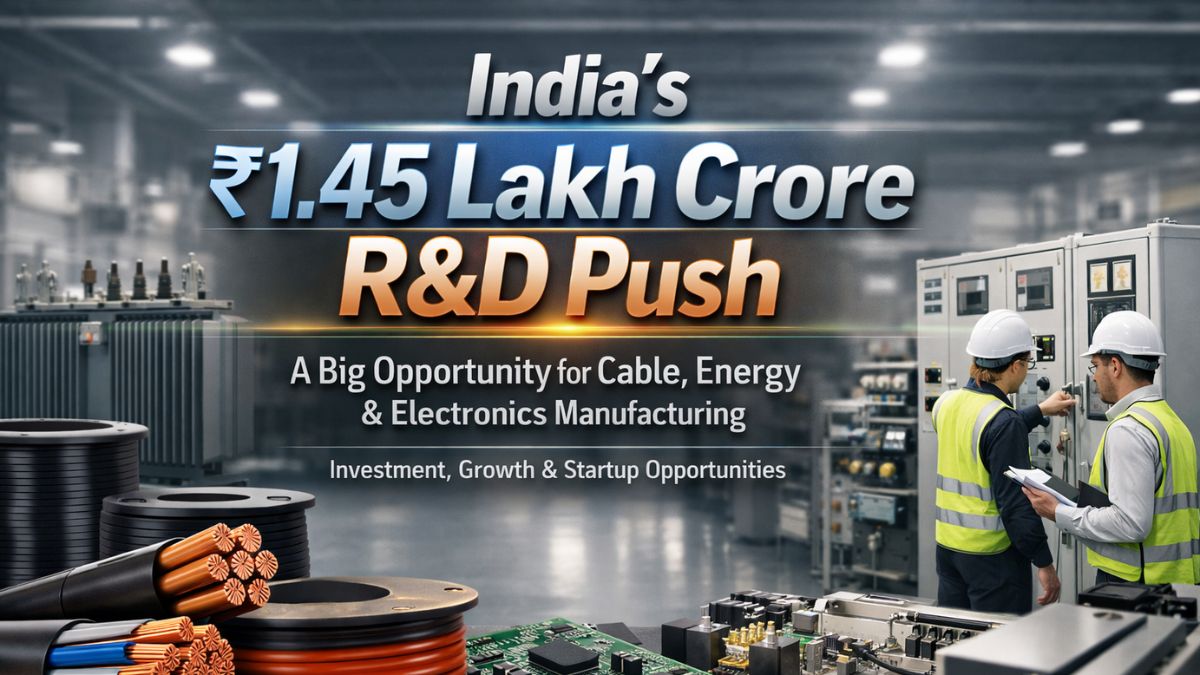
India is going into a new vigorous wave of industrialization with a huge ₹1.45 lakh crore investment in research, development, and manufacturing based on innovation. It is not merely another policy update, rather it is a long-term change meant to transform India into a manufacturing hub of high technology manufacturing.
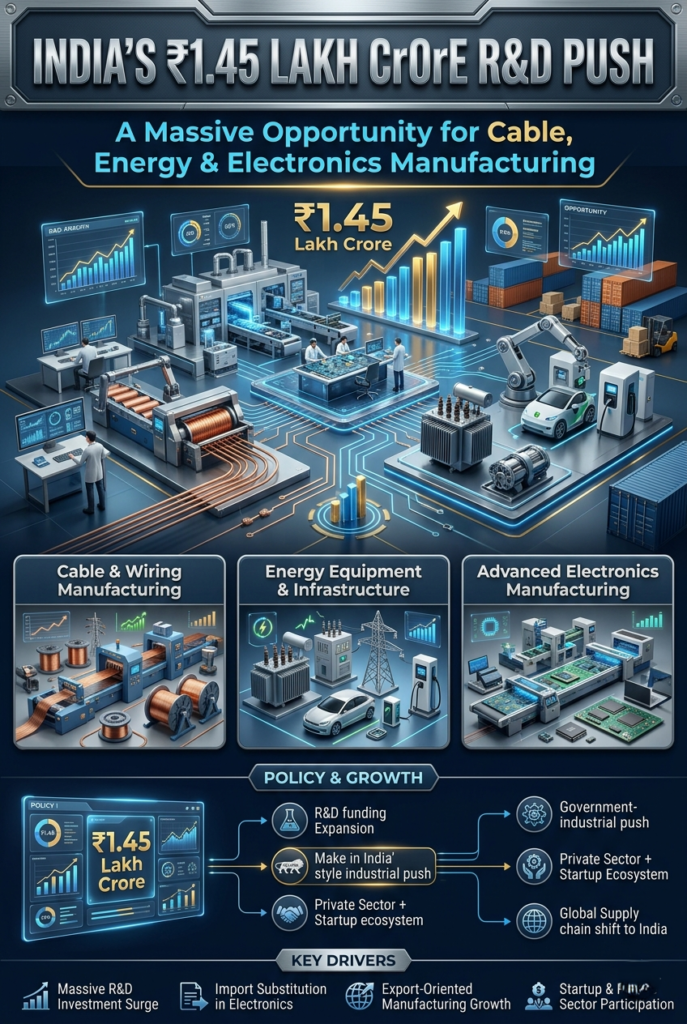
The target is apparent: India does not want to rely as much on imports and prefers to develop a robust domestic capacity in such areas as power cables, renewable energy systems, EV parts, and electronics production.
This is a rare chance to MSMEs and new entrepreneurs to venture into high demand industries that have significant government support and stability in the market.
Table of Contents
ToggleGet Detailed Insights from This Book: Solar Panel
Why This Policy Matters for Entrepreneurs
India has been heavily relying on imports in a wide range of important components including semiconductor parts, high voltage cables, insulation material, and EV grade wiring system. This has added expenses and a lack of control on supply chains.
The government is currently driving a model of manufacturing in which manufacturing is funded by innovation funds and long-term R&D capital. This implies that businesses no longer have the obligation to produce alone but enhance technology and create new solutions.
This change is significant as it generates a favourable ecosystem where MSMEs will be able to develop at a reduced financial risk and enhanced policy provisions.
Rising Demand in Energy, EV & Electronics
Manufacturing of electrical and energy related products is growing at a high rate within India. The three largest sources of this growth are in infrastructure development, renewable energy expansion, and EV adoption.
The demand areas are:
- Solar energy systems on rooftops and in industrial parks.
- EV charging systems and vehicle wires.
- Smart city and metro rail electrical systems.
- Upgrades to power distribution and transmission.
Meanwhile, world firms are decentralizing their supply chains off of China, and this gives Indian producers a chance to export. Such a mix of home market + international demand makes the industry highly appealing.
Access Complete Business Plan: Profitable Business Industry of EV Charging Stations
Investment Required to Start Manufacturing
It is not as difficult to start a small manufacturing unit in this industry as most individuals believe. An investment of approximately ₹75 lakh may be a starting point of a solar cable or wiring harness unit, and a full-scale power cable manufacturing unit can cost ₹1.10 crore to 2.30 crore.
This entails machinery, factory set up and working capital.
Significant cost elements are:
- Machinery and equipment
- Factory civil setup
- Working capital for raw materials
- Utility and electrical installation.
- Licences and compliance costs.
A significant part of the monthly costs (approximately 6070 percent) is spent on raw materials such as copper and aluminium.
Profitability and Business Potential
Cable and electrical manufacturing business has predictable and consistent returns. The demand is steady because of the development of infrastructure and housing.
Key financial highlights:
- Monthly revenue: ₹35 lakh to ₹85 lakh (based on capacity)
- Gross margin: 12-26% based on the type of the product.
- Net margin: 6% to 12%
- Payback period: 3.5-5 years.
Specialty products such as solar cables and EV wiring harnesses are typically more profitable than regular cables.
Government Schemes Supporting MSMEs
Good government support is one of the greatest benefits to new business starters in modern times. A number of plans minimise financial strain and enhance business sustainability.
Key schemes include:
- PMEGP (capital subsidy on new units)
- CGTMSE (collateral-free loans up to ₹5 crore)
- MUDRA loans (up to ₹20 lakh for small units)
- PLI scheme (performance-based incentives)
- RDI scheme (long-term innovation funding)
All these schemes lower barriers to entry and make manufacturing more accessible even to first time entrepreneurs.
Setup Process for a Manufacturing Unit
Establishing a production facility needs to be well organized. This starts with registration of MSMEs, and then picking an appropriate industrial location, ideally in an approved industrial area by the government.
Then, machinery installation and licensing are united. Other significant approvals are BIS certification, factory licence, GST registration, and pollution clearance.
Typical timeline:
- Installation and building: 3 4 months.
- Machinery installation: 2–3 months
- Certifications and approvals: 2 to 4 months.
- Production time: 812 months in total.
Market Growth and Future Opportunity
This industry has a bright future as the demand is flowing in all directions simultaneously. The development of infrastructure in India guarantees a stable domestic demand, and the changes in the global supply chain are creating export opportunities.
This forms an unusual mixture of:
- Stable domestic consumption
- Rising export demand
- Good policy support of the government.
To the entrepreneurs, it implies sustainability of the business in the long term as opposed to the short-term profits.
Role of NPCS in Project Development
NPCS (NIIR Project Consultancy Services) can be significant in aiding entrepreneurs to transform ideas into a structured business plan. Most of the founders of the MSMEs have problems with financial planning, selection of machinery and bank approvals.
NPCS assists in the provision of comprehensive project reports (DPRs), feasibility studies, and technical layouts, which are acceptable by banks and government agencies.
NPCS services include:
- Project report preparation
- Cost and profit analysis
- Machinery selection guidance
- Technical feasibility studies
- Loan documentation that is bankable.
This minimizes risk of the project and enhances the probability of approval of funds.
Conclusion
India’s ₹1.45 lakh crore R&D and manufacturing push is a major turning point for the country’s industrial ecosystem. It is creating strong opportunities in cables, EV components, renewable energy systems, and electronics manufacturing.
For MSMEs, this is the right time to enter the market because demand is rising, government support is strong, and global supply chains are shifting toward India.
Entrepreneurs who act early and plan properly will benefit the most from this long-term growth cycle.
FAQs
Q1. What is the required amount of investment to start a cable manufacturing unit?
A small unit will need about 1.10 crore to 2.30 crore based on size.
Q2. Does cable production pay off in India?
Yes, net profit margins are 6-12 with greater margins in EV and solar cables.
Q3. What are the schemes in government favourable to this business?
Financial support comes in the form of PMEGP, CGTMSE and MUDRA loans, PLI scheme and RDI scheme.
Q4. What is the time required to set it up?
Typically, between 8-12 months between registration and production.
Q5. What is NPCS’s role?
NPCS produces project reports and feasibility studies to aid in funding and business establishment.


