






Introduction: Acetic Anhydride Manufacturing
One of the most significant industrial chemicals that are employed in the pharmaceutical, textile, dye, and agrochemical sectors in India is acetic anhydride. It is important in the production of APIs such as aspirin, paracetamol intermediates, cellulose acetate in textiles and films.
India has high domestic demand but still imports a large portion of its demand. This leaves a huge market gap and a lucrative prospect to local production.
As pharma exports in India expand, chemical clusters are rising and the government encourages the growth of the sector through the Make in India and PLI programs, the production of acetic anhydride has emerged as a long-term and stable investment opportunity.
Table of Contents
ToggleRead the Complete Book Here: Handbook On Chemical Industries (Alcohol Based)
Market Demand and Business Opportunity in India
The estimated demand of acetic anhydride in India is more than 1 lakh metric tons annually, whereas the supply within the country is not sufficient to satisfy the demand. This market vacuum will keep new manufacturers in demand.
The need is primarily focused in the industrial states of Gujarat, Maharashtra, Telangana, Uttar Pradesh and Tamil Nadu, where the pharma companies and chemical industries are large scale.
Key demand drivers include:
- India Pharmaceutical API sector is growing at a rapid rate.
- Increased growth of textile and dye production centers.
- Import dependency on China and other countries
- State pressure to make chemicals locally.
Due to these reasons, long term supply agreements with pharma and chemical firms are prevalent in this segment.
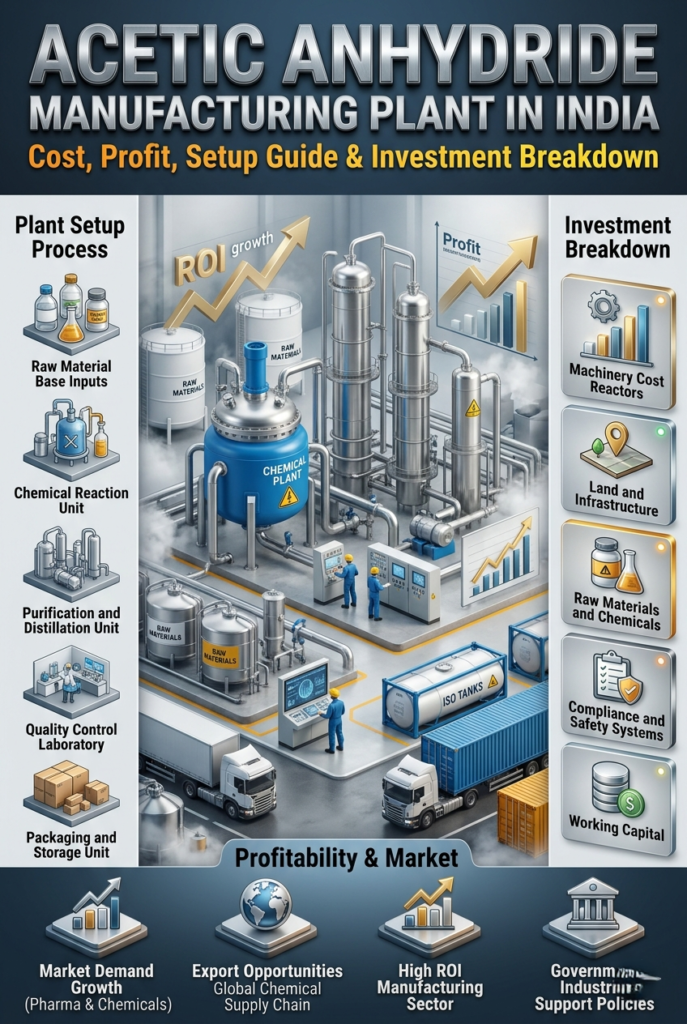
Investment Required for Acetic Anhydride Plant
Investment is primarily based on the level of production and automation.
A small plant (approximately 5 MT/day) typically costs ₹ 2.6 crore 3.8 crore whereas a medium-size plant (20 MT/day) can cost 10 crore to 12.5 crore.
The cost is made up of land development, machinery, installation, safety systems and initial working capital. Working capital stands by far the most important of all component as the raw material can be procured at any moment in time and the customer can pay later.
Land, Location & Infrastructure Requirements
The location is very vital in manufacturing chemicals. The plant is preferably located in a special chemical area where the environmental and safety facilities are already present.
GIDC (Gujarat), MIDC (Maharashtra), and APIIC (Andhra Pradesh) are recommended industrial areas.
An average unit will need approximately 15002000 sq. meters of land. The facility should consist of production units, storage tanks, safety systems and effluent treatment facilities.
Key infrastructure requirements:
- Production and the construction of reactors.
- Storage of raw material and finished goods.
- Effluent treatment plant (ETP).
- Fire safety and emergency systems.
- Utility area and lab.
Access Complete Business Plan: Glacial Acetic Acid Project Report
Machinery and Manufacturing Process
Acetic anhydride is produced through controlled chemical reactions, purified and distilled.
The primary equipment needed is the reactors, the distillation columns, the heat exchangers, the condensers, the storage tanks, and the emission control systems. Quality testing also requires a small laboratory.
The process of production entails the transformation of acetic acid under regulated conditions to get acetic anhydride, after which it is purified to reach the level of an industrial or pharma-grade. As it requires dangerous chemicals, automation and safety measures are necessary.
Raw Materials and Supply Chain.
The glacial acetic acid is the main raw material and it is readily found in India through companies such as IOCL, BPCL, and also through the privately owned chemical manufacturing companies.
Depending on the trends in crude oil, prices usually range between 35-55/kg.
Major supply hubs in India:
- Dahej (Gujarat)
- Bharuch (Gujarat)
- Ankleshwar (Gujarat)
- Maharashtra chemical belt
Proximity to such clusters allows logistics costs to be lowered considerably, and supply to be stable.
Licenses and Regulatory Approvals
To establish a chemical production facility in India, there are numerous approvals required because of the environmental and safety hazards.
The most significant licenses are factory registration, pollution control clearance, fire safety approval and hazardous chemical handling permissions.
Major approvals required:
- Factory License from State Labour Department
- Consent to Establish and Operate (CTE/CTO).
- GST and Udyam MSME Registration.
- Fire Safety NOC
- Hazardous Chemical Storage Permission.
- Drug License (pharma-grade production)
The approvals may require 4-6 months based on state regulations.
Profit Margin and Financial Performance
The production of acetic anhydride is a high margin chemical enterprise in case it is run efficiently.
The selling price ranges between ₹100–₹130 per kg depending on grade and market demand. Plants have the potential to produce high monthly income and consistent cash flows at full capacity.
Typical financial performance:
- Gross margin: 32%–38%
- Net profit margin: 18%–24%
- Payback period: 4–6 years
The key factor in profitability is the control of the cost of raw materials and capacity utilization.
Government Schemes Supporting This Business
There are various financial support programs of MSME chemical manufacturing units in the Indian government.
Key schemes include:
- PMEGP subsidy (15%–35%)
- CGTMSE collateral-free loan up to ₹5 crore
- PLI scheme in the chemical and pharma industry.
- The benefits of Udyam registration to MSMEs.
These plans are less financial strain and enhance project viability among first time entrepreneurs.
Project Timeline
The construction of an acetic anhydride facility takes 12-18 months between planning and production.
These are the timeline of the company registration, land, approvals, construction, installation of machinery and trial production. The process normally takes the longest time during the environmental clearance.
Role of NPCS (NIIR Project Consultancy Services)
NPCS (NIIR Project Consultancy Services) is among the best industrial consultancy organizations in India that assists the entrepreneurs to establish manufacturing plants.
They support projects fully such as detailed project reports (DPR), feasibility study, selection of machinery, financial plan and design of plant layouts.
NPCS services include:
- Techno-economic feasibility reports
- Direction of machinery and processes.
- Planning investment and estimating costs.
- DPR preparation in a bank loan.
- Regulatory and licensing advice.
Banks and financial institutions have accepted their reports strongly, and funding is becoming easy to new entrepreneurs. NPCS can be accessed at niir.org.
Conclusion
The production of acetic anhydride in India is a good industrial prospect, pegged on the large local demand, import reliance and government subsidies. By planning, adhering to regulations and sourcing raw materials strategy, this business would provide consistent long-term profits and high ROI.
Despite the moderated investment requirement relative to large chemical plants, success is pegged on the technical implementation, safety mechanism, and market contracts. Even first-time entrepreneurs can easily venture into this industry with the correct consultancy assistance such as NPCS.
FAQs
Q1. How much capital is needed to invest in acetic anhydride plant?
Small plants need ₹2.6-3.8 crore and medium plants need ₹10-12.5 crore.
Q2. Is the production of acetic anhydride in India profitable?
Yes, it has net margins of between 18-24% based on performance.
Q3. Which is the primary raw material?
The raw material used is glacial acetic acid.
Q4. What is the time of plant establishment?
Approximately, it requires 1218 months comprising approvals and installation.
Q5. What is NPCS’s role in this project?
NPCS offers DPR, feasibility, machinery advisory and full project consulting services.


