





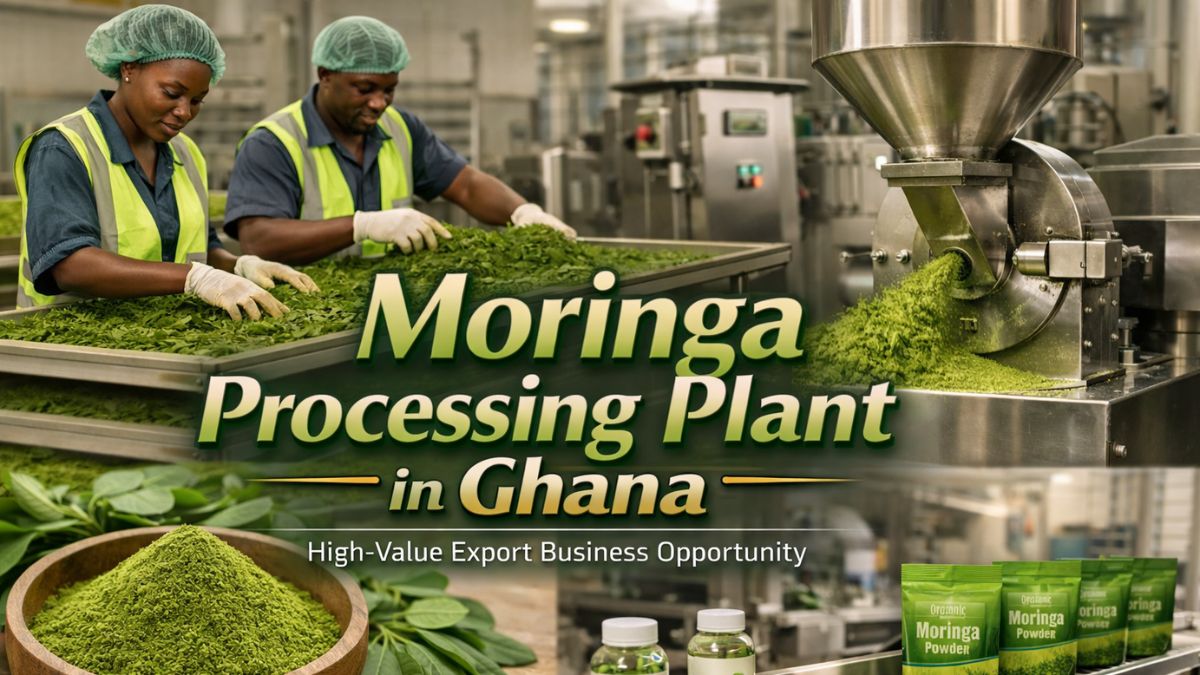
Introduction: Moringa Processing Plant
Moringa (Moringa oleifera) has since outgrown the status of a backyard plant. It is now considered to be a strong superfood ingredient in nutrition, cosmetics and pharmaceuticals all over the world. Its richness in vitamins, amino acids, and antioxidants has predisposed it to be a popular raw material in the natural health sector.
The health value, as well as the increasing commercial demand, of moringa makes it particularly appealing to numerous people. The rapid growth in imports of moringa leaf powder and seed oil are being experienced in countries in Europe, North America and Asia and this presents a good exporting market to the producing countries such as Ghana.
Table of Contents
ToggleDownload the Full Guide: Handbook on Agro Based Industries (3rd Edition)
Why Ghana Is Perfect for Moringa Processing
Ghana has one of the most appropriate locations in Africa to set up a moringa processing plant. The climatic conditions where moringa thrives naturally in the northern parts such as Tamale, Bolgatanga and environs are conducive and require minimal input cost.
The crop is drought-tolerant, multi-seasonal and is able to be planted on marginal land. This provides the entrepreneurs with a great edge of finding raw materials cheaply as well as providing rural farming communities with contract farming systems.
The other significant opportunity is the export-friendly ecosystem in Ghana. Agro-processing projects are actively supported by institutions such as Ghana Export Promotion Authority (GEPA) and Ghana Investment Promotion Centre (GIPC). Moreover, Ghana is a member of AGOA which offers it a duty-free access to the U.S. market, which is highly beneficial in enhancing the profitability of exports.
Global Demand Driving the Moringa Industry
Moringa is gaining demand in various industries. Moringa leaf powder is consumed in protein supplements, detox teas, and herbal teas in the health and wellness industry. Moringa seed oil is also of interest to the cosmetics industry because of its stability, lightness, and ability to repair skin.
This two-market system establishes a high competitive edge of processors since both lines of products can be produced using the same crop, hence diversification of the income streams.
Key global demand drivers include:
- Increase in plant-based nutrition.
- Expansion of organic skin care products.
- Increasing preference for chemical-free supplements
- Growth of functional food and beverage markets.
Moringa Processing Business Model
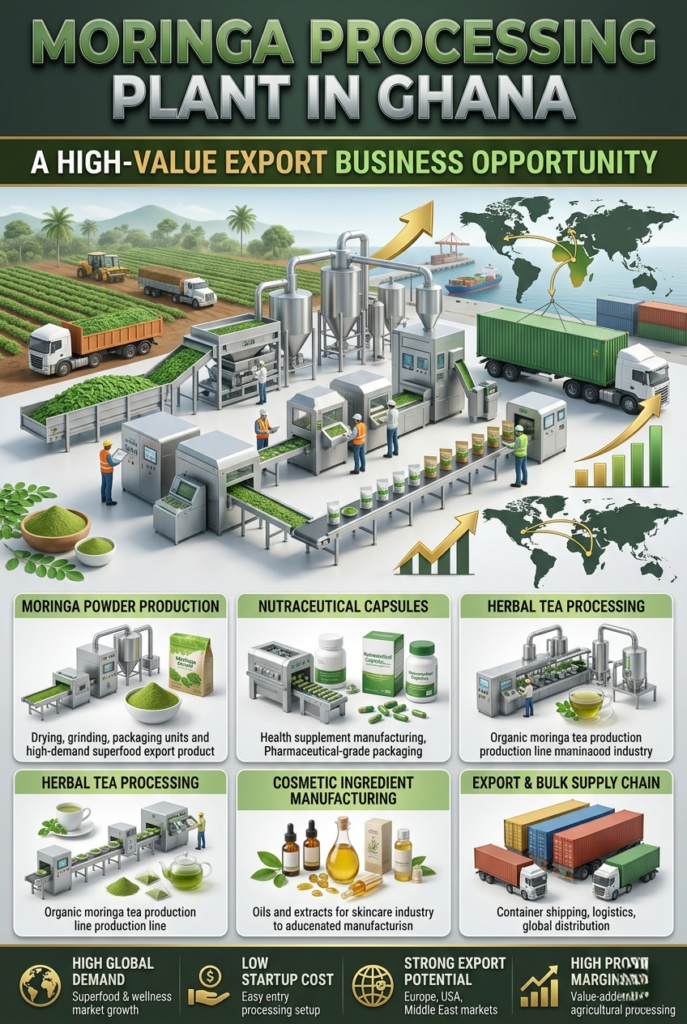
The moringa processing plant is usually specialized in two products, namely the leaf powder and seed oil. They have their respective production process, market segment, and pricing structure.
The fresh moringa leaves are dried in controlled temperatures and milled to fine powder to make leaf powder. Maintaining natural green color, low moisture content and hygienic processing standards are the key success factor. Certified organic, high-quality powder is purchased at a premium price by export buyers.
However, seed oil is produced by cold-press technique. It is highly regarded in the cosmetics industry and has very high market prices owing to its purity and stability.
Common product applications are:
- Leaf Powder to Nutraceuticals, supplements, herbal teas.
- Seed Oil → Cosmetics, hair care products, Skincare.
- Seed Cake: → Animal feed and organic fertilizer.
Access Complete Business Plan: Moringa Powder Production Industry Report
Investment and Profit Potential.
Moringa processing plant does not demand very large-scale industrial equipment, so it is applicable to medium scale investors. The investment is based on the production capacity, level of automation, and certification requirements.
A small-to-medium plant typically has drying facilities, grinding machines, oil recovery machinery, and packaging machinery.
Export pricing and product quality are the primary factors that drive profitability. Certified organic goods are able to fetch much higher margins as compared to non-certified goods.
Key financial highlights:
- Average startup capital requirement.
- Good export price realization in USD/EUR.
- Payback period of about 3-5 years.
- Higher margins of seed oil than of leaf powder.
Export Strategy for Moringa Products
Export preparation and international standards are important in the success of this business. Consumers in Europe and USA demand tough certifications and quality assurance mechanisms.
Important certifications include:
- EU Organic Certification
- USDA Organic Certification
- COSMOS / ECOCERT (cosmetics)
- Food safety certification ISO 22000.
The major ones are trade fairs like Biofach (Germany) and cosmetic ingredient expos where international buyer networks can be developed.
Related Article: Moringa Seed Oil Extraction Business in India
Key Challenges in the Business
Despite the opportunity, the moringa business has operational challenges that should be handled keenly.
- It is essential to have a quality of drying which is consistent or the products may be rejected.
- The processes of certification need time, documentation, and compliance expenses.
- Export payments: cash flow is generally impacted by delays of 30-60 days.
- Strong quality control systems: Repeat international buyers require strong quality control systems.
Role of NPCS (Niir Project Consultancy Services)
Niir Project Consultancy Services (NPCS) is a major consultancy agency that assists entrepreneurs in establishing projects in industries and agro-processing. In the case of moringa processing plants, NPCS offers the overall business advice such as feasibility studies, selection of machinery, market research, and financial planning.
A professionally prepared Detailed Project Report (DPR) of NPCS can assist investors in gaining a clear understanding:
- Total project cost
- Machinery requirements
- Production process flow
- ROI analysis and profitability.
- Market demand and export potential.
The process of obtaining bank loans becomes more straightforward because investors can reduce their financial risks by evaluating the project before its actual start date.
Conclusion
The moringa processing plant in Ghana presents a highly promising export-oriented business opportunity. The moringa-based product suppliers in Ghana have established their position as major suppliers because international demand for their products combined with their agricultural capabilities and government support.
The entrepreneurs who prioritize quality and certification together with their export business development will succeed in creating a sustainable and profitable enterprise for both moringa leaf powder and seed oil production.
The business will obtain sustainable international trade success through its strategic development efforts which receive support from professional services provided by organizations like NPCS.
Frequently Asked Questions (FAQ)
Q1. Is the processing of moringa a good business in Ghana?
Yes, moringa processing is extremely profitable as the raw materials are cheap, there is high demand in the world, and certified products can be sold at high prices.
Q2. Which products are possible of moringa?
Its primary products are moringa leaf powder, seed oil, capsules, tea blends and seed cake organic fertilizer.
Q3. What is the investment to start a moringa processing plant?
The scale is a determinant of investment and a small-to-medium-sized plant usually needs a moderate amount of capital to invest in machinery, installation, and certification.
Q4. Which Ghanaian countries are the importers of moringa?
The USA, Germany, UK, France and Japan are major importers, as well as other European and Asian nations.
Q5. Am I required to get certified to export moringa?
Yes, the USDA Organic, EU Organic and ISO certifications are important to get access to high-end international markets.
Q6. What is the greatest difficulty in this business?
The key issues are the quality of the products to be consistent, the certification expense, and the high-quality international export requirements.


