





Introduction: MSME CLCSS 15% subsidy scheme
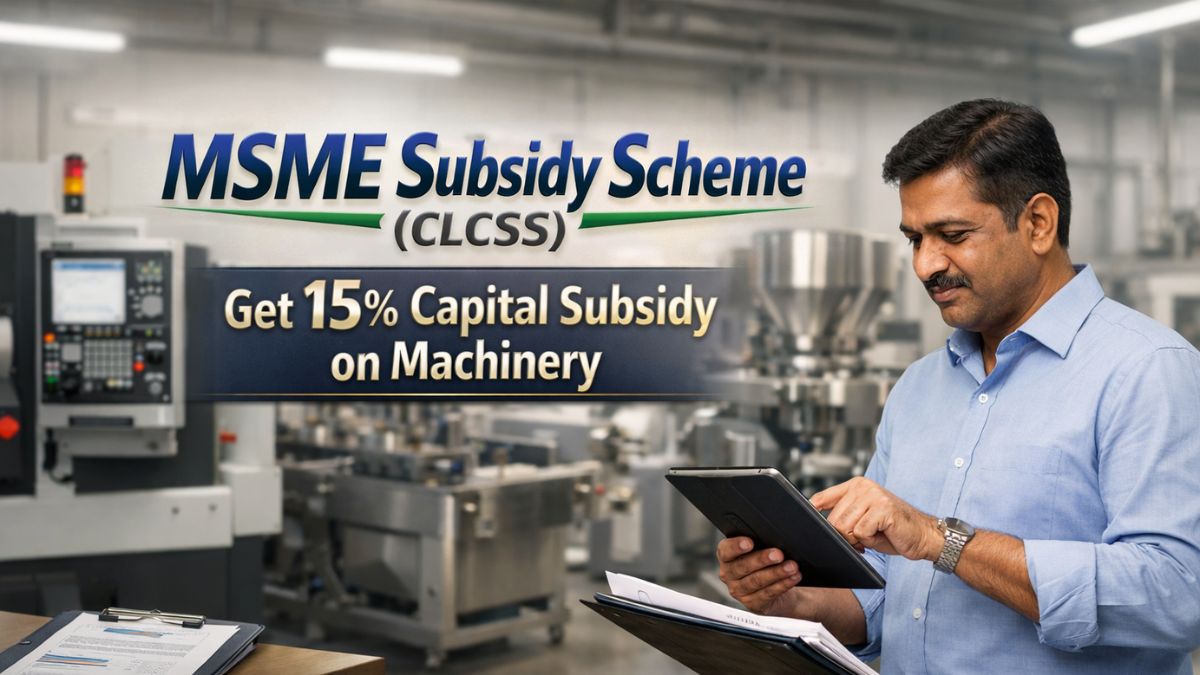
Most of the owners of the MSME in India do not know that government subsidizes investment in machinery through the CLCSS scheme by offering capital subsidy of 15%. This concession can be as high as 15 lakh per unit, but many eligible businesses do not avail.
The credit Linked Capital Subsidy Scheme (CLCSS) aims at assisting small manufacturers to upgrade their technology, enhance production and lower the production costs. Nevertheless, many MSMEs miss this opportunity annually, because of the lack of awareness and appropriate documentation.
In plain words, in case your business is planning to purchase new machinery, the government can directly cut down your loan load by 15 percent but only on the condition that you do it right.
Why MSME Machinery Upgradation is So Important Today
The MSME sector in India provides a high employment rate and GDP, yet most of the units continue to rely on old-fashioned machines. This has a direct impact on productivity and profitability.
Outdated equipment results in low production, increased wastage and poor quality of products. Conversely, modern machines enhance efficiency and assist MSMEs to compete in both local and export markets.
An example is the loss of almost 30 percent of efficiency of textile units with old machines relative to the automated systems. On the same note, food processing units experience an increased rate of rejection as a result of errors in manual processing.
That is why the government has come up with such schemes as CLCSS – to help businesses to modernize without having to spend a lot of money.
What is the CLCSS Scheme?
The Credit Linked Capital Subsidy Scheme (CLCSS) is a central government program under the Ministry of MSME that is conducted by banks, SIDBI, and other financial intermediaries.
In this scheme, the subsidy of 15% on the term borrowings to be used to purchase new machinery is given to eligible MSMEs. The subsidy is not provided in the form of cash but is directly decreased in the loan account and the principal value is decreased.
Key Highlights of the Scheme:
- Capital subsidy on investment of machinery 15%.
- Maximum benefit up to ₹15 lakh
- Applicable on loans up to ₹1 crore
- Only in the case of manufacturing of MSMEs.
- New machinery alone (no second hand)
Who can receive MSME Subsidy?
Small and Micro Enterprises registered under the Udyam Registration portal can participate in the scheme. The business should be actively involved in production and it should borrow some term loan with a registered bank or financial institution.
Simple eligibility requirements are:
- Valid Udyam Registration
- Micro or Small enterprise category.
- Manufacturing sector activity
- Only purchase of new machinery.
- Bank or SIDBI loan.
This renders the scheme affordable even to small businesses owned by families and sole proprietorships.
Get Detailed Project Report (DPR): Project Reports & Profiles
Step-by-Step Process to Avail 15% Subsidy
The subsidy acquisition process is not very hard but need to be observed. An omission of any of these steps may slow down or turn down the application.
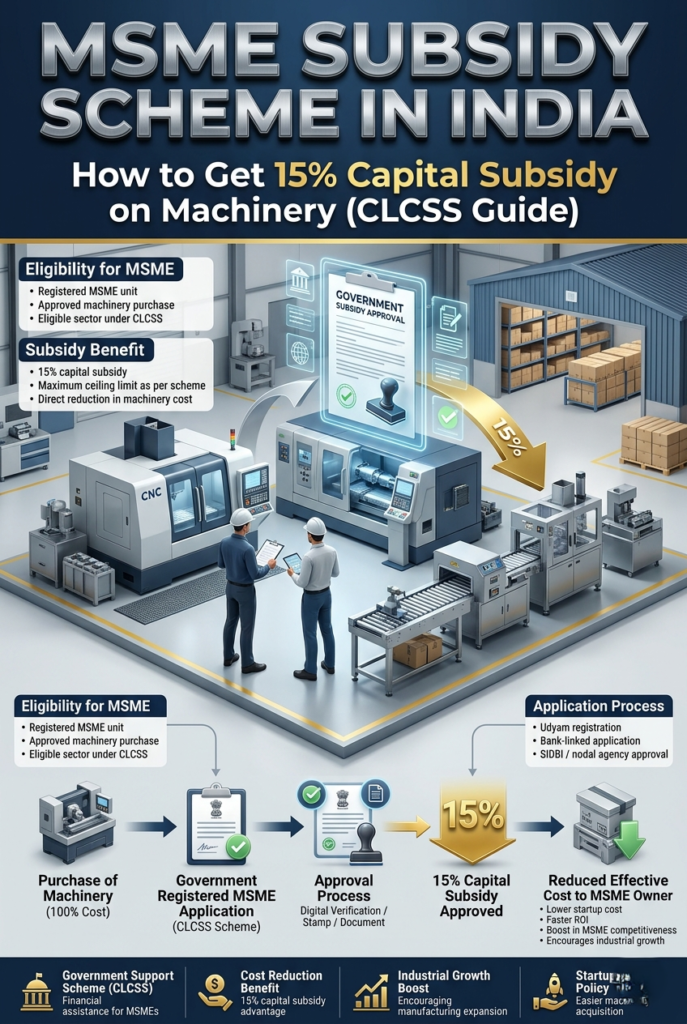
To begin with, make sure that you have your registration of MSME updated and active on the Udyam portal. This registration is compulsory in the applications to do with subsidies.
Then you must go to a bank or Primary Lending Institution such as SBI, Bank of Baroda or SIDBI. You may inform them that you are seeking a CLCSS-linked term loan to upgrade machinery.
This is followed by the next most crucial step that is the preparation of a detailed project report (DPR). This report describes your business plan, machine need, anticipated increase in productivity and financial forecast.
After the bank has granted you the loan, then you can buy the machinery at an authorized supplier. Once installed, the bank would send your subsidy claim to SIDBI with supporting documents.
Lastly, once verified, the subsidy amount will be directly debited to your loan account which will lower your loan balance.
Documents Required for CLCSS Application
MSMEs are advised to have all the necessary documents in place to facilitate easy processing. These include:
- Udyam Registration Certificate
- PAN and GST information.
- Bank loan sanction letter.
- Machinery quotation and invoice.
- Installation certificate
- Detailed Project Report (DPR)
Good documentation is a big boost on the success of approvals and shortening of processing time.
Additional State Subsidy Benefits
Besides the central government subsidy in CLCSS, numerous state governments do have other incentives. These vary depending on location and industry type.
Others such as Tamil Nadu, Gujarat, Karnataka, Maharashtra, and Odisha have additional capital subsidies of between 10% and 25 percent in selected areas.
In other instances, MSMEs are able to pool together the central and state subsidies and, as a result, the effective cost of the machinery can be as low as 40% less. This renders the modernization very affordable to small business.
Importance of a Strong Project Report (DPR)
A poor or incomplete project report is one of the largest causes of rejection of MSME subsidy applications. This document is important in determining business viability by the banks and other financial institutions.
A good DPR must articulately state:
- Machine specification and price.
- Production capacity improvement
- Raw material requirements
- Profit and loss forecasts.
- Market demand analysis
Even qualified businesses can be rejected without a good report.
This is where the professional consultancy services are relevant. A large number of MSMEs seek the assistance of professionals in making bank ready reports that are acceptable.
Role of NPCS (Niir Project Consultancy Services)
NPCS (Niir Project Consultancy Services) is among the top project consultancy organisations in India that facilitates planning and documentation of entrepreneurs in the MSME.
Through its platform Entrepreneur India, NPCS provides:
- Detailed Project Reports (DPRs)
- Feasibility studies
- Market research reports
- MSME business establishment advice.
NPCS has a long history of working in industries like food processing, engineering, chemicals, textiles and packaging. Their reports are also designed based on the bank and government requirements, which enhances the possibilities of receiving loans and subsidies.
To counter the technical requirements and financial approval, NPCS can be used by MSME owners seeking CLCSS.
Why MSMEs Should Not Delay This Opportunity
The government subsidies such as CLCSS are not automatic as they must be applied in time and documented accordingly. Most MSMEs fail merely because they postpone the process or are not aware.
This subsidy is all the more precious as the price of machinery is increasing. Even a few-month delay can spell lost financial gains and delayed increases in business.
Modernization of machinery is not only cost saving on production but also enhances quality, efficiency, and competitiveness in the market.
Conclusion
One of the most valuable government subsidies to MSMEs in India is the CLCSS 15% capital subsidy scheme. It also has a direct impact on cutting the machinery investment costs and promoting the use of technology among small businesses.
Success however lies in good planning, good documentation and application. By acting early, MSMEs can considerably cut down their financial load and enhance their profitability in the long term.
Even such complicated tasks as DPR preparation and subsidy applications are simplified and made more efficient with professional assistance of the organizations, such as NPCS.
Frequently Asked Question (FAQ)
Q1. What is the highest subsidy with CLCSS?
MSMEs can get up to 15% subsidy or ₹15 lakh maximum on machinery investment.
Q2. Who is eligible to this scheme?
Only the manufacturing MSMEs registered under Udyam are eligible.
Q3. Is used equipment permitted?
No, only new machinery with authorised dealers is valid.
Q4. How long does subsidy processing take?
Typically, 60-90 days following the filing of claims by the bank.
Q5. Is it possible to have a combination of state subsidies and CLCSS?
Yes, in several states, it is possible to combine both benefits.


