






Technical Textile Business Ideas
The textile industry is undergoing a major change due to the change in demand of traditional fabrics to technical textiles also referred to as performance-based fabrics. These special materials are fabricated not to be stylish, but functional. They solve engineering and industrial applications like soil stabilization, filtration, medical protection and fire resistance.
India has a strong policy of government and industrial development that is driving this change. The necessity of innovative textile solutions is growing with the rapid development of infrastructure, healthcare facilities modernization, and increasing environmental regulations. Consequently, technical textiles are turning out to be a significant part of the contemporary manufacturing and industrial processes.
To entrepreneurs and investors, this is a rare chance of venturing into a highly demanded industry with greater margins and growth potential in the long run.
Table of Contents
ToggleExplore This Book: Modern Technology of Textile Dyes & Pigments (3rd Edition)
Why Technical Textile Manufacturing Makes Strong Business Sense
The conventional textile companies are usually subjected to stiff competition and seasonal demand because of the changing fashion trends. Technical textiles do not work in the same way as they are not dictated by consumer preferences but by performance requirements. These products are bought by industries due to their need to ensure safety, efficiency and regulatory compliance.
This trend in demand offers a more predictable revenue and improved profitability as opposed to the traditional textile manufacturing.
The benefits of technical textile businesses are some of the followings:
- Greater profit margins than the garment manufacturing.
- Sustained deals with manufacturing customers.
- Lower price competition on account of specialization.
- Increased local and foreign demand.
- Government assistance in terms of incentives and subsidies.
Due to these benefits, manufacturing of technical textiles is rapidly becoming a stable and future-oriented business.
India’s Growing Market for Technical Textiles
The economy of India is growing at a high rate and so is the demand of the industrial materials. Special fabrics are needed to be reinforced and used to drainage in infrastructure projects like highways, railways and urban development. Likewise, hospitals and healthcare establishments rely on hygienic and protective fabrics to ensure patient safety.
Agriculture is also increasingly becoming more technological and there is an increase in the use of shade nets, crop covers and mulch fabrics. The need to filter textiles to regulate industrial emissions and pollution has also increased with environmental regulations.
Such various applications guarantee that the technical textile demand is stable in various spheres, so that it is a stable business opportunity of new entrepreneurs.
Get Detailed Project Report (DPR): Textile, Apparel & Garment Industry
High-Growth Technical Textile Business Ideas for New Entrepreneurs
The technical textile sector consists of a number of lucrative market segments, each having its market demand and investment needs. The decision of the appropriate segment is based on the availability of capital, technical expertise and target market.
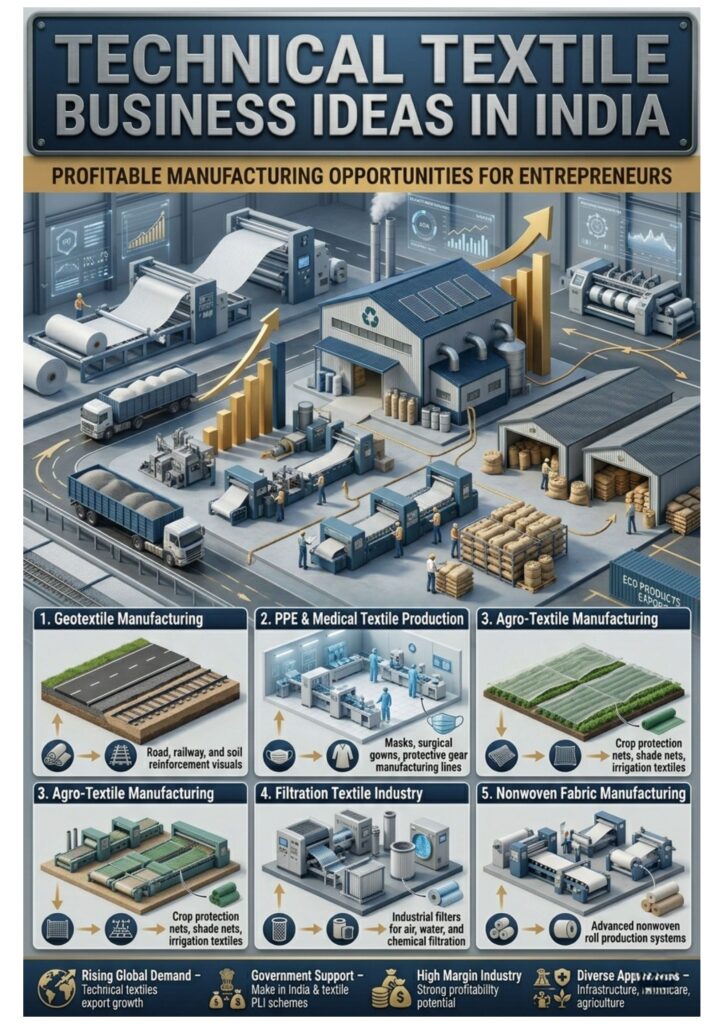
1. Geotextile Manufacturing
Geotextiles have broad applications in construction and infrastructure works as they are used to stabilize soils and erosion proofing. As highway and railroad development is a continuous process, these materials are still in demand.
The reason why this business is appealing:
- Government infrastructure development demand is high.
- Long-term supply contracts
- High durability needs and high pricing.
This segment is also quite appropriate to entrepreneurs who would like to offer materials to the construction and engineering firms.
2. PPE and Medical Textile Production.
Surgery gowns, masks, drapes, and wound care fabrics are all examples of medical textiles. These products are needed by the healthcare sector, which means they have constant demand.
The main advantages of this business are:
- Growing healthcare infrastructure
- Growing need of disposable medical items.
- The export prospects in developing countries.
The production of medical textiles is highly profitable and can be developed in the long term.
3. Agro-Textile Manufacturing
Agro-textiles are applied in enhancing agricultural productivity and shielding crops against environmental degradation. Shade nets and mulch mats are some of the products that have become popular in contemporary farming.
This segment is particularly appropriate to small and medium enterprises since it involves moderate investment and another benefit is the recurring seasonal demand.
Agro-textile goods are common in the form of:
- Shade nets
- Crop protection covers
- Mulch fabrics
- Anti-insect nets
The growth in commercial farming and horticulture is likely to keep this sector growing.
4. Filtration Textile Industry.
Dust, chemicals, and pollutants in manufacturing processes are eliminated with industrial filtration textiles. Cement, chemicals, pharmaceutical, and other industries are industries that need such materials to fulfil environmental and safety requirements.
This segment has a stable demand as regulatory compliance obliges companies to have effective filtration systems.
5. Nonwoven Fabric Manufacturing
One of the most rapidly developing segments in the technical textile industry is the nonwoven fabrics. They have extensive application in hygiene products, medical supplies and packaging materials.
Automation is a major aspect of this business, and it enables manufacturers to manufacture high quantities easily. Due to the rise in consumer awareness on hygiene, the nonwoven fabrics demand is also on the rise.
Investment and Profitability Structure of Technical Textile Businesses
Beginning a manufacturing unit of technical textile needs a carefully laid investment plan. The significant elements of cost include machinery, raw materials, and quality certification. These investments are however normally justified through an increase in selling prices and steady demand.
A majority of the technical textile companies are more profitable as compared to the traditional textile companies due to the specialization and customization of their products. Manufacturers are competing based on performance and reliability rather than just on price.
Profitability is affected by a number of factors:
- Capacity and efficiency of production.
- Quality standards and certification.
- Market and customer relationships.
- Raw material acquisition policy.
- Operational cost management
Those entrepreneurs that make wise planning around these aspects have a high probability of attaining sustainable business growth.
Challenges and Risk Factors in Technical Textile Manufacturing
Technical textile manufacturing is a business like any other industrial business that contains some risks. Learning these issues will enable business people to be well prepared and make expensive errors.
The most prevailing pitfalls are the difficulty in acquiring certifications, initial investment costs, as well as developing a talented workforce. Moreover, the new manufacturers might take some time to build trust among industrial customers.
Though these risks are present, with proper planning and guidance of professionals, they can be reduced. A lot of successful business ventures start with an elaborate feasibility study that looks at the technical needs, the market demand and financial forecasts.
The Importance of Professional Feasibility Planning Before Starting
A well-structured project plan is one of the most significant actions in the initiation of a manufacturing business. In the absence of proper cost estimation and production planning, the entrepreneurs can experience operational inefficiencies or losses.
A professional feasibility report is a clear plan to business success. It assists business people in knowing the amount of money they need to invest, the revenue they should expect and the risks they may take before investing.
Important elements of a feasibility report usually consist of:
- Market demand analysis
- Manufacturing process details
- Planning of machinery and equipment.
- Raw material requirements
- Budgets and profitability forecasts.
Entrepreneurs can use this information and make better decisions and minimize uncertainty.
About NPCS (Niir Project Consultancy Services)
Niir Project Consultancy Services (NPCS) is a professional industrial consultancy firm which assists in setting up manufacturing firms in various industries including textile technical industry.
NPCS focuses on writing comprehensive project reports, and technical advice on new projects. Their services are modeled to assist investors to know the opportunity in the market, the right machinery and how to plan production capacity with ease.
Major services provided by NPCS include:
- Detailed Project Reports (DPR)
- During the preparation of the business plan, the following are conducted:
- Manufacturing process design
- Machinery selection guidance
- Financial planning and estimation of cost.
- Business startup consulting
Having decades of experience in industrial consultancy, NPCS has helped thousands of entrepreneurs to establish successful manufacturing companies.
Future Outlook for the Technical Textile Industry
The future of technical textiles is directly associated with the development of industries and technology. The high-performance materials required by industries are likely to keep increasing as the industries grow more modernized.
The major industries that are likely to become a source of demand in the future are:
- Infrastructure and construction
- Healthcare and medical equipment.
- Agriculture and food production.
- Automotive manufacturing
- Environmental protection
Businessmen venturing into the technical textile business today are putting themselves in a market that has a high growth potential and stability in the long run.
Frequently Asked Questions (FAQ)
Are new entrepreneurs likely to make a profit in technical textile production?
Yes, it is true that in general technical textile production has better profitability rates and is not as subject to changes in demand as traditional textile companies.
How much money would be needed to open a technical textile company?
Capital investment is moderate to high and most of the small and medium units have investment requirements based on the type of product.
Does it offer technical textile startups government support?
Yes, the government program involves financial incentives, subsidies and infrastructure assistance to promote domestic manufacturing.
Are technical textile businesses dependent on the success of export markets?
No, there is a healthy domestic demand in sectors like construction, healthcare, and agricultural sectors.
Why is a feasibility report important before starting a manufacturing unit?
A feasibility report enables entrepreneurs to know the expenses, demand and profitability to decrease financial risk and enhance decision-making.


