





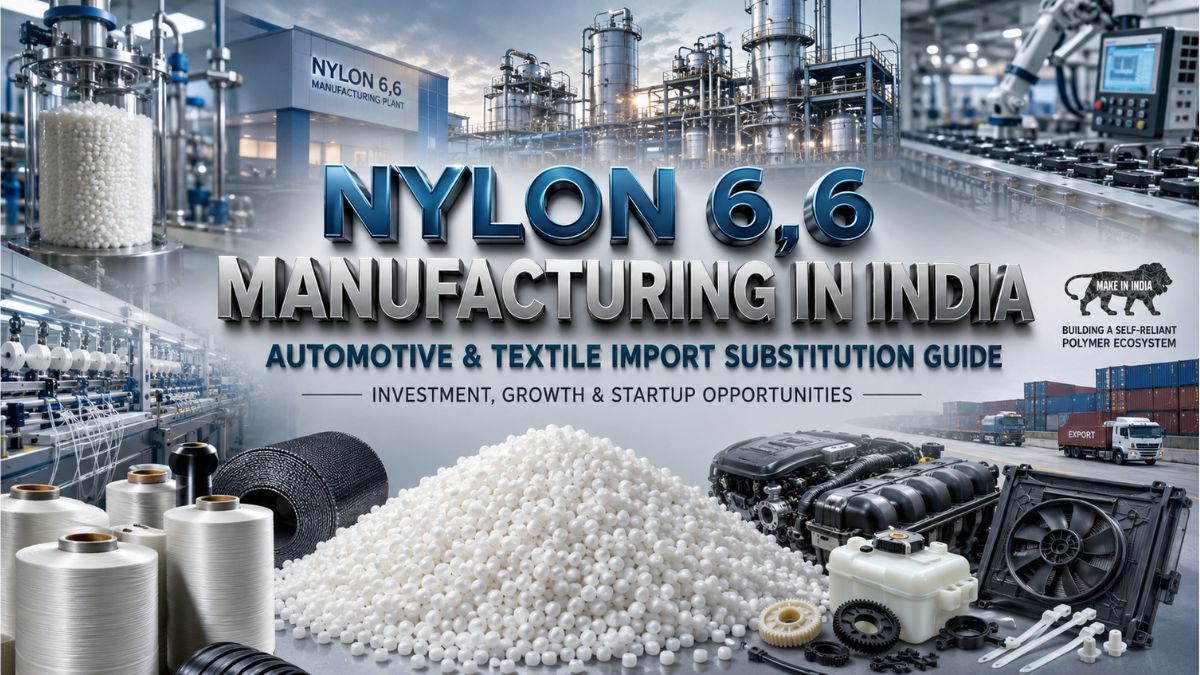
Nylon 6 Manufacturing in India
While India is emerging as one of the world’s biggest industrial economies, it is a single industrial material that is revealing a significant gap in the supply chain — Nylon 6,6 (PA66). In spite of the development of the automobile, petrochemical, and technical textile sectors in the country, India relies heavily on the imported Nylon 6,6 materials from other countries such as Germany, South Korea, China, Japan, and the United States.
Annual Report 2025-26 of Ministry of Chemicals and Fertilizers, Government of India, has around 83.5 KT of installed nylon capacity. However, the production of nylon 6 is almost all domestic and commercial scale production of nylon 6,6 is almost negligible. This presents a tremendous opportunity for entrepreneurs, MSMEs and industrial investors to make the switch from imports to exports.
The nylon 6,6 possesses high performance and engineering polymer properties due to its excellent strength, heat resistance and durability. Compared with regular Nylon-6, PA66 has a superior performance at extreme industrial applications and is indispensable in automotive and technical applications.
Get Detailed Insights from This Book: Modern Technology of Textile Dyes & Pigments (3rd Edition)
Why Nylon 6,6 Demand Is Rising in India
India’s automotive and engineering industry is growing rapidly and this is directly pushing the demand for advanced polymers such as PA66. Today’s cars need to be made of strong and lightweight materials which can withstand high temperature and pressure.
The main applications of nylon 6,6 are:
- Airbag fabrics
- Tyre cord yarn
- Automotive engine components
- Electrical connectors
- Engineering plastic compounds
- Industrial monofilaments
- Technical textiles
- Conveyor belts and filtration systems
The market potential is further gaining strength due to the growth of electric vehicles, increase in technical textiles, and straitening of vehicle safety norms.
India’s Biggest Opportunity: Import Substitution
At present, Indian manufacturers rely on imported raw materials and final products of PA66. This raises the manufacturing expense and provides possible supply chain danger to automotive and industrial businesses.
The opportunity is even more appealing due to strong domestic demand. The estimated consumption of Nylon 6,6 in India is in the multiple thousands of tonnes per year in the automotive, textile and industrial sectors.
Estimated Market Segments
| Application | Estimated Demand |
| Tyre Cord Yarn | 30–35 KT/year |
| Airbag Fabric | 18–22 KT/year |
| Engineering Plastic Compounds | 12–15 KT/year |
| Electrical Connectors | 8–12 KT/year |
| Industrial Monofilaments | 5–8 KT/year |
By replacing a part of such imports, one can generate a multi-crore manufacturing industry in the country.
Get Detailed Project Report (DPR): Textile & Apparel Industry Guide
Best Business Opportunities in Nylon 6,6
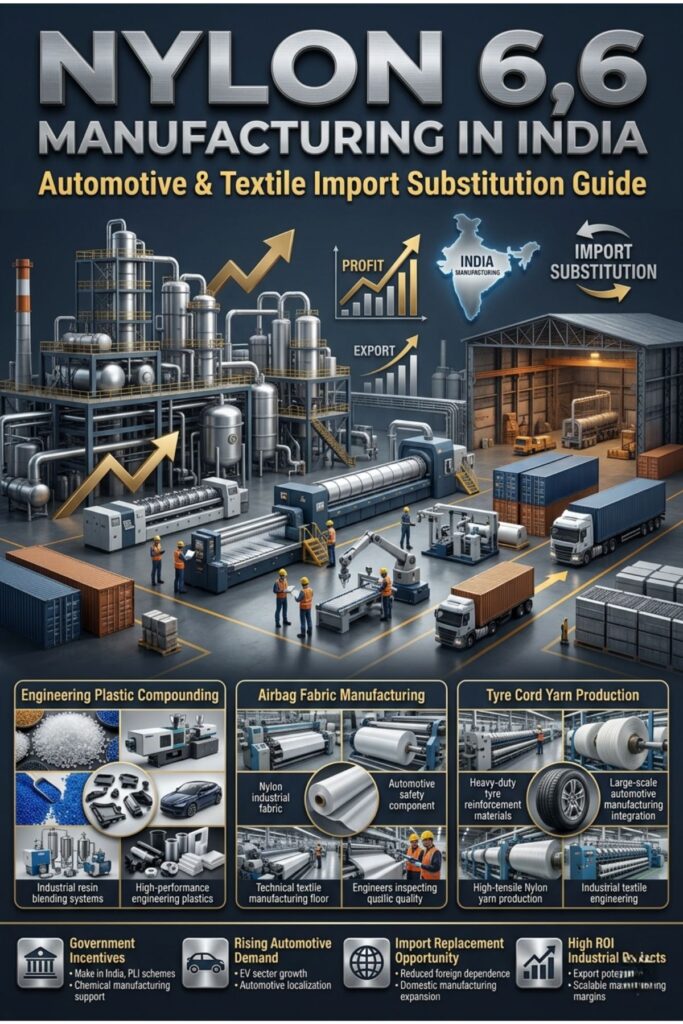
1. Engineering Plastic Compounding
It is currently the most convenient and viable starting point for MSMEs and start-ups in industry.
In this business model:
- Imported from Germany PA66 chips
- Materials are blended with additives and glass fibre
- Some specialty compounds are sold to automotive and electrical applications.
Benefits
- Available for manufacturing via low-cost investment.
- Faster market entry
- Strong demand from EV and automotive sectors
- Good profit margins
The investment required for a mid-scale compounding plant is estimated at ₹25–50 crore.
2. Airbag Fabric Manufacturing
The demand for airbags increases annually in India, with the increase in the number of regulations for automobiles. But the majority of airbag fabrics are still imported.
This opens up a chance to the domestic manufacturers who are able to meet the international quality standards.
Key Advantages
- Long-term OEM contracts
- Growing Automotive Safety Market
- High-value technical textile segment
Depending upon the technology and machinery, a special airbag fabric unit can demand an investment of ₹45-80 crore.
3. Tyre Cord Yarn Production
Another large use of Nylon 6,6 is as tyre cord. The tyre industry of India is growing with a high dependency on imported high performance yarns.
Main Buyers
- Tyre manufacturers
- Conveyor belt companies
- Industrial textile producers
This sector is characterized by stable demand from industry and long-term supply.
Identify high-growth industries before others do
Government Support for Nylon Manufacturing in India
Import substitution and advanced manufacturing is being encouraged by the government of India with its vision of Viksit Bharat. There are some policies and industrial schemes in place to support the manufacture of chemicals & specialty materials.
Key support systems are:
- PCPIR chemical zoning in Gujarat, Odisha, Andhra Pradesh
- PMEGP financing support
- CGTMSE collateral-free loan guarantees
- State-level capital subsidies
- Incentives for electricity and SGST.
Such schemes lower the burden of the new industrial projects.
Challenges and Risks in the Business
The production of nylon 66 is challenging but the opportunity is enticing.
Key challenges are:
- Depending on raw materials that are imported from abroad.
- Requires high working capital in the business
- Technology licensing costs
- OEM approval delays
- Global petrochemical price fluctuations
Critical raw materials such as adipic acid and HMD are controlled by global companies like BASF and Ascend Performance Materials. For this reason, it is essential to use good sourcing strategy and financial planning.
Why Feasibility Planning Is Essential
Many industrially proposed projects are unsuccessful due to the lack of understanding about technical complexity and the financial demands. The Nylon 6,6 projects need to be meticulously planned prior to the investment.
A feasibility report should have:
- Market demand analysis
- Process technology selection
- Machinery requirements
- Raw material sourcing
- Plant layout
- Utility planning
- Financial projections
- Break-even analysis
- Profitability assessment
Even technically sound projects can have a weak commercial performance, if they are not well planned on the feasibility front.
Related Article: Textile Manufacturing Business Ideas in India – High Profit MSME Opportunities with Low Investment
About NPCS – Niir Project Consultancy Services
NPCS (Niir Project Consultancy Services) is one of the best industrial consultancy companies in New Delhi. NPCS supports entrepreneurs, start-ups, and manufacturers to develop profitable industrial projects in the chemical, petrochemical, engineering plastics, textile, and specialty materials industry.
NPCS provides:
- Detailed Project Reports (DPR)
- Techno-Economic Feasibility Reports
- Market Research Studies
- Manufacturing Business Plans
- Financial Modelling
- Machinery Selection Guidance
- Investment Advisory
If you have an idea to start Nylon 6,6 manufacturing in India, then detailed industrial research by NPCS can help you to analyse the project feasibility, identify the most profitable niche, and minimise investment risk.
Conclusion
Today, the Nylon 6,6 industry in India is one of the best import substitution prospects available in the manufacturing sector. There are already demand in the automotive, engineering plastics, airbag fabrics, tyre cord yarn and technical textiles sectors, and there is very little domestic production.
This is an exceptional synergy between the increasing demand and low availability locally, which is a strong opportunity for the first movers. Building technical capability, securing OEM approvals and developing reliable supply chains early can provide long-term benefits to an industry that is experiencing high growth.
It is a true market opportunity. There is already government support. Infrastructure is available. The only thing that’s left is the enthusiasm of industrial promoters to venture into a technically challenging, but highly lucrative manufacturing industry.
FAQ – Nylon 6,6 Manufacturing in India
Nylon 6,6 is primarily used for?
The applications of nylon 6,6 include tyre cord yarn, engineering plastics, automotive components, airbag fabrics, electrical connector, etc. and industrial textiles.
How much do you have to invest?
The investment required in a small to medium scale compounding plant is between ₹25-50 crore plus working capital.
Is the production of nylon 6,6 profitable?
Yes. Gross margin can vary from 20%-35% depending on the application.
What are the highest demand industries?
The automotive sector, tyres, engineering plastics, electrical and technical textile use the most.
What states are the best place to establish a PA66 manufacturing plant?
Some of the best locations are Gujarat, Telangana, Tamil Nadu, Andhra Pradesh and Odisha, due to chemical infrastructure and policy incentives.
What are the services NPCS offers to entrepreneurs?
NPCS offers detailed feasibility studies, project reports, market research and industrial consultancy services to manufacturing start-ups and industrial investment projects.


