





Textile Designing Career in India
Textile design is a fusion of art and industry, and currently one of the most promising business ideas and job prospects in the manufacturing sector in India. The industry is a major exporter of one of the country’s largest export industries, has millions of employees and is continually changing according to changes in technology, sustainability requirements and the global fashion trends. Whether you are a graduate, a freelancer or an entrepreneur, you should be aware of this field as it can lead you to many opportunities ranging from small studios to large-scale manufacturing businesses.
What Is Textile Designing?
The process of creating patterns, textures and structures for woven, knitted, and printed fabrics is known as textile design. It is a blend of creativity and knowledge of materials, production techniques and market trends. A textile designer doesn’t just doodle patterns. They are involved with the entire production value chain, from selection of fibre type, to dye processes and working with weavers to end-user specifications from apparel to home furnishings.
The field can be broadly split into three areas – woven textiles, knitted textiles and printed/surface textiles. They have different technical skills that they need to acquire. Woven Textile Designers are familiar with the structure of the looms; thread counts and yarn weights. The surface designers, on the other hand, concentrate on the position of the printing, colour separation and printing repeat for digital or screen printing. The technical depth of textile design is more than just a creative pursuit; it’s a precise craft that has practical commercial applications.
Get Detailed Insights from This Book: The Complete Technology Book on Textile Spinning, Weaving, Finishing and Printing
Why the Textile Industry Offers Strong Career and Business Potential
India is one of the biggest producers and exporters of textiles in the world. Domestic industry plays a significant part in the manufacturing output of the country and it is one of the major foreign exchange earners. Besides, India’s capabilities in handloom, handicraft and native textiles also provide some niche export opportunities which cannot be matched by any other country.
The Ministry of Textiles, Government of India reports that the industry is directly providing employment to more than 45 million people and 60 million people in allied industries. To a proficient textile designer, it means jobs in garment factories, export houses, home textile industries, technical textile industries and freelance designing firms.
Moreover, international fashion brands are picking up from India to supply raw materials to them. European and North American brands are looking for design-focused suppliers that can combine cost and aesthetics. An employee with a creative and production background becomes a great help, or a designer in his own right who is able to design original products to be sold abroad.
Digital printing technology has also made it easy to enter the market. In today’s world, with a computer, the appropriate software, and a digital print vendor, you can begin a business designing fabrics with only a little money. This is one of the more accessible business ideas in the larger frame of textile manufacturing.
Government Policies and Incentives Supporting Textile Designers
Strong policy framework created by the Government of India for the textile entrepreneurs and professionals. There are a number of schemes which are specifically targeted at new businesses and small business owners in this area.
The Scheme for Integrated Textile Parks (SITP) and the Amended Technology Upgradation Fund Scheme (ATUFS) provide financial assistance for capital investments in the textile infrastructure and technology. These schemes offer machinery/ equipment subsidies that facilitate establishment of a design linked production unit.
Further, the Ministry of Textiles (MoT) has launched a scheme called the Production Linked Incentive (PLI) under which it encourages investments in the manufacture of man-made fibre and technical textiles, where designers with technical expertise are becoming more and more sought after.
The Ministry of MSME provides credit linked capital subsidy, technology support and cluster development assist to the MSME entrepreneurs. Small design studios and manufacturing units can easily comply with the MSME Samadhaan and Udyam Registration portals.
The National Handloom Development Programme (NHDP) and the Design Resource Centre scheme are available to fund designers who wish to work with the traditional craft clusters, having been created specifically for this purpose.
View Full Project Details: Textile Bleaching, Dyeing & Finishing Projects
Business Ideas and Career Pathways in Textile Design
There are several ways of creating sustainable living through textile design. The selection is based on the person’s talents, creative, technical, entrepreneurial or all three of these.
1. Freelance Surface Pattern Designer
Surface Pattern Design is a branch of the creative economy that is growing rapidly, and one of the most popular business ideas for freelance designers. Designer creates florals, geometrics, abstract designs, and then sells them to fabric manufacturers, fashion companies and home decor manufacturers. Global licensing has been made possible for Indian designers by platforms like Spoonflower and Patternbank. The secret to success is to create a strong portfolio of designs in a specialized aesthetic, know the colour trends predicted by colour forecasting firms such as WGSN or Pantone and actively market designs to domestic exporters and overseas buyers. The former can pay a decent amount of money in this sector, especially if they begin licensing designs to several customers at the same time.
2. Bespoke Fabric Design Studio
Establishing a small bespoke design studio, producing custom fabrics for fashion designers, interior decorators and boutique brands, is a very valuable business model. The studio purchases grey fabric, creates original designs for surfaces and receives them digitally or screen-printed via a production partner. The start-up costs are not high: mainly design software, printing sample sets, and marketing to clients. The margins for custom work, however, are much greater than commodity fabrication. The model is very suitable for metros such as Mumbai, Delhi, Bengaluru, where independent fashion labels and interior companies have a high demand for exclusive fabric options.
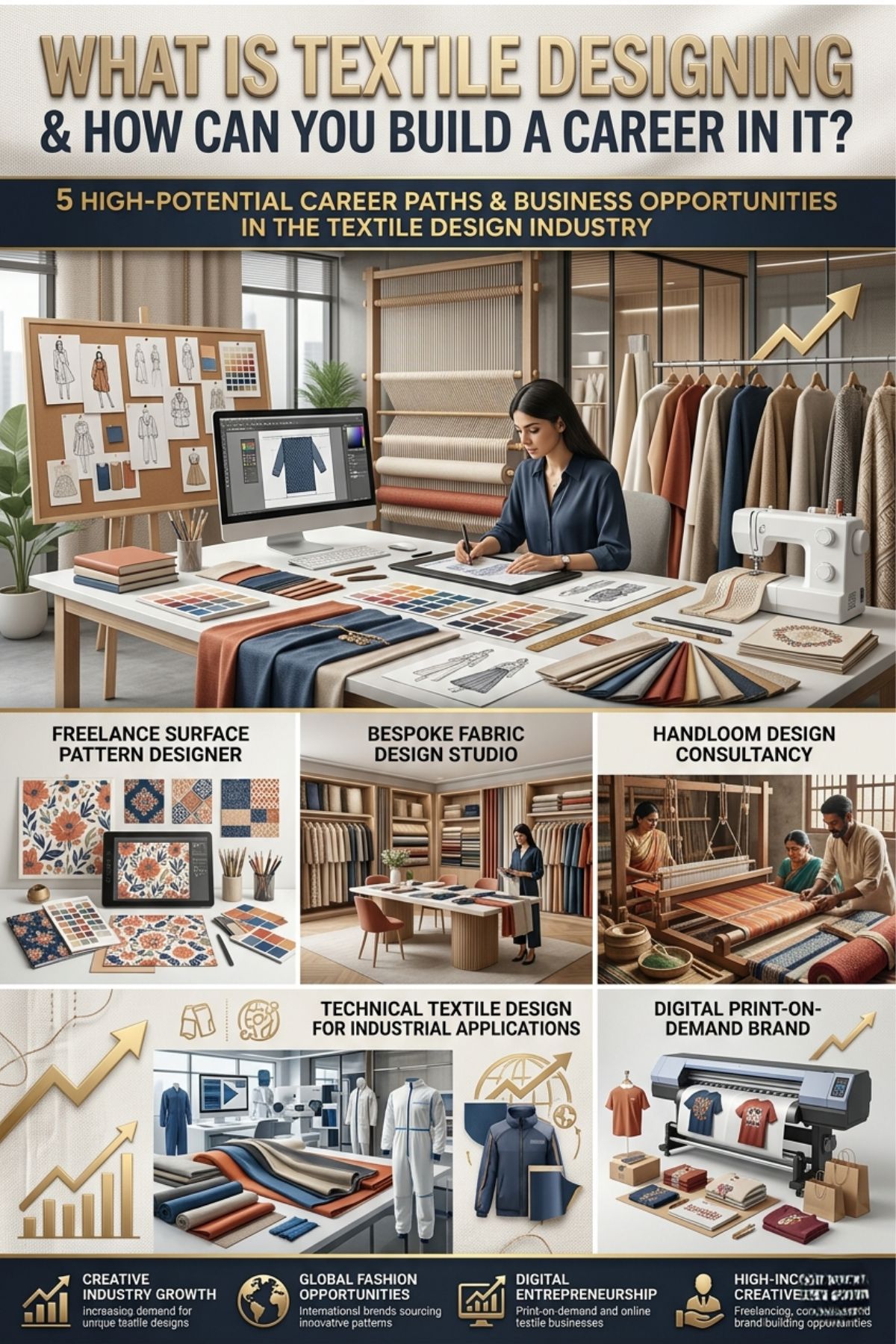
3. Handloom Design Consultancy
The handloom industry in India has a rich tradition but is lacking in modern direction. The designer with an entrepreneurial bent can ensure his design consultancy to handloom clusters, that is, with cooperatives at Varanasi, Pochampally, Chanderi or Kutch to create collections for the modern markets. This model frequently does receive governmental support through the NHDP and state-level craft development program. In addition to the social benefits, handloom consultancy can be a profitable endeavor. Ethical fashion shows have a large demand for well-designed handloom fabrics, as well as local shops. The consultant is paid by design fees, royalties, or retailing the collections directly in an online brand.
4. Technical Textile Design for Industrial Applications
Technical textiles is one of the fastest growing sub-sectors in India. These include materials for medical applications, agriculture, construction, defence and automotive. It is not a showy location, but it is a very business-like and commercial one. Industrial manufacturers are likely to have strong demand for a designer trained in technical textile structures, such as geotextiles, nonwovens and coated fabrics. The government’s attention towards technical textiles and National Technical Textiles Mission (NTTM) has generated a new demand for investment and talent. Here, business ideas involve providing design and prototyping service to technical textile manufacturers who do not have in-house design.
Related Article: Textile Manufacturing Business Ideas in India – High Profit MSME Opportunities with Low Investment
5. Digital Print-on-Demand Brand
Fabric production has been revolutionised due to digital printing technology. The designer may even have a business revolving around print-on-demand, designing original textile patterns, selling fabric by the metre, scarves, clothes, or home furnishings online. Initial investment costs are low. The designer designs the artwork, uploads it to a production partner or e-commerce site, and profits from each sale, while avoiding inventory. For individual designers this is possible with platforms such as Amazon India, Meesho and independent Shopify stores. Creating a brand based on a unique design identity is the long-term benefit; as time goes on and the design becomes more recognizable, it can lead to licensing opportunities or wholesale orders.
Import–Export Opportunity Analysis
India exports textiles in various categories ranging from cotton yarn, grey cloth, apparel and home textiles. Apparel Export Promotion Council (AEPC) and Textile Export Promotion Council (TEXPROCIL) actively encourages the designer led business to enter the world markets.
The easiest-to-export products for textile designers are handmade and design-heavy fabrics. There is a high demand for authentic Indian fabrics that have a modern aesthetic in the markets of the European Union, the United States, Japan and Australia. An informed Indian textile designer can have the advantage of offering these three elements of traceability, craft heritage and original design, that buyers in these markets are willing to pay premium prices for.
For designers in the technical or performance textile category, China and South Korea are often sources of raw materials for specialty yarns and substrates when importing. By knowing this import chain, any designer will be able to quote the industrial client a more competitive price. If you are a new business, getting involved in export promotion councils and international trade shows such as Heimtextil in Frankfurt or Texworld in Paris can be a game-changer in terms of speeding up market entry.
Indian MSME Success Stories in Textile Design
Anita Dongre – AND Design
Starting in Mumbai, Anita Dongre took her enterprise to great heights and established one of the most popular fashion-forward textile brands in India. The success of her career was rooted in her deep knowledge and understanding of craft traditions, especially the hand block print tradition of Rajasthan, and her ability to create beautiful and wearable fashion out of it. She was involved with artisan communities, building a supply chain that combined traditional skill and contemporary design direction. The message for new entrepreneurs is quite simple: collaborate with craft clusters and establish original design language, thus forming up defensible brand position which mass manufacturers can hardly duplicate.
Fab India – John Bissell and William Bissell
The Fabindia started out as an export company, brokering Indian handloom products to foreign buyers. It grew to become a domestic retail powerhouse with hundreds of stores over decades. The design vision was based on authenticity, highlighting the natural dyes, dyes, and weaving techniques of Indian artisanal craftsmanship. The company’s model demonstrates the huge commercial value of design-led sourcing from traditional textile areas. In the present scenario, Fabindia is a blueprint for entrepreneurs seeking to formalize and expand the business of the artisans without compromising the cultural essence of their products.
Manish Malhotra – From Costume Design to Global Brand
Manish Malhotra started out designing costumes for Bollywood films, which gave him extensive knowledge of Indian fabrics, embroideries and the way to make them. He leveraged that to launch a high-end fashion brand, which is now exported to international markets and offers high value clients. His story showcases the potential of a creative vision and positioning, coupled with technical expertise in textiles, to create a business that is scalable and has export potential.
How NPCS Can Help You Enter This Sector
A feasibility report is crucial in the process of establishing a textile design studio, a textile fabric making unit or a technical textile industry for any entrepreneur. We are Niir Project Consultancy Services (NPCS) a firm that offers Market Survey cum Detailed Techno-Economic Feasibility Reports (DPRs) for businesses in the entire textile value chain.
Our reports include manufacturing process, market demand analysis, capacity planning, machinery specifications, raw material requirement, and complete project financials, including profitability projections. If you’re considering a print-on-demand studio, a handloom design consultancy or a technical textile production facility, NPCS provides you with the information you need to make informed investment decisions.
Start with clarity—choose the best business idea
Market Overview: Indian Textile Design Sector at a Glance
The following table summarises key indicators for professionals and entrepreneurs considering entry into the textile design and related manufacturing space.
| Parameter | Detail | Relevance for Startups |
| India Textile Export Value | Approx. USD 35–40 billion annually | Large export-ready market for design-driven products |
| Handloom Sector Employment | Over 35 lakh weavers across India | Significant artisan network available for design collaboration |
| Technical Textile Market Size | Growing at 10–12% per year | Strong demand for qualified technical textile designers |
| Digital Print Fabric Growth | 15–18% annual growth rate | Low-investment entry for print-on-demand design studios |
| Avg. Salary – Entry-Level Designer | ₹2.5–4.5 lakh per annum | Foundational career benchmark before entrepreneurship |
| Avg. Revenue – Freelance Designer | ₹6–15 lakh per annum (established) | Viable self-employment option with good design portfolio |
| PLI Scheme Textile Outlay | ₹10,683 crore announced | Capital incentive for scaling technical textile production |
| NID / NIFT Graduate Output | Approx. 2,000+ graduates annually | Trained talent pool available for industry and startups |
Frequently Asked Questions (FAQ)
Q1. What is required for someone to become a textile designer in India?
A diploma or degree from a well-known design institution will be necessary for the majority of roles within the industry. The two most prestigious routes for a formal textile design qualification are from either NID (National Institute of Design) or NIFT (National Institute of Fashion Technology). It is worth noting that a lot of highly successful textile designers have worked their way up through state-level textile and art schools. For an individual with aspirations to own a design business, understanding software such as Adobe Illustrator and Photoshop and Textile CAD programs would be much more important than credentials, as a formal program often helps with exposure and networking with industry professionals.
Q2. How much capital would be needed to set up a textile design studio?
It is possible to set up a lean design studio – specializing in surface pattern design and digital print – with capital between two and five lakhs of rupees. The costs include those incurred in obtaining a computer, the licenses for software packages and marketing costs, and sample printing costs. The start-up costs for a more organized studio which requires physical sampling infrastructure, an employee and office space could range between 15 to 30 lakhs, while a production-linked studio could cost considerably more. NPCS feasibility reports can give the specific financial details required.
Q3. Would technical textile designer’s skills still be useful to the industry?
Demand for these roles is increasing significantly. Investments in a number of technical textile areas (geotextiles, geotextiles and medical textiles) have increased thanks to the National Technical Textiles Mission. Many of the companies involved are on the lookout for designers with an understanding of structural fabric engineering and functional requirements, which is beneficial if you want to find employment or offer consulting services beyond the fashion and garment industry.
Q4. Is it feasible for a textile designer to generate revenue from exporting designs without having a production unit?
Certainly. Licensing of designs can provide designers with income from exports without having the capital costs associated with producing an article or garment. The designer develops their artwork which is then licensed to an overseas supplier or print-on-demand platform, where the designer may receive a percentage per meter sold or a flat fee. Alternatively, a designer can work as a freelance consultant to export houses and develop seasonable collections for them. TEXPROCIL and AEPC work on a global scale to organize buyer-seller meets, and the platforms offer access to trade fairs enabling designers to develop contacts.
Q5. What design software is important for a textile designer?
The standard software required for surface pattern design is Adobe Illustrator and Photoshop, while for woven textiles production software such as EAT Design Scope and Arahne CAD are common within production offices. Colour management in digital printing is performed using Rip (Raster Image Processor) software while 3D modelling software for textiles and clothes is being considered a worthwhile asset in most designers’ skillsets, as they can showcase ideas to an overseas client prior to the manufacture of physical samples.
Q6. Does the government help handloom designers?
Yes, financial aid is provided for handloom cooperatives and designer-artisan collaborations through the National Handloom Development Program (NHDP). This involves funding for design elements, raw materials, and support for sales and marketing activities. Numerous cluster development programs are implemented at state levels, especially in areas known for handloom production, and designers that choose to register as development partners or collaborate with cooperatives can readily take advantage of government support. The Office of the Development Commissioner for Handlooms, part of the Ministry of Textiles, is responsible for implementing these support schemes.
Conclusion
Far from just a creative job, textiles design is a business activity in one of India’s major business sectors. Whether you establish yourself as a freelance textile designer, found a design studio, become a textile design consultant, or a design-based manufacturer, the business provides tangible business opportunities. Whether you specialize as the owner of a brand, a technical consultant or a manufacturer driven by design, there is no shortage of business opportunities if one is prepared to focus on both creative and technical expertise.
Additionally, as far as entrance to the business is concerned, government incentives are now providing an exceptionally positive environment, especially due to the PLI scheme, the NHDP, micro and small entrepreneur loan programs, and by way of promotion at export councils. Due to India’s vast craft skills, expansive export opportunities and comparatively inexpensive digital infrastructure, the business climate for a strategically positioned textile designer, can lead to a lucrative and saleable business and career.
Entrepreneurs that require comprehensive and quantitative based feasibility studies before starting a business should approach NPCS, who offer exhaustive business reports specifically within the context of textiles. The business opportunity report on the textiles business is available by clicking here. For scheme details and up-to-date information, visit the website of the Ministry of textiles, and visit NPCS for your very own customized DPR.


