





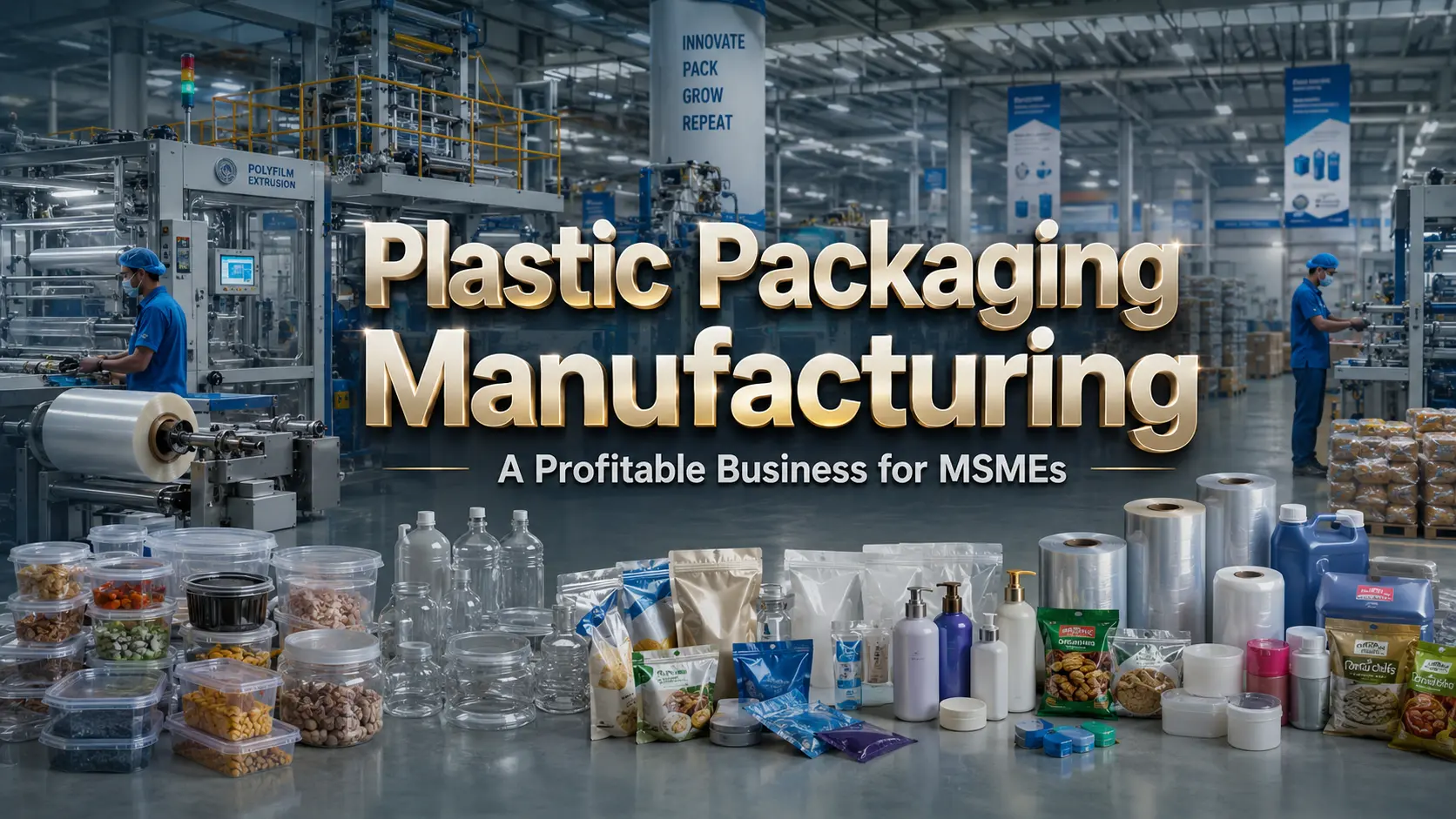
Plastic Packaging Manufacturing Business in India
The ₹2.6-Lakh-Crore Market Most MSME Founders Are Ignoring
Each and every piece of dal, each and every bottle of shampoo, each and every blister pack of paracetamol requires a plastic package before it reaches the consumer. India has only 13 kg of plastic per person per year, whereas the average of 27 kg per capita per year is present in the world. It is not a red flag. This is a revenue map.
Mordor Intelligence states that the Indian plastic packaging market was valued at USD 22.44 billion (around ₹1.87 lakh crore) in recent times and is expected to surpass the USD 26.89 billion mark during the early part of the next decade. But organized manufacturing is still dominated by a handful of mid to large converters. The hundreds of thousands of FMCGs, e-commerce vendors, Pharma units and food processors in Tier-2 and Tier-3 India still struggle to find quality packaging materials locally.
This is a true MSME opportunity because packaging is a purchase that isn’t optional. It is essential to a food company to be able to ship its product. It’s a must-have for any cosmetics brand to have on store shelves. Demand is permanent and does not react to seasonal fluctuations. An entrepreneur who runs a well-managed plastic packaging unit is not simply in on a trend; he or she is connecting in with the supply chain of all the categories of consumption goods in the nation.
Get Detailed Insights from This Book: Modern Technology of Plastic & Polymer Processing Industries
The Supply Gap Nobody Talks About
According to the Plastindia Foundation data, India’s plastic industry has around 50,000 units, majority of them MSMEs. However, distribution is highly skewed. According to Mordor Intelligence data, only two of the three states – Maharashtra, Gujarat, and Tamil Nadu – account for about 60% of the capacity of the organised plastic packaging segment. Local manufacturers fail to cater to the enormous demand from states like Uttar Pradesh, Bihar, Odisha, Jharkhand, Chhattisgarh, Rajasthan and other states which account for a huge and growing consumer base.
The ramifications are real and expensive. A small spice company based at Lucknow places orders for flexible pouches from a converter in Ahmedabad. Transit takes 5–7 days. The minimum order quantities are high. Customisation is slow. There is no viable local option and the brand is tied to the supplier, who is 1,200km away. This is the space that a new MSME can close.
The ecommerce boom has further exacerbated the demand. Mordor Intelligence reports the number of parcels shipped via e-commerce has increased by more than 40% over the last few years, which has fueled the demand for tamper-evident pouches, stretch films, and moisture-barrier liners. The package volume for 15 minutes delivery services increased by 300% in the major metros through quick-commerce platforms alone. Such expansion is not covered by the current base of converters. New capacity will be sold right away, particularly in new areas.
As per the Extended Producer Responsibility (EPR) guidelines issued by the Central Pollution Control Board (CPCB), the new regulations under the Plastic Waste Management Rules, 2018, mandate that plastic manufacturers and importers must make sure that their packaging is recycled or recovered. This is making companies more inclined towards formal and registered EPR compliant suppliers over unformal suppliers which is a direct benefit to a new unit of MSMEs registered as a Udyam Unit.
Table 1: State-wise Demand Concentration and Industrial Clusters for Plastic Packaging
| State / Region | Demand Driver | Key Industrial Cluster | Current Supply Gap |
| Gujarat | FMCG, pharma, petrochemicals | Dahej, Dholera, Rajkot, Ahmedabad | Moderate — well-served, competitive |
| Maharashtra | FMCG, e-commerce, pharma | Navi Mumbai, Pune, Aurangabad | Moderate — high volumes but tight margins |
| Tamil Nadu | Food processing, auto, pharma | Thiruvallur, Coimbatore, Chennai | Moderate — state-funded polymer park active |
| Uttar Pradesh | Food, FMCG, agri-processing | Noida, Kanpur, Lucknow, Agra | High — large demand, limited local supply |
| Rajasthan | FMCG, textiles, agri | Jaipur, Jodhpur, Bhilwara | High — most packaging imported from Gujarat |
| Odisha / Jharkhand | Food, mining consumables | Bhubaneswar, Jamshedpur | Very High — almost no organised local capacity |
| Bihar / Chhattisgarh | Agri-products, food retail | Patna, Raipur | Very High — fastest-growing retail markets |
| Delhi-NCR | E-commerce, retail, pharma | Noida, Faridabad, Gurgaon | Medium — good demand, expensive real estate |
Why the Window Is Open Right Now
It is the perfect time to get into the plastic packaging business, as three separate factors are coming together. Structural demand growth is on the rise in the domestic market. With an average of 13 kg per person per year, compared to 27 kg per person per year as seen globally, India has got a huge potential to increase its plastic consumption per capita. Each packaged good needs packaging, and the rise of the middle class, the rapid urbanization and the formalization of retail through e-commerce are all contributing to packaged-goods consumption.
Second, EPR is weeding out unorganised players. MoEF&CC has imposed EPR targets for all plastic packaging producers. Brands and packaging suppliers are increasingly choosing each other and are increasingly opting for EPR compliant registered packaging suppliers to align with their own EPR. An MSME unit also gets an additional advantage over informal units if it is registered as an MSME and is GST compliant along with having an EPR certificate issued by the CPCB.
Third, the government’s support for capital formation in manufacturing is more available today than ever before. The following scheme is directly applicable:
PMEGP (Prime Minister’s Employment Generation Programme) is a scheme of Khadi and Village Industries Commission (KVIC), Ministry of MSME which provides margin money subsidy of 15% – 35% on project cost of up to ₹50 lakh on manufacturing units for first time entrepreneurs. The subsidy is increased to 35% for the rural applicants and special categories (SC/ST/women/OBC). The applicant provides 5%-10% of the total contribution and the remaining 90%-95% is a loan from the bank. A rural general category entrepreneur saves a total of ₹10 lakh in the initial stage of a project costing ₹40 lakh in a plastic packaging unit.
Get Detailed Project Report (DPR): Plastics, Polymers and Resins Projects
CGTMSE (Credit Guarantee Fund Trust for MSMEs): Offers Credit Guarantee Facility for MSMEs loans up to ₹5 crore, without requiring any collateral. If an entrepreneur doesn’t have any property or assets to guarantee a loan, he or she can still obtain working capital. Available at all financial institutions including banks and NBFCs.
The Udyam Registration free MSME registration on Udyam portal (udyamregistration.gov.in) opens the door to priority sector lending, state-level industrial subsidies like power tariff concessions in Gujarat, UP, Odisha, and other states, and preference in government procurement.
Central Institute of Petrochemicals Engineering & Technology (CIPET): Provides skilling training programmes in plastics processing technology at 45+ centres throughout the country. The first year of having a CIPET-trained production supervisor is a huge cost saver in reducing machine setups and quality problems.
How to Set Up a Plastic Packaging Unit: Step-by-Step
1. Choose Your Product Focus
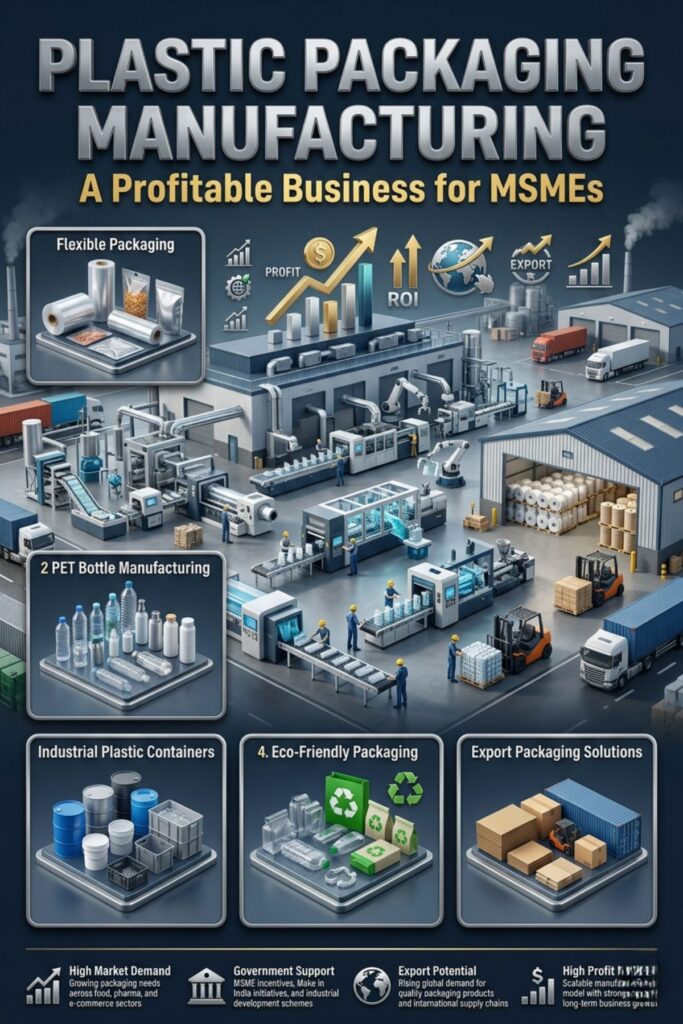
Don’t attempt to produce all plastic types of packaging. Choose a part and dive in it! The 4 entry points that most easily allow an MSME to enter, are:
- The market for flexible packaging (pouches, films, laminates) is the largest with medium capex.
- Rigid containers (bottles, jars, boxes via injection/blow moulding) — higher capex, premium margins.
- Polypropylene woven/non-woven sacks — agriculture, cement, grain — simple machine
- Use bags and multi-layer films (commoditised but high volume)
2. Land and Space Requirements
A flexible packaging unit (FPU) will require 2,000–3,000 sq ft of covered factory area that provides a minimum ceiling height (14′) for extrusion lines. A requirement is that three-phase power (at least 30 kW connected load) is available, the access of a truck to deliver raw materials is available and the proximity to the State Industrial Area or SIDCO/GIDC estate has infrastructure advantages. The rent per square foot per month in an industrial area is ₹8 to ₹20 per square foot, depending on the state’s location.
3. Machinery and Equipment
A flexible packaging and pouch manufacturing line consists of:
- Rewritten Blown Film Extrusion Machine (single/double layer): ₹8-18 lakhs
- Gravure / Flexographic Printing Machine: ₹6 – 15 lakhs
- Bag Making Machine (pouch cutting machine and sealing machine): ₹4-8 lakh
- Lamination Machine: ₹5–10 lakh
- Slitting Machine: ₹2–4 lakh
- Electroplating equipment: ₹2–4 lakh
Some of the good Indian suppliers of machinery are Rajoo Engineers (Rajkot, Gujarat), Mamata Machinery (Ahmedabad) and Windsor Machines (Vapi). Lines from Taiwan or China are imported, but are more expensive, costing 40-60% more, and come with longer service times.
4. Raw Material Sourcing
The key raw materials include LDPE, LLDPE, HDPE, PP and BOPP film rolls. Primary resin is obtained from IOCL (Panipat), HPCL-Mittal Petrochemicals, Reliance Industries (Jamnagar) or GAIL (Petrochemicals). These companies’ distributors are found in all major states. Hindalco distributees are available for aluminium foil used in lamination. The inks and solvents are obtained from the Toyo ink, Siegwerk India or local industrial estate suppliers. Distributor network of GAIL India and IOCL Petrochemicals are present throughout the country.
5. Licences and Regulatory Approvals
Udyam Registration (MSME) – free, on udyamregistration.gov.in, will take 1 day.
GST Registration: compulsory for business with an annual turnover exceeding ₹40 lakh and can be done through the GST portal.
Factory Licence (from State Labour Department) 15–30 days.
Pollution Control Board Consent to Establish & Operate (NOC) (State SPCB) 30-60 days; Cost ₹10,000-₹50,000
Registration on CPCB portal, mandatory for plastic packaging producers and free.
BIS Certification — applicable only for particular products such as food contact packaging, ₹25,000–₹1 lakh
FSSAI Registration: If your packaging is food-grade, and you are supplying them directly to food manufacturers, you will need the FSSAI Registration.
The local municipal body (LMB) will issue a trade licence.
6. Timeline and Team Size
Business registration to first production: about 90 – 120 days with a well-managed setup. Regulatory approval dictates the timeline – beginning the Pollution NOC process on Day 1 since it is the longest process. A minimum of 8-12 members with the following composition should be present: 1 production supervisor (CIPET trained is preferred), 4-6 machine operators, 1 quality checker, 1 storekeeper and 1-2 helpers.
Build a profitable business with the right idea
Table 2: Investment Breakdown for a Flexible Packaging MSME Unit (₹40–60 Lakh Scale)
| Cost Head | Low Estimate (₹) | High Estimate (₹) | Notes |
| Blown Film Extruder (1 line) | 8,00,000 | 18,00,000 | Indian make vs imported |
| Printing Machine (Flexo) | 6,00,000 | 15,00,000 | 2-colour vs 6-colour |
| Bag Making Machine | 4,00,000 | 8,00,000 | Single vs multi-function |
| Lamination + Slitting | 7,00,000 | 14,00,000 | Combined unit or separate |
| Utilities & Misc Equipment | 2,00,000 | 4,00,000 | Compressor, generator, tools |
| Factory Fit-Out / Civil Works | 2,00,000 | 5,00,000 | Rented shed: lower end |
| Regulatory & Compliance Costs | 75,000 | 1,50,000 | Licences, NOC, testing |
| Working Capital (3 months) | 8,00,000 | 12,00,000 | Raw material + payroll |
| Contingency (8%) | 2,50,000 | 4,50,000 | Buffer for delays |
| Total Project Cost | 40,25,000 | 82,00,000 | Scale-dependent |
Note: A project of Rs. 50 lakhs cost at rural premises will be eligible for subsidy of Rs. 15-17.5 lakhs resulting in considerable reduction on promoter’s outflow. The application process is through KVIC PMEGP portal (kviconline.gov.in).
ENTREPRENEUR SPOTLIGHT
With an initial investment of ₹45 lakh, including a part from PMEGP loan, Ravi Shankar Agarwal, Raipur, in Chhattisgarh, has set up a flexible packaging unit in an MSME industrial estate in Raipur. His unit now provides pouch packing for 30+ spice and dry-fruit companies in the region, and has a turnover of ₹1.8 crore per annum with a net margin of 18%. His big secret: “Lock in two anchor clients before you order the machinery. The machinery will pay for itself, but you need to have order flow first. He now employs 14 people and is expanding to a second extrusion line.
Financial Snapshot: What You Can Realistically Expect
These estimates are for a project with a flexible packaging line capacity of ₹50 lakh, which was set up in a tier-2 city and leased out in the factory premises.
Working Capital: ₹40–50 lakh (based on the company’s requirements)
Monthly Operating Cost at 60% Capacity: ₹4.5–5.5 lakh (raw materials: ₹3–3.8 lakh; payroll: ₹80,000–1 lakh; power: ₹40,000–60,000; rent and overheads: ₹30,000–40,000)
Monthly Revenue at 60% Capacity: ₹6–7.5 lakh
Monthly capacity: ₹10-13 lakh/month at 100% capacity
Gross Margin: 28-34% (40-45% of sales price is the raw material cost, 20-25% of the sales price is the margin, and 30-35% is the cost of conversion)
Average capital margin: 16–22% on full capacity (after depreciation, loan repayment and overheads)
Payback Period: 28-36 months from commissioning with 70%+ capacity utilisation. Units with anchor clients that are likely to return a profit before they launch generally pay back the investment within 30 months.
These are based on typical FMCG pouch orders. The payback is even smaller for pharma or specialty packaging, which fetches a price premium of 15-25%. The operating risk of raw material (resin) price volatility, which is linked to crude oil prices, and is likely to have impact on margins by 3-5% in negative months, is the main risk.
Related Article: Plastic Park Scheme India: ₹40 Crore Grant for 8 States
Table 3: Government Schemes Applicable to a Plastic Packaging MSME Unit
| Scheme | Nodal Body | Key Benefit | Eligible For | Apply At |
| PMEGP | KVIC / DIC | 15–35% margin money subsidy on project cost up to ₹50 lakh | New first-time entrepreneurs | kviconline.gov.in |
| MUDRA — Shishu/Kishore/Tarun | SIDBI / Banks | Collateral-free loans ₹50,000 to ₹10 lakh (Shishu), up to ₹10 lakh (Kishore), up to ₹50 lakh (Tarun) | Existing + new MSMEs | Any scheduled bank or NBFC |
| CGTMSE | SIDBI + MoMSME | Credit guarantee for collateral-free MSME loans up to ₹5 crore | Registered MSMEs | Via lending bank |
| Udyam Registration | MoMSME | Priority-sector loan access, state subsidies, power concessions | All MSMEs | udyamregistration.gov.in |
| ZED Certification (Zero Defect Zero Effect) | Quality Council of India | Quality upgrade subsidy up to ₹5 lakh; export market readiness | Manufacturing MSMEs | zed.org.in |
| State MSME Industrial Schemes | State SIDCO / GIDC / TIDCO | Plug-and-play plots, power subsidies, capital investment subsidy (varies by state) | New units in industrial estates | State industries department |
| CIPET Skill Training | CIPET (MoC&P) | Subsidised technical training in plastics processing; reduces hiring and quality costs | Entrepreneurs + operators | cipet.gov.in |
Where to Get a Detailed Project Report
Niir Project Consultancy Services (NPCS) offers detailed project reports, techno-economic feasibility studies, plant layout designs and end-to-end consultations for plastic packaging manufacturing units of all the sizes to the entrepreneurs who want to go beyond the back of the envelope calculations before investing capital. They provide specifications of the machinery, sources of raw materials, financial forecasts, regulatory checklist, and demand analysis of the market, all of which are India-specific. For decades NPCS has been engaged in partnership with the founders of the MSME sector, industrial investors and financial institutions. Reports can be found on niir.org and more business advice for the MSME segment can be found on entrepreneurindia.co. A techno-economic report is also a much less costly way for first-time founders to avoid making costly mistakes when deciding whether or not to enter into plastic packaging or a related category, versus discovering after committing to plant equipment that their product mix or pricing assumptions were incorrect.
The One Step That Separates Founders Who Start from Those Who Don’t
“Majority of the entrepreneurs that are going to read this article will know that they want to be in manufacturing; those that will make it won’t be smarter than us-they’ll just move first. Plastic packaging is not sexy; it’s steady, recurrent, structurally growing business. There is demand for it, government financing tools are present and the non-metro India supply gap is true,” said the company.
Here comes your next step. Dial three FMCG/Food brand companies, anywhere with 50 km from you, this week. Inquire from them as from where are they procuring the packaging at the present, what are their monthly volumes, are they facing supply reliability issues. If 2 of them are saying yes, and almost all the Tier-2 cities will do, you have your market validation. Pull up a detail project report and do PMEGP bank file at the same time. Obtain Udyam registration, simultaneously.
Waiting for the perfect moment is not a strategy. The supply gap will be filled — by someone.
Frequently Asked Questions
Q1. How much does it cost to start a plastic packaging unit in India?
A basic starter unit (flexible – pouches/films) can be setup within total project cost of Rs 38-55 lakh including Machinery + working capital + compliances. Rigid packaging(bottles/jars) costs more at Rs 60-90 lakh as injection or blow moulding machinery are significantly costlier than Flexible machinery. PMEGP subsidy of 15-35% significantly helps a first-time entrepreneur reduce effective promoter investment.
Q2. What licences are mandatory before starting production?
Documents needed: You will be requiring a Udyam Registration (which is free of cost), GST Registration, Factory Licence, Pollution Control Board Consent to Establish and Operate (NOC from your State SPCB). In cases when you produce packaging of food grade material, a BIS certification or FSSAI Licence can be demanded. It is compulsory to have EPR registration on the CPCB portal for each plastic packaging producer in light of the plastic waste management rules.
Q3. Where do I source raw materials (resin) in India?
Primary polymer resins — LDPE, LLDPE, HDPE, PP — are produced by IOCL (Panipat), Reliance Industries (Jamnagar), GAIL Petrochemicals, and HPCL-Mittal. Each has an authorised dealer network in every major state. For specialty materials like BOPP film or aluminium foil for lamination, major suppliers are concentrated in Gujarat, Maharashtra and Tamil Nadu, but the material is transported to pan India. Large lots purchased (5-10 tonnes) lower per kg resin cost by 3-8%.
Q4. What profit margins can I realistically expect?
Gross margins for plastic packaging conversion typically run 28–34%. Net margins after all overheads, loan repayment, and depreciation are 16–22% at full capacity. At 60% capacity — typical in Year 1 — expect net margins of 10–14%. Units that specialise in pharma-grade or printed premium packaging command 15–25% higher prices, improving margins meaningfully. Raw resin price fluctuations tied to crude oil are the primary variable that compresses margins in difficult months.
Q5. Which government scheme gives the most benefit for a new plastic packaging unit?
Who it is most beneficial for: This will be the most beneficial for a brand new entrepreneur on a shoestring budget. How it helps: Margin Money Subsidy of 15-35 percent of the cost of the project up to Rs 50 lakh. This will come off your principal loan amount directly. Where to apply: The online KVIC portal or through the District Industries Centres near you. MUDRA Tarun loans ( up to Rs 50 lakh, no collateral) and CGTMSE backed loans For Working Capital After Establishment If you have the working capital to establish your unit, these loans could be a good fit.
Q6. How can NPCS help me start a plastic packaging business?
NPCS offers detailed project report for plastic packaging machine units which includes all the technical parameters, machinery, financial planning and market assessment. Plastic packaging: an emerging industry | Pack2go It provides support to various entrepreneurs for starting a plastic packaging machine unit as well as their future projects. Their techno-economic feasibility studies are used by entrepreneurs and banks to evaluate project viability before committing capital. Reports are available at niir.org. For ongoing sector insights and entrepreneur resources, visit entrepreneurindia.co.


