





Safic-Alcan, a France-based speciality chemicals distributor, bought a majority stake in Mumbai-based S.A. Ingredients Pvt. Ltd. (SAI), which distributes speciality ingredients to more than 400 customers in pharma and nutraceuticals, sending out a message far stronger than any market report. SAI, which has been established since 1992, was divided from S.A. Pharmachem, as reported in Chemical Weekly, 19 May 2026. Safic-Alcan’s CEO said the primary reasoning was the growth rate of the probiotics market which is expected to be 20% year-on-year and India’s robust GDP growth. The world would not foot the bill for a capital-intensive project in a small distribution business without significant manufacturing potential to back it. Indian MSME founders should be exactly where that is.
The nutraceutical ingredients market in India is estimated at ₹50,000 crore and growing at 12–15% per year. The dependency on imports is still high. The problem of domestic supply shortages is apparent to anyone who has had the time to visit a formulation plant or a contract research lab, and is particularly evident for probiotics, herbal extracts and functional proteins. This is not a fad article. It’s an opportunity for execution.
Why This Sector Is a Strong Startup Opportunity
Market Demand Signals and Growth Drivers
The organised nutraceutical market in India has three pockets of demand; the Pharma channel (vitamins, minerals, amino acids for therapeutic use), the consumer wellness channel (protein supplements, immunity boosters, probiotic beverages) and food fortification (iron, zinc, vitamin D in staple foods). All pools are expanding. Post-pandemic health awareness has not altered, it hardened into purchasing behavior both in Tier-1 and Tier-2 cities.
The Ministry of Ayush has been actively opening up the regulatory environment for botanical and herbal extracts, establishing documented demand for standardised raw materials that domestic manufacturers can produce. At the same time, the Food Safety and Standards Authority of India (FSSAI) has tightened the rules for the labelling and purity of the ingredients used in nutraceutical products, which will penalize products that are not branded with Indian origin and will benefit the producers who are certified.
Export Potential and Import Substitution Logic
Nutraceutical ingredients such as probiotics, omega fatty acids, plant protein isolates, and standardised botanical extracts are some of the major imports from China and Europe to India. India is a leading exporter of pharmaceutical products with exports valued at over $25 billion annually, with nutraceutical ingredients being a significant portion of the business, IBEF reports. The rationale for import substitution is straightforward; manufacture locally to reduce formulation costs for Indian manufacturers and at the same time provide access to export markets to the US, EU and Southeast Asia where demand for Indian source herbal and Ayurvedic products is known.
Identify high-growth industries before others do
Government Schemes, PLI Benefits, and MSME Incentives
The nutraceutical manufacturing of certain categories of nutraceutical ingredients is directly covered under the Production Linked Incentive (PLI) scheme of pharmaceuticals and food processing. Food-grade nutraceutical production is supported by capital subsidies and cold chaining support given by the Ministry of Food Processing Industries (MoFPI). The MSME Ministry’s CGTMSE scheme provides collateral-free loans of up to ₹2 crore, a significant option for first-generation manufacturers aiming to establish pilot-scale production units.
This sector is also supported by the industrial cluster policies. The Maharashtra Industrial Development Corporation (MIDC) has identified pharma clusters around Tarapur, Ambernath, and Aurangabad where nutraceutical ingredient plants can be co-located with the formulation companies, reducing logistics costs and facilitating immediate selling to local buyers.
Entry Barriers — Capex, Licensing, Raw Material Access
This is not a no barrier area. Documented process controls, clean-room specifications for certain products and lab testing infrastructure are required for both FSSAI licensing for food manufacture and GMP certification for pharma-grade supply. The entry-level capex is from ₹60 lakh to ₹4 crore depending on the product chosen. First-time promoters tend to underestimate the importance of raw material access.Qualifying suppliers is an important requirement for using probiotics and botanicals as raw materials. Allow 3-4 months for vendor development prior to first production.
Business Selection Logic
The products with the highest margins have an India Raw Material advantage and the added value is through standardisation and value addition in the extraction method, spray drying and encapsulation, such as turmeric, ashwagandha, ginger, moringa etc. Thin margins for a unit, making crude powder. A unit that provides a standardised extract that has been verified to contain 95% of curcuminoids is fetching 3-4 times the price and fetching a defensible margin of 40-55% to formulation companies.
When selecting among product categories, the founders have three factors to consider in their calculus – margin structure, regulatory complexity, and buyer concentration risk. Herbal extracts and probiotic cultures have good margin and regulatory complexity. Plant proteins are moderate on margin and are easier to license and have a wider pool of buyers. Pharmaceutical excipients generate lower margins, but are contractually guaranteed by known drug companies.
From the very start, scalability is a key factor. The standardised botanical extract can be produced at a pilot capacity of 500 kg/month, which can be scaled up to 2–3 tonnes/month of the same with additional extraction capacity and drying infrastructure, without redesigning the process, with an investment of ₹1.2-crore. This is a step-up model – capex increases revenues – which is more fundable than big greenfield projects for first generation promoters.
You can’t be “not OK” with risk awareness. Botanical raw material prices vary with the seasons. If procurement is not forward-contracted, a sudden crop failure in an important source region could bring margins down 15-20 percentage points. There is also a regulatory risk; FSSAI makes changes in the list of permitted ingredients from time to time and products which are approved today may have usage restrictions in two/three years. Diversification of product on 3–4 ingredients mitigates concentration risk.
Product and Project Opportunities
1. Standardised Herbal Extract Manufacturing
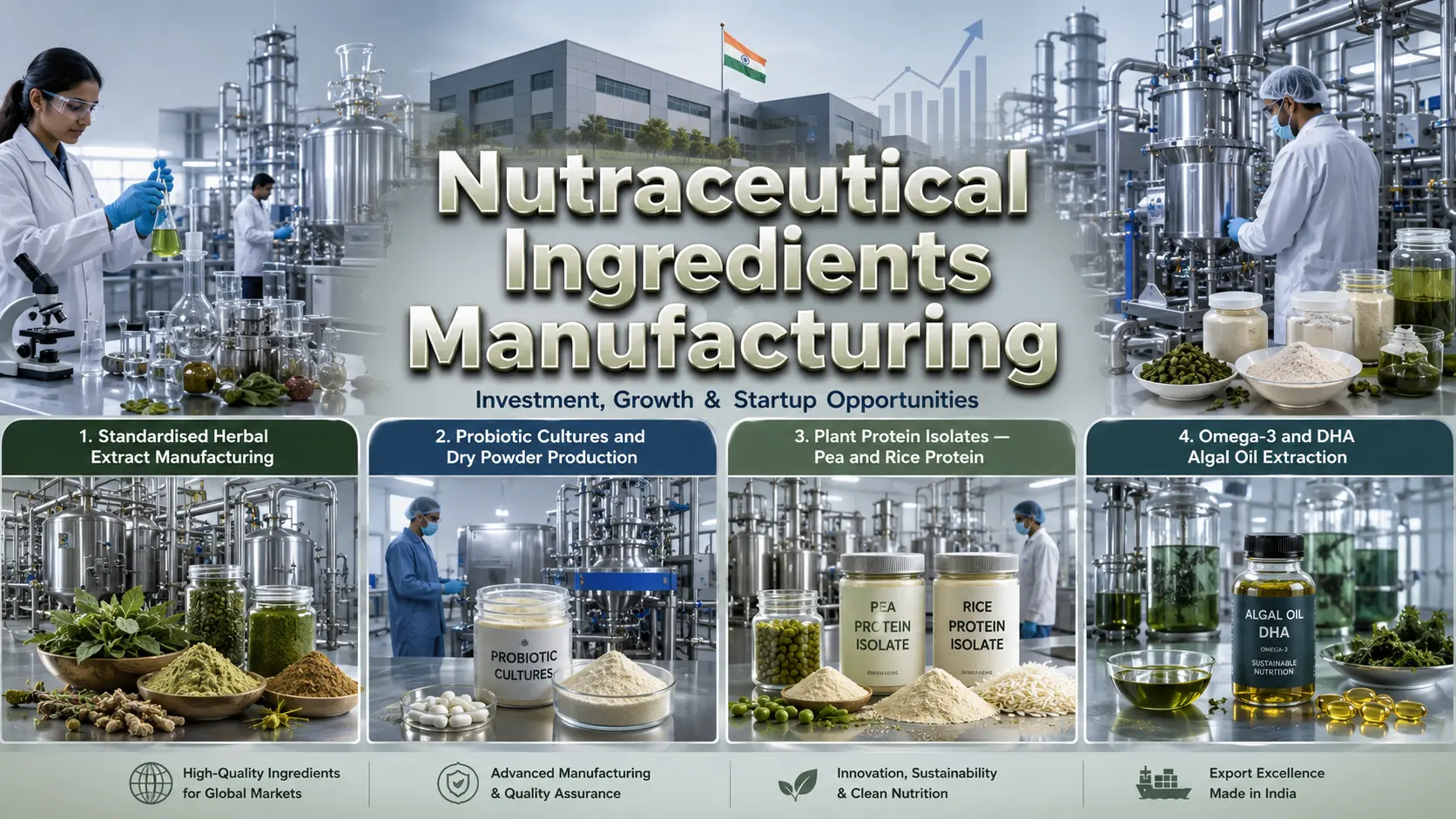
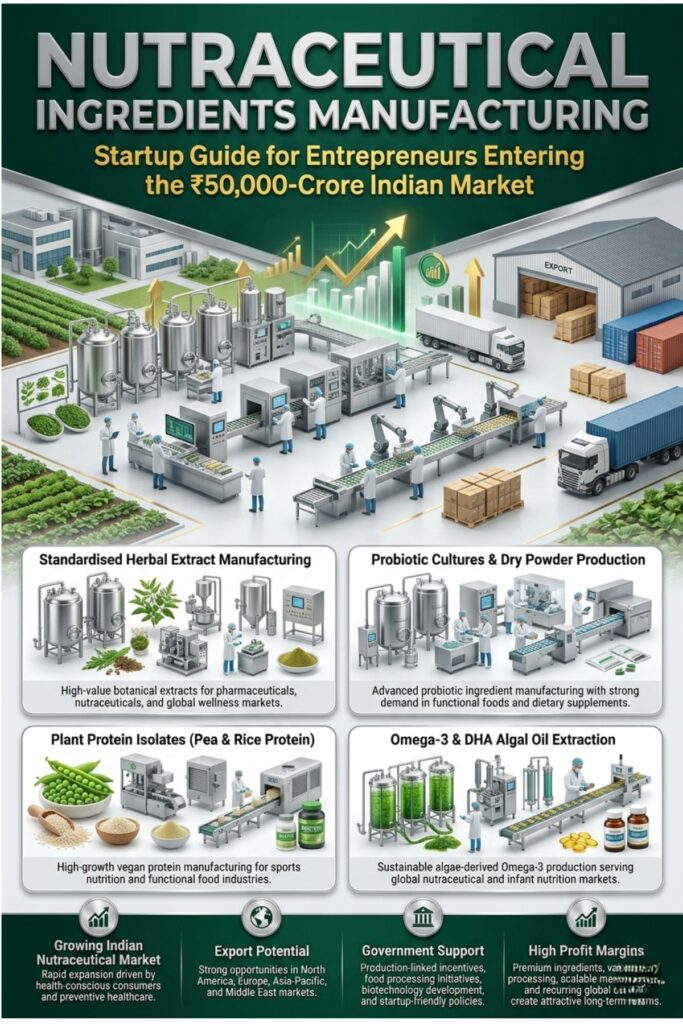
Establish a small extraction and spray drying plant to produce standardized extracts of curcumin, Ashwagandha withanolide and Boswellic acid in Gujarat/ Maharashtra. The capex for a unit with production capacity of 500 kg/month is in between ₹80 lakh and ₹1.2 crore, which involves setting up the solvent extraction equipment, spray dryer and basic quality lab. The target buyers are the companies from the Ayurvedic product industry (Dabur, Himalaya, Patanjali supply chain traders), the companies which formulate the herbal supplements with nutraceutical products, and traders who export to the herbal supplement companies in EU and North America. Finished standardised extracts gross margins vary from 40-55% and break-even can be realised when the utilisation rate is 55-60%. It is mandatory to seek FSSAI registration and export documentation requires 45-60 days to gain qualification of the buyer. The reorder rate of proved buyers is, however, high.
Get Detailed Insights from This Book: Herbal Cosmetics & Ayurvedic Medicines (EOU)
2. Probiotic Cultures and Dry Powder Production
The probiotics market is arguably the biggest growing segment in the nutraceutical ingredients market. The Asia Pacific probiotics market is projected to expand by 20% annually, as mentioned in Chemical Weekly of 19 May 2026, which is an important reason why Safic-Alcan’s management chose to make its S.A. Ingredients acquisition, Safic-Alcan reported. Capex for a freeze-drying or spray-drying unit for the processing of the cultures of Lactobacillus and Bifidobacterium is in the range of ₹1.5 crore to ₹3 crore, which includes fermentation tanks, lyophilizer or spray-drying unit, and cold-chain storage. Margins range from 35–45%. The key buyers are infant nutrition brands, probiotic drink manufacturers, and pharma companies. Technical collaboration is possible without importation of a full line and the technology is available from CSIR-CFTRI, Mysuru.
3. Plant Protein Isolates — Pea and Rice Protein
Plant based protein isolates have seen continuous demand due to sports nutrition and clean label food formulation. Peas and rice are grown in abundance in India but most of pea protein isolate used in India is imported from China and Canada. Protein isolates can be achieved at 80–90% concentration using a wet fractionation with isoelectric precipitation, spray-drying and flavour-masking. The cost of capex varies between ₹1.2 crore and ₹2.5 crore per 500 tonne per year unit. These target buyers are sports nutrition brands (MuscleBlaze, Fast&Up), FMCG bakery and beverage companies as well as institutional buyers for school nutrition programmes. Once scaled up, gross margins are in the range of 28–38%. It’s not a pharma grade certificate, just a food industry operator license is good enough, making it easier to get in the game.
4. Omega-3 and DHA Algal Oil Extraction
Microalgae-based Omega-3 and DHA which is fish-free is a new and high-quality market that is heavily reliant on imports. There are real advantages of input in India due to its coastal geography and algae cultivation tradition. The capex of a small scale supercritical co2 extraction facility for production of DHA 40% Algal Oil, which is actively promoted by Indian distributors in Chemical Weekly, is between ₹2 crore to ₹4 crore. Margins are strong between 30%-42%. Key customers are infant formula producers, pharmaceutical companies making soft-gel capsules, and clinical nutrition brands. This is a demanding technical section — pilot testing of 6–8 months duration should be considered before settling the quality of the product. Buyer willingness to pay a quality premium is proven, however.
Get Detailed Project Report (DPR): Omega 3 Fatty Acid from Sewage Water Manufacturing Plant Report
Indian Entrepreneur Case References
Gaurav Kabra — S.A. Ingredients, Mumbai
Mr Gaurav Kabra founded S.A. Ingredients from the distribution business of his family, which had been in operation since 1992, S.A. Pharmachem. Instead of being a distributor of chemicals, he made a bold move and SAI became a more focused company specializing in pharma and nutraceutical ingredients, bringing in more than 400 clients from both sectors. Safic-Alcan was interested in an India acquisition in the life sciences sector and SAI was on the menu. A lesson for MSME founders: specialization in a big sector adds up to the value of an acquisition in a timelier fashion than a broad product basket. If you were going to defend a business with multiple lines of business, why not two aligned lines of business, as opposed to 20? If you’re defending a business with many lines of business, why not 2 lines of business rather than 20?
Titan Biotech Ltd. — Bhiwadi, Rajasthan
Titan Biotech, domiciled in Bhiwadi in India, is a listed company on the exchanges that produces Peptone, Microbiology Media and Nutraceutical ingredients such as Amino acids and protein Hydrolysates. The company’s ability to ensure the pharma-grade quality control coupled with MSME scale operations, helped it grow from a small fermentation unit to a multi-crore exporter. The early adoption of international certifications – GMP, ISO, Halal – to access Middle East and South East Asian markets was the pivotal choice made by its promoters to tap into new markets ahead of domestic market consumption. Lesson: export premiums that are not justified by domestic prices are only realized after the first two to three years when the cost of certification is paid.
Yashdeep Pharma & Nutraceuticals — Mumbai
A regular advertiser in Chemical Weekly, Yashdeep Pharma & Nutraceuticals is based in Mumbai and specializes in supplying specialty ingredients as well as manufacturing nutraceutical actives. Their product portfolio, which includes niacins, riboflavins, amino acids and plant extracts, is a conscious approach to depth in the pharma-nutraceutical overlap categories. Yashdeep’s case highlights the benefits of being actively engaged in trade media, B2B exchanges, and having GMP documentation in place for small MSMEs. Inbound enquiries as a result of trade visibility will save significant amounts of money in sales costs.
Related Article: Biomanufacturing Business Ideas with Government Support
Import–Export Opportunity Analysis
India’s trade in nutraceutical ingredients is deficit. Herbal products, as well as probiotics, omega fatty acid concentrates and proteins from plants, are imported in bulk from China, France, Denmark and the US. But, momentum is gathering on the other side for exports. Today, Indian-origin botanicals such as ashwagandha, turmeric, neem, and bacopa have gained recognized premium in the markets of European and North American supplements. The APEDA (Agricultural and Processed Food Products Export Development Authority) has been actively promoting export of spice extracts / herbal preparations, and market development assistance for spice export, is available to registered exporters.
Import substitution first, export monetisation second is the best strategic play for Indian MSME manufacturers. Build up domestic supply to Indian formulation companies, quality documentation (CoA, HPLC, microbiological certificate), and then approach the export-oriented distributors. With 20-30 domestic customers, financials of a ₹1-crore manufacturing investment will be met with full capacity before taking into account exporting.
Export promotion incentives are given by the Directorate General of Foreign Trade (DGFT) on nutraceutical ingredient categories through the MEIS and RoDTEP schemes. The ideal practice is to register on the DGFT portal and have a proper document on the Importer-Exporter Code from the very beginning. Ideally, if you are planning to export from the beginning, then register on the DGFT portal and maintain a proper document on the Importer-Exporter Code.
Government Policy and Project Feasibility Groundwork
The Ministry of Chemicals and Fertilizers is administering the Pharmaceuticals Promotion and Development Scheme for which nutraceutical ingredient manufacturing units can have subsided infrastructure in the designated pharma parks. These state level incentives include various schemes such as Package Scheme of Incentives (PSI) in Maharashtra and Industrial Policy in Gujarat that provide stamp duty exemptions, interest subsidies and electricity duty concessions for pharma and nutraceutical manufacturers located in notified zones.
For any founders wanting to invest capital in any new project, it is essential to have a robust techno-economic feasibility study carried out for the same. This is where companies like Niir Project Consultancy Services (NPCS) come into the picture. The market survey cum detailed techno-economic feasibility reports is prepared by the company which includes complete project architecture: manufacturing process; detailed process flow; specification of the raw material, and the machinery involved; product mix options; demand, and market survey of the product; complete project financials with the predicted income statement, cash flows, break-even etc. In case of a founder trying to ascertain if a probiotic plant worth 1.5cr is better or a protein unit of 2.5cr will be more feasible, having the financial model verified before injecting capital is nothing like an added perk, but just good risk management. Latest trend reports of the sectors are always accessible from: Chemical Weekly is one of the leading trade journals of the chemical and allied sectors in India.
Data Table: Nutraceutical Ingredient Manufacturing — Startup Reference
| Product Category | Capex Range (₹) | Gross Margin (%) | Key Buyer Segment |
| Probiotic Cultures (Dry Powder) | ₹80 L – ₹1.5 Cr | 35 – 45% | Pharma, Nutra Brands |
| Plant Protein Isolates (Pea/Rice) | ₹1.2 Cr – ₹2.5 Cr | 28 – 38% | Sports Nutrition, FMCG |
| Herbal Extracts (Standardised) | ₹60 L – ₹1.2 Cr | 40 – 55% | Ayurvedic, Export Markets |
| Omega-3 / DHA Algal Oil | ₹2 Cr – ₹4 Cr | 30 – 42% | Infant Nutrition, Pharma |
| Pharmaceutical Excipients (Nutra) | ₹1 Cr – ₹2 Cr | 22 – 32% | Capsule/Tablet Makers |
Source: Compiled from industry data and Chemical Weekly, May 19, 2026 issue. Capex ranges are indicative for MSME-scale units.
The Window Is Open — But Not Indefinitely
The acquisition of S.A. Ingredients by Safic-Alcan is far more than just a corporate news brief. It is a diagnostic. It suggests that a European specialty chemicals group made an acquisition in Mumbai-based nutraceutical ingredients distribution because the actual Indian manufacturing base is still weak, relative to demand. That space is the entrepreneurial opening.
The Indian nutraceutical ingredient market (almost 50,000 crore) is being served by importers, some large manufacturers and a long tail of smaller processors. Regulations are increasingly stringent, clearing the space for compliant MSME manufacturers from unorganized players and taking away business from unorganised ones. Government incentives schemes are available and accessible. For botanicals, the raw material chains are localized. The technical knowledge base is available through CSIR institutions and industry associations.
This is the way to proceed practically. Identify a category where India has input advantages, apply for FSSAI and GMP licenses before beginning sales, sell to 20-30 Indian buyers to achieve positive cash flow, and certify the product in year two, to export. Early entry rewards will not necessarily go to sectors that shout the most but to those that are already quietly occupied by foreign capital investment. Indian nutraceutical ingredient manufacturing is one such category.
Conduct in depth feasibility study first. Produce according to regulations. Scale with documentation. Entrepreneurs in this sector will succeed based not on the intensity of their love of health trends, but on the rigorous application of principles that treat nutraceutical ingredient manufacturing as a specialty chemical business.
FAQs for the founder
Q1. What is the minimum capital investment required for a nutraceutical ingredient manufacturing facility?
A pilot-scale unit producing herbal extracts or probiotic dry powder, needs an initial Capex ranging from 60 to 80 lakh. Add another 15-20 lakh for FSSAI, GMP certification, laboratory equipment and the first stock of raw materials. Also consider working capital, which typically requires 10-15 lakh for the initial three months before sales come in.
Q2. When is the breakeven point reached?
In an ideal herbal extract unit costing around 1.2 crore operating at 60-65 per cent capacity utilization with 40 per cent gross margin, breakeven will typically occur in 24-30 months. Probiotic units, owing to their higher Capex, may take 30-36 months to break even. The most significant impact on the breakeven period will come from building up a customer base of 15-20 prior to or at the beginning of commercial operations.
Q3. Which licenses and certifications are mandatory to start the production process?
Without an FSSAI manufacturing license (essential for food-grade nutraceuticals), GST registration, a Factory Act license and consent to operate from the pollution control board, you cannot legally manufacture. WHO-GMP certification, if required for pharma grade supply, will add an additional 3-4 months and 10-15 lakh to the project completion time. For exporters, the Importer-Exporter Code (IEC) from the DGFT will be mandatory. A buyer will also check all these documents from your very first conversation so, begin production only when these are in order.
Q4. Is it feasible to compete with Chinese producers on price?
On common nutraceutical ingredient (basic vitamins and bulk amino acids), you will likely struggle to compete with Chinese imports on price. However, on certified organic ingredients, standardised herbal extracts and Ayurvedic active ingredients, you will have the advantage to compete in export markets at a 15-25 per cent premium in terms of price. This can be primarily attributed to the increasing demand for Indian-origin products post the supply chain disruptions caused by the global shipping problems. The key is quality certification rather than price, and the fact that buyers are now preferring to buy Indian products over Chinese imports.
Q5. What are the primary business risks?
The most serious risks involve fluctuating raw material prices (mitigate by entering into forward contracts and developing relationships with 2-3 suppliers per ingredient), regulatory changes by FSSAI regarding permissible ingredients (diversify your portfolio to three or four products), and customer concentration (avoid selling over 25 per cent of your produce to a single client in the first two years of business). A funding crunch between 18 and 24 months due to the strain of working capital is also common and should be planned for in advance.


