






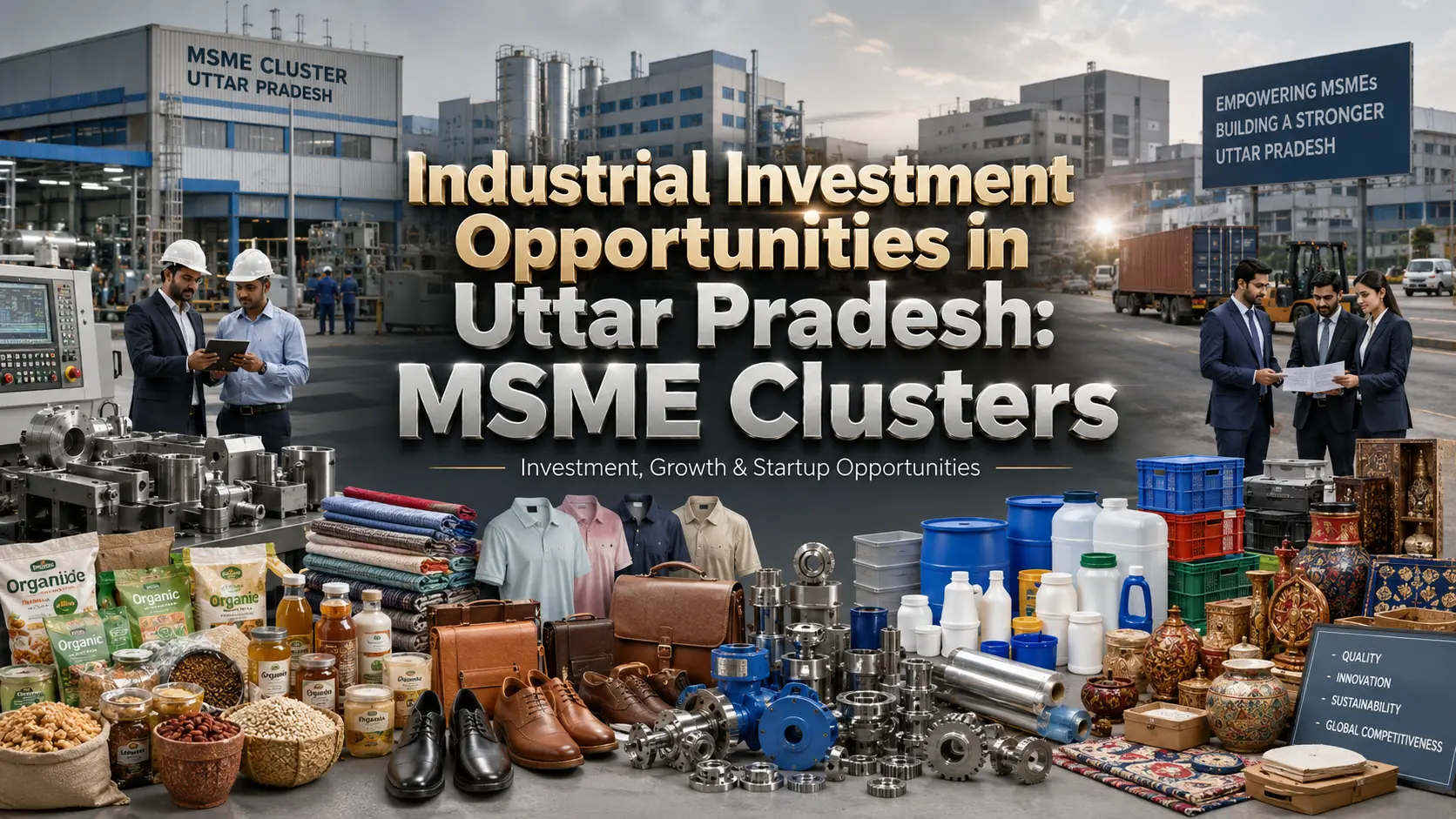
Uttar Pradesh MSME Investment Opportunities
One State. 96 Lakh MSME Units. And Most of Them Are Still Running at Half Capacity.
The total number of MSME units registered in Uttar Pradesh is more than that in Maharashtra and Tamil Nadu. It accounts for 9% of all registered MSMEs and 1.9 crore of the workforce in the MSME sector in India. Yet, in UP, the majority of districts are still very under industrialised, compared to their real productive capacities. While the factories in Noida and Ghaziabad show labour shortages, unemployment among the skilled young people is high in Purvanchal like districts Azamgarh, Jaunpur, Ballia and Mau.
This is no coincidence. It is a gap. For investors and first-time entrepreneurs, that is the opportunity, if they know what the numbers mean.
The gap has been quickly plugged by the Yogi Adityanath government. More than ₹45 lakh crore has been pledged for investment and ₹15 lakh crore invested so far. A total of 15 new industrial zones will be set up in 11 districts covering a total area of 765 acres, all focusing on MSMEs. (Source: Business Standard, June 2025)
If you are a founder who has decided to establish your first manufacturing plant or an investor from whom you are considering investing in sub-₹5 crore manufacturing players with genuine returns, read carefully. What is coming after is not inspiration. It is a map.
Related Article: Why Uttar Pradesh Is the Best State for Potato Powder Manufacturing in India
Supply Shortfalls, Import Dependence, and Districts That Are Crying Out for Industry
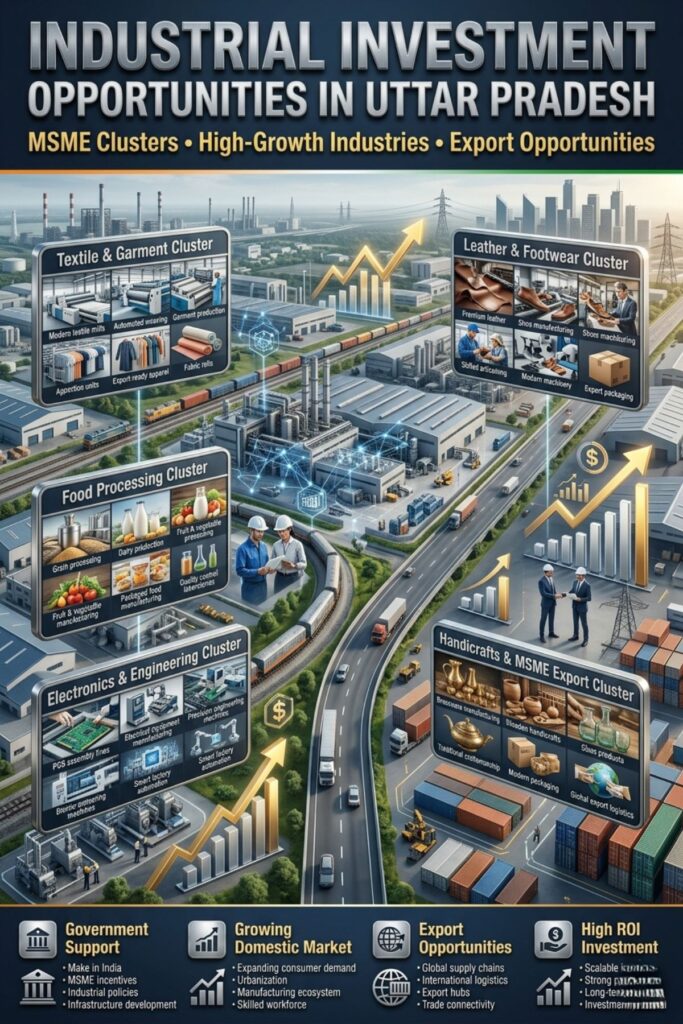
Uttar Pradesh accounts for 44% of the total handicraft exports, 39% of the carpet exports and 26% of leather exports in India. These do not represent niche numbers. These are positions of national dominance. However, even the infrastructure supporting these export hubs — such as common facility centres, testing facilities, cold storage units, power backup units — is lacking in most districts beyond Kanpur, Noida and Agra.
There are 42 handloom clusters in the state. It is the biggest Indian market of textile and apparel. However, the penetration of credit is low in MSME units in UP. The majority of the 96 lakh registered units use obsolete equipment and are borrowing from informal sources at high interest rates as the formal bank loan seems unattainable or cumbersome. (Source: MSME RAMP Program, Government of India)
Uttar Pradesh is traversed by both Dedicated Freight Corridors: Eastern (EDFC) and Western (WDFC) which link UP to ports and consumption centres. However, the logistic cost of MSME units in remote areas such as Mirzapur, Sonbhadra and Banda is still 20-30% more than that of the units nearer to these corridors, simply because the infrastructure is lacking at the last mile.
This is complicated by import dependence. For instance, in selected industries like electronic components, specialty chemicals, precision tools and processed food machinery, UP based manufacturers are still highly dependent on imports which not only imposes a cost burden but also creates a supply chain risk which can be easily addressed by domestic manufacturing at a more profitable cost.
TABLE 1: KEY MSME CLUSTERS IN UP — PRODUCT FOCUS, DISTRICT, AND MARKET POSITION
| District/City | ODOP Product | Cluster Type | Market Position | Annual Export Potential |
| Agra | Leather Footwear | Manufacturing Cluster | India’s largest footwear hub | ₹8,000 Cr+ |
| Kanpur | Leather Goods / Saddlery | Tanneries + Processing | ‘Leather City of India’ | ₹6,500 Cr+ |
| Moradabad | Brassware / Metal Handicrafts | Export-Oriented Cluster | ‘Brass City’; 40+ countries export | ₹12,000 Cr+ |
| Varanasi | Banarasi Silk Sarees | Handloom + Weaving | GI-tagged; global brand | ₹3,500 Cr+ |
| Aligarh | Locks & Hardware | Engineering Goods Cluster | 85% of India’s lock production | ₹5,000 Cr+ |
| Bhadohi / Mirzapur | Hand-knotted Carpets | Weaving + Export | 39% of India’s carpet exports | ₹7,800 Cr+ |
| Gorakhpur | Terracotta Pottery | Artisan + Micro-Manufacturing | Expanding e-commerce reach | ₹500 Cr+ |
| Meerut | Sports Goods | SME Manufacturing | Major share of India’s sports exports | ₹3,200 Cr+ |
Source: UP ODOP Programme (invest.up.gov.in), CBRE-CREDAI MSME Report, Ministry of MSME
THE OPPORTUNITY
Why This Is the Right Time: Policy Tailwinds, Infrastructure Push, and a State Finally Delivering
The world has come together. Today, UP is an interesting industrial location for three reasons — not only in the words that government is using, but on the ground.
One: Infrastructure is ahead of industry. The Purvanchal Expressway, Bundelkhand Expressway, Gorakhpur Link Expressway, and soon to be Ganga Expressway are all industrial corridors. The UP government has already sanctioned an investment of ₹500 crore for two Integrated Manufacturing and Logistics Clusters (IMLCs) along the Ganga Expressway, at Sambhal (₹245 crore) and Meerut (₹213 crore). (Source: KNN India, March 2026) The manufacturing units are expected to benefit from a logistics cost advantage of establishing their units close to these corridors within the next 18–24 months, which will be paid for by latecomers with a premium.
Two: The procurement guarantee is the State’s real money. As per the UP MSME Promotion Policy 2022, the State Government Departments and PSUs are supposed to procure 25% of their requirements from MSMEs of the state. The dedicated sub-quota for women owned units is 4% and for SC/ST owned units is 3%. This is a guaranteed off-take channel, before ever approaching open market, if you are looking to start a manufacturing unit which manufactures for consumables, packaging, uniforms or any industrial products which are used by the government. (Source: Invest UP — Official MSME Policy Portal)
Three: The One District One Product (ODOP) scheme offers infrastructure at the cluster level, not subsidies. Common Facility Centres: These are designed with modern machinery, branding support, e-commerce integration through Flipkart’s Samarth initiative and participation in international trade fairs, and serve as a shared back-office for MSME manufacturers that are unable to afford investing in quality infrastructure on their own.
Key Government Schemes to Access
- PMEGP (Prime Minister’s Employment Generation Programme): Margin money subsidy of 15-35% of the project cost; maximum project cost of ₹50 lakh for manufacturing. Administered by KVIC. (msme.gov.in)
- CGTMSE (Credit Guarantee Fund Trust for Micro and Small Enterprises): Loans for MSME units – up to ₹5 crore with credit guarantee cover – up to 85% for micro units (collateral free loans).
- UP MSME Promotion Policy 2022 — Capital Subsidy: 10-25% subsidy on the fixed capital investment. The highest slab (25%) is for Bundelkhand and Purvanchal. 2% additional for SC/ST and Women entrepreneurs. (up.gov.in)
- MUDRA (Pradhan Mantri MUDRA Yojana): Loans under Shishu (up to ₹50,000), Kishor (₹50,000-5 lakh) and Tarun (₹5-10 lakh) categories of collateral-free working-capital loans.
- Vishwakarma Shram Samman Yojana (UP State Scheme): Margin money grants and interest subsidies are provided specifically for traditional artisans and local craftsperson’s — obviously relevant for ODOP product categories.
HOW TO SET IT UP
Step-by-Step Setup: How to Start a Manufacturing Unit in a UP MSME Cluster
The set up isn’t like most first time founders think, if you go in the right order. A roadmap is provided below for establishing a medium scale manufacturing business (₹50 lakh-₹2 crore investment size) in one of the established MSME clusters of UP.
Step 1 — Product and Cluster Selection
Use the ODOP district map as the basis. UP has 75 districts, each of which has a notified primary product. Identify a cluster in which your product has current supply chain infrastructure such as raw material suppliers, skilled workers and common facility centres. Leather: Agra/kanpur. Metal products: Moradabad / Aligarh. Textiles: Varanasi or Lucknow. Food processing: Gorakhpur, Prayagraj or any district of Purvanchal.
Get Detailed Insights from This Book: Manufacture of Food & Beverages with Project Profiles
Step 2 — Registration and Udyam Enrollment
Register your enterprise on Udyam portal (udyamregistration.gov.in). This is essential before taking any advantage of any government scheme. Udyam certificate is free and it takes less than 24 hours. If your product is covered by the scheme, register on the UP ODOP portal as well.
Step 3 — Land and Space Acquisition
The UPSIDA (UP State Industrial Development Authority) provides plot at subsidised rate in notified areas of industrial development. Apply through upsida.co.in. A 1,000–2,000 sq ft shed area is enough for a small manufacturing unit. The average price of plot allotment in Tier-2 cities like Mirzapur, Unnao and Rae Bareli is ₹800–₹1,500 per sq ft. In Noida and Greater Noida, expect ₹3,500–₹7,000 per sq ft.
Step 4 — Machinery and Equipment
Procurement of primary machinery should be done from a known supplier from NSIC panel or through government organised buyer-seller meets. Leather goods: Stitching machines, lasting machines, edge finishing units. Brass handicraft equipment: lathe machine, polishing machine, die casting machine. Available from Coimbatore, Pune and Rajkot for food processing: sorting, grading, sealing and packaging machinery. Primary machinery costs range from ₹15 lakh to ₹60 lakh, depending on the product and the scale.
Step 5 — Raw Material Sourcing
Cattle markets and tanneries established for raw hides for leather processing in Kanpur, Aligarh. Wholesale metal markets: Brass ingots, Moradabad. Yarns made of cotton and silk: Local markets of Varanasi or mills of Bhiwandi or Surat. Food processing agricultural produce: Local mandis — UP has 257 wholesale produce markets under APMC. Buy local first, to promote cluster economics and keep freight costs low.
Step 6 — Licenses and Regulatory Approvals
Most manufacturing units in UP will need the following:
- The first step in Udyam Registration is the free registration, which is compulsory.
- GST Registration — If you are conducting inter-state sales or revenues exceeding ₹40 lakh, then you are required to register under the Goods and Services Tax (GST).
- If employing 10+ workers using power then this is required under the Factories Act 1948.
- Pollution NOC — For any process which produces effluents or emissions, from UP Pollution Control Board (uppcb.gov.in)
- BIS Certification — With respect to products that have mandatory BIS standards (electronics, electrical goods, helmets etc.).
- FSSAI License is applicable to anyone involved in food processing, agro-based manufacturing.
- Trade License — From local municipal body
All of these applications can be filed through the single window clearance facility of UP named Nivesh Mitra (niveshmitra.up.nic.in). The site will show you the status of your application in real time.
Step 7 — Timeline from Registration to First Production
Udyam + GSTIN: 2–3 days. Factory license: 30-45 days with proper documents in order. Pollution NOC: 30–60 days. Installing machinery: 60-90 days. Overall realistic time from registration to first saleable output: 4–6 months.
Step 8 — Team
The manpower requirement at the Starter manufacturing unit is 8-15 personnel, including 1 Production Supervisor, 2-4 Skilled Machine operators (from local ITI Institute) (UP has 1440+ Government and Private ITI Institutions), 4-6 Semi Skilled Line workers, 1 Accountant-Admin and 1 Quality Control person. The rates of wages of the skilled workers in interior UP districts vary from ₹8,000 to ₹18,000 per month, which are considerably lower than in other states like Maharashtra and Karnataka.
Minimum Investment Required
Micro unit: ₹25 lakh (1-2 machines, space in home premises), small unit: ₹2 crore (500-1,000 sq ft industrial shed, 4-8 machines, 10-12 workers). The PMEGP scheme provides for projects with a maximum of ₹50 lakh, along with a margin money subsidy of 25-35%.
View Full Project Details: Best Business Opportunities in Uttar Pradesh
TABLE 2: INVESTMENT BREAKDOWN FOR A TYPICAL UP MSME MANUFACTURING UNIT (₹75 LAKH SCALE)
| Investment Head | Cost Range (INR) | Central Estimate (INR) | % of Total Capex |
| Land / Shed (Rented — 800 sq ft, 2 yrs deposit) | ₹3–8 lakh | ₹5.5 lakh | 7% |
| Primary Machinery & Equipment | ₹20–45 lakh | ₹32 lakh | 43% |
| Ancillary Tools, Jigs & Fixtures | ₹3–6 lakh | ₹4.5 lakh | 6% |
| Electrification, Cabling & Power Backup | ₹2–5 lakh | ₹3.5 lakh | 5% |
| Raw Material Stock (3-month buffer) | ₹8–18 lakh | ₹13 lakh | 17% |
| Working Capital (wages, utilities, packaging) | ₹5–10 lakh | ₹7.5 lakh | 10% |
| Licenses, Compliance & Professional Fees | ₹1–2.5 lakh | ₹1.8 lakh | 2% |
| Contingency Reserve (10%) | ₹5–8 lakh | ₹6 lakh | 8% |
| TOTAL CAPITAL EXPENDITURE | ₹47–102.5 lakh | ₹73.8 lakh | 100% |
Note: Figures based on a leather goods / light engineering unit in a UP Tier-2 cluster. Machinery costs vary by sector. Land costs assumed on rental basis.
FINANCIAL SNAPSHOT
The Numbers: What You Can Realistically Expect at 60% and 100% Capacity
The following estimates have been made in the context of a leather goods or light engineering manufacturing unit having a total capex of about ₹75 lakhs, and situated in an established UP MSME cluster. Margins can be different depending on the product; it’s more profitable to sell high-margin products such as Banarasi silk or specialty leather products than to sell commodity goods.
Monthly Fixed Costs: ₹1.8–2.5 lakh (rent ₹25,000, wages ₹1.1–1.4 lakh for 10–12 workers, utilities ₹25,000–35,000, EMI on machinery loan ₹30,000–45,000)
Average Monthly Variable Costs at 60% Capacity: ₹3.2 to 4.5 lakh (raw material, packing, freight)
Revenue at 70% Capacity: ₹9–11 lakh/month
Revenue at 100% Capacity: ₹12-15 Lakh/Month
Gross Margin: 38-48%, depending on product mix, direct export share.
Profit Margin (at full capacity, post-EMI and overhead): 18-24%.
The Payback Period is 3.5 to 5 years with 70% utilisation average. Units that can export directly or through e-commerce are faster to recover capex (2.5–3.5 years).
Your investment deserves the right opportunity
TABLE 3: GOVERNMENT SCHEMES FOR UP MSME UNITS — ELIGIBILITY AND KEY BENEFIT
| Scheme | Administering Body | Eligibility | Key Benefit | Maximum Benefit |
| PMEGP | KVIC / MSME Ministry | New micro-enterprise, manufacturing sector | Margin money subsidy on project cost | ₹17.5 lakh (35% of ₹50 lakh) |
| CGTMSE | SIDBI / Dept of MSME | Micro and Small Enterprises | Collateral-free credit guarantee | Up to ₹5 crore |
| UP Capital Subsidy (MSME Policy 2022) | UP MSME Directorate | UP-registered MSME on fixed capital | Subsidy on plant & machinery investment | 15–25% of FCI (Purvanchal: 25%) |
| UP Interest Subsidy (SC/ST/Women) | UP MSME Directorate | SC/ST or women entrepreneurs in UP | 60% interest subsidy on term loan, 5 years | Capped at ₹25 lakh/unit |
| MUDRA — Tarun | Scheduled Banks / MFIs | Non-farm enterprise, turnover up to ₹10 crore | Collateral-free working capital loan | Up to ₹10 lakh |
| ODOP Margin Money | UP MSME / ODOP Secretariat | ODOP product category, district-specific | Margin money grant + CFC access | Product-category specific |
| Stamp Duty Exemption (Purvanchal / Bundelkhand) | UP Revenue Dept | MSME units in eligible regions | 100% stamp duty waiver on land/shed purchase | Full purchase value |
Sources: invest.up.gov.in, msme.gov.in, kvic.gov.in, sidbi.in
ENTREPRENEUR SPOTLIGHT
Ramesh of Moradabad (Brassware Exporter) — Ramesh began his business with just one polishing unit at his home shop in Moradabad, spending ₹4.5 lakh on the investment. In 4 years, he grew his business to a 1,200 sq ft shop with 14 employees leveraging the Common Facility Centre provided by ODOP and the Samarth programme by Flipkart for domestic sales. Now the turnover is more than ₹1.8 crore and 35% is achieved from export contribution from Moradabad Export Promotion Council. His lesson: “Don’t bother to own all the processes—use common facility centres until you have enough money for your own equipment, and the overhead saved was what enabled me to expand.
NPCS SERVICES
Getting Your Project Report Right: A Note on Consultancy Resources
Niir Project Consultancy Services (NPCS) does techno-economic feasibility studies, plant layout designs, machinery cost benchmarking and end to end project consultancy for various manufacturing industries like leather goods, food processing, chemical based and agro based industries for the founders who need a bankable project report before approaching to lender or apply for state subsidies. They are used by commercial banks, SIDBI and DIC offices in the applications of schemes. The resources are available on niir.org and entrepreneurindia.co. A professionally done NPCS report can minimize “back and forth” with bank loan officers and subsidy scheme administrators for the first-time founders who are not familiar with what an NPCS should include: capacity assumptions, break-even analysis, plant layout, regulatory compliance checklist etc.
CONCLUSION + CALL TO ACTION
Your Next Step Is Not Research. It’s a Decision.
The data is clear. UP is not an emerging industrial destination, it is already established, with 96 lakh MSME units, dominant export positions in handicrafts, leather and carpet and the infrastructure pipeline is advanced compared to that of the private sector. The entrepreneurs setting up in Purvanchal, Bundelkhand and on the corridors of the new expressways over the next 24 months will have a structural advantage over others.
If you are really serious, make one concrete step to take this week: define a specific ODOP district and a specific product that you think fits your skills or capital. Open the Invest UP portal, and check the availability of UPSIDA plots in your desired district, download UP MSME Promotion Policy 2022. Then consult your closest District Industries Centre (DIC), all the districts of UP have one of these.
Capital chases up founders. Know the cluster, the subsidy slab and the licence sequence before the next investor comes in.
Frequently Asked Questions
Q1. What is the lowest investment needed to start an MSME manufacturing unit in UP?
The minimum practical investment is subject to the product category. A micro unit that is leather stitching or has light assembly can begin with costing of ₹8–15 lakh (two machines, space adjacent to home, 4–5 workers). A small unit with dedicated industrial space, 6-8 machines, 10-12 workers needs the investment of ₹40-80 lakh. The PMEGP scheme is for new manufacturing projects with a subsidy of 25–35% on the project cost, and is the first place for low-capital founders to look at.
Q2. What licenses and registrations are a must to begin production?
The three are not negotiable, they are compulsory from day one – Udyam Registration (free, at udyamregistration.gov.in), GST Registration and — if 10 or more power workers on roll – Factory Licence under the Factories Act 1948. Depending on the product you will require a Pollution NOC from the UP-Pollution Control Board and an FSSAI licence for food items. Apply several times through UP’s Nivesh Mitra portal and check their status.
Q3. How can I get raw materials for cluster-based manufacturing in UP?
Source within a cluster as much as possible. Whole sale markets of brass and metal for metalware in Moradabad. Kanpur’s tannery belt of hides and processed leather. The areas of Varanasi where yarn is traded for the textile industry. There are 257 APMC regulated mandis in UP in relation to the agricultural produce. Noida and Greater Noida have established component trading hubs for precision parts and Electronics, etc. NSIC organized buyer-seller meets also help in meeting with the confirmed suppliers at a negotiated rate.
Q4. What are my profit margins going to be?
For most of the light manufacturing products, full capacity net margins of 18–24% can be realized. Production gross margins are typically in the 38-48% range depending on product mix, and whether you are selling domestically or export directly. For Units that invest in branding their products (Banarasi silk, Bhadohi carpets, Aligarh locks) the net margins could be in the range of 28-32% at maturity, and could command premium price tags. Typically, a payback of 3.5-5 years is achieved on an investment of ₹75 lakh on a unit running at 70% capacity.
Q5. What can be done by the government for the MSME units in UP?
The UP MSME Promotion Policy 2022 provides a capital subsidy of 10-25% on FCI (high slab in Purvanchal and Bundelkhand), 60% interest subsidy (5 years max. limit of ₹25 lakh per unit) for SC/ST women entrepreneurs, 100% stamp duty exemption in Purvanchal and Bundelkhand and 25% mandatory procurement sub-quota from state PSUs and departments. PMEGP, CGTMSE and MUDRA loans are also available in the middle. For details of the scheme matrix visit invest.up.gov.in.
Q6. What is NPCS all about and how will it help me to prepare for a loan application or the state subsidy?
NPCS (Niir Project Consultancy Services) offers detailed project reports (DPRs) which consist of production capacity analysis, machinery cost estimate, plant layout design, raw material requirement, break even analysis and regulatory compliance checklist. It is often necessary to submit a DPR at banks and DIC offices when applying for loans and subsidies. NPCS reports are industry specific and can be tailored to your industry product. Visit niir.org or entrepreneurindia.co for access to their resources.
Data Sources & Citations
The data and statistics in this article draw from the following authoritative sources:
- Invest UP — Official Government of UP Investment Portal
- UP MSME Promotion Policy 2022 — invest.up.gov.in
- Ministry of MSME, Government of India — PMEGP Scheme Details
- MSME RAMP Programme — State Investment Profile: Uttar Pradesh (ramp.msme.gov.in)
- Business Standard — UP targets 15 new MSME industrial zones (June 2025)


