






ROI Calculation for Industrial Projects in India
The Number That Kills More Businesses Than Competition Does
7/10 of the MSME industrial units in India do not get back their initial capital in the projected payback period. Not because demand “ran out of steam. Not that there was a lot of competition. Founder didn’t do any ROI analysis before investing.
That is the awkward truth that lurks in the mindset of unit closures that the Ministry of MSME has revealed in its Annual Report on MSME Sector. A press-part manufacturer of Rajkot, Gujarat was forced to close his shop after 3 years despite 90% capacity utilisation due to underestimation of working capital of Rs. 38 lakhs. There was a market for him. His machines were in operation. His math was wrong.
ROI is not a spreadsheet term of art. If you’re an MSME founder who invests ₹25 lakh to ₹2 crore of your personal money — much of which could be borrowed and much of which was collateralised with your family’s property — ROI is what will help you survive. In this article you will learn how to calculate it step by step before spending a single rupee, and a number of real-life industrial examples from all over India to prove it.
Why Most Industrial ROI Calculations Go Wrong
Go anywhere in any MSME cluster, like Ludhiana’s bicycle parts belt, Moradabad’s brass goods hub or Coimbatore’s pump and motor corridor and you will see the same pattern. Founders compute ROI as the ratio of expected revenues to machine cost. That is not ROI. This is not even a close approximation of ROI.
According to the SIDBI MSME Pulse Report, more than 60% of manufacturing MSMEs do not have any formal financial model when they start a project. Their decisions are based on instinct, what their peers do, and the rosy optimism that’s in the equipment supplier brochures. Obviously, equipment suppliers will always display the machine at 100% from Month 1.
The real issues that introduce distortion when calculating ROI in industry:
- There is an understatement of working capital. The majority of founders do “raw material” and wages. They do not remember receivables cycles (which in B2B Industrial Supply Chains are 45–90 days). That money is idle and does not return anything.
- Under equipment. According to data from the national level, the first year capacity utilisation of greenfield MSME manufacturing units is 52–58%.
- Interest’s costs are not included. Suppose you have taken a term loan for MSMEs and made a loan of ₹40 lakh with an interest rate of 11.5% per annum, which is the typical interest rate of MSMEs, that means that ₹4.6 lakh has to be deducted from your return for ROI to be positive.
- Depreciation is ignored. This is the reality: If there is a ₹25 lakh CNC machine that depreciates by 15% WDV then in Year 1 alone it will lose ₹3.75 lakh, a real cost that will impact on tax liability and replacement planning.
- Opportunity cost is an absent cost. If you have invested ₹50 lakh in FD which gives you 7.5% interest, your industry project should not fall short of this interest rate, otherwise it is not earning any money.
A significantly high percentage of under-performing new MSMEs have been found in the Uttar Pradesh, Bihar, Odisha and Jharkhand states, where the capital-intensive sectors have been dominated by the founders without having financial modelling of their business activities, shows the data from the Annual Survey of Industries (ASI) compiled by the MoSPI.
Related Article: 43 Best Small Scale Manufacturing Business Ideas with High ROI
Table 1: Common ROI Calculation Errors and Their Financial Impact
| Error in Calculation | Typical Omission Amount | Impact on ROI | Sector Most Affected |
| Working capital undercount | ₹8–22 lakh per ₹1 cr project | ROI overstated by 6–14% | Food processing, chemicals |
| Capacity utilisation overestimate | 15–25% capacity gap in Year 1 | Revenue short by ₹12–30 lakh pa | All manufacturing sectors |
| Interest cost excluded | ₹4–8 lakh pa on ₹50L loan | Payback extended by 12–18 months | Capital-intensive sectors |
| Depreciation not counted | ₹2.5–6 lakh pa on major machinery | Net margin overstated by 4–9% | Engineering, auto-components |
| Opportunity cost ignored | ₹3.5–5 lakh pa (7% on ₹50L capital) | ROI benchmark set too low | All sectors |
| GST working capital blocked | ₹2–6 lakh in ITC refund cycle | Cash flow gap in months 1–4 | Export-linked units |
Why Formal ROI Modelling Is a Competitive Advantage Right Now
In the last 3 years, India has registered more than 2.5 crore new Udyam-registered MSMEs. As per the data in the Udyam Registration Portal, the manufacturing segment is registering at 18% growth rate annually. The capital is now coming in. But the rate of failures among units which are unable to convince lenders and buyers of their structured financial viability is climbing at the same time.
Today, formal ROI modelling is not an option, there are three key changes in structures:
First, it is now becoming a requirement for institutional credit. Collateral free loans up to Rs. 5 crores are available under the Credit Guarantee Fund Trust for Micro and Small Enterprises (CGTMSE) scheme, however, the Detailed Project Report (DPR) is assessed prior to sanctioning by banks. If there is no ROI or payback modelling in a DPR, it’s a no-go. CGTMSE guaranteed loans have gone past the mark of ₹2 lakh crore in total guarantees with the borrowers getting this facility coming with numbers.
Second, the 14 sectors under the Production Linked Incentive (PLI) scheme including food processing, textiles and specialty chemicals have a requirement to submit financial projections for five years with baseline ROI norms. If you don’t, you will not get through the screening process.
Third, export buyers, in particular from electronics, auto-components and pharmaceutical packaging, are now running financial audits of their suppliers. They seek to find out if their supplier can afford to keep supplying. Having a documented ROI model, updated on a quarterly basis, indicates that the business is not running on a “hunch.Having a documented ROI model, updated quarterly, means that the business is not running on a “hunch.
Special schemes that provide an incentive for disciplined financial plans:
- Prime Minister’s Employment Generation Programme (PMEGP): Subsidies ranging from 15 percent to 35 percent of the project cost; but the DPR with ROI projections is required for the application.
- MUDRA Tarun Loans (₹10–50 lakh): The sanction of the loans is accelerated for the units with projected ROI above 18% over 3 years.
- Fast-track manufacturing licences for units with an ROI of more than 20% in the third year – Startup India Industrial Application.
- Capital subsidies up to 10–25% (Gujarat, Tamil Nadu, Telangana) are available to the MSMEs who submit bankable project reports with ROI models.
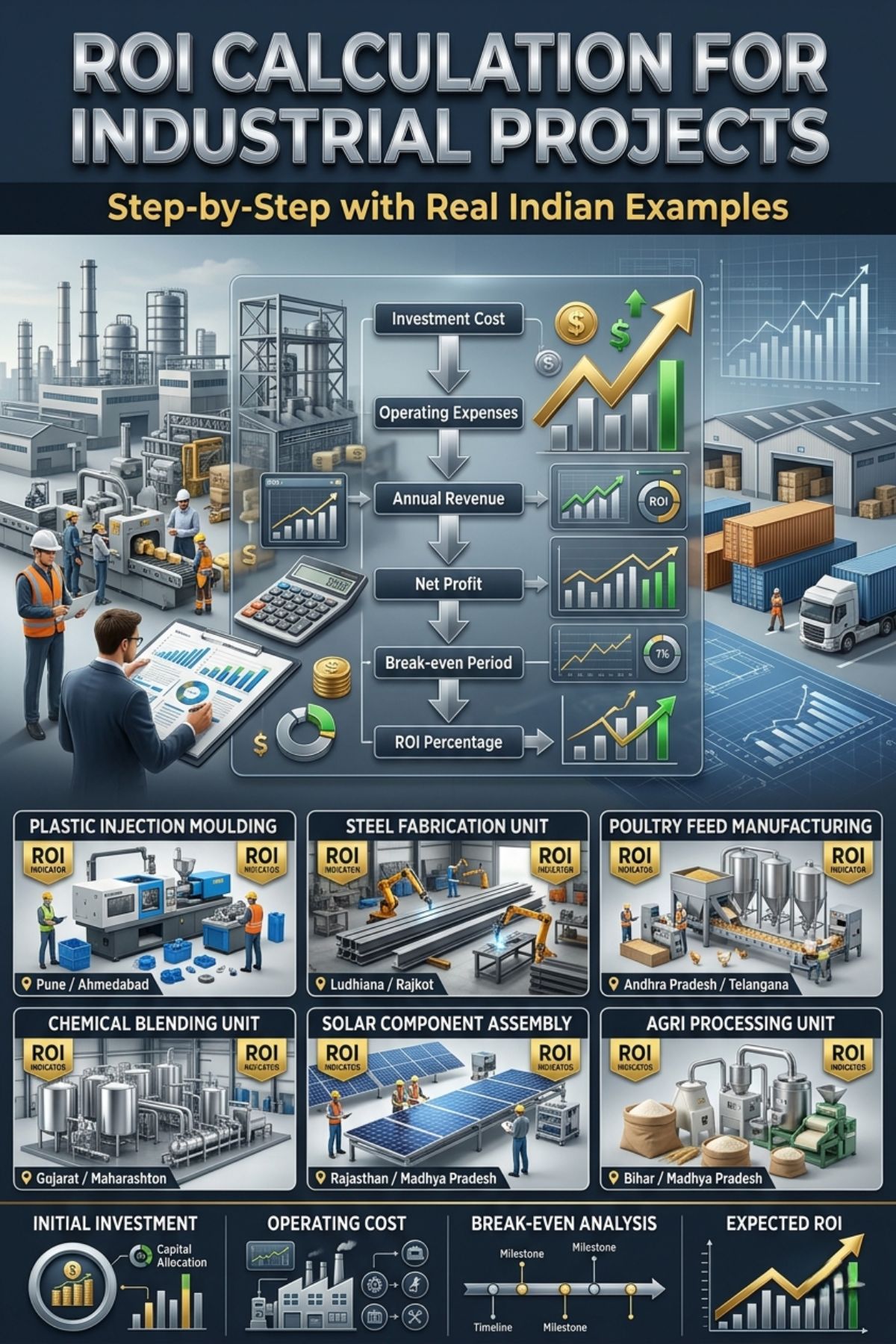
The Step-by-Step ROI Calculation Method for Industrial Projects
No one ROI formula fits all industrial projects. However, there are logical steps each founder should go through before investing. Let’s see it, step by step; here is a small plastic injection moulding unit in Chakan, near Pune.
Step 1: Define Total Project Cost (TPC)
TPC is not limited to the cost of the machine. It is one rupee you will pay before the first saleable unit is out.
The formula used to calculate the total project costs (TPC) is: TPC = Fixed Capital Investment + Pre-Operating Expenses + Initial Working Capital.
For Example: Plastic Injection Moulding Unit at Chakan in Maharashtra:
- Land (leased, 2,000 sq ft shed): ₹18,000/month = ₹2.16 lakh upfront deposit + 3 months advance
- Machinery (2 x 150-ton injection moulding machines & ancillaries): ₹38 lakh
- The cost of electrification, civil works, installation is ₹4.5 lakh.
- The working capital requirement (first cycle) for raw material of PP/HDPE granules is ₹9 lakh.
- Pre-operative cost (Registration, Licences, trial run): ₹1.8 lakh
- Contingency ₹3.4 lakhs (8% of fixed capital)
Total Project Cost: ₹58.86 lakh
Step 2: Estimate Annual Revenue at Different Capacity Levels
Do not determine capacity at 100%. Calculate at 60% (realistic Year 1), 75% (Year 2), and 90% (Year 3+).
For the Chakan unit: Installed capacity = 480 MT/year of moulded plastic components. SVP on PP components – 82/kg ( B2B , avg inustrial price – Maharashtra).
- At 60% capacity (288 MT): Revenue = ₹2,36,16,000 (~₹2.36 crore per year)
- At 75% capacity (360 MT): Revenue = ₹2,95,20,000 (~₹2.95 crore per year)
- At 90% capacity (432 MT): Revenue = ₹3,54,24,000 (~₹3.54 crore per year)
Step 3: Calculate Annual Operating Costs
Operating Cost in terms of the concerned case means cost of operation comprising on cost of raw materials, cost of electric power, cost of labour, rent for the shop, cost of maintenance, cost of interests on working capital and all the other overheads.
- Raw material (PP granules at ₹58/kg at 60% capacity): ₹1,67,04,000
- Power (3-phase industrial, Maharashtra, ~1,80,000 units): ₹12.6 lakh
- Labour (8 workers + 1 supervisor + 1 QC): ₹9.6 lakh
- Others: ₹1.9 lakh
- Maintenance/consumables/tooling: ₹ 4.2 lakh.
- Interest on working capital loan (₹9L at 10.5%): ₹0.95 lakh
Total Annual Operating Cost (at 60% capacity): 1,98,19,000 ( -1.98 crore)
Step 4: Calculate Gross Profit and Net Profit
Gross Profit=Revenue−Operating Cost=2.36crore−1.98crore=38lakh
Strip Out Cash Op-Ex and Term Interest:
- Depreciation (15% WDV on ₹38L machinery): ₹5.7 lakh
- Interest on term loan (₹35L outstanding at 11.5%): ₹4.03 lakh
Net Profit Before Tax = ₹38L – ₹5.7L – ₹4.03L = ₹28.27 lakh
Once the effective tax rate is 25%: Net Profit After Tax = ₹21.2 lakh
Step 5: Calculate ROI
ROI (%) = (Net Annual Profit / Total Project Cost) × 100
ROI = (₹21.2 lakh / ₹58.86 lakh) × 100 = 36.01%
Decent ROI for a 1st year industrial unit. One should take that context as well that is at 60% capacity. At 90% (Year 3), the net profit is approximately 41-44 lakhs which showsROI of about 70%-74% of total investment.
Step 6: Calculate Payback Period
Formula to compute the simple payback period is as follows:
Annual Net Cash Inflow = Net Profit + Depreciation = ₹21.2L + ₹5.7L = ₹26.9 lakh
Payback Period = ₹58.86L / ₹26.9L = 2.19 years (approximately 26 months)
This is within the acceptable range for Light Manufacturing in India. Payback period of the MSME loan is usually less than 4 years for banks and institutional lenders. This unit meets this benchmark well.
Step 7: Apply the IRR Test for Capital-Intensive Projects
For project worth greater than 1 crore calculate Internal Rate of Return (IRR). Which is the discount rate where all future cash flows have a Representable(NPV) of zero. Target IRR in India for industrial MSME projects: >18% (above the WACC for the project). Any IRR over 25% is a real “hottie” for an industrial investment.
Use Investopedia IRR Calculator to calculate IRR for free or model it in a simple cashflow sheet using NPV formula in Excel.
Get Detailed Project Report (DPR): Plastic Injection Moulding Plant for Auto Parts
Table 2: ROI Comparison Across Common MSME Industrial Sectors in India
| Sector / Unit Type | Typical TPC (₹ lakh) | Year 1 ROI (60% cap.) | Year 3 ROI (90% cap.) | Payback Period |
| Plastic injection moulding (Pune/Ahmedabad) | 55–80 | 34–38% | 68–76% | 24–30 months |
| Steel fabrication unit (Ludhiana/Rajkot) | 35–60 | 28–32% | 55–65% | 28–34 months |
| Poultry feed manufacturing (AP/Telangana) | 40–75 | 22–26% | 48–54% | 30–38 months |
| Paper cup / packaging unit (NCR/Mumbai) | 45–90 | 30–36% | 60–70% | 26–32 months |
| Chemical blending unit (Gujarat/Maharashtra) | 60–120 | 18–24% | 44–52% | 36–48 months |
| Solar component assembly (Rajasthan/MP) | 80–150 | 20–28% | 50–60% | 30–40 months |
| Agri-processing (flour/rice milling, Bihar/MP) | 30–55 | 16–22% | 38–46% | 36–48 months |
Get Detailed Insights from This Book: Modern Technology of Agro Processing & Agricultural Waste Products
Financial Snapshot — What Realistic Numbers Look Like
The figures listed below are based on the plastic injection moulding example and are indicative of the situation in a typical Tier 2 industrial cluster in Maharashtra. They are not prescriptive, but rather representative; make adjustments for state, sector and scale.
- Capital Expenditure (Total Project Cost): ₹58-65 lakhs
- Monthly Operating Cost (at 60% capacity): ₹16.5–18 lakh
- Annual Revenue at 60% capacity: ₹2.3–2.5 crore
- Annual Revenue at 100% capacity: ₹3.8–4.1 crore
- Gross Margin: 16–19% (at 60% capacity), rising to 22–26% at 90%+
- Net Margin: 8–10% (Year 1), 14–18% (Year 3 at stabilised operations)
- Time to recover the investment of the product: 24–32 months (central estimate: 26 months)
- IRR over 5 years: 28–34%
An important point to note: the increase in capacity utilisation from 60% to 90% in Year 3 isn’t just about revenue — it’s about the unit economics. Fixed costs (depreciation, rent, interest) remain constant and all additional output produced between 60% and 90% goes almost entirely into the bottom line. This is the “operational leverage effect” that rewards patience in manufacturing businesses.
Table 3: Government Schemes Supporting MSME Industrial Projects — ROI Impact
| Scheme | Administering Body | Benefit | ROI Impact | How to Apply |
| PMEGP | KVIC / MoMSME | 15–35% capital subsidy on project cost | Reduces TPC; improves ROI by 8–15% | kvic.gov.in |
| CGTMSE | SIDBI / MoMSME | Collateral-free loans up to ₹5 crore | Reduces need for personal collateral | cgtmse.in |
| MUDRA Tarun | MUDRA / PSBs | Loans ₹10–50 lakh without collateral | Reduces equity requirement | mudra.org.in |
| PLI Scheme | Sector-specific Ministries | Production-linked incentives 4–10% on sales | Adds 4–10% net revenue in eligible sectors | dpiit.gov.in |
| Technology Upgradation Fund (TUF) | MoT for Textiles | 5% interest subsidy on term loans | Reduces interest cost; improves cashflow | texmin.nic.in |
| State MSME Incentive Packages | State Industries Depts | Capital subsidy 10–25% + tax breaks | Reduces TPC by 10–25% in eligible states | State-specific portals |
| Startup India Industrial | DPIIT | Fast-track clearances + tax holiday | Reduces pre-operative time and compliance cost | startupindia.gov.in |
Entrepreneur Spotlight
Rameshbhai Patel, Rajkot, Gujarat
Rameshbhai set up a press components manufacturing unit in Rajkot’s Aji GIDC in his early thirties with ₹42 lakh in capital — ₹18 lakh personal savings and ₹24 lakh CGTMSE-backed term loan. He first spent six weeks with the assistance of a SIDBI Business Correspondent to create a comprehensive ROI model prior to investing. His model predicted a payback of 31 months when operating at 65% capacity.
Actual payback: 28 months. Now, his unit is running with three shifts, 22 employees and rakes in a turnover of ₹1.8 crore in a year.
Learning outcome: ‘The model was not perfect. It was nice to have a model, because that gave me a sense of what to rectify if things went wrong. “Numbers are important, if you don’t have them you are just guessing.”
Scale of operation: Annual Turnover of ₹1.8 crore, 22 employees, Rajkot, Gujarat
Find high-return business ideas based on your budget & ROI
Where to Get a Bankable Project Report Built
A second proven, yet far higher in cost option – DPRs From Project Consulting Firms (If You Can Afford One) For founders who need a well-polished DPR with ROI calculations, payback models, floor plans, machine specs and bank-ready financials, Niir Project Consultancy Services (NPCS) is one of the few established firms in India. They produce techno-economic feasibility studies and detailed project reports in thousands of industrial verticals – from food processing to specialty chemicals to precision manufacturing – designed for institutional lenders. NPCS DPRs and feasibility studies also includes the financial modelling structures detailed here. You can get project report samples, investment trends and consultancy for nearly all business verticals at niir.org and entrepreneurindia.co A first-time entrepreneur who’s never had to prepare a DPR at all would find getting a professionally written one at this stage infinitely less expensive than making a large calculation error later.
What You Should Do Next
You do not ask your CA to compute ROI once your machines are delivered. It is the fi rst step of all industrial projects, even of a small project like putting a lathe in a 5×5 feet shed. As we go to any loan manager, before ordering any machine tool, before you enter into any lease on an industrial shed, apply the seven steps discussed herein for your particular project.
Tally your MSME ministry Project Report requirements against a checklist. Get an Udyam Registration at udyamregistration.gov.in (takes less than 30 minutes and lets you in to all the government schemes shown in table 3). Structure a financial model for your business, then run it at 50% capacity and ask yourself “If the ramp up is slow how soon do I hit the wall, out of cash”? You’re not ready if you can’t answer that.
It’s not the market, silly! Your financial model is your largest risk.
Frequently Asked Questions
Q1: What is a realistic ROI target for a first-time MSME industrial investment?
For light manufacturing in India (plastic processing, food processing, metal fabrication), a post-tax ROI of 25-40% on total project cost in Year 1 at 60% capacity is realistic and financeable. Anything less than 18% ROI will attract most institutional lenders will not approve the term loan without additional collateral. However, anything above 35% will qualify such term loans for priority processing by the bank under CGTMSE-supported schemes.
Q2: What licences does a new manufacturing unit need before starting production?
The ones every sector mandatorily need are: Udyam Registration (MSME), GST Registration, Factory Licence (for those with power who employ more than 10 workers), Pollution NOC from State Pollution Control Board, and Shops & Establishment registration. For some sector-specific ones you might need: BIS hallmark for steel and electrical, FSSAI for food production, and Drug licence for pharmacy. For a Tier 2 city, the budget will be in the 1.5-2.5 lakh range and it’ll take about 45-90 days to clear everything.
Q3: Where can I source raw materials at competitive rates across India?
Depends on your sector. For processing plastic/HDPE granules from Reliance Industries (Hazira) or GAIL Petrochemicals (Pata, UP) via dealers or distributors either direct or authorized. For steel fabrication: SAIL stockists in Punjab, RINL dealers in Andhra Pradesh. For food processing raw material: NAFED and FCI procurement centres for agri-commodities. Always get 3-month forward contracts to stabilise your cost model – raw material price swings directly erode ROI.
Q4: How do I calculate ROI if I am taking a bank loan for part of the project?
You calculate two ROIs: Return on Total Investment (ROTI, using Total Project Cost as denominator) and Return on Equity (ROE, using only your own capital contribution as denominator). Lenders look at ROTI; you as a founder should focus on ROE. If you put in 20 lakhs of your own money in a 60-lakh project and earn 21 lakh net profit in Year 1, your ROE is 105% – while ROTI is 35%. Both numbers matter, for different decisions.
Q5: What government support is available specifically for ROI improvement in manufacturing?
Three programs directly impact manufacturing ROI: PMEGP: An available 15-35% capital subsidy reduces your TPC (Total Project Cost) resulting in a direct positive impact to ROI. CGTMSE: Because your loan no longer requires collateral, it costs less for money. TUFS: An interest subsidy of 5% on a machinery loan will lower your financing costs. To get any of the 3 through your local DIC they will be happy to file the required paperwork.
Q6: How does NPCS help with project report preparation and ROI modelling?
Niir Project Consultancy Services also offers sector-wise Detailed Project Reports (DPR) consisting of ROI Analysis, payback period analysis, IRR analysis, Plant Layout, machinery requirement, and bank-format financial projections database of over 5000 industrial sectors. Reports are available as standard packages for common sectors or as custom-built studies for specialised projects. Visit niir.org for report samples and entrepreneurindia.co for sector-specific business intelligence.


