





Ginger Oleoresin Manufacturing Business
Ginger Oleoresin as a Powerful Business Idea
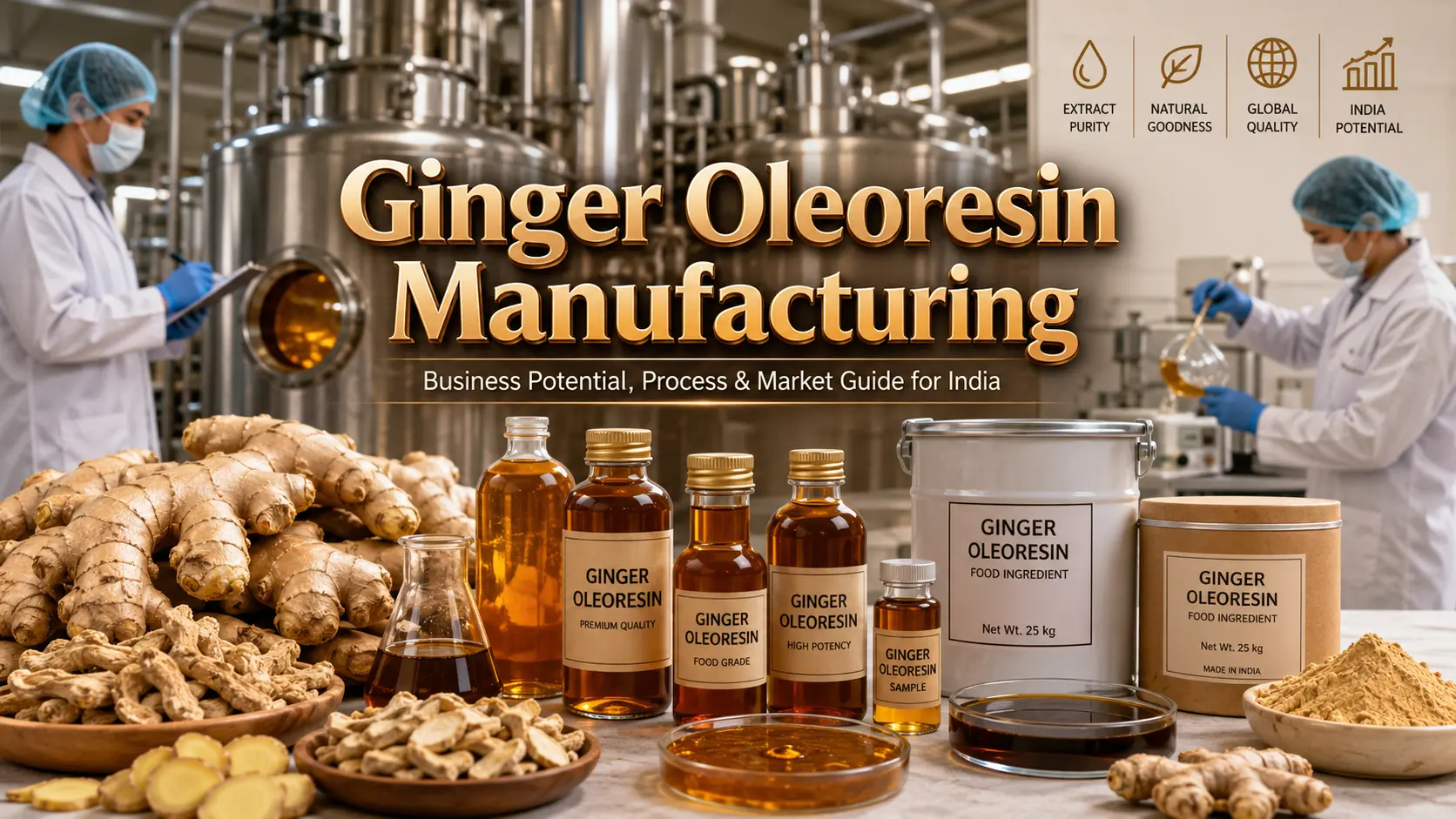
Ginger oleoresin is one of the most versatile business ideas of the spice extract manufacturing business. Compared to other speciality oleoresins that have limited usage, ginger oleoresin has several different applications: as a personal care ingredient, as a food flavouring agent, as a pharmaceutical active ingredient and as a nutraceutical raw material. This is a diversified demand that results in a more stable income for the manufacturers. India, being the biggest ginger producer in the world, enjoys natural and significant cost advantage in developing this business.
Understanding Ginger Oleoresin and Its Market Value
Ginger oleoresin is a dark amber to greenish-yellow viscous liquid extracted from dried ginger rhizomes using solvents or CO₂. It possesses two main functional groups, namely gingerols and shogaols which are the characteristic pungent components and which are the major bioactive compounds of pharmaceutical importance; the other is volatile essential oils which give off its characteristic aroma for use in food flavoring. The proportions of these components will vary depending on the extraction technique and the quality of the raw material.
The Indian spices export includes a considerable amount of ginger-based products like dried ginger, ginger oil, oleoresin, etc., according to the Spices Board of India. But ginger oleoresin is not being used to its full potential at home when compared to its export market potential. The price of the food grade ginger oleoresin is from ₹800 to 1,800 per kg in the international market and the pharmaceutical grade standardized extract of [6]-gingerol can be sold at ₹3,000–8,000 per kg in nutraceutical market.
Get Detailed Insights from This Book: The Complete Book on Ginger Cultivation and Value-Added Ginger Products
Government Incentives for Ginger Processing
Units for processing ginger can avail support under various schemes of the Ministry of Food Processing Industries such as PLI programme for specialty food ingredients. The Spices Board offers development support for infrastructure improvement for ginger processing. Small and medium extraction units can be financed by PMEGP. Also, the entrepreneurs from certain areas like the major ginger producing areas in Northeast India can avail of special area development incentives offered under the N.E. Industrial Policy which provides additional capital subsidies and tax benefits.
Business Ideas in Ginger Oleoresin Manufacturing
Standard Food-Grade Ginger Oleoresin
The largest use of ginger oleoresin is in the food processing industry, where it is a substitute for the less consistent fresh or dried ginger, added to standard formulations. Ginger oleoresin is highly appreciated by food manufacturers for its uniform flavor, ease of use and long shelf life, especially in biscuit, gingerbread, drink, curry powder, sauces and confectionery applications. The investment amount for establishing a food-grade ginger oleoresin unit of 15,000-30,000 litres per year is about ₹2-4 crore per annum. Sourcing raw material from Assam, Himachal or Kerala will guarantee quality and cost efficiency.
Pharmaceutical-Grade Gingerol Extract for Nutraceuticals
Standardized ginger extract, that is, ginger at 5-20% standardized to gingerol, has seen a significant increase in use in the nutraceutical market based on the proven clinical effects of ginger, including its use as a digestive aid, anti-inflammatory agent, or anti-nausea agent in the treatment of motion sickness. This market fetches much higher prices than the food-grade oleoresin market. In order to produce this product, a more complex extraction and standardization facility is needed which involves HPLC analysis for gingerol quantification. The margin is substantial however: from 3–5 times as much as pharmaceutical grade ginger extract may be sold as standard oleoresin. APEDA encourages export of such value-added products.
Get Detailed Project Report (DPR): Ginger Cultivation, Ginger Processing and Ginger value added Products and Projects
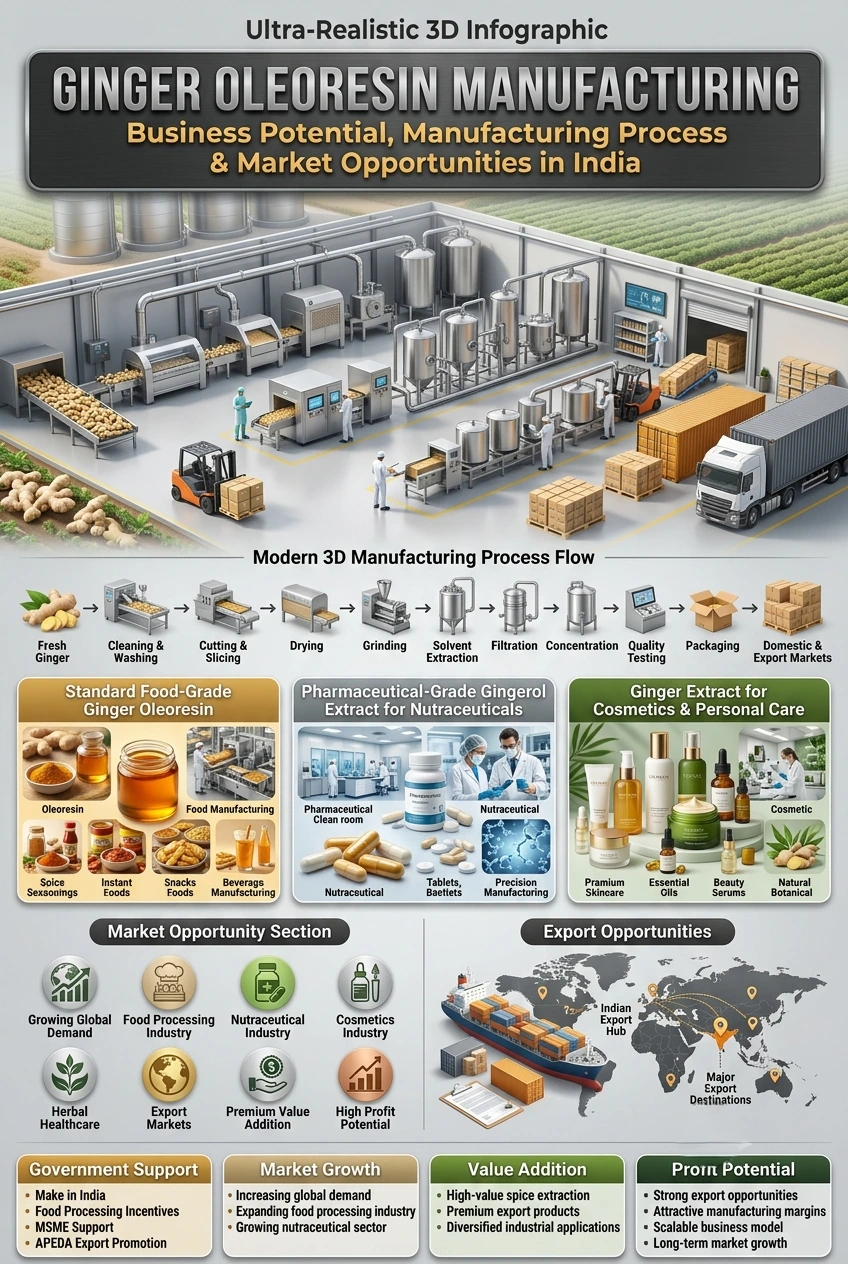
Ginger Extract for Cosmetics and Personal Care
Ginger extract and ginger oleoresin are employed in formulations for the personal care and cosmetics market in hair care, anti-dandruff, warming massage oils and anti-inflammatory skin care. This segment is expanding quickly on a worldwide scale thanks to the consumer’s preference for a natural, active ingredient. The requirements for cosmetic grade ginger extracts are different from food use (purity, colour and specific bioactive content should meet the specification of personal care industry). But if an entrepreneur finds ways to build relationships with cosmetic ingredient distributors and contract manufacturers in Europe or South Korea, he or she can tap this high dollar market segment.
Import-Export Analysis
Indian exports of ginger oleoresin go to flavour houses, food manufacturers and supplement companies throughout the U.S.A., EU, UK, Japan and Australia. According to IBEF, processed ginger exports from India are showing consistent growth – including value added ginger extract. Export markets have been less competitive than chilli or turmeric oleoresin and provide new entrants with increased pricing power. The best way to the premium markets is to aim for natural health foods distributors and flavour ingredient brokers in the USA and Germany.
MSME Success Stories
Kancor Ingredients — Kerala
The products of Kancor, ginger oleoresin manufactured in their Kerala units, have been sold to multinational companies all over Europe and America on long-term contracts. They invested in the extraction of CO₂ specifically for ginger, which resulted in a cleaner and more aromatic product than solvent extracted one, which was appreciated by the premium buyers. According to Kancor’s experience, the creation of customer relations is not only based on the principle of price competition but also on the principle of differentiation of technology.
Related Article: Ginger Oil & Ginger Powder Manufacturing: A High-Growth Business Opportunity for Indian Entrepreneurs
Verka Naturals — Himachal Pradesh
A few small, niche ginger oleoresin producers in the state have created viable businesses by exploiting their location near the areas of high ginger production in the state. These enterprises have created direct farmer procurement systems and kept the processing units small and agile, enabling them to match the cost structures of the bigger processing units based out of Kerala. This proves that capability as an advantage, control of the supply chain can offset the scale in the oleoresin business.
About NPCS
Niir Project Consultancy Services (NPCS) offers expert Consultancy Services for the preparation of Detailed Techno-Economic Feasibility Reports (DPRs) which encompass Market Survey. Our reports are detailed and encompass manufacturing processes, market research, and demand analysis, process flow diagrams, product mix & capacity planning, equipment and raw materials details, project financials, and profitability analysis.
Discover business ideas that actually make money
Ginger Oleoresin: Product Grades and Market Parameters
| Grade | Gingerol Content | Primary Application | Price Range (per kg) |
| Food Grade Standard | Not specified | Food flavouring, beverages | ₹800–1,800 |
| Food Grade Premium | Minimum specified | Confectionery, fine foods | ₹1,500–2,500 |
| Nutraceutical Grade 5% | 5% [6]-gingerol | Dietary supplements | ₹2,500–4,500 |
| Nutraceutical Grade 20% | 20% [6]-gingerol | Pharmaceutical nutraceuticals | ₹5,000–10,000 |
| Cosmetic Grade | Standardized bioactives | Skincare, haircare | ₹3,000–8,000 |
Frequently Asked Questions
Q: What is the difference between ginger essential oil and ginger oleoresin?
Ginger Essential oil is composed of just the volatile aromatics in the ginger plant (monoterpenes and sesquiterpenes), and therefore the primary use is fragrance and flavour. Ginger Oleoresin contains the volatile oil fraction PLUS the non-volatile pungent actives (gingerols and shogaols). This makes it a more whole functional ingredient.
Q: How much dried ginger is needed to produce one kilogram of oleoresin?
Roughly 10 to 15 kilograms of dried ginger rhizomes may be required to produce 1 kilogram of the finished standard ginger oleoresin, depending on the moisture, gingerol and ginger content of the raw materials and extraction efficiency.
Q: Which variety of ginger produces the best oleoresin?
Cochin ginger (Kerala) and Maran ginger (Himachal Pradesh) were rated as better varieties of ginger for oleoresin extraction owing to their higher oleoresin content, with a favourable gingerol–volatile oil ratio. The ideal dried ginger has a moisture content of 10-12% and oleoresin content of 3-5%.
Q: Can ginger oleoresin be used in beverages?
Yeah Water dispersible ginger oleoresin. This is achieved via an emulsification of the oleoresin using food-grade emulsifiers. Traditional oil-soluble oleoresin isn’t suitable for water, as you may expect, so it must be emulsified first in applications such as juices, soft drinks etc.
Q: What are the health benefits driving nutraceutical demand for ginger extract?
The documented clinical benefits of this herbal product, which have accelerated the market growth of nutraceuticals, are numerous and diverse including: the ability to mitigate nausea (beneficial in pregnancy, motion sickness, chemotherapy) the prevention of inflammation digestive system support beneficial effect to cardiovascular health Therefore, a large worldwide supplement market has developed and is readily available for the standardized ginger extract.
Conclusion
Ginger oleoresin production is an attractive business proposition for Indian businessmen, as it is a viable multi-market enterprise. Strong demands from the food industry, expanding nutraceutical application and emerging cosmetic use make the diversification of the business model inherent and more stable than a business model based on a single market. This is a perfect time to start a ginger oleoresin manufacturing company in India because of its raw material advantage and the export support provided by the Spices Board.


