







Top Business Magazines in India
The business content in India is abundant at the present time. Information is everywhere, from podcasts to YouTube channels, LinkedIn posts to WhatsApp forwards, it comes at you from all angles. But there are still plenty of costly investment blunders that are often committed by the entrepreneurs. Chasing of trends on no data. They take the numbers into saturated markets. They do not understand the amount of capital needed, or they do not receive government subsidies to which they are entitled.
It is not lack of information. It is the absence of organized, confirmed, ready-to-decide information. It’s the space a quality business magazine fills: it curates, validates and delivers intelligence in a way that you can act on.
This guide highlights the best business magazines available in India today for various types of readers such as startup founders seeking the latest news within the ecosystem, MSME business owners seeking new projects, industrial investors researching manufacturing opportunities, and professionals staying updated on macroeconomic changes.
Why Business Magazines Still Matter in the Age of Social Media
Content that’s short, best for engagement, not accuracy. Algorithms feed you back what you think. A magazine – especially one with editorial integrity – does something else: It packages the world into a unified, fact-checked story that can be acted upon.
That is a significant difference for the entrepreneur who is making an investment decision of ₹25 lakh or ₹2 crore. A poorly-timed project can cost a business year. A monthly subscription that will keep you from making one of these types of mistakes is more than worth the cost!
The following are the qualities that you can always rely on to be found in good business magazines:
- Vetted, structured and up-to-date sector intelligence that social feeds can’t match
- Policy and regulatory changes (GST changes, PLI schemes, MSME notifications) with real context
- The “financial benchmarks” include the cost structures and the payback periods and profitability ratios for real projects.
- This content is curated by practitioners and not content farms, so there is no leadership and strategy content from nonprofessionals.
- Reading rhythm once a month that propels you ahead, not to catch up
How to Choose the Right Magazine for Your Stage and Sector
Not all business magazines are alike for all readers. These three questions should be asked before subscribing:
- What do I want to achieve? Inspiration and sensitivity to the environment? Project decisions based on financial intelligence? Leadership development? Your answer should determine your choice.
- In what sector am I — or am I about to enter? Different content is required for a consumer-tech start-up than a food processing start-up or a pharma MSME.
- Do I need depth and/or breadth? There are certain magazines that deal with the entire business scene at a broad level. Some explore niche markets and industries. Depth is more useful when deciding on a capital allocation.
With those filters in mind, here is an honest list of the top business magazines that are available for Indian businessmen today.
Top Business Magazines in India for Entrepreneurs — 2026 Guide
1. Entrepreneur India — Best for Manufacturing & MSME Project Intelligence
Ideal for: Potential entrepreneurs before engaging in manufacturing projects, MSME entrepreneurs, industrial investors, feasibility researchers
Subscription: ₹1,060/year (12 issues, nationwide delivery) | entrepreneurindia.co/downloads-magazine
Entrepreneur India is a publication by one of the most established and trusted industrial consultancy firms in India, Niir Project Consultancy Services (NPCS) and is not completely represented by any other publication in this list. It is not about rounds of funding from startups or leadership of corporations. It is about assisting normal businesses to discover and assess the perfect industrial project to invest in.
Each month, the manufacturer/industrial project ideas are short-listed based on various project parameters such as market demand, availability of raw materials, capital investment, plant and machinery needs, financial feasibility, payback period, and exportability. It’s not editorial opinion, it’s due diligence from a consultant standpoint, written in readable form.
Sectors include all major industry ranging from India:
- Food processing, agro-based industry, dairy, spices and edible oils
- Chemicals, specialty chemicals, industrial solvents, APIs, ayurvedic formulations
- PACKAGING: flexible packaging versus rigid packaging, biodegradable packaging versus non-biodegradable packaging.
- Textiles, clothes, technical textiles and non-wovens.
- Nanotechnology applications in areas of renewable energy, waste-to-wealth, EV components, nutraceuticals.
- This includes construction materials, steel, rubber, auto components.
Explore This Book: The Complete Technology Book on Textile Spinning, Weaving, Finishing and Printing
Government policy updates for MSMEs are also covered in each issue – Government scheme notifications from the Ministry of MSME, news updates for PLI Scheme from DPIIT, news updates for PMEGP funds from KVIC and news updates on export promotion from APEDA and DGFT.
The archive is what really makes this magazine special. Archived versions of the publications are available online up to 2012, and represent a valuable asset for research that allows you to better understand the demand cycles in an industry, identify potential opportunities and recognize the history of a sector before investing capital into a future direction.
Verdict: This is the one monthly publication that resonates with your work if you are considering a manufacturing project, looking at MSME diversification, or assisting a client to consider an investment decision in industry. It can’t be replaced by general business magazines.
2. Business Today — Best for Macroeconomic & Corporate Intelligence
Ideal for: Business owners who need to monitor overall economic activity, policy observers, senior management professionals
Business Today is India’s oldest and most trusted business magazine that offers depth on company earnings, budget analysis, RBI policy and sectoral economic changes on a regular basis. It’s a book that everyone who needs to understand how to make business decisions in the context of the macro environment — how interest rates, inflation rates, or trade policy changes impact their sector.
It is best used in conjunction with a sector-specific resource rather than as a stand-alone guide to project and investment decisions.
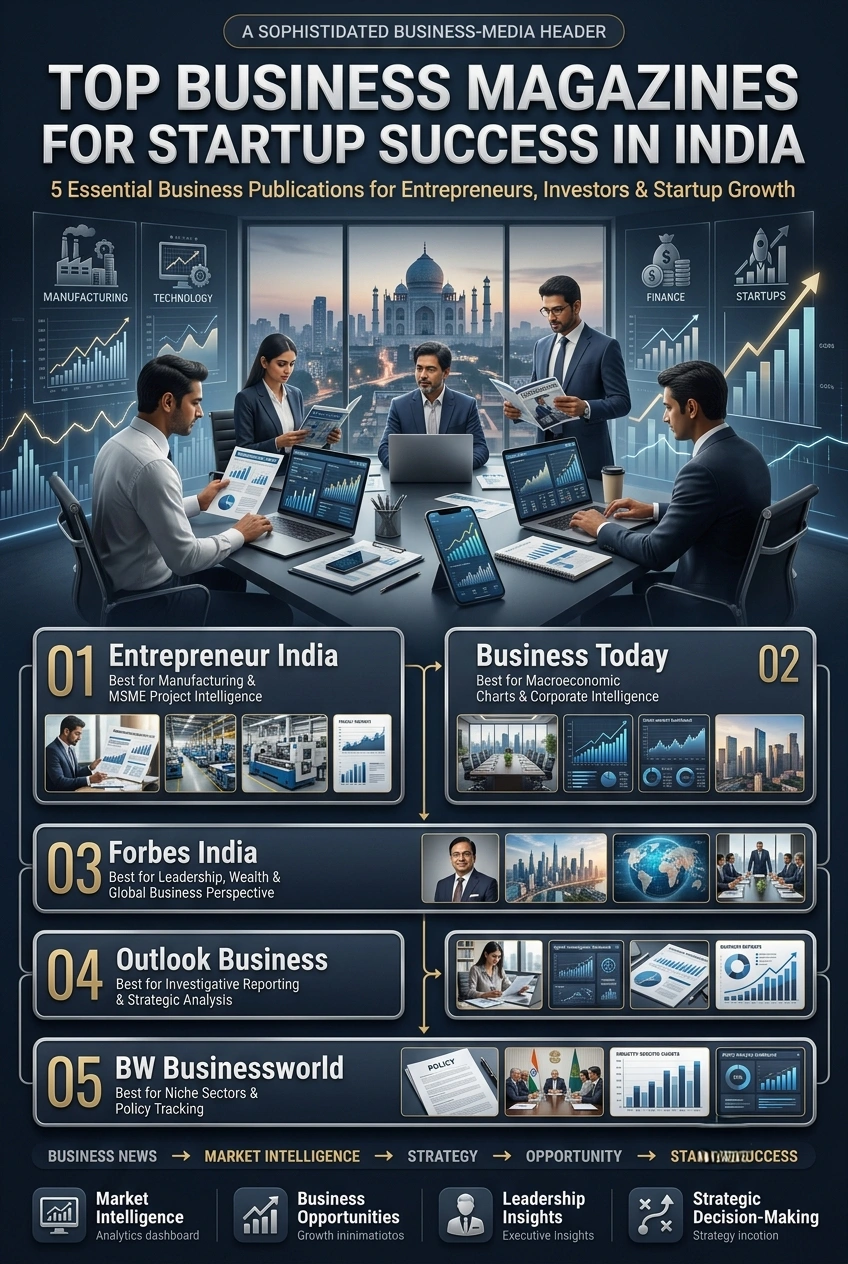
3. Forbes India — Best for Leadership, Wealth & Global Business Perspective
This course is ideal for ambitious entrepreneurs with an international perspective, investors and leadership professionals.
Forbes India is the Indian voice of the brand’s global credibility. Its profiles of business-building success stories, wealth rankings, and study of business dynamics around the world are useful for business founders who are looking at business beyond the domestic market. The writing is always excellent and the discussions about new business models and the disruptive leaders are always interesting and informative.
For MSMEs and industrial investors focused on manufacturing, it is more about a mindset than an operational view — this is more useful for the former and less useful to the latter.
Related Article: Why Global Buyers Are Suddenly Rushing to India’s Factories
4. Outlook Business — Best for Investigative Reporting & Strategic Analysis
Best suited for: Senior professionals, policy researchers, investors who are looking for in-depth stories in the sector.
Unlike publications that focus on news, Outlook Business takes a long-form, investigative approach. It goes beyond mere reporting of market dynamics, corporate behaviour, financial institution strategy and disruption of sectors. Entrepreneurs seeking to grasp the forces that are shaping their industry – more than just the latest news headline – will find Outlook Business to be a scrupulous, well-sourced read.
5. BW Businessworld — Best for Niche Sectors & Policy Tracking
Ideal for: Medium-sized companies, female business owners, industry-specific insurance buyers
The advantage of BW Businessworld is that it is specialised and will dive deep into niche sectors such as infrastructure, health care, sustainability and women entrepreneurship which are not regularly done in the wider publications. It has solid tracking of its policies, and some interesting feature articles on enterprise change, if you are a founder past the startup stage.
The MSME Reader’s Dilemma — And Why Specialisation Matters
India’s MSME industry is sizeable, diversified and dynamic. The Ministry of MSME estimates that more than 6.3 crore businesses fall into this category, from a food processing business at a village to precision engineering at Coimbatore. The government has created a robust support system: NSIC (credit and marketing support), SIDBI (financing support), KVIC/PMEGP (subsidy for financing) and Startup India (recognition and tax benefits).
But most of the general business magazines aren’t geared for this reader. They have been covering quarterly updates from Zomato, new ventures from Reliance or the latest Series C by a Bengaluru fintech. Helpful background reading, let’s say — but not what a Surat-based garment producer or a chemical company in Ankleshwar wants when planning to increase their capacity or launch a new product line.
Industrial publications of the kind that we can offer complete plug the void. Manufacturers and MSMEs are always interested in reading the publication that gives them the most relevant, operational information, rather than just a few bits and pieces of it.
Get Detailed Project Report (DPR): DPR Consultant in India – Detailed Project Report Consultants & Consultancy Services
9 Government Portals Every Indian Entrepreneur Should Bookmark
The best business magazines track these portals so you don’t have to — but bookmarking them directly is worth your time:
- Ministry of MSME — Udyam registration, scheme notifications, policy updates
- Startup India — Startup recognition, tax benefits, government procurement access
- Make in India — Sector-specific investment facilitation and PLI scheme details
- NSIC — Credit support, raw material assistance, marketing schemes
- SIDBI — MSME financing, refinance, and microfinance access
- DPIIT — Industrial policy, FDI norms, PLI scheme administration
- APEDA — Agri-export promotion, market intelligence, certification
- DGFT — Export-import policy, RCMC registration, trade facilitation
- Reserve Bank of India — Priority sector lending norms, credit flow data for MSMEs
Start with clarity—choose the best business idea
How to Build Your Personal Reading Stack
A magazine can’t be all things to all people. The best way to do this is to create a reading pile or two or three, publications that are mutually useful, but do not overlap too much. For a manufacturing entrepreneur a well-balanced portfolio may include the following:
- Entrepreneur India for project intelligence, sector feasibility, and MSME policy — the operational core
- Business Today or Outlook Business for macroeconomic and corporate context — the strategic layer
This will cost less than ₹5,000 per year for the entire stack. If you return at least one well-thought though project choice, it’s multiples. If you return one project choice that you have thought about well, it’s multiples.
Final Thoughts
There is a lot of opportunity, but also noise in India’s entrepreneurial landscape. One of the most overlooked competitive advantages an entrepreneur can develop is a disciplined reading habit, which should be centered around the right publications for your stage and sector.
General business magazines bring you information about the world. The sector-specific ones assist you in making decisions in a sector. The top entrepreneurs excel at doing both – keeping their eyes on the big picture AND having operationally relevant intelligence about their own industry.
Choose one subscription to start with and meet your current decision-making requirements. Build from there. Also, keep this in mind: The price of the correct information is always lower than the price of the wrong decision!


