





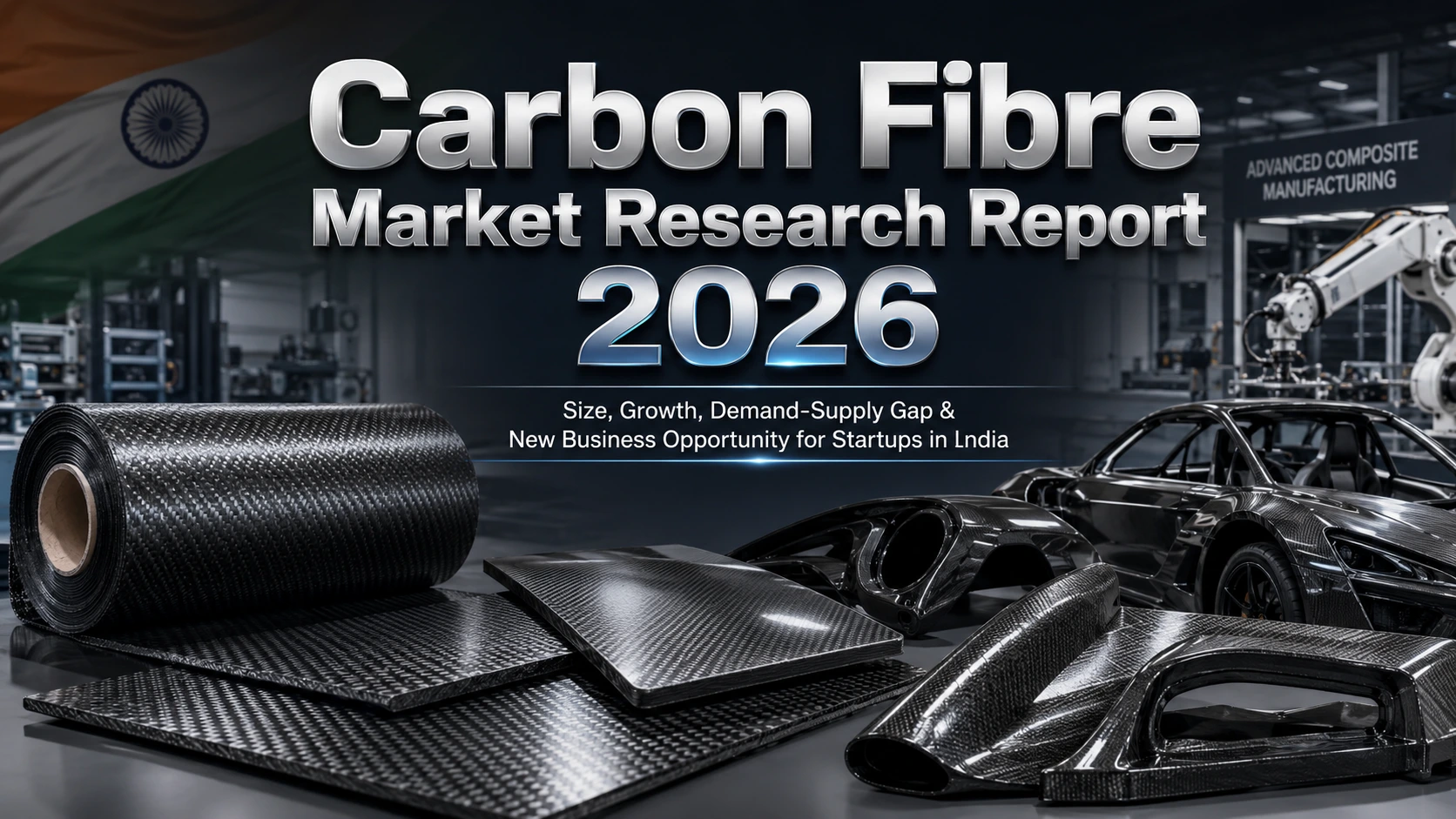
Carbon Fibre Market in India
Another name which can be recognized by most of the reports in this series is carbon fibre: India imports all of its carbon fibre requirement. All the carbon fibre parts in every aircraft, wind turbine spar cap, CNG cylinder, and sporting goods manufactured in India begin with imported carbon fibre. That’s on the change — Reliance Industries, Jindal Advanced Materials, and government-backed labs like BARC, HAL, and MIDHANI have all announced their plans for domestic production, but as yet, it’s a first-mover opportunity where the government is interested.
What Is Carbon Fibre?
Carbon fibre is a high strength, high stiffness, high-quality lightweight reinforcing material consisting of thin strands of carbon atoms bonded together that is approximately 1/5 the weight of steel. Approximately 90-95% of the world’s carbon fibre is produced from a polyacrylonitrile (PAN) precursor, while the rest is produced from pitch- or rayon-based precursors. The manufacturing process is a difficult one, which requires two steps, the first in which the precursor fibre is stabilized by heating it to temperatures of 390-590°C, the second during which the fibre is carbonized at very high temperatures (1,830-5,500°C), without burning it.
The final product of the fibre is received in a series of intermediate products:
- Raw fibre formats for various downstream processing: Continuous carbon fibre, long carbon fibre and short carbon fibre.
- Fabric and prepreg – woven carbon fibre fabric, and woven carbon fibre impregnated with resin for moulding.
- Final carbon fibre reinforced plastic (CFRP) components for end applications (composite parts)
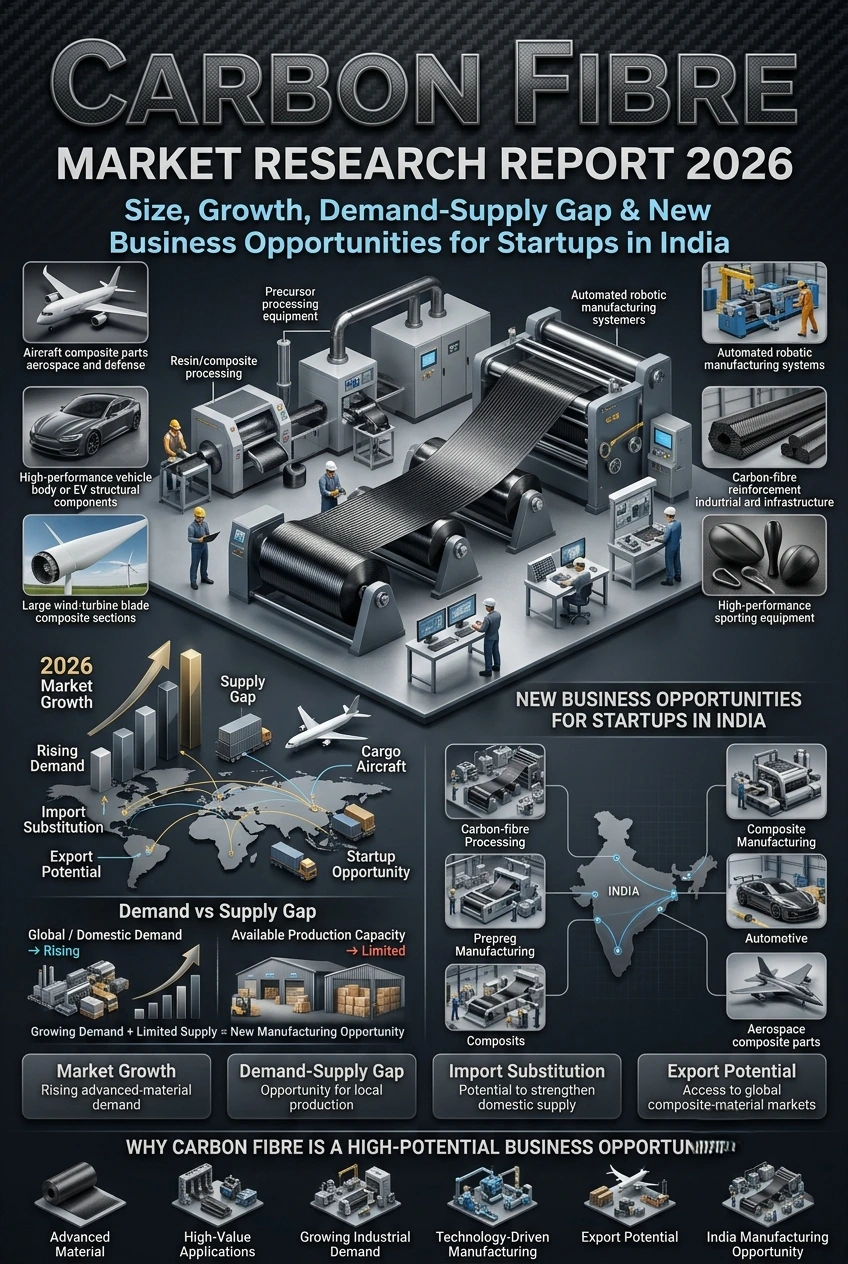
They are used in the aerospace and defence industry in structural components (~50% of global consumption), in the automotive sector for lightweighting for fuel efficiency and EV range extension, in the wind energy industry (turbine blade spar caps, which is becoming a major use as wind blades grow larger in size), in pressure vessels (CNG/hydrogen cylinders), in sporting goods, and construction/infrastructure reinforcement.
Get Detailed Project Report (DPR): Carbon Fibre Manufacturing: Complete Project Report & Business Guide
Global and India Carbon Fibre Market Size and Growth
The global carbon fibre and yarn market size was estimated to be USD 2.3–2.5 billion in 2024-25, which is expected to grow at a CAGR of around 7.5% (2026-2033) to reach USD 4.7 billion by 2033. Historically about half of global consumption has been in the aerospace and defence industry and the worldwide market is expected to grow to about 400,000 tonnes by 2035, but wind energy is now playing an important and growing part.
While absolute quantities of the carbon fibre market are much smaller in size in India, the growth rate is faring at a decent pace as compared to the global growth. Based on estimates, India used carbon fibre at around 5.6 kilotonnes in 2024, which is expected to more than double to 12.1 kilotonnes by 2030 at a CAGR of ~12.8% as compared with glass fibre, which is growing at ~6.5% CAGR, during the same period. Separate Indian market studies indicate that the market will grow at a CAGR of about 8.3% and reach a value of approximately USD 908.5 million by 2030 (India Carbon Fiber Market – wider scope including composites).
Note on figures: Carbon fibre market studies differ widely and can be based on raw fibre tonnage, the wider composite/CFRP value chain, or be split and examined downstream applications along with the CFRP value chain. NPCS will be able to create a value-chain specific Investor-ready TEFS for you, based on your value-chain position (precursor, fibre, fabric/prepreg, or composite parts).
India’s 100% Import Dependency — and the Race to Close It
This is the defining factor of the Carbon Fibre market in India, India is 100% dependent on imports from leading international suppliers such as Hyosung Advanced Materials, Toray, Teijin and Syensqo for the whole carbon fibre and derived composite material requirement. The highly concentrated import concentration statistics for India reveals that the USA, China, Indonesia, Taiwan and Germany are the leading countries exporting carbon fiber to India, with the import volume rising by 43.0% in 2024 compared to 2023, indicating that the domestic demand for carbon fiber is increasing at a fast pace, and it is still being fulfilled entirely from abroad.
That’s now starting to change, there are several of big projects announced:
- Reliance Industries has announced the total plan of carbon fibre capacities of 20,000 tonnes, with a first phase capacity of 4,000 tonnes in Gujarat, which is expected to come online by early 2026.
- Jindal Advanced Materials is joining forces with MAE S.p.A. (Italy), a global supplier of carbon fibre equipment, to build a 3,500-tonne plant by 2027.
- Bhabha Atomic Research Centre (BARC), Hindustan Aeronautics Ltd. (HAL) and Mishra Dhatu Nigam Ltd. (MIDHANI) are on the verge of starting their own indigenous manufacturing programs, while more details are still coming to light.
If these initiatives come through as planned, India is indeed on the verge of becoming a self-sufficient market with a competitive production base in the next 2-3 years, but the opportunity is still wide open.
Access Complete Business Plan: Carbon Fibre Manufacturing: A High-Potential Opportunity for Startups and Entrepreneurs
Policy Tailwinds
- Production-Linked Incentive (PLI) scheme for advanced manufacturing: Providing direct financial incentive for carbon fibre and composites manufacturing in India with allocation of over ₹26,000 crore for advanced manufacturing sectors.
- National Technical Textiles Mission: Offers a conducive policy environment for technical textile materials like carbon fibre, both in R&D and scale up of manufacturing.
- Make in India and defence indigenisation programmes: Directly driving demand for domestically-sourced lightweight, high-strength materials for military aircraft, missile systems, and other defence applications, reducing reliance on imported components.
- FAME II EV scheme and automotive lightweighting push: With India’s automotive industry projected to reach USD 300 billion by 2026, and EV sales growing 40% year-on-year, government support for EV adoption directly benefits composite materials that improve vehicle range and efficiency.
- Local content requirements for renewable energy and government procurement: India is witnessing emerging local content requirements (and other markets such as Middle-East) which diversifies supply chains and are specific to the use of composite materials in the Indian market.
India Demand-Supply Gap: Carbon Fibre
| Parameter | Current Position |
| Domestic carbon fibre production | Zero — India currently has no domestic carbon fibre (raw material) manufacturing capability |
| Import dependency | 100% — all carbon fibre consumed in India is imported, primarily from the USA, China, Indonesia, Taiwan, and Germany |
| Import growth rate | 43.0% growth from 2023 to 2024, reflecting rapidly rising underlying demand |
| Demand growth (India) | Carbon fibre consumption projected to more than double from 5.6 kilotonnes (2024) to 12.1 kilotonnes (2030), a 12.8% CAGR |
| Announced domestic capacity (in development, not yet operational) | Reliance Industries (20,000 tonnes planned, 4,000-tonne first phase from early 2026); Jindal Advanced Materials (3,500 tonnes by 2027); plus BARC, HAL, and MIDHANI initiatives |
| Nature of the gap | A complete, currently unaddressed import-substitution gap — the largest and cleanest gap identified across this entire report series, with demand doubling within six years and essentially zero current domestic raw fibre production |
| Opportunity for new entrants | Extremely high at the primary fibre manufacturing level (though highly capital- and technically-intensive) and more accessible at the downstream fabric, prepreg, and composite component manufacturing level |
Reading the gap: This is the starkest demand-supply gap in this report series — India makes none of its own carbon fibre and imports all of it, while consumption is projected to more than double within six years. Primary fibre manufacturing (PAN precursor production and carbonisation) is genuinely capital- and technically-intensive, realistically suited to large, well-capitalised conglomerates like Reliance and Jindal rather than a typical MSME entry point. But India already has functioning intermediate-product manufacturers (prepreg, fabric) and composite part fabricators — meaning the more accessible entry points for smaller entrepreneurs sit downstream, converting (initially imported, later domestic) fibre into finished components for India’s growing aerospace, defence, EV, wind energy, and CNG cylinder markets.
Get Detailed Insights from This Boo: Book
Major Indian Carbon Fibre and Composite Value Chain Companies
| Company | Base/Region | Value Chain Position | Notes |
| Reliance Industries Ltd. | Gujarat | Planned primary fibre manufacturing | Announced 20,000-tonne total capacity plan, with a 4,000-tonne first-phase facility targeted for early 2026 — India’s most advanced domestic carbon fibre production initiative |
| Jindal Advanced Materials | India (with MAE S.p.A., Italy) | Planned primary fibre manufacturing | Targeting a 3,500-tonne plant by 2027 in technology partnership with Italian carbon fibre equipment supplier MAE S.p.A. |
| Bhabha Atomic Research Centre (BARC) | Mumbai, Maharashtra | Planned/R&D-linked fibre manufacturing | Government research institution expected to launch domestic production initiatives |
| Hindustan Aeronautics Ltd. (HAL) | Bengaluru, Karnataka | Planned production, aerospace-linked | State-owned aerospace manufacturer expected to develop domestic carbon fibre capability for defence applications |
| Mishra Dhatu Nigam Ltd. (MIDHANI) | Hyderabad, Telangana | Planned production, defence-linked | State-owned special metals and materials company expected to enter carbon fibre manufacturing |
| Kineco Exel Composites India (KECI) | Goa | Downstream — pultruded components | Setting up a pultruded spar cap manufacturing plant, with deliveries slated to start in 2026, serving the wind energy segment |
| The Bhor Chemicals and Plastics Pvt Ltd. | India | Downstream — fabric/prepreg/composites | Recognised Indian composite materials value chain participant |
| Time Technoplast | India | Downstream — composite pressure vessels | First Indian company to manufacture type-IV CNG composite cylinders for both cascade and on-board applications |
| NIKOL Advance Materials Pvt. Ltd. | India | Downstream — composite materials | Recognised Indian carbon fibre composite value chain participant |
Major International Carbon Fibre Players
| Company | Country | Notes |
| Toray Industries, Inc. | Japan | Global market leader by scale and diversified portfolio; among the primary current suppliers of carbon fibre to India’s import-dependent market |
| Hyosung Advanced Materials | South Korea | Major global carbon fibre producer and current key supplier to the Indian market |
| Teijin Limited | Japan | Major global carbon fibre and composites manufacturer, current supplier to India |
| Syensqo (formerly part of Solvay) | Belgium | Major global specialty materials company and current India supplier; actively expanding carbon fibre composite recycling partnerships |
| Hexcel Corporation | United States | Major global aerospace-grade carbon fibre and composites manufacturer |
| SGL Carbon | Germany | Major European carbon fibre and graphite materials producer |
| Mitsubishi Chemical Group Corporation | Japan | Major global chemicals and advanced materials producer with significant carbon fibre capacity |
| Zhongfu Shenying Carbon Fiber Co., Ltd. | China | Rapidly growing Chinese carbon fibre producer, identified as gaining significant market momentum |
Market Segmentation
By Raw Material/Precursor
- Polyacrylonitrile (PAN)-based — dominant, ~90-95% of global production
- Pitch-based
- Rayon-based
By Product Type
- Continuous carbon fibre
- Long carbon fibre
- Short carbon fibre
- Recycled carbon fibre (emerging, growing CAGR of ~19.87% globally 2026-2031)
By Tow Size
- Large-tow (50K) — currently dominant in India, primarily for wind energy pultruded spar caps
- Small-tow (24K) — growing preference for pressure vessels, electrical cable cores, and automotive applications
- High-performance tow (3K, 6K, 12K) — required for aerospace and defence, dominated globally by Toray, Hexcel, and Syensqo
By Application
- Wind energy (pultruded spar caps) — currently India’s dominant application segment
- Aerospace and defence — high-value, stringent qualification-driven segment
- Automotive (lightweighting, EV components)
- Pressure vessels (CNG/hydrogen cylinders)
- Sporting goods
- Construction and infrastructure (bridge rehabilitation, reinforcement)
Key Growth Drivers
- India’s current high level of dependency on imports, which is increasing at a rapid pace. Global consumption is expected to more than double by 2030 and there is no domestic production of fibre at present, thus alone this puts significant pressure on investment in new manufacturing.
- Government PLI and defence indigenisation support. Concrete financial incentives and policy focus on import reduction in advanced materials, including defence and aerospace.
- Growth of wind power industry. The application of carbon fibre pultruded spar caps, which is being increasingly used in wind turbine components for scaling up the size of the blades for wind turbines, is a major thrust area in India today.
- Lightweighting of EVs and vehicles. The demand for composite materials as potential weight reduction solutions for enhancing EV range is structurally projected to continue growing as India’s EV sales increase by 40% annually and the automotive industry is projected to reach USD 300 billion by 2026.
- Expansion of the manufacturing of drones and UAVs. The drone industry in India is expected to grow at a compound annual rate of 40% to USD 1.8 billion by 2030, which relies on carbon fibre tubes and machined components.
- Demand for CNG/hydrogen pressure vessel. Type-IV composite pressure vessels is a growing application in India, currently being largely met by Time Techno last, in the context of developing natural gas and hydrogen vehicle infrastructure.
Related Article: Empowering the Future with a Carbon Fiber Plant in India
Challenges and Restraints
- Complete precursor import dependency. Although the domestic fibre production has started, the PAN precursor is also being imported, and backward integration beyond production of fibre is needed for true self-sufficiency.
- High capital and energy requirement. Carbon fibre has to be produced under extremely high temperature conditions with a considerable investment, which means that only well-established conglomerates and government-backed entities can produce the carbon fibre in primary production.
- Fragmented downstream ecosystem. India’s resin systems, weaving, and composite manufacturing value chain is still a fragmented one, and needs coordination and policy support along with public-private partnerships to grow up.
- Sustainability and recycling issues. The global challenge of carbon fibre composites’ sustainability will be a challenge that will need investment to overcome as usage grows, especially if the quality of the material is to be preserved for recycling.
- Strict requirements for qualification for high value applications. To produce carbon fibre for the aerospace and defence industry, a decade of process control expertise and strict qualification is needed — a challenge even for well-resourced new companies aiming to enter this niche market.
- Currently, glass fibre is the dominant material in the market, due to its lower price. Tremendous amount (around 98.5%) of India’s total composite material value is still in glass fibre reinforced polymers, which can be attributed to the lack of significant end markets (such as commercial aerospace) other than which could have led to higher penetration of carbon fibre.
Competitive Landscape
The carbon fibre market in India is today fully import-dependent at the primary fibre level with the presence of global players – Toray, Hyosung, Teijin, Syensqo, etc. – and a fairly fledgling domestic manufacturing base with a handful of companies such as government-backed (BARC, HAL, MIDHANI) and government-sponsored (Reliance Industries and Jindal Advanced Materials) companies, none of which are yet fully commercial. The downstream value chain, which includes functioning fabric, prepreg, and composite component manufacturers, is well more developed and has much less competition than the primary fibre production segment in India (Bhor Chemicals, Time Technoplast, Kineco Exel, NIKOL Advance Materials). This is a structure that is truly open at the top of the value chain and moderately concentrated at the bottom.
Carbon Fibre Manufacturing: Business Opportunity for Startups and MSMEs
- Downstream fabric, prepreg, and composite component manufacturing. Given India’s currently import-dependent raw fibre supply, converting imported (and eventually domestic) carbon fibre into fabric, prepreg, and finished composite components for wind energy, automotive, and pressure vessel applications is the most immediately accessible entry point.
- Defence and drone-related specialized composite component manufacturing. India’s drone industry and Defence Indigenisation efforts are generating a demand for smaller batch sizes and precision-engineered carbon fibre components, which is a more cost-effective approach than producing the carbon fibre itself, and is ideal for technically adept entrepreneurs.
- Supply of pressure vessel components for CNG/hydrogen. The use of composite pressure vessel components in the growing natural gas and hydrogen vehicle infrastructure in India is an established application that’s demand secure, inspired by the model Time Technoplast has already established.
- Processing recycled carbon fibre. The global recycled carbon fibre market is expanding at almost 20% CAGR, and India’s wind energy industry is maturing and is expected to start blade decommissioning in the near future—early capability for recycling and reprocessing gives an early move to an entrant in an emerging feedstock stream.
- Assembly of composite parts for OEMs. With no need to invest in primary fibre production, it provides a lower risk services-based entry point to the Indian market for automotive, aerospace, and wind energy OEMs making a foray into the country.
Assumption flag: This is a capital and technical intensive sector, which is well suited to large and well capitalised companies and is not a typical MSME greenfield opportunity at that stage of the value chain. NPCS provides detailed, bankable Project Reports based on an honest scope of your realistic entry point in the value chain, ranging from downstream fabric/prepreg manufacturing, composite component manufacturing, to feasibility assessment for primary fibre manufacturing, and brings technology-specific lists of machinery and market assessment based on your target capacity.
Smart entrepreneurs start here—find your perfect venture
How NPCS Supports Entrepreneurs Entering This Space
If any entrepreneur or manufacturer is considering setting up a carbon fibre or composite manufacturing unit, the first step towards that process is to undertake Detailed Project Report (DPR), which must address the positioning of the value chain, capacity of the plant, sourcing of technology, and equipment, procurement strategy for raw materials or precursors, manpower planning, project cost, segment and target market specific financial viability etc.
About NPCS (Niir Project Consultancy Services)
NPCS is a New Delhi-based industrial consultancy, established in 1994, and an ISO 9001:2015 certified organisation with over 30 years of experience in techno-economic and project consultancy. Over three decades, NPCS has delivered more than 150,000 project reports and profiles across 85 countries, covering virtually every manufacturing and process industry, including advanced materials, composites, and technical textiles.
NPCS operates across three integrated platforms:
- niir.org — the primary repository of industry-specific Detailed Project Reports, business plans, and techno-economic feasibility studies
- entrepreneurindia.co — market research, project profiles, and manufacturing business opportunity content aimed at entrepreneurs and MSMEs
- npcsblog.com — industry insight, trend analysis, and manufacturing sector commentary
NPCS’s core deliverables relevant to a carbon fibre/composite venture include:
- Detailed Project Reports (DPRs) with plant capacity, machinery specifications, and layout
- Techno-economic feasibility studies, including value-chain positioning guidance
- Financial modelling — project cost, profitability analysis, ROI, and break-even calculations
- Raw material and market assessment specific to India’s aerospace, automotive, wind energy, and defence sectors
- Support documentation for PLI scheme applications, funding, and regulatory approval processes
Entrepreneurs evaluating this sector can access relevant carbon fibre and composite manufacturing profiles directly on niir.org and entrepreneurindia.co, or request a custom feasibility study scoped to a specific value-chain position and capacity.
Government and Institutional Reference Links
- Department for Promotion of Industry and Internal Trade (DPIIT) — PLI Schemes
- Ministry of Defence — Defence Indigenisation
- Defence Research and Development Organisation (DRDO)
- Ministry of Micro, Small and Medium Enterprises (MSME)
- Development Commissioner, MSME (DCMSME)
- Bureau of Indian Standards (BIS)
- Press Information Bureau (PIB), Government of India
- Startup India
- Invest India (National Investment Promotion and Facilitation Agency)
Entrepreneurs are advised to verify the latest PLI scheme guidelines, National Technical Textiles Mission funding norms, and defence indigenisation procurement requirements directly on these portals, as these provisions are periodically revised.
Conclusion
Carbon fibre represents the most complete, unambiguous demand-supply gap identified across this report series: India currently produces none of its own carbon fibre and imports 100% of a rapidly doubling demand base. Major domestic production initiatives are underway but not yet operational, meaning genuine first-mover opportunity still exists — both at the primary fibre level for well-capitalised entrants, and more immediately at the downstream fabric, prepreg, and composite component level for a broader range of technically capable manufacturers.
For entrepreneurs and established manufacturers evaluating advanced materials investments, carbon fibre and its downstream composite value chain offer a genuinely rare combination: a complete current import gap, doubling demand, explicit government policy priority, and early-stage domestic competition that hasn’t yet consolidated.


