





Ghaziabad New Industrial Hub
The Story Behind the Headlines
Picture this. A land of 1200 ha along the Delhi-Meerut Expressway. Planning of 200 factories. About 5,000 jobs on the verge of creation. But the vast majority of business owners in the NCR have yet to feel it.
That’s the opportunity that’s already lying in the recent report on Madhuban Bapudham in Navbharat Times in Ghaziabad. Check out the full development at Navbharat Times. The Ghaziabad Development Authority (GDA) has formally agreed to create a structured industrial zone at Madhuban Bapudham, and the enterprises that establish a presence here in the next year or two will reap advantages that can’t be obtained after the zone becomes more mature.
No, it’s not a forward-looking tale of what might happen. The RRTS is already in operation. The expressway is already open for use. Part of the township of GDA is already occupied. The next phase is an industrial layer, the next phase is a business layer and that next phase is what is all about.
Navbharat Times’ reporting is the earliest official public confirmation of this industrial thrust. Business owners who take note of market signals – not when it gets crowded – know why it’s important.
Identify high-growth industries before others do
Breaking Down the Navbharat Times Report: Numbers That Matter
All worthwhile business decisions begin with “numbers”. Let’s look at the Navbharat Times story and beyond the headline:
The “200 Factories” Number
Not 200 factories come in at once to a zone. They are a series of waves (anchor units first, then suppliers, then service providers). The highest margin and the lowest competition is in the earliest wave. Entrepreneurs who join at this stage may find themselves in a situation where they are guaranteed contracts for the long haul before prices and expectations are established by the market.
The “5,000 Jobs” Number
This translates into 5,000 direct jobs, or 15,000-20,000 people (including dependents) engaged in economic activities within and around this zone. Proportional demand growth in food, transport, housing, retail, health care, and personal services. A service business entrepreneur would be as close as it gets to creating its own customer base from scratch.
The “1,200+ Hectares” Number
Scale is important in industrial areas. It is important to note that smaller zones fill up rapidly. Madhuban Bapudham’s footprint of 1,200+ hectares translate to multiple generations of businesses. The entrepreneurs who enter now, are not playing for the little pie, but for the big and very large pie that will grow.
Three Reasons This Zone Will Grow Faster Than Most People Expect
The RRTS Effect is yet to be underestimated
The majority of the studies on new industrial areas are based on road access. That is Madhuban Bapudham and along with-it NH-9 is running. However, the more important reason would be the Duhai Namo Bharat RRTS station, which is located 1.5 km away. Rail served industrial zones have been known to draw higher quality workers, longer tenure and greater logistic reliability than road only zones. This distinction is apparent to investors and factory owners when they decide on a location.
GDA’s Track Record in Madhuban Bapudham Is Already Proven
GDA has been working on Madhuban Bapudham for years, whereas speculative township projects are being developed by the private developers. Pockets for residential use are filled. Auctions of commercial and institutional land have been held. This is an activity in progress as described on the GDA’s own website. The industrial zone announcement is not a ‘greenfield’ commitment; it’s the next phase of a project that’s already producing results.
UP’s MSME Policy Is Genuinely Competitive Right Now
The development of MSMEs has been thrusted in the state’s priority list in Uttar Pradesh. UP ranks among the most appealing manufacturing locations in the north today thanks to the incentive package of 50% exemption on stamp duty in Ghaziabad, 100% reimbursement of EPF for five years, and availability of central government schemes. The full policy is written on Invest UP’s MSME page.
Government Support: What Is Actually Available to You
Government schemes are a common resource that entrepreneurs think they can only reach if they’re a large business or not a local business. For the MSME entrepreneurs who are entering a zone like Madhuban Bapudham, the actual situation is better. The scheme portal of the MSME Ministry’s scheme portal with ongoing programmes with a tangible impact on the economy:
- Remove the largest hurdle for the first time factory operators with the removal of collateral requirements for loans up to ₹2 crore through CGTMSE.
- The subsidy for PMEGP is 25-35% of the capital cost, which brings the cost of the project down considerably for new manufacturing units.
- Vinay Welcome: Welcome message for the Udyam registered entrepreneurs
- Further 100% reimbursement for five years with UP EPF means continued labour cost savings.
- For UP, 50% Stamp Duty to be exempted in Ghaziabad is a direct saving on land acquisition.
Startup India’s registration provides tax exemptions under Section 80-IAC – a significant benefit for startups and also provides access to the Startup India Fund of Funds of ₹10,000 crore – which is a meaningful funding pathway for growth-stage startups, as it is structured as a company and not a proprietorship.
6 Manufacturing Opportunities — Including the Ones Most Entrepreneurs Will Miss
When considering a new industrial zone, most entrepreneurs will think of the obvious: the types of industrial zones. This section delves deeper to recognise manufacturing plays that are truly high-margin, export-ready and appropriately designed for an MSME entry point within the unique industrial context of Madhuban Bapudham. All 6 are also based on the actual demand data from the 200+ factory ecosystem informed by Navbharat Times.
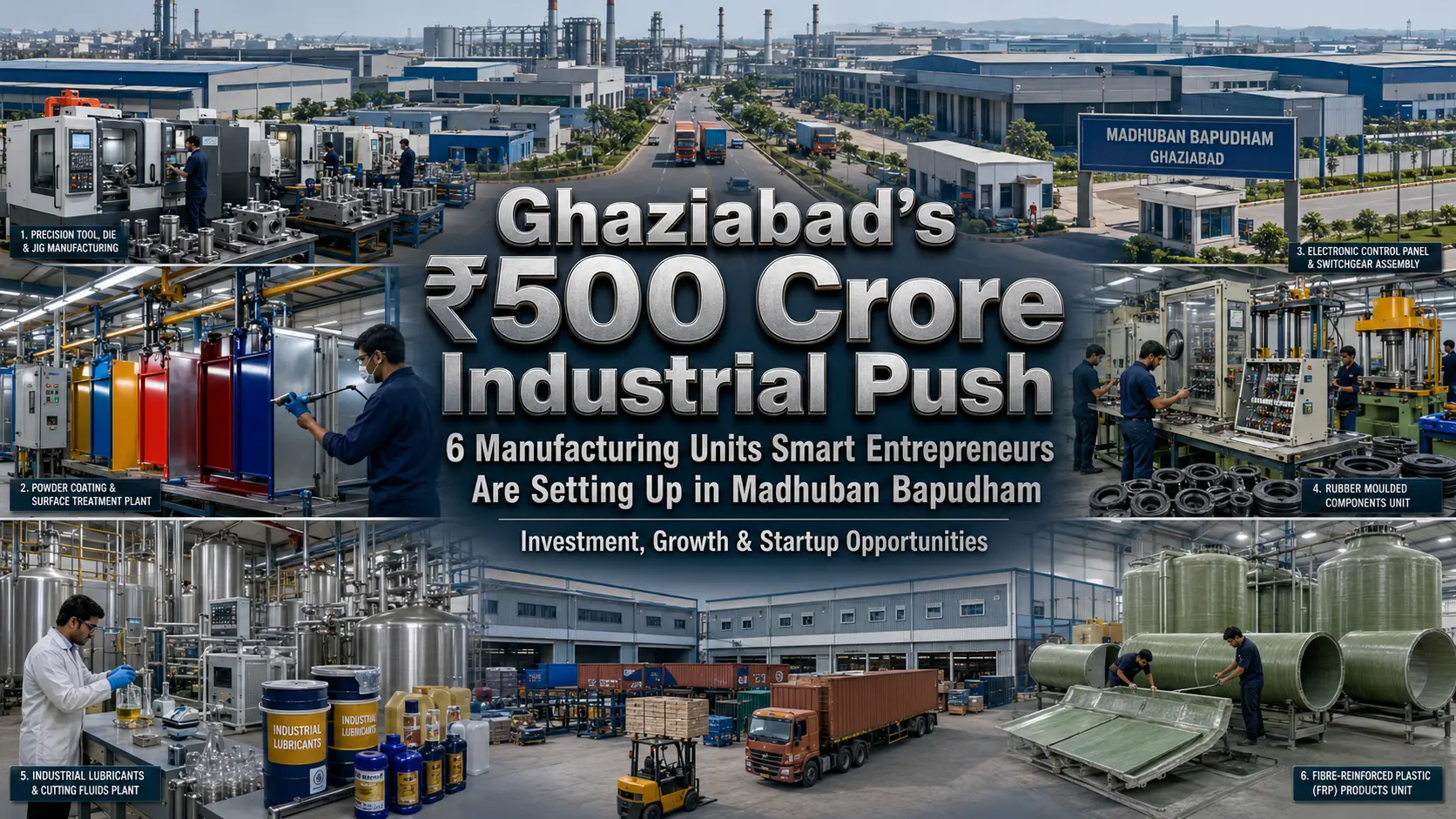
1. Tool, Die and Jig Manufacturing (Precision Tooling Shop)
All plastic moulding, sheet metal and forging units in the zone require custom designed tools, dies, jigs and fixtures. At present most of the small factories in NCR procure tools from Ludhiana or Pune at exorbitant prices and with long lead times. Madhuban Bapudham’s precision tooling shop is the need that meets local edge that is absent from the far-flung suppliers. High value Tooling (₹50,000 to ₹5 lakh per die), Repeat Order, CNC VMC and skilled machinists. Setup cost: ₹70 lakh to ₹1.5 crore. It is the highest margin manufacturing category in an industrial cluster, and a category which has been universally neglected in newly formed zones.
2. Powder Coating and Surface Treatment Plant
All the metal parts produced in the area, such as sheet metal parts, structural parts, auto ancillary parts, etc. must be surface treated before they can be used. Powder coating, zinc plating, phosphating and anodizing are process industries that provide job work to other manufacturers. The cluster of Madhuban has its own powder coating and surface treatment plant, which has 30-50 job work factories as its clients, and has a captive and recurring demand.
No factory would send their metal parts for surface treatment to Delhi for 40 km distance when nearby Delhi is 2 km away. The set up cost of Powder coating line is ₹40-80 lakh. Revenue model: per kg or job work pricing for a batch. SMEs receive between 28-35% on job work revenues.
3. Electronic Control Panel and Switchgear Assembly Manufacturing
All factories, irrespective of their manufacturing, require electrical control panels, MCC (Motor Control Centres), PLC panels and distribution boards. Unlike mass-manufactured, these are mostly assembled and are best suited for MSME units that have 10-20 skilled electricians and assemblers. BEL, Sahibabad, has always developed a robust electronics manufacturing capability among Ghaziabad’s workforce. Both new construction demand (for every factory being setup for Madhuban Bapudham cluster) and recurring demand for maintenance replacements add up to the requirement for a control panel unit for the Madhuban Bapudham cluster of 200+ factories. Setup cost: ₹30-60 lakh. Government and PSU buyers are also given a boost in their procurement process when switchgear product is registered with MSME Ministry and certified with BIS.
4. Rubber Moulded Components Manufacturing
The engineering, auto-ancillary, pump, valve and HVAC factories use rubber moulded components in high volumes like gasket, O-ring, seal, grommet, vibration damper, pipe seal etc. A manufacturing niche that is very hard for new business owners to grasp, but that commands high profit margins (25-35%) because it is technical in nature and clients prefer to work with vendors who are within close proximity of where they are located, which can then handle quick response to custom orders.
A rubber moulding unit comprising 6-10 compression or injection moulding presses can cater for 20-30 factories at a time, in an area of 2,000-4,000 sq.ft. Setup cost: ₹35-65 lakh. Suppliers in Delhi and Mumbai are ready with raw material (Natural and Synthetic Rubber compound) within 48 hours.
Get Detailed Insights from This Book: The Complete Book on Rubber Processing and Compounding Technology
5. Industrial Lubricants and Cutting Fluids Manufacturing
Cutting oils, coolants, hydraulic fluids, gear oils and rust preventive compounds are used continuously in every metal-cutting, machining, and fabrication factory. These are not branded consumer products; these are industrial formulations which are produced locally by many MSME manufacturers and sold to industrial distributors under their own brand or as private label. A small lubricant blending and filling unit consists of blending vessel, filling line and storage tanks costing ₹25-45 lakh. The annual industrial lubricant market in NCR is at ₹800-1200 crore. The zone-based manufacturer supplies Madhuban Bapudham directly to the customer, thereby beating the Delhi distributor prices and delivery speed. DGFT is available for export to ASEAN and Middle East.
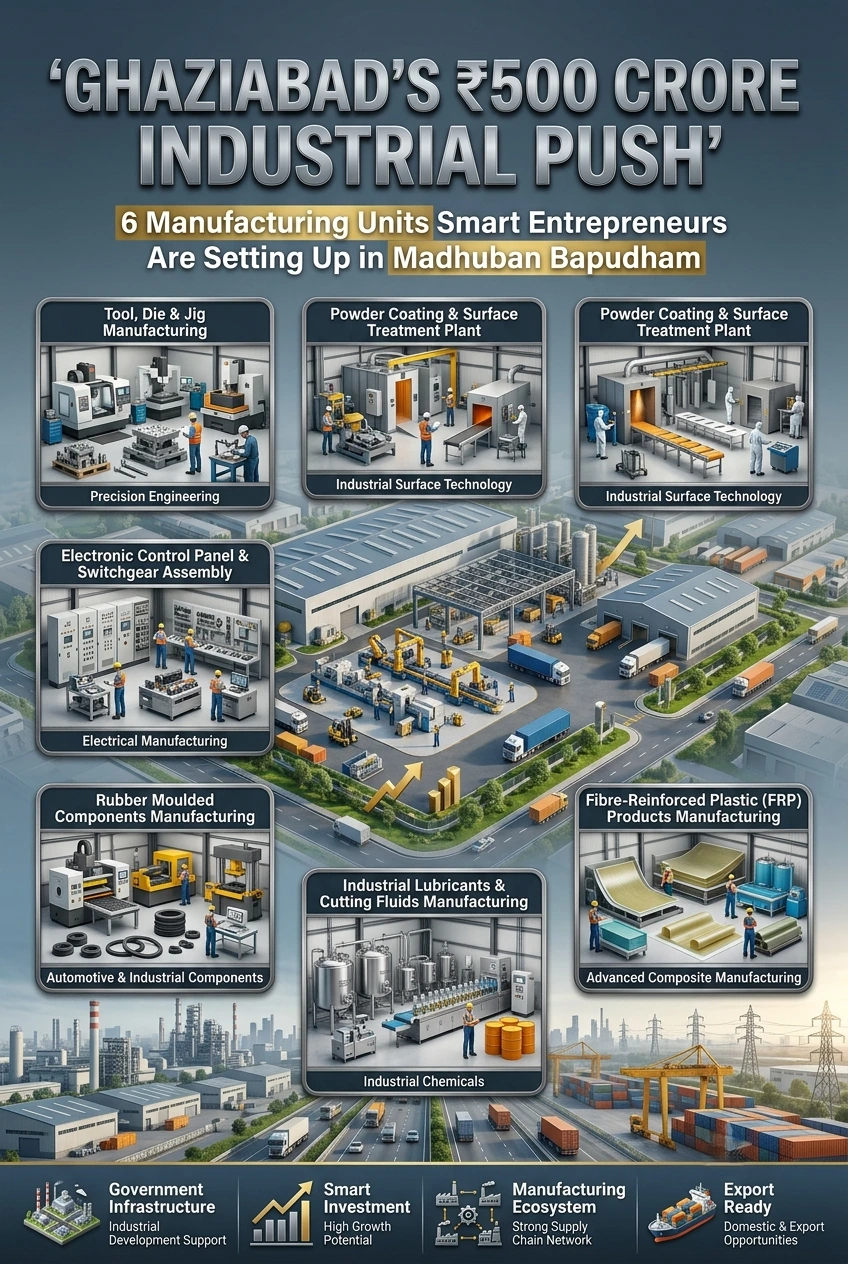
6. Fibre-Reinforced Plastic (FRP) Products Manufacturing
Water tanks, cable trays, chemical storage containers, ventilation ducts, gratings, and enclosure structures for factories are made from FRP (fibreglass-reinforced plastic). Lighter than steel, resistant to corrosion, and increasingly being used for building purposes in industry. An FRP fabrication shop for the Madhuban Bapudham zone is supplying for construction (required during the setup of each factory, FRP tanks, cable trays, enclosures etc. in the operational stage of the factory, maintenance replacement of FRP parts are required) This is a not so crowded manufacturing segment in the present industrial scenario in Ghaziabad and thus is an excellent opportunity to be the first one to play it.
The capital cost for a manual and semi-mechanised FRP fabrication unit is between ₹30-55 lakh. There is a growing export of products to the Gulf for oil and the chemical plant applications.
View Full Project Details: Fibre Reinforced Plastic Manufacturing Plant Report
The Export Angle: Ghaziabad’s Underappreciated Trade Advantage
Ghaziabad is located 35 km away from Delhi ICD (Inland Container Depot) which is one of the main customs & freight processing ports in North India. The proximity is a boon for factory owners of Madhuban Bapudham as export logistics are faster and cheaper compared to majority of the other industrial areas in western UP.
The export profile of Uttar Pradesh is already strong in areas such as engineering goods, readymade garments, handicrafts and food processing, which are the type of manufacturing units that are likely to be part of Madhuban Bapudham. An entrepreneur, who develops export capability from the beginning, not as a future goal, taps a market multiplier which a domestic only competitor is not able to reach.
- Auto-ancillary components, created export demand from Japan, Germany, USA
- This is a period of increasing demand in ASEAN for plastic packaging and industrial components.
- Electrical fittings and engineering goods – good markets in the Gulf and Africa.
- Consumer goods and FMCG products – Indian markets in the UK, Canada, Middle East
What History Tells Us About NCR’s Industrial Zone Successes
Noida’s Phase-I Industrial Area: The Template
The entrepreneurs who came in the early days before NOIDA became the official address of the industrial area (Phase-I) in the 1980s, and established businesses worth hundreds of crores. In greater Noida, in the industrial belt of Manesar the pattern continued, and in Kundli. Madhuban Bapudham is on the same trajectory as all of its predecessors, and it has far more connectivity than any of its predecessors had when it opened.
Sahibabad’s Lesson for Madhuban Bapudham
Now adjacent to the ongoing development, Sahibabad Industrial Area confirms Ghaziabad’s potential in terms of large-scale manufacturing. The same media that has been reporting on the rise of industrialization in Sahibabad for years now is talking about Madhuban Bapudham’s rise. The line of the narrative is itself a sign that this is not a stand-alone development, but the next chapter in a successful industrial belt.
Related Article: 35 MSME Manufacturing Business Ideas Up To Rs 70 Lakhs: New & Upcoming Opportunities
NPCS – Niir Project Consultancy Services: Due Diligence Before You Invest
The key factor between good entrepreneurs and bad entrepreneurs in new industrial zones is preparation. NPCS (Niir Project Consultancy Services) is an expert in pre-investment due diligence for precisely the sort of opportunities that Madhuban Bapudham stands for. Founders get a detailed project report that includes a financial model, regulatory checklist and analysis of market demand before they invest any money.
- Sector-specific feasibility studies with market demand validation
- Plant and machinery cost estimates with sourcing guidance
- Regulatory and licensing roadmap for your specific business category
- Bank-ready Detailed Project Reports (DPRs) accepted by nationalized banks
- Technology selection and manufacturing process advisory
For entrepreneurs who want to move fast but move right, an NPCS report is the most cost-effective investment in avoiding expensive early mistakes in a new zone.
Quick Reference: Madhuban Bapudham Industrial Hub at a Glance
| Indicator | Detail |
| Zone Name | Madhuban Bapudham Industrial Hub, Ghaziabad |
| Development Authority | GDA (Ghaziabad Development Authority) |
| Total Township Area | 1,200+ hectares |
| Planned Factory Units | 200+ |
| Direct Employment Target | 5,000+ jobs |
| Nearest Rail Connectivity | Duhai RRTS Station — 1.5 km |
| Road Connectivity | NH-9 Delhi-Meerut Expressway |
| Stamp Duty Benefit (MSME) | 50% exemption in Ghaziabad |
| Collateral-Free Loan | Up to ₹2 crore via CGTMSE |
| Capital Subsidy Available | 25-35% via PMEGP |
| Best Entry Window | Now — pre-saturation, anchor factories arriving |
FAQ: Straight Answers for Practical Entrepreneurs
Q1. Is this the right time to enter, or should I wait until the zone is more developed?
The right time is now — not when the zone is fully developed. Once 200 factories are operational and the zone is established, land costs will be higher, contracts will be locked, and early suppliers will have multi-year relationships with anchor clients. The advantage of entering an industrial zone in its formation phase is precisely that competition is minimal and first-mover relationships are easy to build.
Q2. What is the realistic timeline for factories to start operating here?
Industrial zones of this type typically see the first anchor factories become operational within 18-24 months of formal announcement, with the broader cluster building over 3-5 years. The practical implication: businesses that establish themselves in the next 12 months will be ready to serve anchor clients from day one of their operations.
Q3. Do I need to be based in Ghaziabad to benefit from this development?
No. Several of the business opportunities — export documentation, training, staffing, and even some supply businesses — can be run from nearby locations in NCR with a local presence or delivery point near the zone. However, businesses requiring daily physical presence (canteen, facility management, precision engineering) need a local base.
Q4. Which government registration should I complete first?
Udyam Registration on the MSME Ministry portal is the single most important first step — it is free, takes under an hour online, and unlocks access to CGTMSE loans, PMEGP subsidies, and government procurement priority. Do this before anything else.
Q5. Are there risks in entering a zone this early?
Yes — and they are worth naming honestly. Industrial zone development timelines can shift. Factory arrival can be slower than announced. Cash flow in the early phase requires careful management. The mitigation is a realistic financial model (which an NPCS feasibility report provides), starting lean, and building flexible contracts rather than fixed infrastructure before client volumes are confirmed.
Q6. How does the export opportunity connect to a small MSME unit here?
The Delhi ICD (Inland Container Depot) is 35 km away, making container exports accessible. A small MSME producing engineering components, plastic parts, or consumer goods can register an IEC code through DGFT, find an export freight forwarder, and begin exporting within months of starting production. Export turnover also unlocks additional government benefits under the Foreign Trade Policy.
Final Word
Navbharat Times‘s report on Madhuban Bapudham is the kind of market signal that separates entrepreneurs who build early advantages from those who enter markets that are already competitive and expensive. The industrial hub that GDA is creating is not speculative. The infrastructure exists. The policy support is active. The connectivity is operational.
What remains is the decision: to move while the zone is forming, or to wait until it is established. The businesses that will define Madhuban Bapudham’s commercial ecosystem — the go-to canteen, the preferred logistics partner, the trusted safety supplier, the default staffing agency — are being decided right now, not in three years.
Register your MSME , explore startup benefits at startupindia.gov.in, and get your project report ready before the anchor factories start calling for suppliers. The opportunity that Navbharat Times has identified is real. The question is simply whether you will be part of it.


