





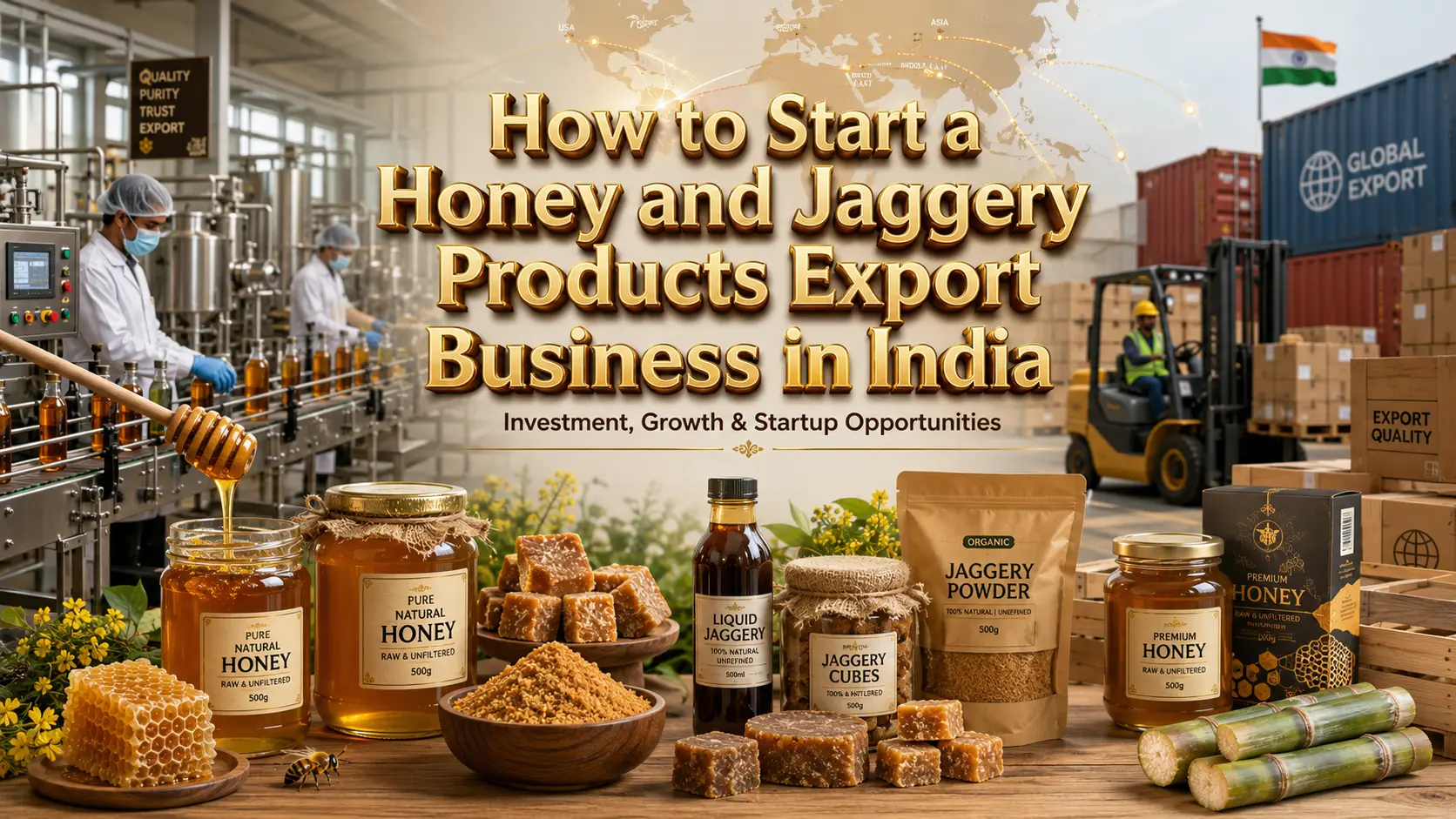
Honey and Jaggery Export Business
The global natural sweeteners market is undergoing one of the most dramatic changes in food history, driven by today’s consumers who are turning their backs on refined sugar and artificial sweeteners in favour of natural, minimally processed sweeteners that have health benefits. In India, the honey and jaggery industry have been at the forefront of this global trend, generating two of the world’s most popular and desired natural sweeteners at economically viable prices and unique quality characteristics.
Honey and Jaggery seem to be an interesting business opportunity for those looking to venture into natural food export business: low investment requirement, high and growing demand in the global market, financial assistance from the APEDA and natural competitive advantage offered by natural foods in both these products in India. Investing in quality testing, organic certifications, and brand storyteling are all rewarded by the sector.
Read the Complete Book Here: The Complete Book on Beekeeping and Honey Processing
Why Honey and Jaggery Exports Are a Strong Natural Foods Opportunity
Honey is a special product in the international health food market: at the same time, it is a natural sweetener, a functional food with antimicrobial properties, and a top-quality culinary ingredient. Although India produces the second largest amount of honey in the world, its market in the premium market in the US, EU and Japan is constrained by quality issues and adulteration that has blemished the reputation of Indian honey. This reputation gap creates the business opportunity as entrepreneurs that can provide verifiably pure, quality-tested honey that is organic certified can access premium export markets, at prices of 3X to 5X higher than commodity honey exports.
A result of this, unrefined cane or palm sugar known as Jaggery, has gained phenomenal recognition in the world of health foods as a nutritionally better sugar that preserves the molasses content and even those minerals that are lost during the white sugar refining process. Indian jaggery exports have been growing rapidly to the USA, EU and Japan, both due to demand from the Indian community and the mainstream health food consumers. Value addition in jaggery (raw blocks to high quality jaggery powder or specialty products) presents an interesting business economics to the processing entrepreneur.
APEDA and Government Policy Framework
Honey and jaggery are under the scheduled product mandate of Agricultural and Processed Food Products Export Development Authority (APEDA). APEDA offers financial support for upgrading quality testing facilities, organic certification, packaging upgradation, and market promotion efforts. APEDA has also put in place a database of registered exporters of honey and jaggery for the discovery of the suppliers by the international buyers.
The National bee Board (NBB) is an organization under the Ministry of Agriculture that encourages beekeeping and honey production in India. NBB offers small and medium honey producers and exporters financial support for procurement of honey production equipment, extraction equipment and infrastructure.
APEDA Organic Certification, under National Programme for Organic Production (NPOP), is an internationally recognised infrastructure for organic certification, which will take Indian exporters of honey and jaggery to premium organic markets of US, EU and Japan.
The honey and jaggery product exports are eligible under DGFT RoDTEP Scheme and the specific packaging inputs used in export-oriented processing units are eligible under advance authorisation scheme.
Business Ideas in Honey and Jaggery Export
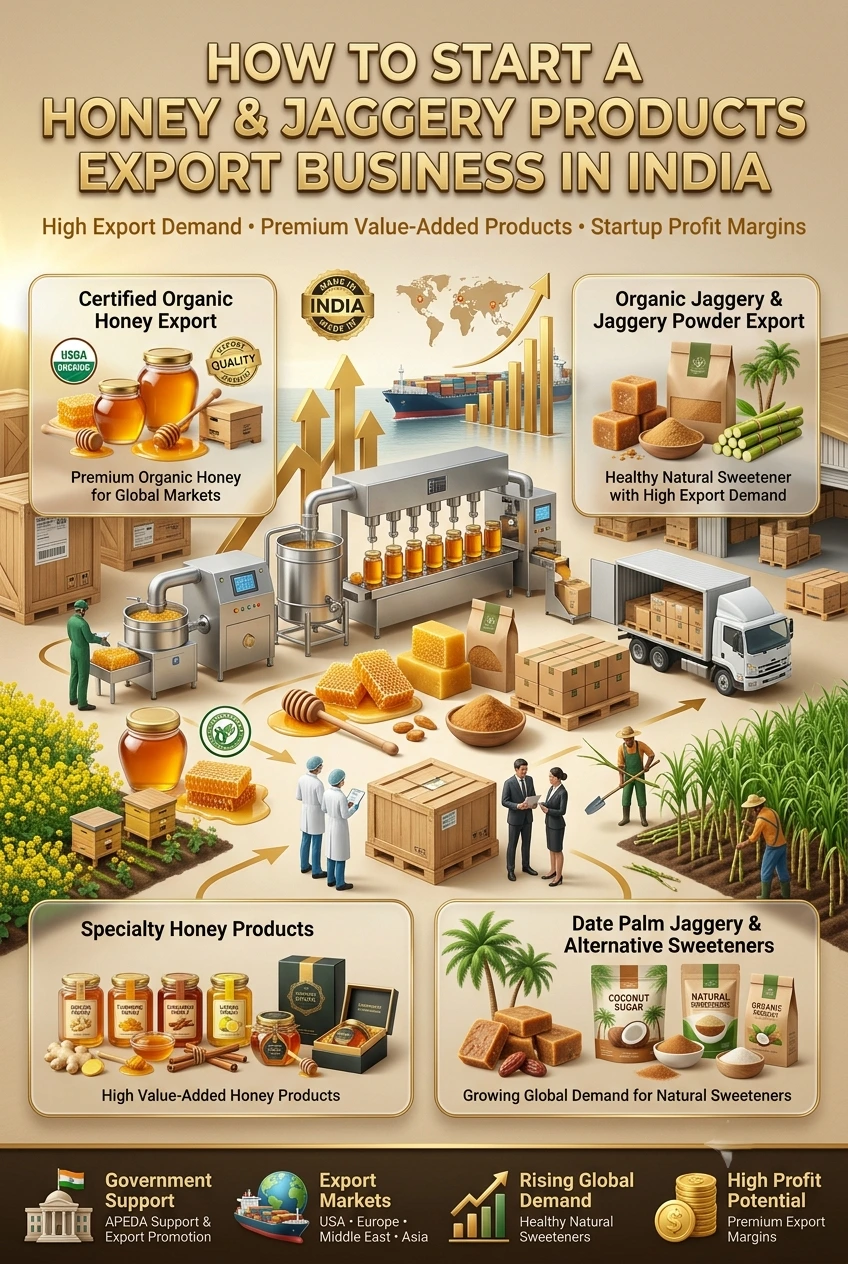
1. Certified Organic Honey Export
The premium organic honey, with different Indian origins (multi floral, Himalayan, Sidr, single origin botanical) fetches an extraordinary price in the health food markets of the US, EU and Japanese markets. While single origin and certified organic Indian honeys are premium products and have limited competition in the world market, commodity honeys from India are competing with Argentina and China. The investment cost of an organic honey processing unit (extraction, filtration, testing, bottling and packaging) is from ₹15 lakh to ₹50 lakh. Duties for compliance include NPOP organic certification and FDA facility registration with the U.S. Compliance is necessary for exports.
Himalayan raw honey collected from forest honey bees is in a special premium positioning in the global market today and is found to be priced ₹2,000 to ₹5,000 per kg unit in the health food stores in US and Europe.
2. Organic Jaggery and Jaggery Powder Export
The most export-friendly jaggery format – Organic jaggery powder – is witnessing a fantastic demand surge in the United States, the European Union and Australia from food manufacturers as well as health food enthusiasts. Organic Jaggery from Maharashtra (Kolhapur area) and from Rajasthan is world famous for its quality. An investment of ₹ 20 lakh to ₹ 60 lakh is sufficient to set up a power processing plant for jaggery powder comprising cane juice extraction/ dissolution of block jaggery, filtration, concentration, spray drying/ tray drying, sieving and packaging.
The basic compliance requirements are NPOP organic certification and FSSAI licensing. The retail price ranges of high quality/quality organic jaggery powder in US and EU health food stores are ₹500 to ₹1500 per kg — which is a strong premium over domestic wholesale price of jaggery, which is ₹40 to ₹80 per kg.
3. Specialty Honey Products — Infused and Value-Added
The niche for honey that is flavoured with spices of Indian origin (turmeric honey, ginger honey, cinnamon honey, black pepper honey) and for specialty formats such as creamed honey, raw honeycomb and honey-based wellness products offers high margin opportunity in the context of the export of honey. These products bring together the production base of honey in India with the heritage of the ingredients of the Ayurveda system and offer unique products throughout the world. The cost of investment in a specialty honey products unit is relatively low, ranging from ₹10 lakh to ₹30 lakh with a focus on mixing, filling, and packaging equipment.
The direct-to-consumer health-conscious users in the US, UK and EU who are willing to pay a premium price for the functional honey products are reached directly through e-commerce platforms such as Amazon, iHerb and wellness specialty retailers online.
Get Detailed Project Report (DPR): Honey Processing Plant Project Report
4. Date Palm Jaggery and Alternative Sweetener Exports
The date palm jaggery of West Bengal and coconut palm jaggery of Kerala and Tamil Nadu are some of the regional specialty sweeteners, which are in strong demand internationally, as an alternative to refined cane sugar. Jaggery products from palm trees also have unique Flavors, ranging from caramel to molasses to fruity, that foodies, food bloggers and artisan food producers in the US and EU are actively looking for. The investment for palm jaggery processing and export unit ranges from ₹10 lakh to ₹30 lakh. Compliance is with APEDA and FSSAI. Premium positioning on the basis of authentic regional provenance stories and organic certification fetches a price of ₹800 to ₹2,000 per kg in international specialty food channels.
Import-Export Opportunity Analysis
India’s honey and jaggery exports are growing from a strong base. The APEDA AgriExchange export statistics show honey and sugar cane products (including jaggery) as growing export categories. USA, UK, Germany, and UAE are the leading honey export destinations. Jaggery exports to US and EU are growing significantly as health food retail adoption increases.
The quality premium is the key commercial driver in both categories. Commodity honey from India competes on price alone and faces constant downward pressure. Premium organic, single-origin, and certified honey and jaggery products operate in a different market entirely — where provenance, purity, and certification are the primary purchase drivers and price sensitivity is low. The business decision of which tier to target determines both investment requirements and margin potential.
Related Article: Building a Profitable Medicated Honey Brand: Manufacturing, Positioning, and Market Entry Strategy
Indian MSME Success Stories in Honey and Jaggery Exports
At Apis India Limited, Karnal, we created one of India’s largest honey export businesses through a consistent investment in quality testing, organic certification and compliance with European Union regulations – from a small domestic honey aggregation company to a major exporter of EU certified honey. The evolution of our quality investment – including understanding the EU pesticide MRL compliance, creating traceable supply chains back to individual beekeepers – showcases the potential of investing in honey export regulatory compliance to unlocking access to the premium export markets.
Conscious Food, a Mumbai-based organic food company, built significant organic jaggery export revenue in US and EU health food markets by focusing on certified organic sourcing, minimal processing, and authentic product storytelling. Their brand narrative — connecting US health food consumers to Indian organic jaggery farmers — created a buyer loyalty that commodity jaggery suppliers cannot access.
Several Maharashtra-based jaggery cooperatives have built direct export relationships with UK and US specialty food importers by providing organic certified jaggery powder at consistent quality — demonstrating that collective farmer-producer organisation models can achieve export scale in specialty sweetener categories that individual small processors cannot reach alone.
Discover business ideas that actually make money
How NPCS Supports Honey and Jaggery Export Business Planning
We at Niir Project Consultancy Services (NPCS) provide professional consulting for the preparation of Market Survey cum Detailed Techno-Economic Feasibility Reports (DPRs) for setting up new honey and jaggery products processing and export businesses. Our reports include processing technology selection, organic certification pathway guidance, APEDA registration and financial assistance mapping, market research and export demand analysis, and complete project financials with profitability projections.
Honey and Jaggery Export Business: Key Data Overview
| Product Category | Investment Range | Key Certification | Target Markets | Typical Margin |
| Organic Honey (Multi-floral) | ₹15L – ₹50L | NPOP Organic + FSSAI | US, EU, Japan | 40–80% |
| Single-Origin Raw Honey | ₹15L – ₹40L | NPOP + FDA Reg (US) | US, UK, Germany | 50–100% |
| Organic Jaggery Powder | ₹20L – ₹60L | NPOP Organic + FSSAI | US, EU, Australia | 60–120% |
| Specialty Infused Honey | ₹10L – ₹30L | FSSAI + APEDA | US, UK, Gulf | 60–120% |
| Palm Jaggery (Date/Coconut) | ₹10L – ₹30L | APEDA + FSSAI | US, EU, Australia | 50–100% |
Frequently Asked Questions (FAQ)
1. What quality testing is required for honey exports to the EU?
Imports of honey into the EU need to meet specific maximum residues levels (MRLs) of veterinary drugs residues (particularly antibiotics e.g. Chloramphenicol and tetracyclines), pesticides residues and heavy metals. The EU regulators regularly check Indian honey for these contaminants. In order to access to the EU markets, investing in laboratory tests through an NABL-accredited lab on every shipment is highly necessary.
2. What is the NPOP certification process for organic honey?
Honey must be NPOP (National Programme for Organic Production) certified, and for this, the beekeeping operation, its forage and harvesting sites, as well as processing plant, all must have the required certifications. After a successful inspection by the certification agency, an NPOP certificate is provided. The conversion time period required to organic beekeeping operation is about one year.
3. Can jaggery be exported without APEDA registration?
APEDA-registered products require this registration before any commercial export can occur. Registration ensures export under specific APEDA financial support plans and schemes and offers various advantages in market development. Exporters without APEDA registration do not receive the same support and are at a disadvantage when it comes to the legal implications of exports.
4. What is the difference between raw honey and processed honey for export?
Raw honey, unheated or filtered to any extent, retains its beneficial enzymes, pollen and antimicrobial factors. Processed honey is commonly heated and/or strained to clarify its appearance (by removing pollen). Raw honey carries substantial price premiums in health food stores. Processed honey goes for commodity food ingredient pricing.
5. How important is pollen analysis for premium honey exports?
Pollen analysis — identifying the botanical and geographic origin of honey through its pollen content — is required for premium single-origin honey certification and is used by EU food authorities to verify origin claims. For premium Himalayan or specific botanical variety honey, authentic pollen profiles verified by accredited laboratories are the credibility foundation for premium pricing.
6. What packaging formats work best for honey exports?
Premium honey targeting the US and EU health food retail segment will mostly come in glass jars of 250g, 500g, or 1kg. Food-grade squeeze bottles may be offered for the more convenience-oriented product. Bulk honey for food industry buyers is exported in food-grade HDPE drums or IBC containers. Investment in premium glass packaging with brand labelling is essential for retail channel access; drum packaging serves institutional food ingredient buyers.
Conclusion
Honey and jaggery export represent one of India’s most natural and distinctive business ideas in the global health food economy — products with authentic Indian heritage, scientifically validated health benefits, and growing global consumer demand that no synthetic competitor can address. The investment threshold is low relative to other export categories, APEDA’s financial assistance reduces compliance costs, and the margin profile — particularly for certified organic, single-origin, and value-added products — is exceptional. Entrepreneurs who invest in organic certification, quality testing, authentic sourcing, and premium packaging will find honey and jaggery to be among the most rewarding natural food export businesses available in India today.


