





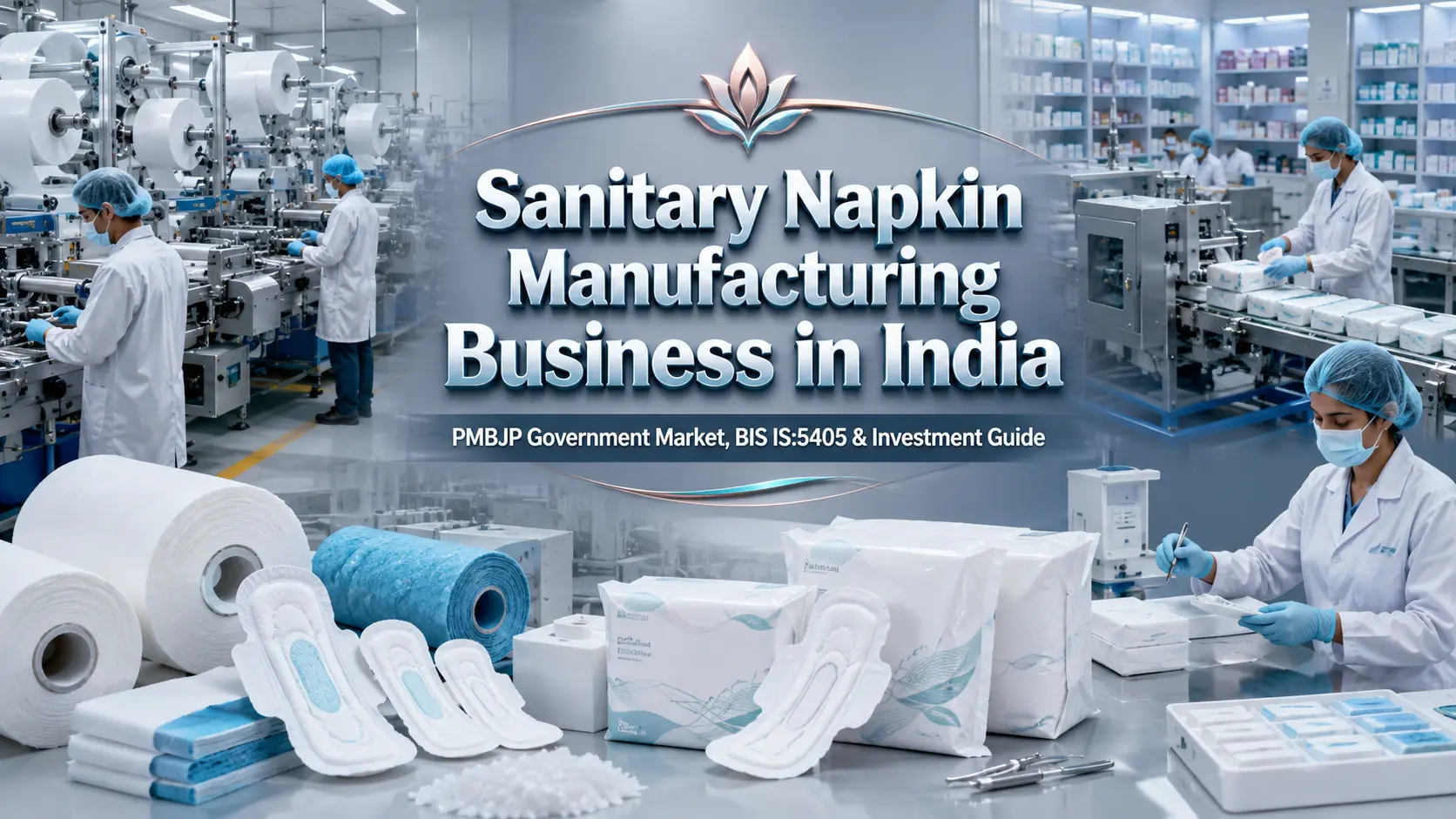
Sanitary Napkin Manufacturing Business
A consumer healthcare product, Sanitary Napkins is one of the most impactful products in India, with 355 million women of menstruating age, and a penetration of only 36-40 percent in rural areas (India’s sanitary napkin market is growing at 20+ percent annually as awareness, affordability and PMBJP government distribution bring formalisation to menstrual hygiene management in India’s rural and semi-urban population). The size of this market is projected to reach Rs 3,500-4,000 crore and is one of the most structurally attractive consumer healthcare manufacturing opportunities available in India.
The PIB: National Family Health Survey-5 Data (NFHS-5) indicates that access to menstrual hygiene products has grown in urban India, and there is a significant opportunity for market penetration in rural India.
Get Detailed Insights from This Book: Disposable Products Manufacturing Handbook
Market Opportunity: Why This Business Cannot Be Ignored
The problem of unsafe menstrual hygiene materials in India is well known: more than 200 million women in rural India are yet to use safe menstrual hygiene materials. PMBJP sells subsidised sanitary napkins (Suvidha brand) at a subsidised price of Rs 1 per pad through Jan Aushadhi stores across the country and provides a government procurement channel for the domestic sanitary napkin manufacturers, who can sell at competitive rates to PMBJP, in the process creating brand awareness among the rural female population of India.
The problem of Wikipedia: Menstrual Hygiene Management in India has been identified as one of the most notable public health challenges in India and the availability of affordable sanitary napkins has a direct link with the education of women and their participation in the labour force. The research published in NCBI: Menstrual Hygiene and School Attendance Study (MHS) proves that access to sanitary napkins has a direct relationship with the attendance rate of adolescent girls in rural India, showing the social impact of the manufacturing business.
Sanitary napkin institutional supply and large-format retail procurement must be done through BIS IS:5405. The requirements of absorbency, rewet, skin sensitisation, freedom from colour bleeding and dimensional consistency are defined by Bureau of Indian Standards (BIS) IS:5405. BIS IS:5405 certified manufacturers have access to the largest institutional buyer channels – PMBJP Government procurement, Pharmacy Chain (Private Label) and Large Retail (Reliance, Big Bazaar, DMart). According to the IBEF: India FMCG and Consumer Health Sector, India’s sanitary napkin and feminine hygiene category is one of the fastest growing FMCG sub-segments in the country with a long-term structural demand because of the penetration in rural areas.
Industry Analysis: Growth Drivers and Demand Outlook
The Indian sanitary napkin market is valued at Rs 3,500-4,000 crore and is growing by 15-20 per cent per year. The FICCI’s Women’s Healthcare Report predicts the addressable market for affordable sanitary napkins in the rural segment will grow to triple by 2030 as the rural market is driven from 36 percent towards the government’s goal of universal access, making it one of the most demand-proven businesses in India’s consumer healthcare market. According to the WHO Menstrual Hygiene Programme Guidance, access to sanitary napkins that are affordable should be viewed as a basic women’s health right and a priority public health investment for developing countries.
The PMBJP government distribution channel is exclusively available for domestic manufacturers who are capable of meeting the quality specifications. For rural women entrepreneurs desiring to start up their micro and small-scale sanitary napkins production for supplying rural community sanitary napkins to the government health programmes with support from KVIC (Khadi and Village Industries Commission) and SHG (Self Help Group) programmes. Under the Ministry of Women and Child Development, women entrepreneurship in production of sanitary napkins is promoted through skill development programmes and enterprise support to women groups based on SHG under NRLM.
India Sanitary Napkin Market Snapshot
| Parameter | Market Data | Notes |
| India Market Value | Rs 3,500 – 4,000 crore per year | Industry estimates |
| Market Growth Rate | 15-20% CAGR | Rural penetration expansion |
| Current Rural Penetration Rate | 36-40% (menstruating women) | Large untapped market |
| BIS Standard | IS:5405 (Sanitary Napkins) | Mandatory for institutional supply |
| PMBJP Subsidised Napkin Price | Rs 1 per pad at Jan Aushadhi outlets | Government scheme supply price |
| Core Technical Component | SAP (Superabsorbent Polymer) core | Same as adult diaper technology |
| Market Leaders | Stayfree (Kimberly-Clark), Whisper (P&G), Sofy | Domestic brands growing |
Get Detailed Project Report (DPR): Sanitary Napkins and Feminine Hygiene Products
How to Start: Step-by-Step Guide for Entrepreneurs
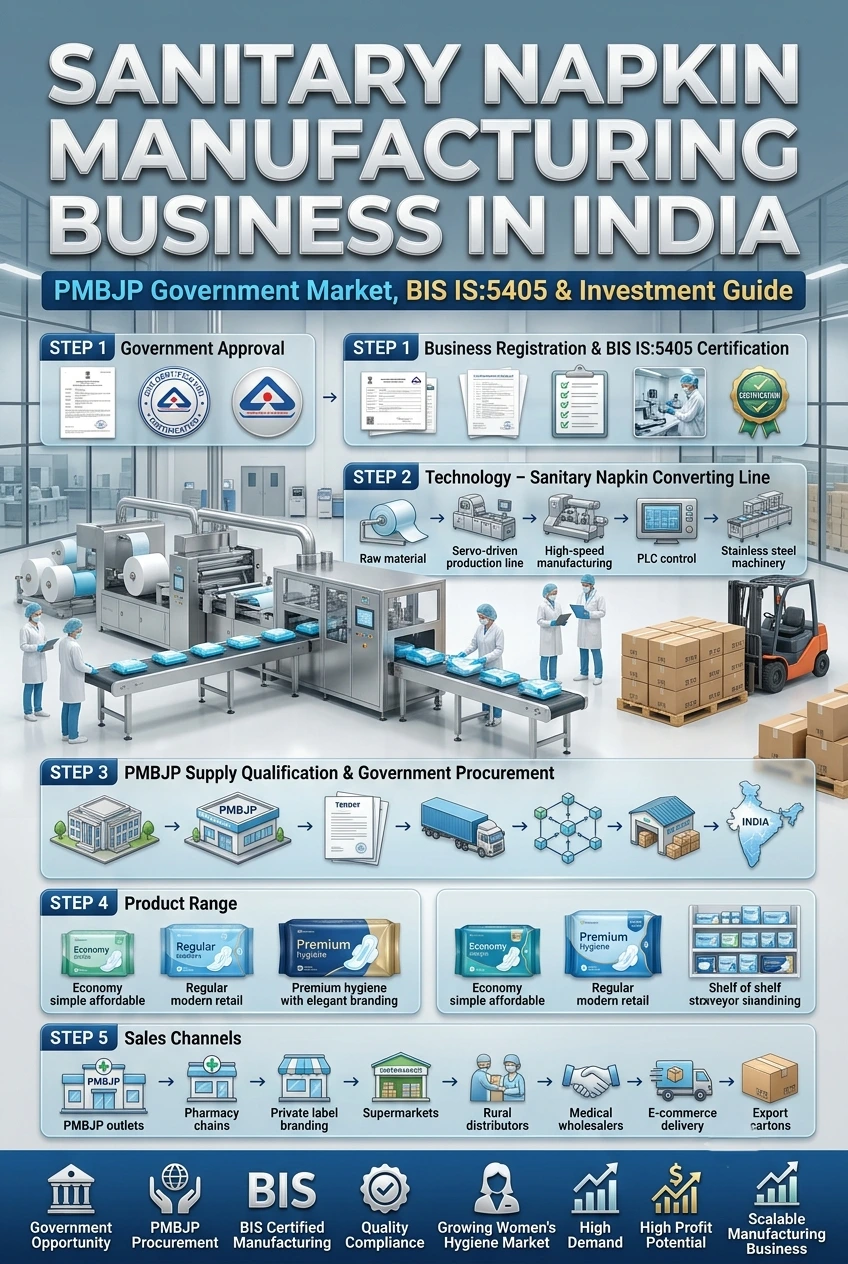
Step 1: Business Registration and BIS IS:5405 Certification
Register entity and get Udyam MSME registration, factory licence, GST. Get BIS IS:5405 (Sanitary Napkin) certified – compulsory for PMBJP government supply, private label by pharmacy chains, large retail procurement. The absorbency under pressure, rewet, length and width dimensional tolerance and the absence of skin-irritating substances are specified in IS:5405.
Step 2: Technology: Sanitary Napkin Converting Line
The Sanitary napkin production involves a converting machine which incorporates fluff pulp (or SAP) formation, top sheet (nonfeed or peeled PE film) application, backsheet (PE film with release paper) bonding, application of silicone release paper strip, application of side adhesive for attaching to underwear, individual wing folding (for winged napkins) and individual wrapping. The machines which are available in the market at Rs 40-80 lakh are capable of producing 200-400 pads per minute.
Step 3: PMBJP Supply Qualification and Government Procurement
Contact PMBJP’s implementing body, Bureau of Pharma PSUs of India (BPPI) with your BIS IS:5405 certificate, product specification compliance certificates and pricing proposal to implement the PMBJP’s programme named Suvidha napkin. PMBJP procurements are tendered on a regular basis and having a status of approved BPPI supplier ensures a secured institutional volume at low marketing cost.
Step 4: Product Range: Economy, Regular, and Premium Variants
economy napkins (non-SAP, ultra-thin core) will support Rs 1-3 per pad retail value in PMBJP and rural market. Regular napkins (SAP core, 4-5 hours protection) are sold at Rs 5-8 per pad in retail in the pharmacy and supermarket. Organised urban retail requires premium overnight napkins (higher SAP) at Rs 12-25 per pad. There are specific raw material, machine setup and channel specifications for each tier.
Step 5: Sales: PMBJP, Pharmacy Private Label, and Rural Distribution
For government supply, the PMBJ must be approved by BPPI. Urban institutional volume comes from chain private label (Apollo, MedPlus). The most effective last mile distribution channel for moving to the rural market is the rural SHG (Self-Help Group) distribution system. E-commerce (Amazon, Flipkart, Meesho) makes the multi-channel distribution model complete for the Urban and Semi Urban Digital Buyers.
Find the most profitable startup for your investment range
Project Investment Breakdown
| Cost Item | Estimated Amount (INR) | Notes |
| Sanitary napkin converting machine (200-400 ppm) | Rs 40 – 80 lakhs | Core production equipment |
| Factory space (5,000 sq ft) | Rs 5 – 10 lakhs per year | Industrial estate preferred |
| SAP (if SAP-core napkins) | Rs 8 – 15 lakhs per month stock | Superabsorbent polymer |
| Nonwoven topsheet and PE backsheet (1 month) | Rs 10 – 18 lakhs | Raw material stock |
| Individual wrapping and carton packing line | Rs 5 – 10 lakhs | Individual and bulk packing |
| BIS IS:5405 certification and QC lab | Rs 3 – 6 lakhs | Mandatory certification |
| MSME registration and factory licence | Rs 1 – 2 lakhs | Business setup |
| Working capital (3 months) | Rs 20 – 35 lakhs | Salaries and distribution |
| TOTAL PROJECT COST | Rs 92 – 176 lakhs | Scale to Rs 3Cr+ for premium line |
Financial Projections and Profitability
A sanitary napkin unit producing 500,000 pads per day can generate annual revenues of Rs 8-18 crore depending on product tier and channel mix. FICCI’s Women’s Healthcare Market Report notes that domestic sanitary napkin manufacturers who combine PMBJP government supply with pharmacy chain private label achieve net margins of 18-28 percent — significantly above the margins achievable by single-channel government-only suppliers due to the price premium in pharmacy retail versus PMBJP tender pricing.
The market’s extraordinary scale — 355 million potential users growing at 3 million additional users annually as adolescent girls age into the market — creates demand visibility unmatched in virtually any other consumer healthcare category. Invest India’s consumer health sector analysis confirms India’s sanitary napkin market among the top 5 global expansion markets by absolute user growth over the next decade.
Related Article: Guide to Launch Profitable & Purpose-Driven Sanitary Napkin Manufacturing Unit
Government Schemes and Incentives for Medical Manufacturers
| Government Scheme or Programme | Key Benefit | Applicability |
| PMBJP – Pradhan Mantri Jan Aushadhi Yojana | Guaranteed institutional procurement at scale through Jan Aushadhi outlets | BPPI-approved manufacturers |
| PMEGP (MSME Ministry) | 25-35% capital subsidy for new manufacturing units | New micro and small manufacturers |
| CGTMSE (SIDBI) | Collateral-free loan up to Rs 5 crore | MSME sanitary napkin manufacturers |
| KVIC/Gramodyog SHG Scheme | Rural women entrepreneur sanitary napkin units | SHG-based production models |
| State MSME Capital Subsidy | 15-25% subsidy on plant and machinery | State-notified MSME units |
| National Rural Livelihood Mission | SHG micro enterprise support for rural production | Rural women’s SHG enterprises |
Entrepreneur Spotlight
Meenakshi Sundaram | Madurai, Tamil Nadu
Meenakshi Sundaram, a social entrepreneur from Madurai, established a sanitary napkin manufacturing unit in Madurai’s SIDCO industrial estate with Rs 1.05 crore investment in a Chinese converting machine and BIS IS:5405 certification support. Her business model specifically revolves around PMBJP supply qualification and the building of a network to distribute within the rural SHGs and the rural districts of Tamil Nadu.
The year two saw BPPI PMBJP supplier approval and Meenakshi supplies 3 lakh pads a day to the Suvidha economy napkin programme and one pharmacy chain private label. Annual revenues stand at Rs 6.8 crore with 24 percent margins. She employs 45 women workers and has trained 120 rural SHG members as distribution agents.
How NPCS Supports Your Business Launch
Niir Project Consultancy Services (NPCS) has prepared over 8,000 Detailed Project Reports (DPRs) across industrial sectors including medical devices and hospital disposables over 45 years. In the manufacturing of Sanitary napkin and Menstrual hygiene product NPCS provides a detailed DPR with: Plant layout Machinery specifications with supplier names Raw material successor license and approval Process of manufacturing Financials of the plant and bank loanability DPR.
Entrepreneurs who commission a NPCS DPR receive guidance on government scheme applications, export registrations, and quality certification roadmaps customised to their state and scale. Visit niir.org to explore project reports for this sector, or browse Entrepreneur India magazine at entrepreneurindia.co for sector case studies and investment analysis.
Key Reference Links and Further Reading
Bureau of Indian Standards – IS:5405 Sanitary Napkin: https://www.bis.gov.in
KVIC – Khadi and Village Industries Commission: https://www.kviconline.gov.in
FICCI – Women’s Healthcare Committee: https://ficci.in
Invest India – Consumer Healthcare Sector: https://www.investindia.gov.in
MSME Ministry India – PMEGP Scheme: https://msme.gov.in
Frequently Asked Questions
Q: What government scheme supports sanitary napkin distribution in India?
The Pradhan Mantri Bhartiya Janaushadhi Pariyojana (PMBJP) distributes subsidised Suvidha sanitary napkins at Rs 1 per pad through its network of Jan Aushadhi Kendras nationwide. Bureau of Pharma PSUs of India (BPPI) procures these. Manufacturers certified with BIS IS:5405 are invited to apply as approved BPPI vendors for this Govt Institutional Procurement programm.
Q: What BIS certification is required for sanitary napkin manufacturing?
BIS IS:5405 (Sanitary Napkins, Specification) mandatory standard. The Indian Standards specifications include standards for pressure absorption capacity, re-wet value, pH of absorbed liquid, absence of harmful colours and finishes, dimension tolerances for width and length, and packaging standards. BIS IS:5405 certification is mandatory for supplying to PMBJP as well as for institutional purchases made by pharmacy chains and bulk retail customers.
Q: What is the difference between economy and premium sanitary napkins?
These economic ones were targeted towards PMBJP/Rural retail and sold between Rs 1-3 per pad, made of fluff pulp only and had some width and the pad only offered 2-3 hrs of protection. Then there were normal ones to be sold at pharma retail of Rs 5-8 with a SAP pad giving 4-5 hrs. Premium overnight napkins (Rs 12-25 per pad) use higher SAP concentration, are extra-long (340-400mm), and may include wings for leak protection.
Q: Can a woman entrepreneur or SHG start a sanitary napkin unit?
Yes, and this is strongly encouraged by government programmes. KVIC supports women SHG-based sanitary napkin production with micro enterprise training and subsidised equipment. Several state governments and NRLM (National Rural Livelihood Mission) provide specific support for rural women sanitary napkin enterprises. Even a 5-person SHG can set up a small manual or semi-mechanised napkin unit for rural local market supply.
Q: What is the production capacity of a standard napkin converting machine?
Entry-level sanitary napkin converting machines (Rs 40-80 lakh from Chinese suppliers) produce 200-400 napkins per minute, equivalent to 2-4 lakh pieces per 8-hour shift. At 8 hours per day, two shifts produce 4-8 lakh pieces daily — sufficient to generate Rs 2-3 crore annual revenue at economy pricing or Rs 4-6 crore at pharmacy retail pricing.
Q: How can NPCS help plan a sanitary napkin manufacturing business?
NPCS prepares Detailed Project Reports for sanitary napkin manufacturers covering converting machine selection, SAP and nonwoven sourcing, BIS IS:5405 certification roadmap, PMBJP supply qualification process, SHG distribution strategy, and complete financial projections for various scales. Visit niir.org for project report details.
Conclusion
Sanitary napkin manufacturing is simultaneously a social mission and a commercially compelling business, driven by India’s large unaddressed menstrual hygiene gap and PMBJP’s government distribution programme that provides guaranteed institutional procurement volume for approved suppliers. BIS IS:5405 certification is the key quality credential that opens government, pharmacy chain, and large retail buyer channels.
Commission a Detailed Project Report from NPCS to plan your converting machine investment, PMBJP qualification process, and multi-channel distribution strategy including rural SHG networks. Ensure your BIS IS:5405 certification application is submitted early in your production timeline to avoid delays in institutional channel qualification.


