





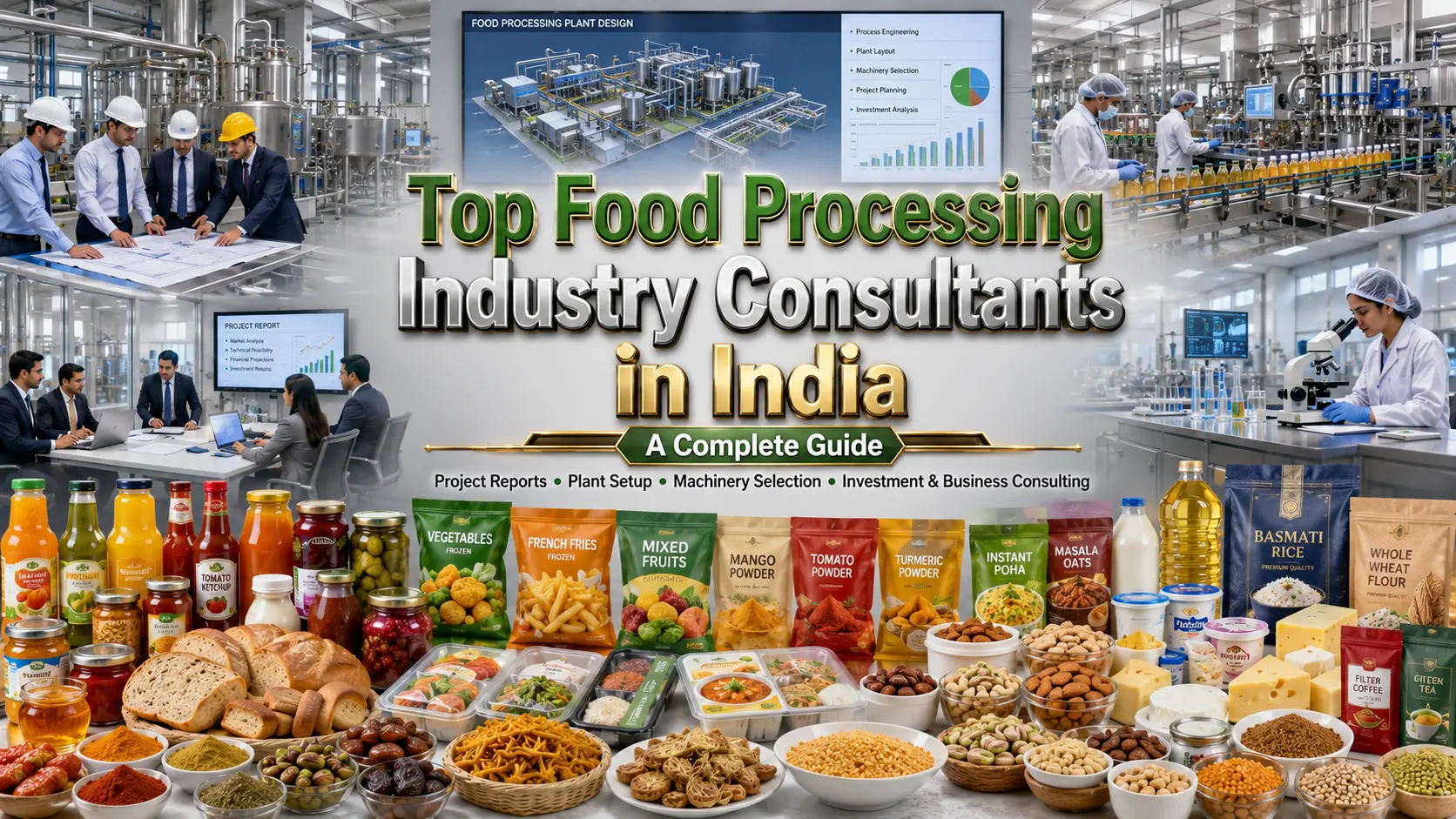
The food processing industry in India is transforming from a unorganized and fragmented industry base to a organised and investment-worthy industry. This change is what has made food processing industry consultants in India so integral in setting up new projects. Today’s entrepreneurs are not simply building out a small business, they are bidding for investor capital and international business orders, as well as displaying products in retail stores that require professional planning from the outset.
A first-generation entrepreneur with a good product idea will have trouble with selecting the machinery, sizing the capacity, or bank documentation. This is where a specialist consultant steps in and brings an idea to a bankable, compliant plant. Besides, the markets have seen an increasing demand for structured project reports which are being pushed by schemes like PM Kisan Sampada Yojana and PLI for food processing into the sector.
This article explains what these business advisors do, why India has become a veritable land of these kinds of advisors, and offers a few tips on the parts an entrepreneur must consider to shortlist the right advisor for a food processing project.
Read the Complete Book Here: Handbook on Fruits, Vegetables & Food Processing with Canning & Preservation
What Food Processing Plant and Process Consultants Actually Do
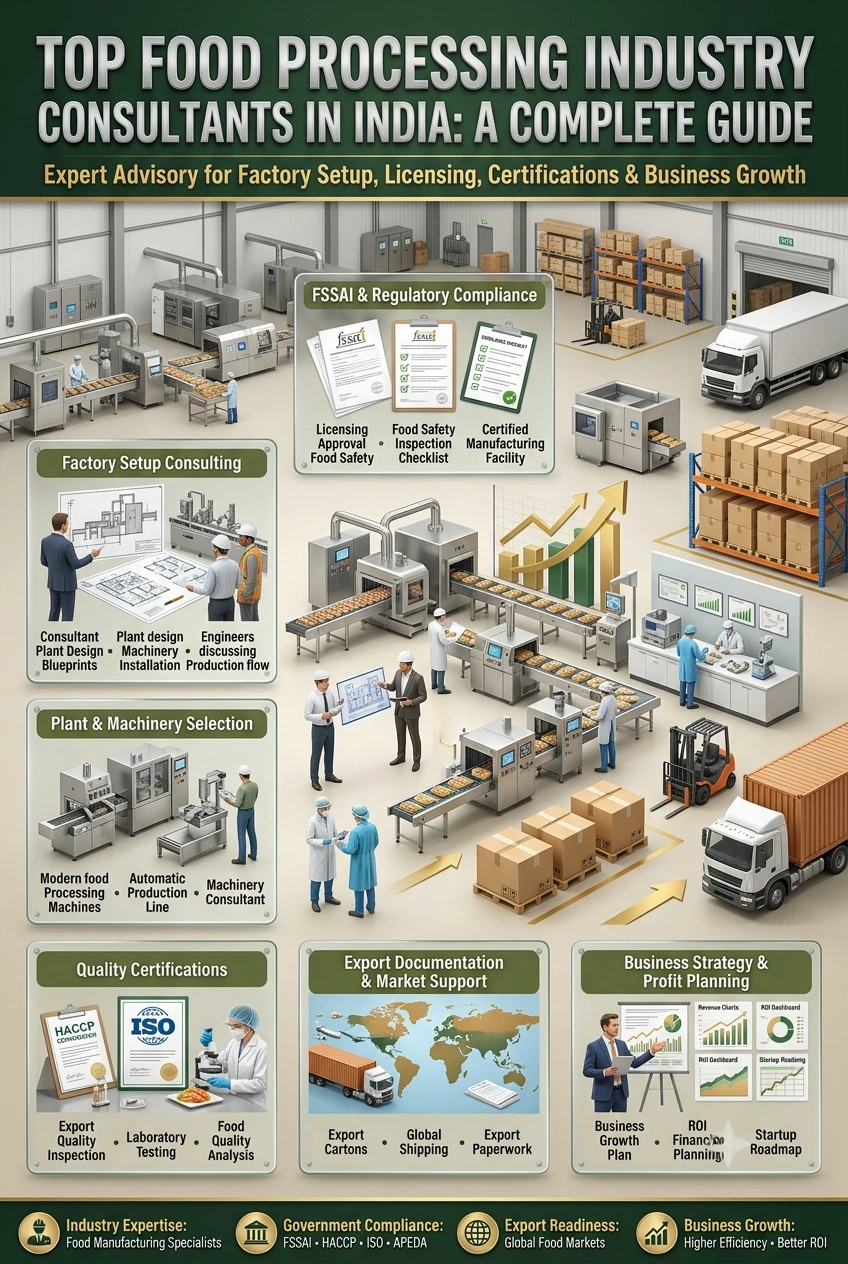
The work of a food processing consultant begins much before the order for the first machine is given. The first step is a feasibility assessment: the proposed capacity, product mix and location are checked for the financial viability of the project, based on supply of raw materials and market demand. Therefore, this stage is critical for determining if the rest of the project should be undertaken.
The next step in the process is to prepare a detailed Project Report, which is arguably the most critical document in the entire process. A DPR includes a description of the manufacturing process, specification for the machinery and raw materials, the project’s cost, the source of the funds and the expected profits to be made. This document is a critical document for the banks and financial institutions to sanction the term loans under MSME or PMEGP.
In addition to documentation, many consultants can assist with process engineering and plant layout — determining the best layout of the raw material intake, processing lines, packaging and cold storage areas for efficient raw material flow. However, for larger projects EPC (Engineering, Procurement, and Construction) support may take place so in this case, the consultant or the associated company manages every machinery procurement and installation process.
All of this happens in compliance work alongside. All food units in India must also have a licence from FSSAI and depending on the type of the product they sell, they may also require a license from the State Pollution Control Board and must be registered under the Factories Act. A consultant who is well aware of this regulatory environment can help the entrepreneurs save from the time-consuming delays after the plant has been constructed, as well as the associated costs.
Why India Has Become a Hotspot for Food Processing Consulting
Unlike many manufacturing industries, food processing has structural advantages from its raw material base ranging from fruits and vegetables to dairy, grains, marine-based and many others. But the raw material advantage has to be turned into finished products for export—an area requiring technical and financial planning skills that has generated consistent demand for consulting services.
This trend has been accentuated by government push. Schemes under the Ministry of Food Processing Industries (MoFPI) include formalisation of micro food business enterprises, mega food parks and cold chain infrastructure, and production linked incentive schemes have attracted bigger players to establish new capacity. Import substitution in such sectors as processed fruit pulp, ready-to-eat meals and specialty ingredients is also creating space for new local producers.
Export potential is an additional factor. Agencies like APEDA actively promote and assist agri-food exporters and consultants with knowledge of export documentation and quality certification are becoming even more useful for units aiming to market their products overseas than home sales.
The Indian food and agro-processing industry has developed a niche for boutique management consulting firms, a niche that is unique compared with other industries in India, which can be attributed to the three factors: the strength of the raw material, policy support and the rising demand for food and consumables.
Get Detailed Project Report (DPR): Food Processing and Agriculture Based Projects
How to Evaluate and Shortlist the Best Food Processing Industry Consultants in India
Domain expertise should be the first filter. A food-processing DPR specialist, not a generalist consultancy company, will know more about shelf-life limitations, cold chain economics and price fluctuations of raw materials, depending on the season. Request samples of their projects by industry and not just a company portfolio.
Experience with feasibility and DPR work is also important. A consultant who has had the benefit of actual loans from banks will have a higher level of credibility than one who is just writing reports when it is required. It’s a good question to pose outright about how many of their reports were used successfully for loan applications.
When the project gets beyond the paperwork, engineering/EPC capability plays a role. A consultant who has in-house or partnered engineering support will be able to take a client from concept to commissioning, instead of passing the engineering implementation off to someone outside of the client’s sphere of influence mid-project.
Knowledge of the regulatory arena is essential in this industry. A technically good project can go astray just because the consultants are not well versed in FSSAI norms, Pollution Control Board clearances and the obligations under the Factory Act.
Lastly, client base and references will let you know how the firm works in the real world. A consultancy with a broad client base throughout the country across various industries is likely to have the experience to deal with the regional differences in raw material and regulations that are found in this sector.
Choose the right startup backed by real market demand
Role of NPCS in Food Processing Project Consultancy
Established in 1994, Niir Project Consultancy Services (NPCS), a Delhi based industrial consultancy, is one way in which a well-established Indian organisation helps in this process. NPCS can prepare Detailed Project Reports and techno-economic feasibility studies for food processing and allied agro-based projects for different projects including the description of the manufacturing process, raw material procurement, market survey and demand analysis, the process flow diagram, product mix planning and full financials of the project along with profitability analysis.
During more than 30 years of consulting experience, the firm has achieved a proven track record in 85 countries, including more than 150,000 project reports over the past 10 years, with a strong focus on agro-industrial and food manufacturing projects. This type of cumulative multi-sector experience can prove valuable in recognizing real-life challenges, such as mismatched machinery, incorrect capacity estimates, regulatory gaps, and more, that a single-sector advisory company may not notice.
If you are planning to pursue several projects in food processing and agri-based manufacturing under the food sector, you can check out NPCS’s project profiles dedicated catalog that includes techno-economic reports for various food products such as snack foods, frozen foods, agro-processing, instant food, spices and grain milling: Food Processing and Agriculture Based Project Profiles. This type of catalog is helpful less as a final comprehensive resource and more as a first reference guide to compare the capacity and cost options for a project, before preferably selecting one of them.
Best Food Processing Industry Consultants in Delhi and the Broader India Consultancy Landscape
Delhi has emerged as one of the biggest centres of food processing consultancy in India not only because of its proximity to the policy-making institutions viz. Ministry of Food Processing Industries, FSSAI, various trade bodies, but also because of the concentration of industry. The city and its surroundings in the NCR belt are home to many of the established DPR and feasibility players as well as process engineering specialists.
Outside of these five cities, there are regional concentrations of food-tech and process engineering consultants, often related to regional strengths—such as the dairy industry in Gujarat, seafood processing on the western and eastern coasts. But this isn’t everything that entrepreneurs should consider; sector depth and documentation are normally more important than just being physically close to the consultant’s office.
However, when you need to coordinate often with the central ministries, bank head offices or national level scheme applications, then dealing with an India consultancy firm in Delhi can be really convenient.
Related Article: PROJECT REPORT FOR FOOD PROCESSING UNIT Cost, Machinery & ROI — A Complete Entrepreneur’s Guide
Food Processing Consulting Services Compared
The table below outlines the differences in focus and the typical output of the key classes of food processing plant consultants, which can assist the entrepreneur in selecting the right class of consultant for their project development stage.
| Consulting Service Type | Core Focus | Typical Deliverables | Best-Fit Client |
| Feasibility & DPR Consultants | Techno-economic viability, project cost, and profitability assessment | Detailed Project Report, financial model, bank-ready proposal | First-time entrepreneurs, MSME loan applicants |
| Process & Plant Consultants | Machinery selection, process flow, plant layout design | Process flow diagrams, layout drawings, capacity planning | Units scaling capacity or adding product lines |
| EPC Consultants | Engineering, procurement, and construction execution | Turnkey plant commissioning, vendor coordination | Mid to large-scale greenfield food processing units |
| Regulatory & Compliance Consultants | FSSAI licensing, BIS certification, pollution clearances | License applications, HACCP/ISO documentation | Units preparing for commercial launch or export |
| Market Research Consultants | Demand analysis, competitor mapping, export potential | Market study reports, pricing strategy notes | Entrepreneurs entering a new product category |
Frequently Asked Questions
What is the cost of DPR for food processing plant in India?
The amount of work involved in the financial modelling needed, product complexity, and the size of the project all influence the cost of the DPR. The basic report for a small-scale unit will cost less than a comprehensive report for a multi-product, export-oriented plant as a comprehensive report requires more in-depth market research and engineering inputs. When it comes to capacity and scope, it’s best to take a direct quote instead of a fixed one from the industry.
What is the difference between a process consultant and an EPC consultant?
A process consultant is a person who is geared towards the design of the manufacturing process, plant layout and specification of machinery on paper. An EPC consultant takes it one step further, by also being responsible for the equipment to be procured and the construction and commissioning works to be carried out. Many entrepreneurs opt to engage a process consultant first and then the engineering arm of the same company or another EPC partner for execution.
What is the way to select the best food processing plant consultant India?
Please examine the consultant’s history of work specifically in the sector, request examples of DPRs they have created and check if previous reports have been successful in attracting bank funding. Regulatory knowledge of FSSAI and State Level clearance is expected to be a standard ‘filter’ and gaps will only be identified when the plant is already in operation.
When do I need an FSSAI licence – before or after I start building?
Some approvals and site related clearances are preferable to be sorted out prior to construction as plant layout and effluent handling may impact the licensing process later on. Registration or licensing by FSSAI is usually done nearer to the commissioning of the unit, but by involving the compliance process early in the life of the project, there is no rework.
Is there a consultant available to assist with food processing projects both domestically and internationally?
Yes, but it’s a different kind of work. For export-oriented projects, there should be extra inputs, including quality certification, packaging standards, documentation in line with APEDA and destination country requirements; it is best to ensure that a consultant has experience in export projects than to assume general manufacturing experience.
What type(s) of support can a consultant offer post-DPR?
Most consultants provide ongoing services for loan follow-up and machinery vendor coordination and regulatory filing after the report is filed. This scope should be explained at the start, as some companies view the DPR as a one-off product, whereas others continue to work with the company post commissioning.
Conclusion
Setting up a food processing unit in India today involves far more than buying machinery and renting a shed. Between bank documentation, FSSAI compliance, and increasingly competitive product markets, the entrepreneurs who succeed are usually the ones who invest early in proper feasibility work and a credible Detailed Project Report.
For anyone starting this process, the practical next step is to shortlist two or three consultants with genuine food processing experience, request sample reports, and have a direct conversation about capacity assumptions and compliance timelines before signing on. A well-prepared DPR does not just help secure a loan; it also becomes the operational blueprint the entrepreneur will actually follow once the plant is running.
Reference Links
Ministry of Food Processing Industries (MoFPI)
Food Safety and Standards Authority of India (FSSAI)
Agricultural and Processed Food Products Export Development Authority (APEDA)
India Brand Equity Foundation (IBEF) — Food Processing
Invest India — Food Processing Sector
All India Food Processors’ Association (AIFPA)
Assumption notes: FSSAI has been treated as the primary sector regulator with the Ministry of Food Processing Industries as the relevant government body, since food processing sits under both; the technical keyword used is Food Technology. All reference links were verified as live at the time of drafting.


