





Manufacturing Business Ideas in Jharkhand
Why Jharkhand Is Becoming India’s Next Industrial Powerhouse
Jharkhand has been quietly preparing itself for a position of strength to attract big-scale industrial investment. The state has an abundance of almost 40% mineral reserves in India. It contains the world’s most precious reserves of coal, iron ore, copper, bauxite and uranium. Those who consider making serious investments in long-term business ideas with asset values, must give Jharkhand a serious look. The state government has been actively developing the ease of doing business framework. Investor friendly policies have been adopted in the industrial policies. There is an increase in infrastructure spending. The demand for manufactured goods from Jharkhand’s raw material base is also on the rise both within the country and beyond.
But the manufacturing and processing sector is still not as well developed as it could be in Jharkhand, given the available resources. This is one area where smart investors and industrialists make the difference. The business ideas mentioned in this article are specifically for those businesses which need investment of ₹10 crore and more. They are not micro enterprises. They are serious industrial projects, which are supported by the real market demand, government support and scalable business models.
The Resource Advantage That No Other State Can Match
It is useful to know why location is a crucial factor in business project planning and development before proceeding with specific business ideas. Mineral-rich Jharkhand offers a structural cost advantage to manufacturers. There is a local availability of Iron Ore, Coking Coal and Non-Ferrous minerals. This radically cuts the raw material logistics cost, one of the largest margin killers in heavy manufacturing. The steel plants of Jharkhand are blessed with the availability of coal and iron ore at the same time. Likewise, it cuts the cost for the limestone procurement for the cement manufacturers. Ore can be bought domestically instead of imported for copper smelters.
In addition, the forest cover, water bodies and land availability in the state are favorable to industries with land intensive setups. Subarnarekha and Damodar rivers are key sources of water for process industries. Here, it is a mix of minerals, water, land and better logistics that make for a rare industrial geography. Investors who understand this can be a big advantage to create very competitive companies with a favourable cost structure.
View Full Project Details: Business Opportunities in Jharkhand – A Comprehensive Guide
Government Policies and Incentives Driving Industrial Growth
The Jharkhand Industrial and Investment Promotion Policy is one of the most comprehensive policies for large investors at the State level. It provides power tariff concession, interest subvention schemes, capital subsidy, and exemption of stamp duty. Incentive is available for anchor industries with investment worth of more than ₹200 crore, which are eligible for various facilities such as provision of land at a concessional rate and faster clearance from various authorities through a single window system.
The Jharkhand Industrial Area Development Authority (JIADA) is responsible for the industrial estates and allotment of land in Jharkhand and investors can know the complete policy and make application for industrial clearance through this body. The detailed schedules of incentives to be availed by the investors at various scale of investment, eligibility and procedure of application is available in the Jharkhand Udyog (Industries Department) website in sector-wise form.
In the case of single window clearance, the Jharkhand Investment Promotion Board (Nivesh Mitra Portal) is the official portal for speedy approval, e-environmental clearance and statutory permissions of the State. This portal helps to save a lot of time and complexity in setting up a new industrial unit. Besides, Jharkhand Bijli Vitran Nigam (JBVNL) is responsible for power connection scheme and tariff setting for industries which is vital for industries like steel, ferro alloy and cement industries.
The Production Linked Incentive (PLI) scheme, at the national level, includes various sectors including specialty steel, food processing and pharmaceuticals, which are relevant to Jharkhand’s resource base. The Ministry of Commerce and Industry has designated eastern India as a key investment corridor. In addition, MSME investors can benefit from credit linked capital subsidies as per MSME schemes from the Ministry of MSME. The Make in India initiative further bolsters the case for investments in manufacturing in Jharkhand. All these layers of central and state policy provide a really enabling climate for investors putting in significant amounts of capital.
Key Jharkhand Government Portals for Industrial Investors
Investors should bookmark and watch regularly these government portals of Jharkhand before any finalization of any industrial work:
- Ministry of Micro, Small and Medium Enterprises, Government of Jharkhand: www.msmed.gov.in — The official website of the MSME Department of the Government of Jharkhand for industrial policies, incentives to industries and investor facilitation.
- JIADA — Jharkhand Industrial Area Development Authority: Allotment of industrial plot, development of industrial estate and infrastructure for manufacturing units.
- Invest in Jharkhand (Nivesh Mitra): Single window investment clearance portal for new businesses.
- Jharkhand Bijli Vitran Nigam (JBVNL): For industrial power connections, load sanction and information regarding tariffs.
- Mineral procurement, mining lease status, and raw material sourcing support of Jharkhand State Mineral Development Corporation (JSMDC).
- Government of Jharkhand (Official Portal): jharkhand.gov.in — Official web portal of all the government departments and schemes of Jharkhand.
Top 15 Large-Scale Business Ideas in Jharkhand for ₹10 Crore+ Investment
1. Integrated Steel Rolling Mill
Steel continues to be the mainstay of India’s infrastructure development story. The rolling mill segment downstream of the steel production is largely unmet by private sector in Jharkhand, where large public sector units produce steel in large quantities and contribute to significant steel production in India. The integrated steel rolling mill in Jharkhand can use the availability of raw materials to supply TMT bars, structural steel sections or wire rods competitively throughout the country. The investment amount is usually ₹15 crore and can be increased according to the production capacity. TMT bar demand in India has been structurally strong with the increased demand from housing, roads, bridges, metro rail projects etc.
The geographic location also provides freight benefits to cater the markets in eastern and northern parts of India. Investment can be made by applying for allotment of land in the defined industrial estates through JIADA and financial modelling can be done by referring to the parameters for projects under DPIIT.
2. Sponge Iron (DRI) Manufacturing Plant
The key product in between iron ore and steel is Direct Reduced Iron or Sponge Iron. Despite the introduction of new technologies for production of Sponge iron, India is still one of the largest producers where Jharkhand has contributed a significant share of its production in the country. However, domestic demand always exceeds supply, especially for the electric arc furnace-based steel plants which employ sponge iron as a raw material. The investment required for 100,000 TPA rotary kiln based DRI plant in Jharkhand is in the range of ₹25-40 crore. The business model is simple; buy iron ore and non-coking coal at local rates, convert into sponge iron and sell to the steel melting shops.
There is a good, reliable off-take market. Furthermore, waste heat from sponge iron plants can be utilized for power generation, which will result in extra revenue stream. The investors in this segment will enjoy the dual benefit of being able to avail of the iron ore and coal availability in the region with a short span of logistics.
3. Ferro Alloys Manufacturing Unit
Ferro alloys are vital components in the manufacture of alloy steels, stainless steel and high-performance industrial grades of steel. India’s steel sector is consuming millions of tonnes of ferro alloys every year, and the demand increases in accordance with the production of steel. Jharkhand has good reserves of manganese ore, chrome ore and silica which are required for the manufacture of ferro manganese, ferro chrome and ferro silicon respectively. The investment in a ferro alloys plant employing electric arc furnace varies from ₹20 crore to ₹60 crore, depending on the capacity and product operations.
The export potential in this area is important as well. Ferro Alloys exported to Europe, Japan, South Korea, Middle East from India. So investors can develop a domestic supply company, and an export-oriented revenue stream at the same time. India’s medium-term demand for ferro alloys is expected to be very positive, considering its increasing contribution in the global production of alloy steel.
Related Article: Top Ferro Alloys Industry Consultants in India: A Complete Guide for Entrepreneurs
4. Cement Manufacturing Plant
India’s cement market is in a growth phase and is poised for sustainable growth as the government has been pushing for infrastructure development and the housing market has been growing with the PMAY scheme with the road construction project Bharatmala also being a significant thrust area for the industry. Jharkhand has a huge deposit of limestone, which is the main raw materials used in cement production, in Palamu, Hazaribagh, Latehar and other districts. This situation makes the case for investment in cement production within the State very strong.
For setting up a medium scale cement plant of 500–1000 TPD, the investment is expected to be between ₹50 crore and ₹150 crore. The cement is a high volume, steady demand product where pricing is strong and/or underserved regionally. The market of cement consumption in Eastern India (Jharkhand, Bihar, Odisha) is still in the high growth phase. The first player to establish a foothold in a region’s supply chain can secure a strong competitive advantage before national players tighten the screw. Also, slags and fly ash from the nearby steel and power plants can further cut down the production cost.
5. Copper Smelting and Refining Facility
India is importing significant quantities of copper, even though it has resources of copper ores within its territory, especially in the states of Jharkhand and Rajasthan. A medium-sized copper smelting plant in Jharkhand, which benefits from its close proximity to the Singhbhum copper belt, would not only cut India’s reliance on copper import, but also serve the fast-growing domestic market. The investment cost for a decent copper smelting business is at ₹40 crore. The Indian demand for copper is also rising due to the growth in power generation, EV production, electronics and renewable energy infrastructure.
Further, sulphuric acid is produced as a by-product in copper smelting and is usable by the fertiliser industry, thus giving an additional source of revenue. Information on minerals procurement and lease is available through Jharkhand State Mineral Development Corporation (JSMDC).
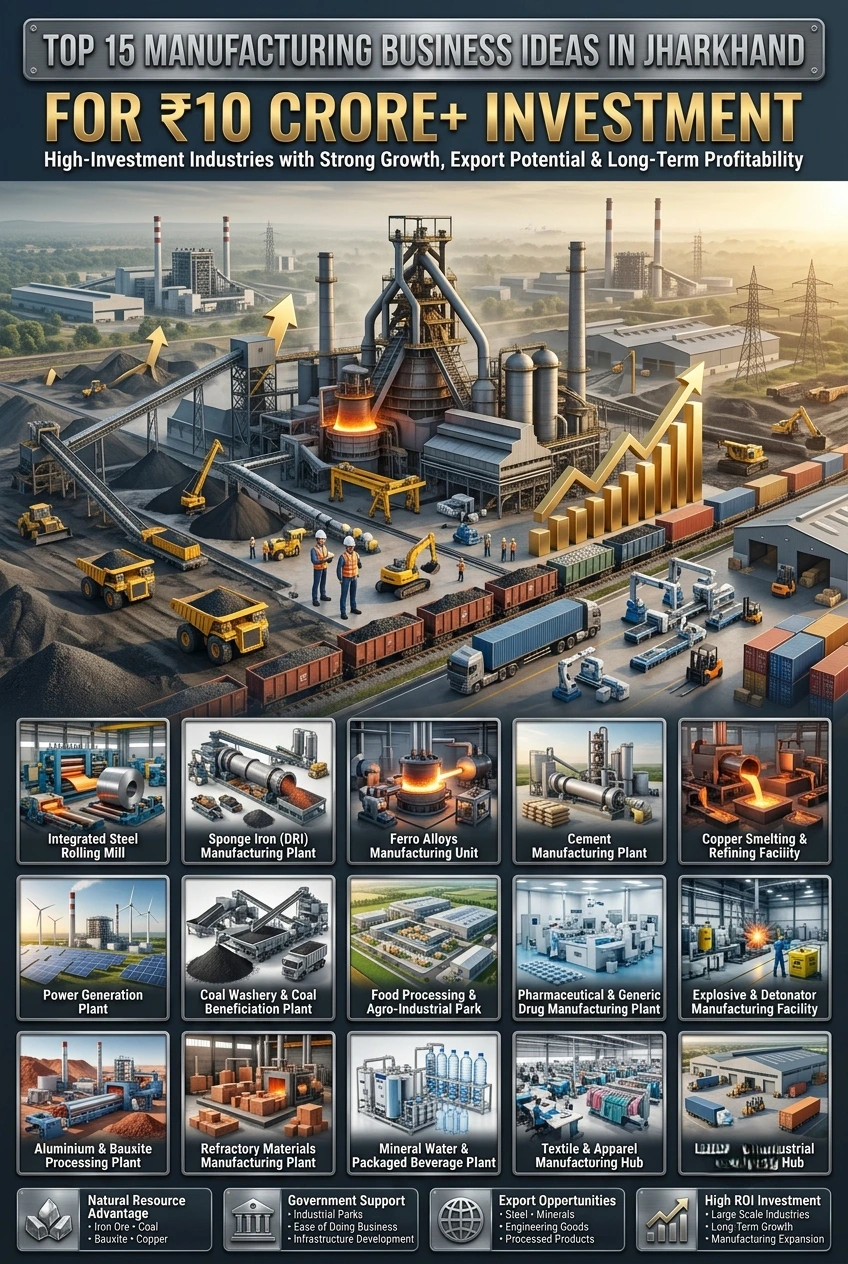
6. Power Generation Plant (Thermal / Renewable Hybrid)
Jharkhand has coal deposit which have traditionally been used to generate thermal power. But the state also has a considerable amount of untapped renewable energy resources, especially solar and small hydro. For industrial consumers that require continuous power, a combination of thermal baseload power generation with solar peaking capacity can offer reliable power. Power plants in the medium size range of ₹25-100 crore can generate power for nearby manufacturing clusters and therefore dependence on grid power can be minimized. For the developer the long-term PPA with industrial buyers offers revenue visibility.
JBVNL (Jharkhand Bijli Vitran Nigam) is responsible for power connection procedures and tariff structure of industrial units. In addition, the electricity demand in the state is likely to climb significantly with the development of industrial activity in the state, thus making the business case a viable one.
7. Coal Washery and Coal Beneficiation Plant
India is one of the countries which produces hundreds of crores of tonnes of coal per year but the major portion of the coal produced in the country has high ash content which reduces the calorific value of it. The raw coal is treated in coal washery to remove its impurities and produce washed coal of higher heat value. This upgraded coal is worth a higher price. Jharkhand is the state with the highest coal production in India. A coal washery business is a naturally advantageous business to be established near the major coal fields like Dhanbad, Ramgarh or Bokaro.
The investment capacity for small to medium scale washeries ranges from ₹15 crore to ₹60-80 crore per plant for high capacity washeries. Customer industries include power generation companies, steelworks and cement factories. It’s an industrial infrastructure company with contract-driven, predictable revenue streams and a high premium potential for exports.
8. Food Processing and Agro-Industrial Park
Jharkhand’s agriculture and tribal economy have a significant share of maize, rice, pulses, oilseeds, vegetables and forest products like lac, tamarind and mahua. Nonetheless, the state’s food processing facilities are very meager. The majority of agricultural produce is sold in the raw state at a low farmgate price, and value-adding is done outside of the State. A combination of primary processing, cold storage, packing and value-added product manufacturing can enable the recovery of much from Jharkhand’s agri-produce in an integrated food processing park.
The investor with investment corpus in between ₹20 crore and ₹50 crore can build the entire infrastructure for processing of domestic FMCG along with providing the export market for tribal and organic foods. APEDA provides export facilitation support specifically for processed food entrepreneurs and Jharkhand Udyog provide support through various incentives for the food sector.
Explore This Book: Handbook on Fruits, Vegetables & Food Processing with Canning & Preservation
9. Pharmaceutical and Generic Drug Manufacturing Plant
India exports the maximum number of generic drugs globally. But, the business of pharmaceuticals is still restricted to Gujarat, Hyderabad and Maharashtra. Pharma production capacity is very low in eastern India, especially in Jharkhand in comparison to the population and requirement of the healthcare sector. Investment of ₹15 – 30 crores is needed to establish a generic pharmaceutical formulations plant capable of making tablets, capsules, syrups and injectables that meets the WHO-GMP standards in Jharkhand. There is a huge domestic market and export options into regulated markets in Africa, Southeast Asia and Latin America available for WHO-GMP certified manufacturers.
Besides, there are PLI national level incentives for drug manufacturers. The convenience of being in close vicinity to the emerging healthcare infrastructure of the city of Ranchi with a ready and large local market is also a factor.
10. Explosive and Detonator Manufacturing Facility
Industrial explosives and detonators are essential consumables for mining, quarrying, tunnelling and infrastructure construction activities. The mining industry, particularly the coal, iron ore, copper ores and uranium industry are significant in Jharkhand, resulting in a large captive demand in the state. Nowadays, most of the explosives are being imported from the other states from the manufacturers in Jharkhand, inducing logistic costs and vulnerability in supply.
This captive local demand can be captured by a licensed explosives manufacturing unit in the mining belts of Dhanbad or Ramgarh which produces ammonium nitrate-based explosives, detonators and initiation system. Capital investment is ₹20–35 crore (at the start), strict compliances under Explosives Act. Revenue visibility is strong due to long-term offtake agreement with the mining companies.
11. Aluminium and Bauxite Processing Plant
The state of Jharkhand has significant bauxite resources, but there is limited processing of the resource in the state. The bauxite is moved to alumina refineries outside the state, or exported, with only a small amount of value added. The establishment of bauxite calcination unit / alumina refinery unit in Jharkhand generates a lot of economic value locally. Aluminium production downstream includes aluminium ingots, sheets, extrusions and foils, which are used in various sectors such as automotive, aerospace, packaging and construction. The demand for aluminium in India is rising rapidly, driven by the production of electric vehicles, renewable energy projects, and the use of lightweight materials in construction.
The information relating to leasing and sourcing minerals from bauxite is available with the Jharkhand State Mineral Development Corporation. Investing in the vicinity of bauxite deposits in either the Lohardaga or Gumla districts could gain access to national supply chains and export markets, ranging from ₹30 crores to ₹80 crores.
12. Refractory Materials Manufacturing Plant
Products used for furnace lining, kiln lining and high-temperature industrial equipment that are resistant to heat are classified as refractory materials. Refractories are the necessary consumables for every steel plant, cement kiln, glass furnace, and petrochemical reactor. Jharkhand, where there exist significant steel and cement industries, alone demands a significant amount of refractories. To this end, India imports some of its requirements of advanced refractories from China and Germany, presenting a definite opportunity for import substitution. Investment in a refractory manufacturing plant ranges from ₹15 crore to ₹40 crore, for the production of fireclay bricks, high alumina products and monolithic refractories.
Local sources for raw materials such as fireclay, kyanite, bauxite and silica are available. The customer base of refractories is steel plant, cement plant, glass manufacturing companies who are buying on long term supply contract which gives stability of revenue to the company.
13. Mineral Water and Packaged Beverage Plant
Jharkhand has ample groundwater resources and springs, especially in districts like Ranchi, Hazaribagh and Netarhat. The water from these sources can be used as natural mineral water that can sustain a high-end packaged water enterprise. In addition to water, the fruit industry and agricultural base in the state can also be used in this packaged beverage business to produce natural juices, health drinks, and value-added beverages such as mahua juice, tamarind, amla and seasonal fruits.
The packaged beverage market in India is expanding at a double-digit pace on account of health consciousness and urbanisation. The investment in a combined mineral water and beverage plant comes to ₹10-25 crore. The traditional tribal food ingredients developed products can be marketed on premium natural and organic channels across the country and internationally.
14. Textile and Apparel Manufacturing Hub
Tribal Textile and Weaving crafts, such as Tussar Silk, Sambalpuri Weaves, etc. and Handlooms are rich in Jharkhand but large-scale textile industries are not well developed. The State Government has identified Textile Parks as priority zones for investments. A textile manufacturing unit in Jharkhand that makes yarn, fabric or readymade product (garments) has advantages in terms of lower labour cost as compared to Gujarat or Maharashtra, access to premium export product of Tussar silk and PLI scheme benefits for man-made fibre and technical textiles.
There is an investment need of ₹20–60 crore to cater to the domestic fast fashion market as well as export buyers from abroad. The new manufacturers are supported by Technical and market access by Textile Committee of India. Information about policy incentives in the sector is given on the portal of Jharkhand Industries Department.
15. Logistics and Industrial Warehousing Hub
The state of Jharkhand, which is rapidly developing its industrial base, requires the provision of organised logistics infrastructure. At present, the state does not have modern warehouses, cold chain facilities and multimodal logistics parks suitable for the scale of industries. An investor investing in a large format logistics and warehousing project comprising of bulk minerals, processed goods, temperature-controlled storage and container handling plants would be able to access a burgeoning demand stream from steel plants, cement manufacturers, food processors and the ecommerce industry.
Stable rental and fee-based income can be earned from a wide range of industrial tenants in a logistics park investment of between ₹20 and ₹50 crore that is strategically positioned near the national highways and JIADA-managed industrial estates. The National Logistics Policy and PM Gati Shakti programme has created a good environment for private logistics infrastructure investors.
Import–Export Opportunity Analysis for Jharkhand Investors
Jharkhand’s industrial base creates multiple export opportunities that investors should factor into their project planning. India exports significant volumes of iron and steel products, ferro alloys, copper products, and processed minerals to markets in Southeast Asia, the Middle East, Europe, and the Americas. Jharkhand-based manufacturers enjoy a freight cost advantage for supplying to Indian ports via the Dedicated Freight Corridor.
On the import substitution side, India currently imports advanced refractory products, specialty ferro alloys, pharmaceutical APIs, and certain processed food ingredients. Jharkhand investors who set up plants targeting these import substitution opportunities can build businesses protected by natural cost advantages and government import substitution policies.
The EXIM Bank of India provides specialised financing for export-oriented units. Investors should also explore Export Promotion Councils specific to their sector for market intelligence, buyer introductions, and certification support. The Foreign Trade Policy framework offers Duty Drawback and RODTEP benefits that improve export profitability. For mineral export data and trade statistics, the Jharkhand State Mineral Development Corporation (JSMDC) is a useful state-level reference.
Find high-return business ideas based on your budget & ROI
Indian MSME and Industrial Success Stories Worth Studying
Tata Steel — Jamshedpur’s Century-Old Industrial Anchor
One of the oldest, and best documented, Indian industrial success story has been Tata Steel’s plant in Jamshedpur. It was Jamsetji Nusserwanji Tata himself who chose the Jharkhand location for his steel plant exactly for the reason articulated in this piece – near raw materials of iron ore and coking coal. What was a green field punt on a raw material geography blossomed into one of the biggest steel players in Asia.
The takeaway for the contemporary entrepreneur is very evident – if you choose your location wisely, on a foundation of raw material logic, it generates an everlasting competitive advantage.
Today Jamshedpur has created an enormous industrial ecology comprising of hundreds of ancillaries, MSME enterprises.
Ramkrishna Forgings — Eastern India’s Manufacturing Champion
The Jharkhand based company, Ramkrishna Forgings, is an outfit floated by the Mundhra family and over time, has established a formidable international presence as a manufacturer of components for commercial vehicles and industries worldwide for OEM sales and also developed an export oriented business by gradually enhancing their technology levels and obtaining necessary certifications for international market sales from a modest beginning as a regional player. Today, it supplies to truck manufacturers in North America and Europe. The success model demonstrates that even from a Tier-2 industrial location, a focused, quality-driven manufacturer can reach global markets. The key lesson: choose a high-growth end-use industry, invest in quality from day one, and build export orientation into the original business model.
Usha Martin — Wire and Wire Rope Pioneer
Usha Martin, headquartered in Ranchi, built India’s largest wire rope manufacturing business starting from Jharkhand’s steel-rich ecosystem. Promoter Brij Kishore Jhawar recognised early that steel wire rope — used in mining equipment, elevators, bridges, and cranes — was a value-added product with global demand and high margins compared to commodity steel. By narrowing its focus to a downstream application of steel, rather than trying to play in the bulk steel industry, Usha Martin established a profitable and secure business which ultimately transformed it into a global provider of steel wire ropes.
For entrepreneurs working with MSME businesses, Usha Martin serves as an excellent example of leveraging a specific segment within a commodity industry, and growing specialized skills and market connect within it.
How NPCS Helps Investors Plan and Validate These Projects
For investments of Rs. 10 crore or above for a new industrial project no one would take risk on feelings and assumptions. No one will spend money blindly unless confirmed with concrete analysis. We offer professional services of preparing Market Survey cum Detailed Techno-Economic Feasibility Reports (DPR) for setting up a new industry and businesses in any part of India including Jharkhand.
Each of our feasibility reports includes detailed manufacturing process descriptions, market research and demand analysis, process flow diagrams, product mix and capacity planning, machinery and raw material sourcing information, and complete project financials covering capital cost estimates, revenue forecast, profitability analysis and payback period calculations. We have a simple mission – to assist aspiring entrepreneurs with the rigorous assessment of their project’s feasibility, profitability and long-term viability prior to deploying significant amounts of capital. Entrepreneurs who engage with data-driven feasibility analysis will make smarter investment decisions, will secure bank financing far more easily, and will avoid catastrophic errors during project implementation.
Jharkhand Large-Scale Business Ideas: Quick Reference Table
| Business Idea | Key Raw Materials | Est. Investment (₹ Crore) | Primary Market | Export Potential |
| Steel Rolling Mill | Billets, Sponge Iron | 15–50 | Domestic Infra | Medium |
| Sponge Iron (DRI) | Iron Ore, Coal | 25–40 | Steel Plants | Low |
| Ferro Alloys | Manganese, Chrome | 20–60 | Steel/Export | High |
| Cement Plant | Limestone, Fly Ash | 50–150 | Eastern India | Low |
| Copper Smelting | Copper Ore | 40–80 | Power, EVs | Medium |
| Power Generation | Coal, Solar | 25–100 | Industrial Buyers | Low |
| Coal Washery | Raw Coal | 15–80 | Power, Steel | Medium |
| Food Processing | Agri Produce | 20–50 | FMCG, Exports | High |
| Pharma Plant | APIs, Excipients | 15–30 | Domestic, Export | High |
| Explosives Mfg. | Ammonium Nitrate | 20–35 | Mining Industry | Low |
| Aluminium Processing | Bauxite | 30–80 | Auto, Aerospace | High |
| Refractory Materials | Fireclay, Bauxite | 15–40 | Steel, Cement | Medium |
| Packaged Beverages | Water, Fruits | 10–25 | Consumer Market | Medium |
| Textile Hub | Silk, Fibre | 20–60 | Domestic, Export | High |
| Logistics Park | Land, Infrastructure | 20–50 | Industrial Tenants | Low |
Frequently Asked Questions (FAQ)
Q1. Which business in Jharkhand gives the highest return on ₹10 crore investment?
Of all the manufacturing and processing business like Ferro alloys plants, pharma units and coal washeries that provide best relative returns vis-a-vis capital invested. For Ferro alloys: there’s huge export demand and premium prices fetched by products. For pharma units: both domestic and export market, with good Govt incentive backing. For coal washeries: consistent contract-based income.
Q2. What government incentives are available for large-scale investors in Jharkhand?
Jharkhand’s policy for industrial and investment promotion has included incentives like capital subsidy, interest subvention, stamp duty exemption, power tariff concession, and single window clearance to large investors. The Jharkhand Industries Department’s web site has details of these incentives, and clearances can be applied for online on Invest in Jharkhand. At the central government’s level PLI has been initiated for steel, food processing, Pharmaceuticals and textiles sector.
Q3. How can I find buyers for my Jharkhand-manufactured products in export markets?
Industry Specific Export Promotion Councils like ECPC India (for engineering products), APEDA (for food & agri-products), Pharmexcil (for pharma products), assist their members in providing buyer introductions, participation in trade fairs, as well as market intelligence. ECGC Ltd. Is another premier trade body that also assists Indian exporters. ECGC along with EXIM Bank of India provides not just loans and financing but also support for the export market development of Indian companies.
Q4. Where do I apply for an industrial plot in Jharkhand?
For allocation of land in notified estates of Jharkhand, the application process is handled by Jharkhand Industrial Area Development Authority (JIADA). Direct application is through JIADA’s online portal jiada.in. For greenfield projects located outside JIADA estates, land acquisition assistance can be sought from Invest in Jharkhand single-window portal.
Q5. What is a Detailed Project Report (DPR) and why do I need one?
A DPR is a detailed report encompassing all aspects from technical specifications, analysis of demand for product, manufacturing process, capital costs, projected income, profitability estimation to break even point calculation. Banks and other financing institutions consider a professionally crafted DPR essential when evaluating applications for sanctioning of loans. It also enables the promoters to assess risks involved in the business and confirm all their presumptions about it before actual investment.
Q6. Which districts in Jharkhand are most suitable for industrial investment?
Dhanbad and Bokaro for coal, coke and steel based industrial units. Jamshedpur and East Singhbhum for steel downstream, engineering and copper related enterprises. Ranchi as the state capital for pharma, food processing, textiles and services sector. Hazaribagh and Ramgarh for mining, coal washeries, explosives and its allied works. Lohardaga and Gumla for bauxite and aluminium based investment proposals.
Conclusion: The Industrial Opportunity of the Decade
Jharkhand has a real moment to seize. A rare confluence of mineral endowments, developing infrastructure, proactive industrial policies and an increasing consumer market is making the state ripe for investment. The business ideas I have listed above are no idle guesses- they are supported by authentic market need, government incentives and the structural cost advantages that its physical location gives Jharkhand.
The investors who move early — who build plants, secure land, establish supply chains, and develop market relationships before the state’s industrial corridor reaches full capacity — will benefit most. Jharkhand is not the next Pune or Ahmedabad. It is something more interesting: a mineral-rich, underinvested, policy-supported industrial frontier with decades of growth runway ahead. For investors with ₹10 crore and above, few states in India offer this combination of upside and structural advantage.
For those ready to take the next step, we recommend commissioning a professional DPR before finalising your investment. Rigorous feasibility work is not a bureaucratic formality — it is the foundation of every successful industrial project. You can review Jharkhand’s investment overview on IBEF, and begin your regulatory journey.


