





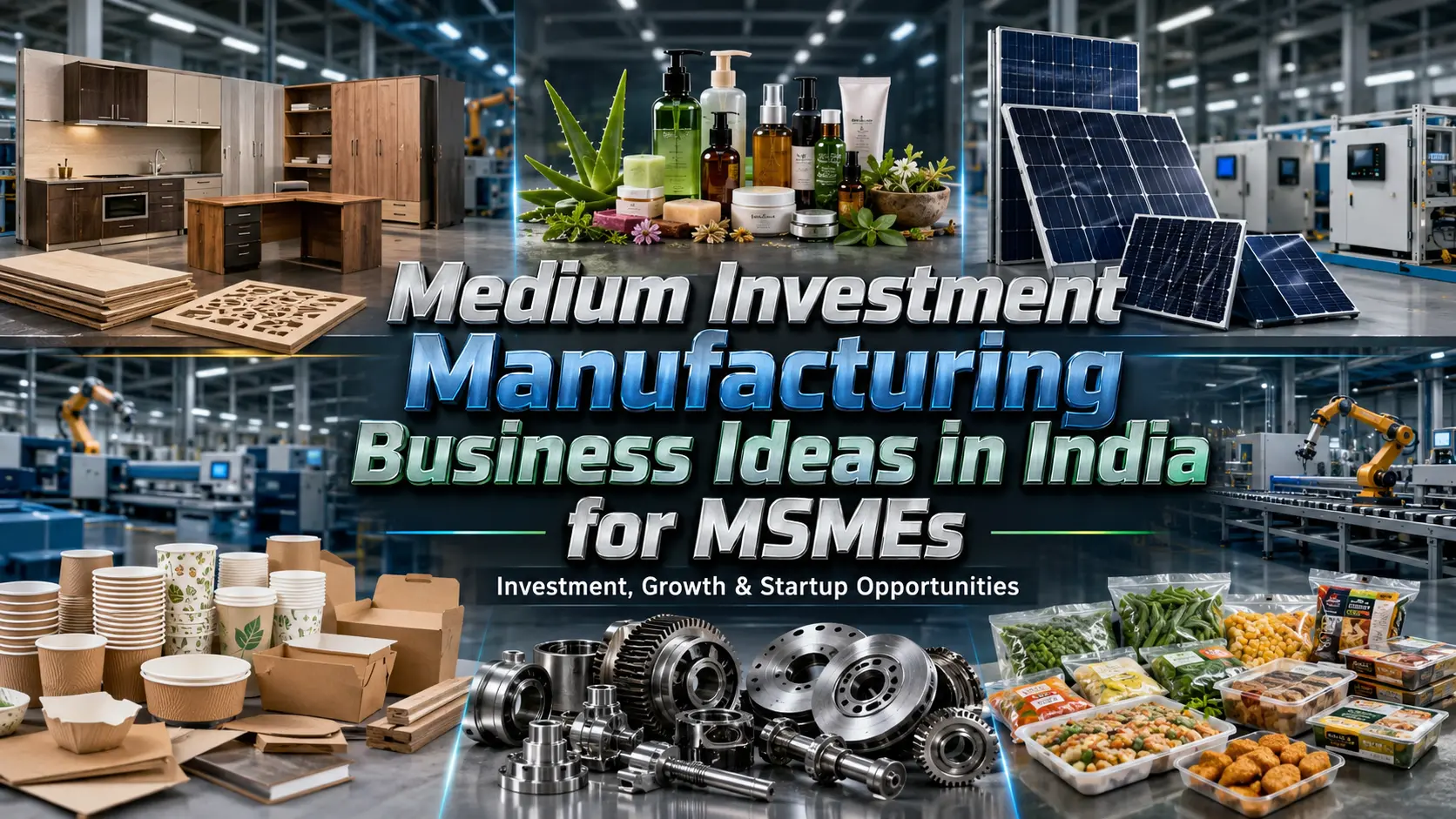
Each year, the number of first-time entrepreneurs in India who look for good business ideas that require low investment in the beginning but have high returns is on the rise. Between the small-scale, saturated and over-stimulated manufacturing market and the capital-intensive, large industry market, is the quiet, medium investment market. After seeing hundreds of feasibility reports over the years, I can tell you this: the entrepreneurs who are successful here are not the ones who are looking to “trend” but those who know what the demand is, what the government is willing to provide, and what the cost is going to be.
Why Medium Investment Manufacturing Is Worth Your Attention
India’s manufacturing sector is undergoing a true transformation. Companies are going beyond their reliance on a single country to diversify their supply chains and local consumption continues to grow with increasing income levels in tier-2 and tier-3 cities. As a result, there are good salesmen for medium scale units that can produce good quality at competitive rates, not just in India but abroad.
A medium-investment unit, which usually invests anywhere between ₹25 lakh to ₹1.5 crore, is at a sweet spot. It’s big enough to realize meaningful economies of scale, but small enough to not be overwhelming for a founder without a large corporate team. Moreover, this also has the advantages that it is able to make decisions faster, the cost of compliance is small, and adjust to market feedback faster than large industrial houses.
And export demand is another opportunity. Indian manufacturing costs are lower than those of many developed countries and global buyers prefer to deal with reliable, medium-sized vendors and not just large conglomerates, hence a surge in orders for sectors such as renewable energy components, processed food and auto ancillaries from overseas markets.
Government Policies and Incentives Supporting New Manufacturers
In recent years, there has been real progress in policy support for this investment sector. The Prime Minister’s Employment Generation Programme (PMEGP) is operated by the Ministry of MSME and provides capital subsidy ranging from 15-35% as per category and location. In addition to that, the Credit Guarantee Fund Trust for Micro and Small Enterprises (CGTMSE) provides loans to the entrepreneurs with a maximum credit limit of ₹2 crore without requiring any collateral, making it easier for them to access financing for their businesses.
There are also sector specific Production Linked Incentive (PLI) Scheme for solar equipment, textiles and food processing which incentivizes the manufacturers if they expand their production and achieve quality parameters. Besides, there are some state industrial policies that provide the following benefits to set up units in designated industrial areas: capital subsidies, stamp duty exemption, power tariff concession.
Entrepreneurs referred to the detailed and updated scheme information which are available directly.
Multiple Medium Investment Business Ideas for Startups
Apart from the Glassdoor app, these are some other medium investment business ideas that you can start.
Here are six specific manufacturing business ideas that have been proven to have high project number feasibility across this investment range.
1. Modular Furniture Manufacturing
The demand for the modular and compact furniture has been constant due to urbanization and rising space constraints. While the unit in traditional carpentry is made up of pieces of wood which are cut and shaped by hand, the modular furniture unit is composed of standardised modules, engineered wood panels, and CNC cutting machines, leading to quicker production time and quality control.
The investment in a unit is in the range of ₹35-60 lakh which can generate manufactured furniture assembled in the unit, can sell the manufactured furniture to retail showrooms and also through e-commerce, and can cater to the rapidly growing online furniture market. Margins are usually 20-30% and repeat institutional orders from Real Estate developers can significantly stabilise the cash flow.
2. Herbal and Ayurvedic Cosmetics Unit
It is obvious that consumer choices are leaning more towards natural and chemical free personal care products. A herbal cosmetic manufacturing unit with machines required for manufacturing cosmetics such as face packs, herbal soaps and oil for hair etc., will need relatively simple machines and reasonable investment of raw materials. This business can be expanded in both ways, as Ayurvedic and herbal products are a strong exportable product and have a good market in Middle East and Southeast Asian countries. Important points to note for entrepreneurs entering this space: Take FSSAI and AYUSH licensing seriously from the initial stage as delay in compliance is the top reason for projects getting stuck.
Explore This Book: Herbal Cosmetics & Ayurvedic Medicines (EOU)
3. Solar Panel Assembly Unit
With the target of renewable energy, India sees the demand for solar panels have surpassed the current domestic manufacturing capacity. The solar panel assembly unit, which is involved in the assembly of the modules instead of manufacturing cells, requires a relatively smaller investment amount and also contributes to a rapidly expanding segment. There is consistent order flow, through government tenders, rooftop solar subsidy programmes, and private commercial installations. As silicon prices change, prices of components also change, so there is a need to incorporate flexibility into pricing strategies of entrepreneurs.
Explore This Book: Solar PV Power and Solar Products Handbook
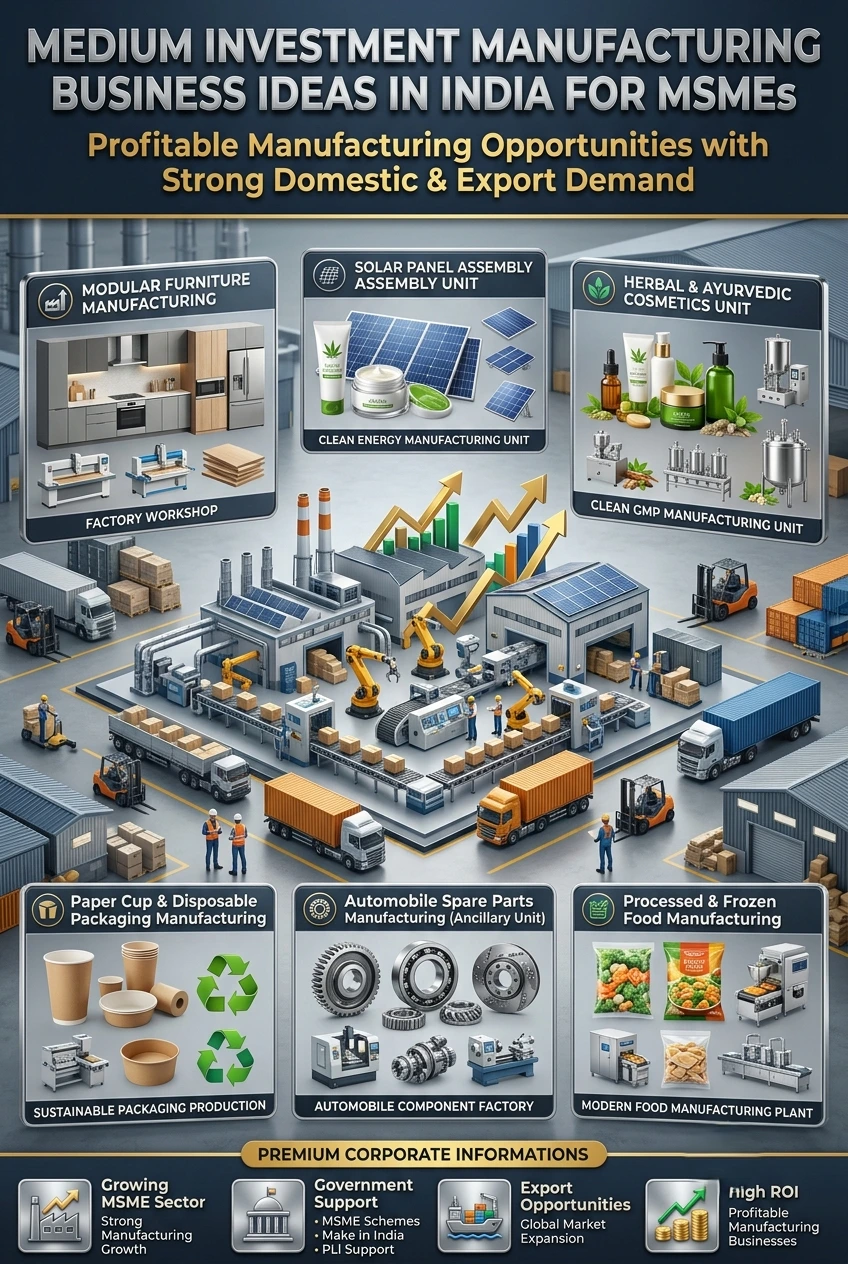
4. Paper Cup and Disposable Packaging Manufacturing
Plastic bans in multiple states have given a boost to demand for paper-based disposables in India. A paper cup and packaging unit is used by cafes, restaurants, and institutional caterers, who use large and constant quantities of paper. The cost of machinery is also not too high, and the raw material is, for the most part, paperboard that is used for food products, which is readily available in the country. The nation’s wider thrust towards sustainable packaging also supports this business to sustain the trend of steady growth.
Related Article: Paper Cup & Disposable Products Manufacturing: A Low-Investment Guide for First-Gen Entrepreneurs
5. Automobile Spare Parts Manufacturing (Ancillary Unit)
As India is emerging as a world-class automobile manufacturing country, there is always a demand for ancillary parts such as clutch assemblies, brake parts, and small precision components. Having to become a Tier-2 or Tier-3 supplier to major OEMs implies quality certification, which in turn usually results in long-term supply contracts. That stability is what makes the auto ancillary sector attractive to entrepreneurs who aren’t in the business of riding the ups and downs of the retail market.
6. Processed and Frozen Food Manufacturing
Urban lifestyles have been dramatically increased and this shows up in processed and frozen food consumption. A frozen paratha making unit, a ready to cook curry making unit or a processed food unit can cater to retail chains as well as the growing quick commerce delivery service. The biggest challenge in operation here is the cold chain logistics, which is also a major concern for entrepreneurs in their project reports before finalizing the capacity plans.
Get Detailed Project Report (DPR): Food Processing and Agriculture Based Projects
Import-Export Opportunity Analysis for New Startups
Some of these have really cross-border value. Indian herbs are attractive in natural and wellness in particular and some parts of Europe and Gulf countries have good demand for such exports. On the other hand, there is stable demand from foreign auto manufacturers looking to de-risk their supply chain from China.
Solar items, for the time being, depend more on imports than exports, as India still relies on imports for a good portion of solar cells. However, this creates a domestic opportunity rather than an export one: assembly units that source locally wherever possible can position themselves as reliable ‘Make in India’ suppliers to solar developers. For entrepreneurs considering trade-linked business models, the
Directorate General of Foreign Trade (DGFT) portal provides updated export incentive schemes and documentation requirements.
Indian MSME Success Stories Worth Learning From
Kishor Biyani built Future Group from a single garment manufacturing venture, and while his retail expansion later faced challenges, his early decision to control manufacturing quality directly, rather than depend entirely on third-party vendors, remains a useful lesson for new manufacturers: control your core production process before you scale distribution.
Karsanbhai Patel, founder of Nirma, started as a small-scale detergent manufacturer selling door-to-door in Ahmedabad. His model succeeded because he priced aggressively for the mass market while keeping production costs lean, a strategy that any medium-investment manufacturer entering a competitive category can still apply today.
Falguni Nayar, founder of Nykaa, though primarily a retail platform, built her early credibility by partnering closely with quality-focused manufacturers, including several herbal and cosmetics producers. Her success shows that manufacturers who prioritise consistent product quality often find themselves becoming preferred suppliers to fast-growing retail and e-commerce brands.
How NPCS Supports Entrepreneurs Evaluating These Business Ideas
We at Niir Project Consultancy Services (NPCS) provide professional consulting for the preparation of Market Survey cum Detailed Techno-Economic Feasibility Reports (DPRs) for setting up new industries or businesses. Our reports include detailed manufacturing processes, market research and demand analysis, process flow diagrams, product mix and capacity planning, machinery and raw material details, and complete project financials with profitability analysis. We’re trying to help entrepreneurs make an informed judgment about feasibility, profitability, and sustainable scale before writing checks so that capital flows to projects that have the right chance to generate a return.
Find the most profitable startup for your investment range
Comparative Snapshot: Investment and Payback Across These Business Ideas
| Business Idea | Approx. Investment (₹) | Typical Monthly Capacity | Indicative Payback Period |
| Modular Furniture Manufacturing | 35–60 Lakh | 150–250 units | 3–4 Years |
| Herbal & Ayurvedic Cosmetics Unit | 25–50 Lakh | 8–12 MT | 2.5–3.5 Years |
| Solar Panel Assembly Unit | 75 Lakh–1.5 Crore | 1–2 MW capacity | 4–5 Years |
| Paper Cup & Disposable Packaging | 30–55 Lakh | 10–15 lakh pieces | 3 Years |
| Automobile Spare Parts (Ancillary) | 50 Lakh–1 Crore | Varies by component | 3.5–4.5 Years |
| Processed & Frozen Food Unit | 40–70 Lakh | 5–8 MT | 3 Years |
Frequently Asked Questions
Which medium-investment manufacturing business is most profitable for a first-time entrepreneur?
Herbal cosmetics and modular furniture units tend to offer strong margins because raw material costs stay moderate while demand keeps rising in urban and semi-urban markets.
How much capital do I actually need to start a medium-scale manufacturing unit?
Out of all medium investment projects listed in the article most require between Rs 25 lakh to Rs 1.5 crore (based on investment on plant, machinery and shed and working capital).
Can I get a bank loan for these business ideas?
Yes, MSME can obtain loans that don’t need security under a particular plan known as CGTMSE, loans for a particular tenure time period or term loan under PMEGP, or some state industrial finance corporations.
Do I need a detailed project report before applying for a loan?
Almost every bank and financial institution demands a DPR which includes a feasibility report of the project in terms of the market study and the capital required on account of the purchase of plant and machinery as well as estimates of the projected profitability of the project.
Is export potential real for these medium-investment sectors?
Yes, especially in solar products, food and auto ancillary parts where buyers around the globe is searching for affordable price from Indian players.
How long does it take to become profitable?
Based on typical project economics, most units in this bracket reach break-even within three to four years, assuming steady capacity utilisation.
Conclusion
Medium-investment manufacturing continues to reward entrepreneurs who combine sound market research with disciplined financial planning. None of the business ideas covered her promise overnight success, but each one rests on genuine, verifiable demand, supportive government policy, and realistic capital requirements. As always, the difference between a project that survives its first three years and one that doesn’t usually come down to preparation done before the first machine is even purchased.


