





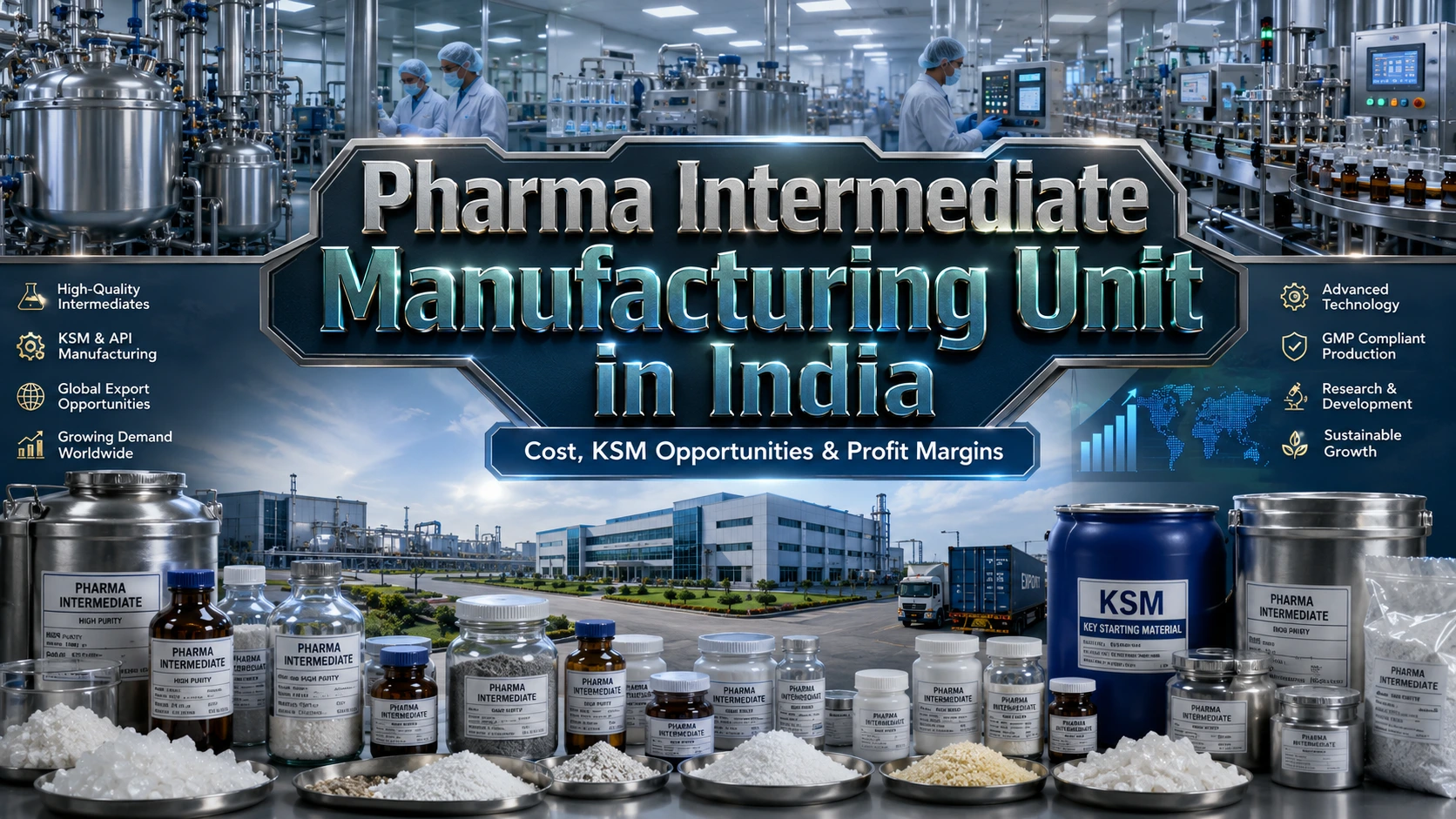
India is the largest manufacturer of vaccines in the world, accounting for 80% of all vaccines consumed in the country, and the third largest for pharmaceuticals. But ask any formulation company what is their real chemistry and the honest answer is uncomfortable – China. Almost 70 per cent of the major starting materials and intermediates used in the production of bulk drugs in India still come from few suppliers in China whose lead times and prices are not under the control of the founder. That singular dependency is the doorway for anybody serious with regards to pharma intermediate manufacturing India projects today. This is not formulation manufacturing, which already has hundreds of small units competing for slim profit margins on branded generics. One step up the stream are the intermediate and KSM manufacturing, which are not quite so real a chemistry but are far less congested. The government has also become cognizant of this change and is funding it with cash.
Why Pharma Intermediate Manufacturing Is a Genuine Opening
Begin with the most important number – import dependency. The Department of Pharmaceuticals refers to this quite frequently, that the around 68-70% of KSMs and API intermediates for Indian bulk drug manufacturers come from China. It is that dependency which is the reason for the Centre’s scheme of production linked incentive for fermentation based and chemical-synthesis bulk drugs and intermediates with an investment of nearly seven thousand crores of rupees. Three focused Bulk Drug Parks, in Himachal Pradesh, Andhra Pradesh and Gujarat, are now providing shared effluent treatment and the capital subsidy of up to seventy percent on common infrastructure. That subsidy alters the entry math in India in an interesting way for anyone considering pharma intermediate manufacturing as one’s first move.
Capex varies as well with complexity. The basic chlorination or esterification plant may begin from nearly fifteen crore rupees for the capacity of two hundred to three hundred tonnes per annum. Forty to eighty crore rupees are required for steroid or hormone intermediate production, which requires cleaner utilities and control of the process. It is licensing that is the actual filter: pollution control consent, hazardous waste authorisation and often a petroleum licence for solutions storage will take twelve to eighteen months. Founders who don’t account for this time period typically end up short of working capital just before revenues begin.
Get Detailed Insights from This Book: Drugs & Pharmaceutical Technology Handbook
Margin Structure and Risk Before You Commit
Not all intermediate courses are the same. The gross margins where commodity intermediates are trading lie in the neighborhood of 12-18% and Chinese price dumping can wipe them out overnight. Instead, specialty and custom-synthesis intermediates that are associated with a single innovator molecule regularly clear twice the amount of EBITDA: twenty-five to thirty-five percent. This is the distinction between a strong pharma intermediate manufacturing India business and the mediocre one – chemistry corner entrepreneurs who choose a niche in chemistry and submit a Drug Master File early will secure buyers who have little option but to stick with the founder.
Scalability has a predictable trajectory. Most serious participants begin with a single multipurpose (500-1,000 litre) batch reactor and test one or two items, and then add additional reactor trains when repeat orders are given. The most common cause of mid-size intermediate units failing within three years is jumping to a large continuous process plant without having an anchor buyer. There are three areas of risk: volatility in raw material prices related to crude oil derivatives, regulatory lag in environmental clearance and buyer concentration if a founder relies on just one or two formulation companies for offtake.
Product and Project Opportunities Worth Evaluating
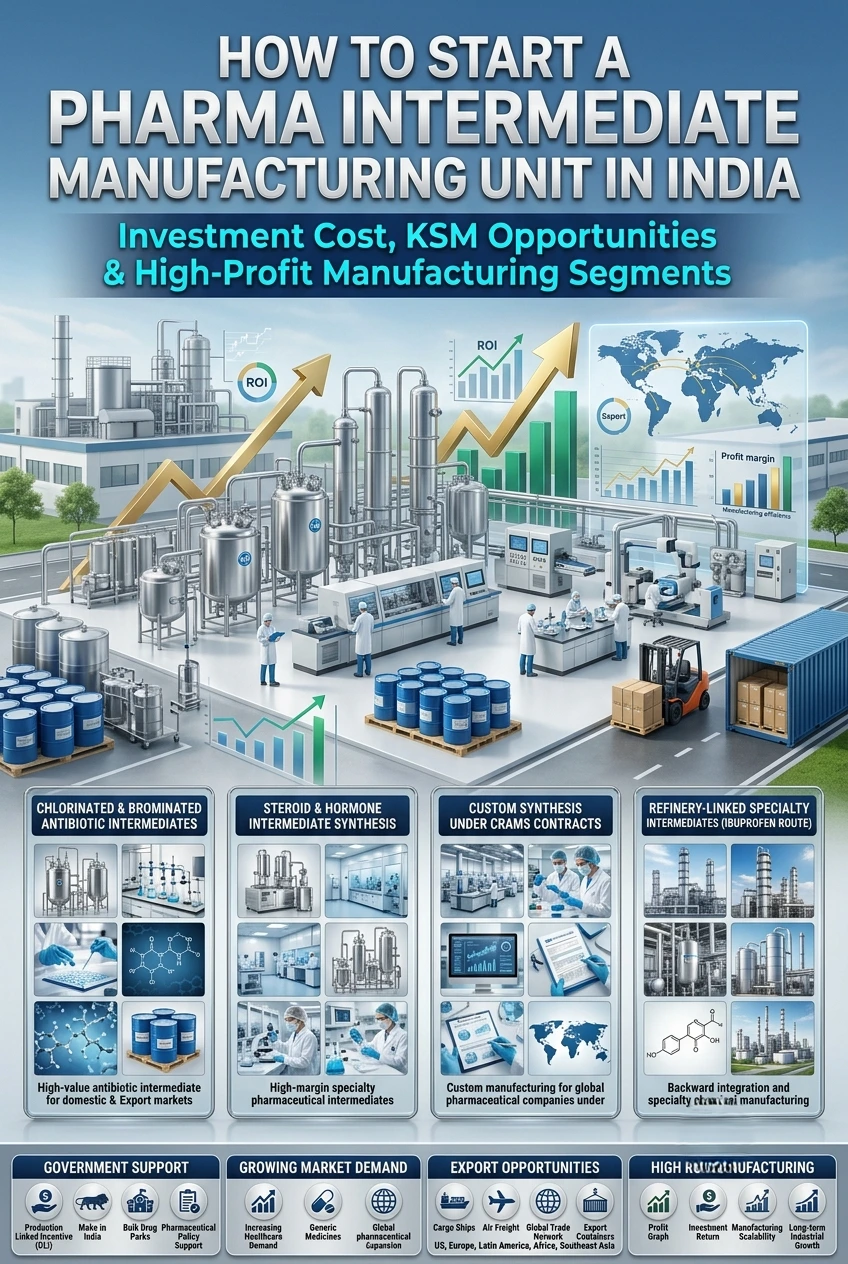
Chlorinated and Brominated Antibiotic Intermediates
The antibiotic formulation companies based around Hyderabad and Vadodara, who make amoxicillin, cephalosporin and azithromycin, are continuously purchasing chlorinated and brominated intermediates, as they can’t be stored without breaking down. The capex for a plant of 150-250 tonnes per year, with an estimated radius of 300 kilometres for two or three anchor buyers, is estimated at eighteen to twenty-five crore rupees, this amount also including the cost of effluent treatment. Once the sample batches are completed and the product is certified, gross margins fall in the range of eighteen to twenty-two per cent, but it may take six to nine months for the first purchase order to arrive after certifying the product.
Get Detailed Project Report (DPR): Pharmaceutical Drugs & Fine Chemicals Directory
Steroid and Hormone Intermediate Synthesis
Steroids intermediates used in the manufacture of contraceptive; anti-inflammatory and hormone replacement packages have a smaller user base and a higher realisation. Space for a dedicated unit, usually between forty and fifty crore rupees, for the needs of a clean room and segregated utilities, can have a twenty-eight to thirty-two per cent EBITDA once qualified by two or three formulation houses. Steroid chemistry requires skilled process chemists; and buyers are unlikely to test out a new supplier unless that supplier has a proven track record – a second venture opportunity for the founders who have already operated an easier to manage intermediate line.
Custom Synthesis Under CRAMS Contracts
Contract Research and Manufacturing work suits founders who don’t want to wait for the market to come to them. A unit focused on CRAMS is a small-batch, flexible-sized unit of a few crores of rupees, which is capable of supplying formulations to the domestic or export market based on a fixed list of molecules through multi-year contracts. Twenty – twenty-eight percent margins, and since contracts do not take place, but re-tend, revenue visibility is stronger than commodity manufacturing. The downside is that it takes a year or more to negotiate the first deal due to technical audits.
Refinery-Linked Specialty Intermediates: The Ibuprofen Route
The one opportunity that many founders may not be aware of is closer to the petroleum industry than most think. The production of Isobutyl benzene as an intermediate in the manufacture of painkillers like ibuprofen also reduces the raw material cost since it can be sourced from any captive refinery feedstock instead of from any aromatic stream of the crude residues. A plant based on this feedstock benefit, with capex of around twenty-five to thirty crores, directly targets the buyers for the formulation of analgesics and NSAIDs. The economics work since the feedstock does not sit in the market; it is akin to the refinery by-product where the manufacturer enjoys a structural cost advantage which Chinese IBB exporters cannot muster.
What Indian Promoters Got Right
Three Indian promoters show how a serious pharma intermediate manufacturing India business actually gets built. Murali K. Divi, founder of Divi’s Laboratories, worked inside multinational pharma companies before starting his own intermediate business with a narrow focus: high-purity, custom-synthesised intermediates for global innovator companies rather than commodity generics. That single decision — sell process expertise, not volume — turned a modest Hyderabad unit into one of India’s most valued pharmaceutical companies. The lesson is not the scale Divi’s eventually reached, but the discipline of picking depth over breadth from day one.
Rajendra Gogri built Aarti Industries on a different logic: backward integration into basic chemicals and specialty intermediates simultaneously, insulating the group from price swings that hurt single-product manufacturers. Neuland Laboratories, under the Rao family, took a third route — a CRAMS-first model prioritising long-term innovator contracts over spot sales. The applicable lesson across all three: pick one structural advantage and build around it deliberately.
Find the most profitable startup for your investment range
The Import-Substitution and Export Opening
China’s dominance in KSM supply is a gap Indian founders have not filled fast enough. Global formulation buyers in the United States and European Union have spent recent years diversifying away from single-country sourcing, a shift the industry calls the China-plus-one strategy. Indian intermediate manufacturers who file a Drug Master File with the US FDA or a Certificate of Suitability with European regulators gain access to that diversification demand directly, often at better realisation than domestic sales alone offer. Trade facilitation data tracked by the Pharmaceuticals Export Promotion Council of India shows this diversification accelerating year on year, and India’s broader pharmaceutical export performance, tracked by India Brand Equity Foundation, confirms the country already supplies a meaningful share of global generic demand — intermediates are simply the layer of that supply chain still under-built domestically. New entrants can plug in without competing head-on against Chinese scale: qualify one molecule thoroughly, file the regulatory dossier early, and let buyer diversification pressure do the sales work an aggressive export strategy would otherwise require.
Feasibility Planning Before Capital Deployment
None of this rewards guesswork. Refinery-linked feedstock economics, buyer qualification timelines, and effluent treatment costs all need modelling before a founder signs a lease or orders a reactor. The Annual Report 2024-25 of Ministry of Petroleum and Natural Gas, Government of India — accessible at mopng.gov.in — documents how public sector refiner MRPL has already filed patents around manufacturing active pharmaceutical ingredients from captive refinery streams, including an isobutyl benzene route developed to lower ibuprofen production costs. That kind of feedstock innovation is exactly the signal a promoter evaluating pharma intermediate manufacturing India should track before choosing a product line.
Founders who want that rigour before committing capital typically commission a Market Survey cum Detailed Techno-Economic Feasibility Report. Niir Project Consultancy Services prepares these for entrepreneurs entering industrial manufacturing, covering process flow, machinery and raw material specification, capacity planning, and full project financials — turning instinct into a number a bank can actually evaluate.
Conclusion
The pharma intermediate manufacturing India opportunity is not glamorous. Nobody photographs a chlorination reactor for a startup magazine cover. But glamour was never the point — control over your own chemistry supply chain is. India built formulation capacity fast, then discovered it had outsourced the harder, more defensible layer of the business to a supplier base seven thousand kilometres away that a pandemic and multiple regulatory disputes have already proven unreliable.
For a founder choosing between a hundred competing formulation units and a handful of intermediate manufacturers, the decision hierarchy is straightforward. Pick one molecule family, not five. File the regulatory dossier before the plant is even fully commissioned, because qualification timelines run longer than construction timelines. Secure at least one anchor buyer commitment before finalising capex, and use the Bulk Drug Park subsidies wherever your state has one operating. Twelve to eighteen months of licensing patience is not optional; treat it as part of the project timeline rather than a delay to complain about.
The sector has genuine room for new entrants. Bulk drug import dependency has not meaningfully narrowed in years despite the incentive scheme’s existence, which says something about how few founders have acted on this opportunity. The chemistry is demanding, the compliance is real, and the capital requirement is not small. But for a founder with the patience to build one qualified product line properly, pharma intermediate manufacturing India remains one of the more defensible industrial bets available today.
Related Article: Pharma Manufacturing Business Telangana: Bulk Drug Park Guide
Capex vs Margin Overview by Intermediate Type
| Intermediate Type | Capex Range | EBITDA Margin | Target Buyer |
| Chlorinated/Brominated Antibiotic Intermediates | ₹18-25 Cr | 18-22% | Antibiotic formulators (Hyderabad/Vadodara) |
| Steroid & Hormone Intermediates | ₹40-50 Cr | 28-32% | Hormone & anti-inflammatory formulators |
| CRAMS Custom Synthesis | ₹10-20 Cr | 20-28% | Domestic & export innovator companies |
| Refinery-Linked IBB (Ibuprofen Route) | ₹25-30 Cr | 22-26% | NSAID/analgesic formulators |
| Commodity KSMs (general) | ₹15 Cr+ | 12-18% | Generic bulk drug makers |
Source: Industry estimates; NPCS sector analysis
Frequently Asked Questions
From a founder’s perspective — practical, decision-oriented questions:
What is the minimum capex to start a pharma intermediate manufacturing India unit?
Entry-level chlorination or esterification units can start near fifteen crore rupees for 200-300 tonnes annual capacity. Steroid or CRAMS-focused units need more, typically forty crore rupees and above, because of cleaner utilities and segregated processing formulation buyer’s demand.
How long does licensing take before production can start?
Pollution control consent, hazardous waste authorisation, and solvent storage clearances typically take twelve to eighteen months combined. Budget this into your timeline rather than treating it as a delay, since buyer qualification cannot begin until clearances are in place.
How is break-even typically reached in this sector?
Break-even usually arrives in the third or fourth year, once one or two anchor buyers move from trial batches to repeat purchase orders. Units chasing five or six buyers before quality certification is complete tend to delay break-even further, not accelerate it.
Is export more profitable than domestic supply?
Export realisation is typically fifteen to twenty-five percent higher once a Drug Master File or Certificate of Suitability is filed, but the filing itself takes twelve to twenty-four months and real documentation cost, so treat export as a second-phase strategy, not a launch plan.
What is the biggest risk new entrant’s underestimate?
Buyer concentration. Most first-time intermediate manufacturers depend on one or two formulation companies for the bulk of revenue in the first three years, and losing either buyer mid-contract can stall cash flow faster than any raw material price swing.


